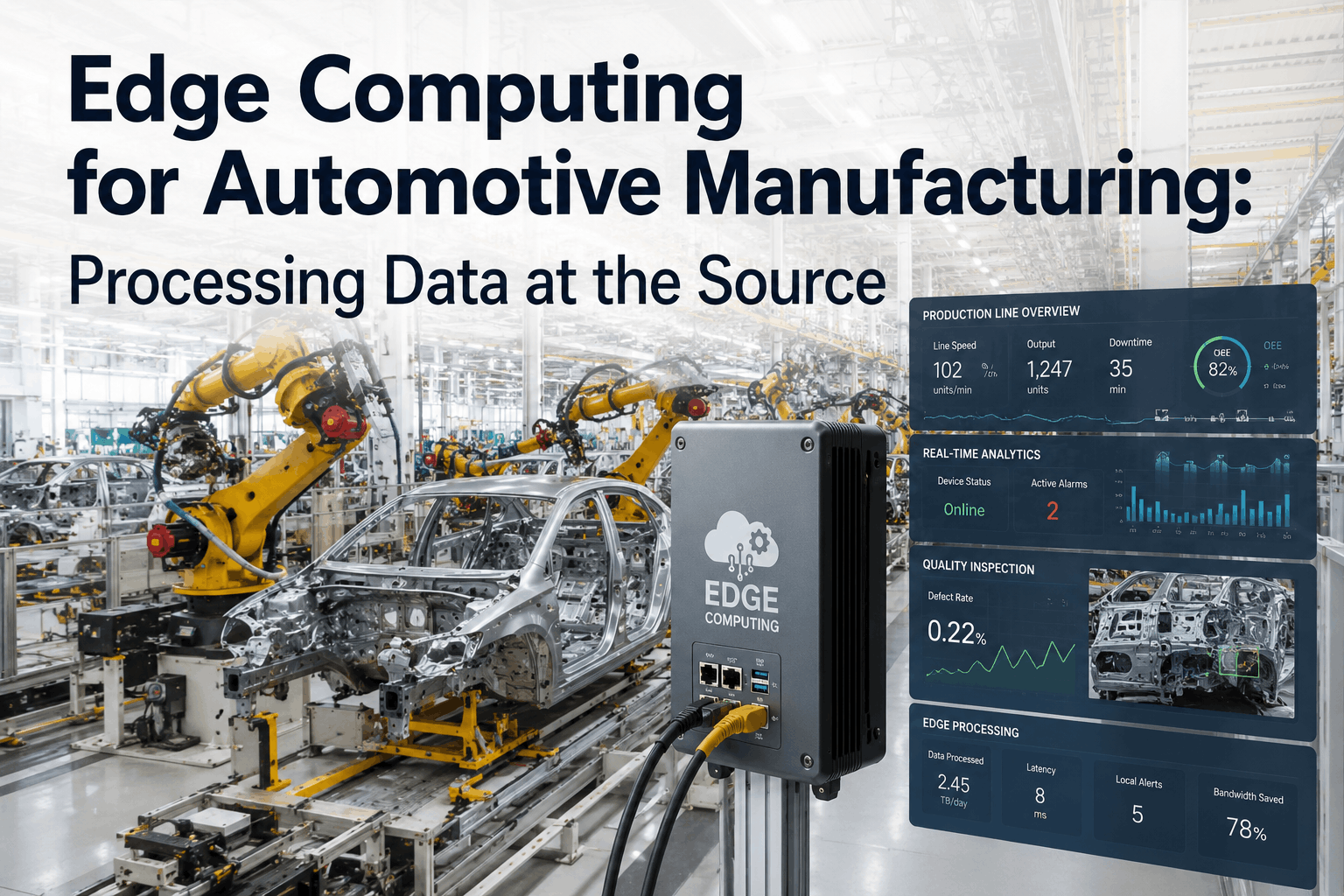
Edge Computing for Automotive Manufacturing: Processing Data at the Source

By Camryn Potts on May 23, 2026

edge-computing-for-automotive-manufacturing-processing-data-at-the-source

Every stamping press, welding robot, and vision camera on an automotive assembly line generates data continuously — and most of it never gets used. Not because it lacks value, but because sending raw sensor streams to a cloud platform 800 miles away introduces the one thing automotive production cannot tolerate: delay. Edge computing solves this by moving computation to where the data is born. Instead of shipping raw data to intelligence, edge computing brings intelligence to the data — processing it in milliseconds, at the machine, on the plant floor. Book a demo to see iFactory's edge computing platform in action.

Edge Computing — Automotive Manufacturing
Edge Computing in Automotive Plants: Why Processing at the Source Changes Everything
How edge architecture eliminates the latency, bandwidth, and reliability limitations that prevent cloud-only IoT from delivering real-time production control — and how automotive manufacturers deploy it.

The Cloud-Only Problem in Automotive IoT

Cloud computing transformed enterprise IT. But automotive production is not enterprise IT. A server in a data center cannot tell a welding robot to halt before the next cycle — not when the round-trip latency is 80–200ms and the process window is 40ms. Cloud-only IoT architectures create three fundamental problems for automotive manufacturers that edge computing directly resolves.

01
Latency Too High for Real-Time Control
Cloud round-trip times of 80–200ms exceed the response windows of critical automotive processes. Weld quality decisions need feedback in 30ms. Press fault detection must act within a single stroke. Cloud cannot close these loops — edge can.
Cloud latency: 80–200ms  |  Edge latency: <5ms
02
Bandwidth Cost at Production Data Scale
A single automotive assembly plant generates 2–5 terabytes of raw sensor data per day. Transmitting all of it to the cloud costs $180K–$400K per year in data egress fees alone — before storage and processing. Edge processing filters at source, sending only events and insights rather than raw streams.
Cloud data cost: $180K–$400K/yr  |  Edge reduction: 80–95%
03
Production Stops When Connectivity Fails
Cloud-dependent systems halt when internet connectivity is interrupted — through ISP outages, network maintenance, or WAN failures. In an automotive plant producing one vehicle per 60 seconds, a 30-minute connectivity outage costs $750K. Edge nodes operate fully autonomously, keeping production intelligence running whether the WAN is up or down.
Cloud outage risk: Line-down  |  Edge: Continues autonomously

What Edge Computing Actually Means on the Plant Floor

Edge computing in automotive manufacturing means deploying compute hardware — servers, industrial PCs, or ruggedized AI accelerator nodes — physically within the production environment, typically within 50–100 metres of the equipment they serve. These nodes run AI inference models, data processing pipelines, and control logic locally, without cloud dependency for time-critical decisions. iFactory's edge nodes are rated for automotive plant environments: IP54 protection, -20°C to 60°C operating range, and EMC-certified for operation alongside welding and high-current equipment.

Where Edge Nodes Sit in an Automotive Plant
Body Shop
Edge Node
Weld guns Robots Clamps
AI: Weld quality · Robot fault detection
Stamping
Edge Node
Presses Feed lines Transfer systems
AI: Die fault · Feed anomaly · Tonnage monitoring
Paint Shop
Edge Node
Vision cameras Env. sensors Conveyors
AI: Surface defect detection · Booth condition
Final Assembly
Edge Node
Torque tools AGVs Scanners
AI: Fastener validation · Sequence control
Plant Data Platform & Cloud
Receives filtered events, KPIs, and model updates only — not raw sensor streams

The Edge-Cloud Architecture: How the Layers Divide Responsibility

Effective automotive IoT is not edge-only or cloud-only — it is a deliberate split of responsibilities between both layers, based on time sensitivity and data volume. Getting this split right is what separates architectures that deliver real-time control from those that merely collect data.

Decision / Task
Runs at Edge
Runs in Cloud
Weld quality accept/reject
Yes — 30ms response
Too slow
Press fault halt command
Yes — <5ms
Too slow
AGV route update
Yes — <800ms
Latency risk
Predictive maintenance alert
Yes — local inference
Cloud for model updates
Production schedule optimisation
Not required
Yes — overnight batch
Supply chain risk scoring
Not required
Yes — multi-source data
AI model training
Not required
Yes — GPU compute
Cross-plant benchmarking
Not required
Yes — enterprise view

Five Edge Computing Use Cases Delivering ROI in Automotive Plants

01
In-Process Weld Quality Classification
94% reduction in weld rework escapes

Current draw and electrode force data from 340 weld guns is processed by an edge AI node at 500Hz. The model classifies each weld as accept/reject within 30ms — before the robot repositions. Rejected welds trigger automatic re-weld commands locally. Cloud receives only a daily summary of weld quality KPIs — not the 2.8TB of raw waveform data generated per shift.

See weld edge AI in a demo
02
Stamping Press Fault Detection
41% reduction in die damage incidents

Force and vibration sensors on 24 stamping presses stream data to an edge node at 1kHz. The AI detects tonnage anomalies, die misalignment, and lubrication failure within a single press stroke — then signals the press controller to halt before the next cycle. Edge processing absorbs 99.7% of raw data locally; only fault events and hourly summaries transit to the plant platform.

Book a demo — stamping edge AI
03
Paint Booth Vision Inspection
96% defect detection rate at line speed

Eight high-resolution cameras capture vehicle body images at paint booth exit. An edge AI vision server processes all eight camera feeds simultaneously, classifying surface defects by type and location in under 2 seconds per vehicle. The raw image data — 4.2GB per vehicle — never leaves the plant floor. Only defect event records and thumbnails are forwarded to the quality management system. Talk to iFactory about paint line vision deployment.

04
Predictive Maintenance on Motor-Driven Equipment
38% reduction in unplanned downtime

Vibration and temperature sensors on 180 motors, pumps, and conveyor drives feed a time-series edge AI model that runs continuously on a single edge server in the electrical room. The model detects bearing degradation signatures 48–72 hours before failure and generates maintenance work orders automatically in the CMMS. No production data leaves the site; only maintenance alerts and equipment health scores sync to the enterprise dashboard.

Schedule a predictive maintenance demo
05
Real-Time OEE Monitoring Without Cloud Dependency
Live OEE across 400+ stations — zero cloud latency

A plant-wide OEE monitoring deployment uses four edge nodes to aggregate cycle time, downtime reason codes, and quality data from 400+ production stations in real time. Operators see live OEE on floor-level dashboards with sub-second refresh — powered entirely by edge processing. The plant operates full production intelligence during WAN outages, a requirement driven by a prior incident where a 4-hour connectivity loss cost $1.8M in unmonitored production drift.

Edge Hardware Selection: What Automotive Environments Require

Not all edge hardware is equal — and automotive plant environments are among the most demanding in the world for compute hardware. Selecting the wrong node specification is a common and costly implementation error. iFactory's team specifies edge hardware for your exact production environment.

IP54 / IP65
Ingress Protection Rating
Automotive plants expose hardware to metal swarf, coolant mist, and wash-down. IP54 is the minimum for general plant environments; IP65 required in wash zones and near coolant systems.
-20°C to 60°C
Operating Temperature Range
Paint shop environments exceed 45°C. Outdoor loading dock installations drop below 0°C in winter. Edge nodes must operate across the full plant temperature envelope without active cooling.
EMC Class A
Electromagnetic Compatibility
Resistance welders, servo drives, and high-current presses generate significant electromagnetic interference. Edge nodes must be EMC-certified to operate reliably in proximity to this equipment.
GPU + CPU
AI Accelerator Requirement
Vision AI inference requires GPU acceleration to achieve line-speed throughput. Predictive maintenance and time-series AI models run efficiently on CPU-only nodes. Hardware spec follows use case, not a single standard configuration.
OPC-UA Native
Industrial Protocol Support
Edge nodes must connect to PLCs, SCADA systems, and industrial sensors using OPC-UA, Modbus TCP, PROFINET, or EtherNet/IP — the protocols your equipment already speaks. No middleware layer should be required.
DIN Rail Mount
Installation Form Factor
DIN rail mounting allows edge nodes to be installed inside existing electrical cabinets near the equipment they serve — minimising cable runs, eliminating the need for additional enclosures, and simplifying maintenance access.

Edge Computing ROI: The Numbers That Drive Investment Decisions

$1.8M
Average annual saving from unplanned downtime prevention per plant
Based on 38% downtime reduction on a single final assembly line
80–95%
Reduction in cloud data transmission cost through edge filtering
Typical for a 200–400 sensor-point deployment
11 weeks
Typical time from edge deployment kickoff to live AI alerts
iFactory deployment methodology — assessment through production go-live
3–5x
Typical Year 1 ROI on edge AI investment
Combined downtime, quality, and energy savings vs deployment cost

FAQ: Edge Computing in Automotive Manufacturing

SCADA systems monitor and control specific equipment using fixed rules and thresholds — they were not designed for AI inference or adaptive decision-making. Edge computing nodes run machine learning models that learn from historical data and detect patterns that no fixed rule could define. Edge also serves as a data aggregation and normalisation layer that connects heterogeneous equipment — something SCADA systems typically do not do across process boundaries. The two systems complement each other: SCADA for deterministic control, edge AI for intelligent prediction.
New equipment requires new baseline data collection — typically 4–8 weeks of normal operation — before AI models can be trained for that asset. During this period, the edge node monitors the equipment using statistical process control thresholds rather than AI inference. Once sufficient data is collected, a new model is trained in the cloud and pushed to the edge node via the model management pipeline. Existing models for other equipment continue running uninterrupted throughout this process. Book a demo to see iFactory's model lifecycle management.
A typical automotive assembly plant of 200,000–400,000 sq ft requires 4–8 edge nodes, positioned to serve distinct production zones — body shop, stamping, paint, and final assembly. The number depends on sensor density, AI inference workload (vision AI requires significantly more compute than time-series AI), and network topology. iFactory conducts a site survey and data flow analysis before specifying node count and placement to avoid both over-provisioning and compute bottlenecks.
Yes. Edge nodes integrate with MES and ERP through standard APIs — REST, OPC-UA, or direct database connectors. The edge layer reads production context (work orders, vehicle builds, station assignments) from MES to contextualise sensor data, and writes quality events and maintenance alerts back to MES workflows. No modification to MES or ERP configuration is required. iFactory supports SAP, Oracle, Siemens Opcenter, Rockwell Plex, and custom MES platforms. Contact us to confirm compatibility with your stack.
Raw production data stays on the edge node and is not transmitted to the cloud. Only derived data — AI-generated events, quality alerts, KPI summaries, and model performance metrics — is forwarded to the plant platform or cloud. This means sensitive process parameters, quality inspection records, and production volumes remain within the plant's own infrastructure. For manufacturers with data sovereignty requirements or supplier confidentiality obligations, this architecture eliminates the risk of raw process data leaving the facility.

Deploy Edge AI on Your Production Line — Starting With Your Highest-Value Use Case

iFactory designs, deploys, and supports edge computing architectures for automotive manufacturers — from single-line pilots to plant-wide deployments — with proven results in body shop, stamping, paint, and final assembly environments.
Edge AI Deployment Real-Time Weld Quality Press Fault Detection Vision Inspection MES & ERP Integration

Share This Story, Choose Your Platform!