Every automotive plant is running a silent data crisis. Robots, CNC machining centres, conveyor systems, press lines, vision inspection stations, and PLCs are generating millions of data points per hour — but most of that data never reaches the MES in a form that can be acted on. Custom middleware breaks. Proprietary protocols create islands. Integration backlogs stretch for months. Meanwhile, AI-powered optimization and predictive maintenance remain aspirational because the data pipeline they need simply does not exist. OPC-UA changes that equation — and when combined with AI, it transforms machine connectivity from an IT infrastructure project into a competitive production advantage. Book a demo to see how iFactory deploys OPC-UA + AI connectivity in automotive MES environments.
The Integration Problem Blocking AI in Automotive Plants
Before OPC-UA, connecting a new machine to an automotive MES meant choosing between painful options. Every equipment vendor shipped devices speaking different languages — Siemens PROFINET, Rockwell EtherNet/IP, Modbus RTU, FANUC FOCAS, Mitsubishi MC Protocol, and dozens of proprietary extensions. Every integration required custom code, bespoke middleware, and months of engineering time. When machines were replaced or upgraded, the integrations broke. IT and OT teams spent more time maintaining connectivity than extracting value from the data.
What OPC-UA Actually Solves
OPC-UA — Open Platform Communications Unified Architecture — was released by the OPC Foundation to provide a single, vendor-neutral, platform-independent protocol for industrial machine communication. Rather than each machine speaking its own dialect, OPC-UA provides a common language that every device, controller, and application can use. Talk to an iFactory integration expert about your plant's connectivity landscape.
The OPC-UA + AI Stack: How They Work Together
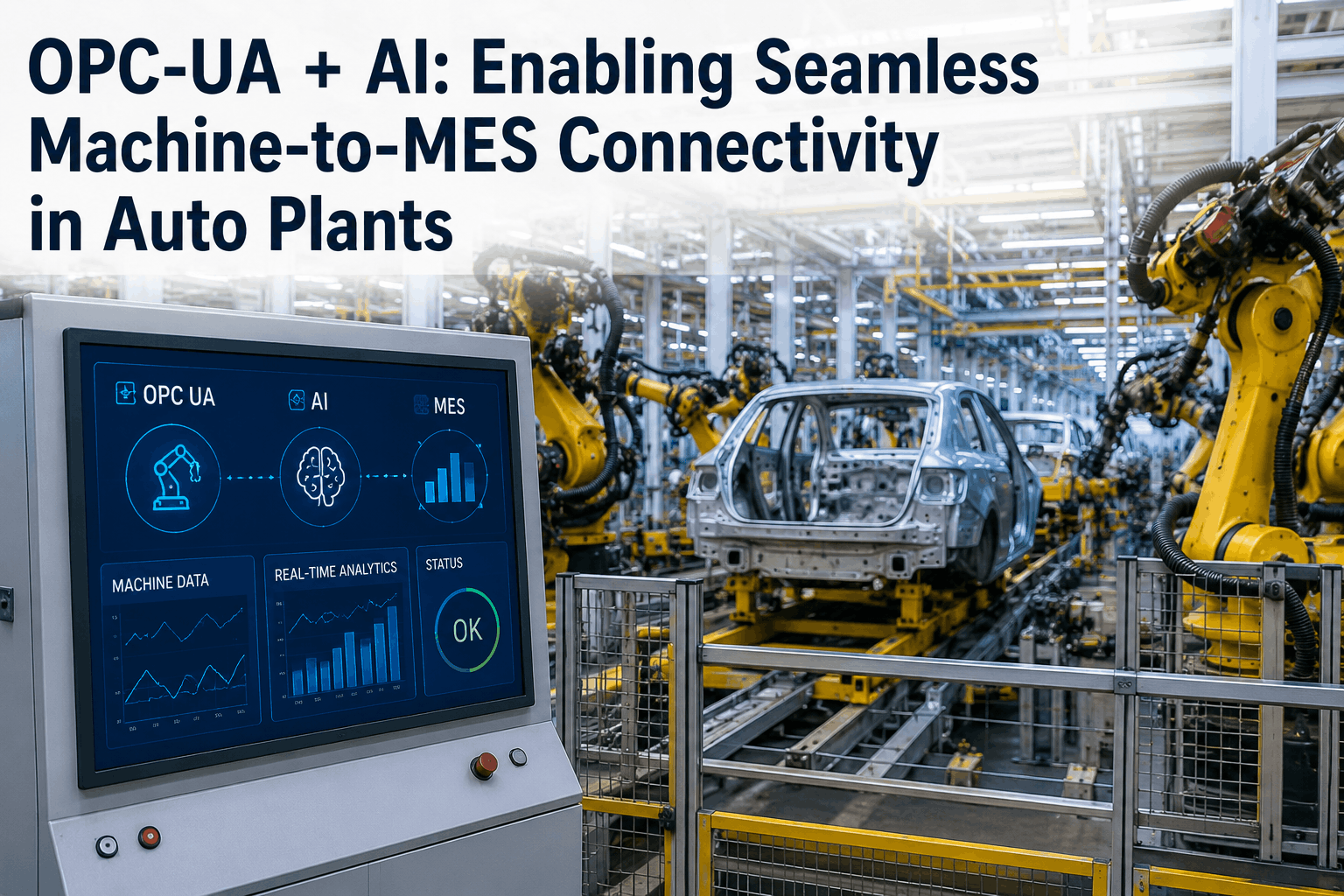
OPC-UA solves the connectivity problem. AI solves the intelligence problem. Together they create something neither delivers alone: a self-aware production system that sees everything, understands everything, and acts in real time. Book a demo to see the full OPC-UA + AI stack demonstrated on automotive use cases.
OPC-UA Servers
Every machine — CNC, robot, press, conveyor, vision system — exposes an OPC-UA server. Spindle load, cycle time, alarm states, tool position, production counts, quality measurements: all published as structured, self-describing data in real time. Modern PLCs from Siemens S7-1500, Allen-Bradley ControlLogix, and Mitsubishi iQ-R include native OPC-UA servers in standard firmware.
Real-Time Processing
Edge AI nodes subscribe to OPC-UA data streams and run inference locally — classifying machine states, detecting anomalies, predicting tool wear, and generating alerts in milliseconds. Processing at the edge eliminates the round-trip latency of cloud inference for time-critical decisions. Results are published back via OPC-UA to MES and plant systems simultaneously.
Execution & Record
MES subscribes to both raw OPC-UA machine data and processed AI intelligence outputs. Production events are automatically confirmed, quality results are written to traceability records, and AI-generated maintenance alerts trigger work orders — all without manual operator entry. The MES becomes a live system rather than a lagging record of what already happened.
ERP & Analytics
Aggregated, contextualized production data flows from MES to SAP, Oracle, or cloud analytics platforms — giving operations, quality, and supply chain teams real-time visibility from machine level to enterprise level. AI scheduling recommendations generated from MES data write back to ERP production orders, closing the loop from machine to business system in seconds.
Five AI Use Cases OPC-UA Connectivity Unlocks
Interested in a specific use case for your plant's equipment mix? Talk to an iFactory OPC-UA integration specialist today.
OPC-UA Connectivity: Legacy Plant Considerations
A common concern at brownfield automotive plants is that older equipment — 10–15 year old CNCs, legacy PLCs, analogue instrumentation — cannot support OPC-UA natively. This is addressable without full equipment replacement through three proven approaches:
KPI Impact: OPC-UA + AI vs. Legacy Connectivity
FAQ: OPC-UA + AI Integration in Automotive Plants
The major automotive equipment vendors all support OPC-UA natively in current-generation hardware: Siemens (S7-1500 PLCs, SINUMERIK 840D/840DSL CNCs), Fanuc (30i/31i/32i CNC series, R-30iB/R-30iB Plus robots), ABB (IRC5/OmniCore robot controllers), Kuka (KR C4/KR C5), Allen-Bradley (ControlLogix 5580, Compact GuardLogix), and Mitsubishi (iQ-R/iQ-F PLC series). For older equipment, edge gateways bridge the gap. Contact support to check compatibility for your specific equipment list.
OPC-UA includes enterprise-grade security at the protocol level — X.509 certificate-based authentication, TLS/SSL encryption of all data in transit, and role-based access control for read/write permissions. Unlike legacy protocols that transmit data in plain text, OPC-UA connections are encrypted end-to-end. For automotive plants operating under IEC 62443 OT cybersecurity standards or customer-specific security requirements, OPC-UA's built-in security model eliminates the need for additional security middleware layers between OT and IT networks.
Yes — this is a core design principle of OPC-UA deployments. OPC-UA servers on PLCs and CNCs run as a read-only data publication layer alongside the existing control program. The control logic is not modified. AI models consume the OPC-UA data stream passively in the initial deployment phase, generating recommendations for operator review before any closed-loop control is activated. Edge gateways for legacy machines are installed at the cabinet level during a scheduled maintenance window — typically under 4 hours per machine. Book a demo to review the zero-disruption deployment plan for your plant.
umati (universal machine tool interface) is an OPC-UA companion specification developed by the VDW (German Machine Tool Builders' Association) that defines a standardized information model for machine tool data. For automotive machining plants, umati means that spindle speed, feed rate, tool number, program name, machine state, and production count are exposed in the same OPC-UA structure regardless of whether the CNC is from Siemens, Fanuc, Heidenhain, or Okuma. AI models trained on umati-structured data can deploy across any vendor's equipment without reconfiguration — dramatically reducing the AI integration effort for multi-vendor machining environments.
iFactory's architecture positions OPC-UA data collection at the edge, AI processing at the plant level, and bi-directional integration to SAP S/4HANA, SAP Digital Manufacturing, and other ERP/MES systems via standard APIs. Machine-level events confirmed by OPC-UA (production count completions, quality gate passes, alarm events) automatically update SAP production orders and MES work queues — eliminating the manual confirmation step that creates data lag between the shop floor and the ERP. Schedule changes from SAP flow back to MES and are published to shop floor work queues within seconds. Book a demo to see the SAP-to-machine data flow in action.
A single CNC machine publishing via OPC-UA at 100ms polling intervals generates approximately 2–5 GB of raw data per day. A 50-machine cell produces 100–250 GB/day. iFactory's edge AI layer performs real-time data reduction — filtering, aggregating, and contextualizing the raw stream before forwarding relevant events and AI inferences to MES and ERP. Only meaningful production events, AI alerts, and quality records reach the enterprise systems — not raw sensor streams. This approach keeps MES databases performant and ERP integration manageable while preserving full machine-level data at the edge for AI model training.