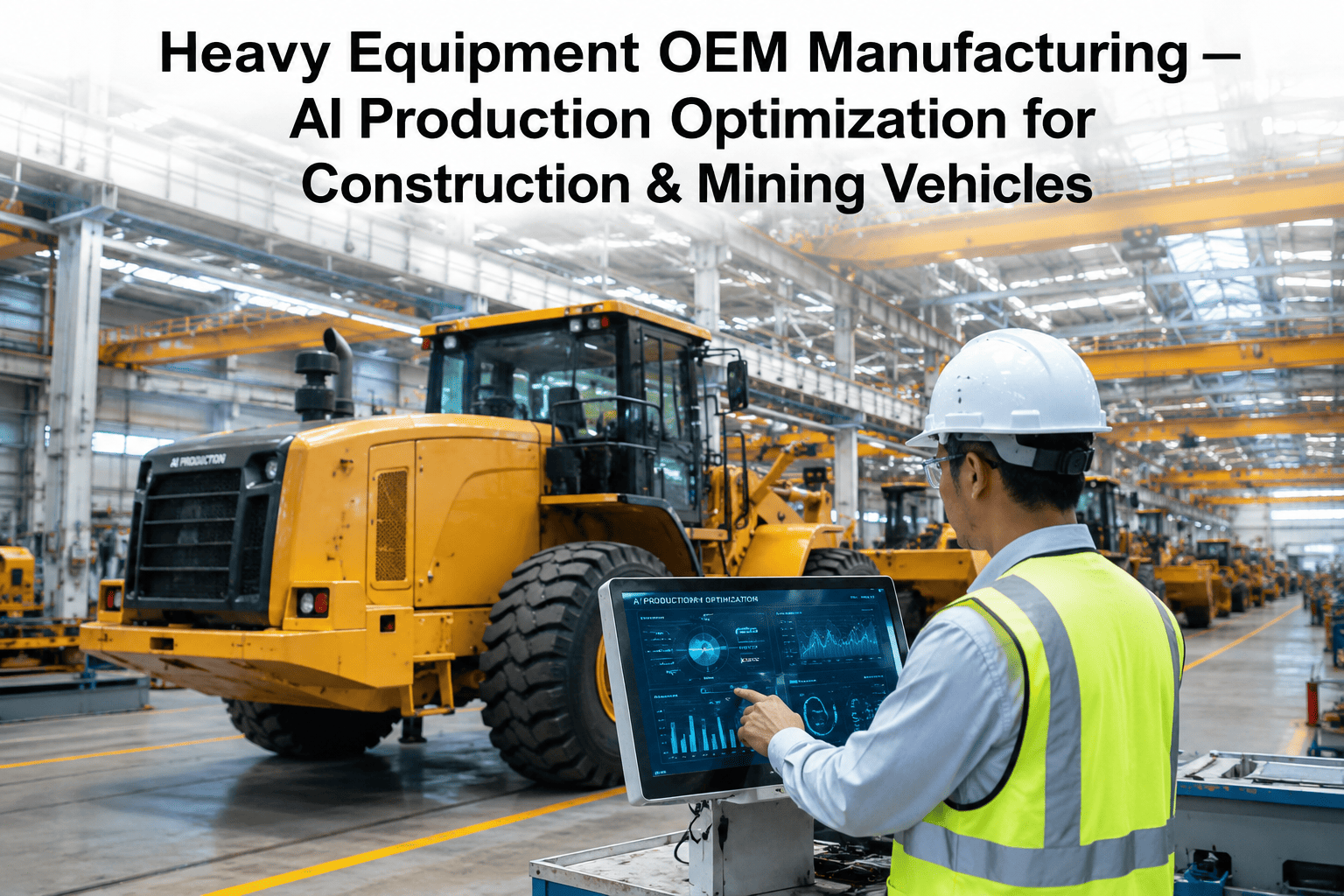
A plant manager running a heavy equipment OEM facility faces a scheduling problem that automotive plants rarely see in the same form — a single excavator or wheel loader configuration might run only a few dozen units a month, built across welding, machining, and assembly stations that also need to switch between several other configurations the same week. Low-volume, high-complexity production means the OEE losses that matter most are not long steady-state runs interrupted by breakdowns, but the changeover time, the welding rework, and the machining tolerance drift that accumulate silently across dozens of different configurations. AI-driven monitoring across welding, machining, and assembly gives a plant manager visibility into exactly where those losses are concentrating, configuration by configuration, instead of one blended OEE number that hides where the problem actually is.
Heavy Equipment OEM Manufacturing — AI Production Optimization for Low-Volume, High-Complexity Builds
AI-driven monitoring across welding, machining, and assembly stations gives plant managers configuration-level visibility into OEE, changeover time, and quality — built for construction and mining equipment production where volume is low but complexity is high.
Where Heavy Equipment Production Actually Loses Time
A heavy equipment build moves through welding, machining, and final assembly stations that each carry their own complexity burden — large structural weldments requiring multiple pass sequences, machined mounting faces holding tight tolerance across a heavy fabricated frame, and assembly sequences that vary meaningfully between a mining-spec configuration and a construction-spec configuration of the same base machine.
Why Standard OEE Metrics Undersell What Is Actually Happening on the Floor
Overall Equipment Effectiveness built for high-volume, low-mix production assumes long steady-state runs where availability, performance, and quality losses are relatively easy to attribute. A heavy equipment plant running many configurations in low volume experiences a different reality — changeover time between configurations can consume a meaningful share of available hours, and a single blended OEE figure across a whole plant obscures which specific configuration, which specific weld station, or which specific machining operation is actually driving the loss.
AI-driven monitoring solves this by tracking OEE at the configuration level, not just the station level — separating the productivity loss that comes from an unusually complex mining-spec build from the loss that comes from a genuine equipment fault, so a plant manager is not chasing a maintenance issue that is actually a product mix problem, or vice versa.
See Where Complexity Is Actually Costing You Production Hours
Configuration-level OEE, weld quality, and machining tolerance visibility built for low-volume, high-complexity manufacturing.
The Four Data Layers Behind Configuration-Level Visibility
Construction and Mining Equipment Each Carry Their Own Production Profile
Construction equipment production typically runs higher volume with more standardized configurations, while mining equipment production tends toward lower volume with heavier customization per customer contract — larger structural sections, more extensive hydraulic customization, and longer cycle times per unit. A plant building both needs monitoring that adapts its baseline expectations to which product line a given build belongs to, rather than applying one standard against fundamentally different production profiles.
Why Low Production Volume Makes Every Quality Escape More Expensive
In a high-volume automotive plant, a quality escape affects a batch that can often be isolated and contained quickly. In a low-volume heavy equipment plant, a single machined component or weldment represents a much larger share of that month's total output, and a defect discovered late in assembly or in the field carries a proportionally larger cost and schedule impact. Continuous weld and machining monitoring is specifically valuable in this environment because it catches the defect at the station where it occurred rather than several stations downstream, when the part has already been built into a larger, harder-to-disassemble structure.
Questions Plant Managers Ask About AI Monitoring for Heavy Equipment Production
Give Every Configuration the OEE Visibility It Deserves
AI-driven monitoring built for low-volume, high-complexity heavy equipment production — from structural welding through final assembly.