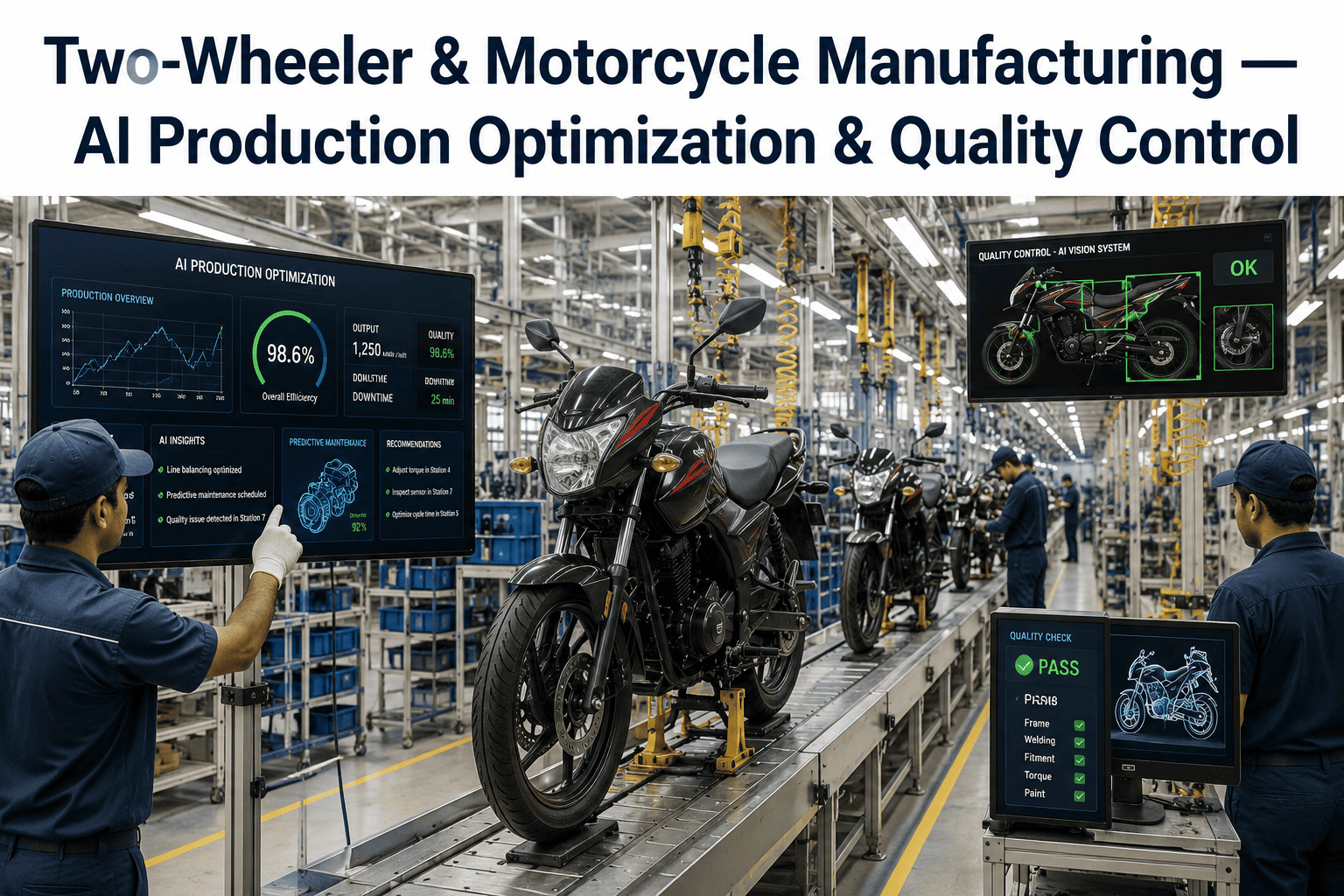
A two-wheeler plant runs at a pace most other vehicle manufacturers would find hard to imagine. Frames move through welding cells every few seconds, tanks and fenders pass through paint booths in continuous sequence, and final assembly lines can push out a completed motorcycle roughly once a minute on a busy shift. At that speed, a plant manager doesn't have the luxury of catching quality problems after the fact — by the time someone notices, dozens more units have already left the same station with the same defect. This piece looks at where two-wheeler production actually breaks down, what the global volume numbers mean for 2026 planning, and how AI-driven monitoring keeps weld, paint, and assembly lines in spec at commuter-vehicle speed. A short walkthrough shows how it applies to your own line takt time.
Two-Wheeler Manufacturing
Keeping Quality in Step With High-Volume Two-Wheeler Production
Weld, paint, and final assembly lines that run at commuter-vehicle takt times need real-time monitoring, not sampled inspection. See what AI production optimization changes.
The Scale of Global Two-Wheeler Production
The global two-wheeler market was valued at roughly $170.7 billion in 2025 and is projected to grow at a 5.9% compound annual rate between 2026 and 2035, with motorcycles alone holding an 81% share of the category. India anchors this scale more than any other country, producing somewhere in the range of 28 million motorcycles in a recent fiscal year and accounting for 15 to 20% of the world's total motorcycle population, with roughly 300 million two-wheelers already registered domestically. That volume isn't concentrated in a handful of mega-plants either — it's spread across dozens of high-throughput facilities where takt times are measured in seconds, not minutes, and where a plant manager's quality strategy has to match that pace or fall permanently behind it.
$170.7B
global two-wheeler market size, 2025
5.9%
CAGR projected through 2035
28M
motorcycles produced annually in India alone
81%
share of the two-wheeler market held by motorcycles over scooters
Urban congestion, rising fuel costs, and dense first-mile mobility needs across Southeast Asian megacities are all pulling volume further upward, which means the plants already running near full capacity today are the ones under the most pressure to find efficiency gains without adding physical line capacity. That pressure lands squarely on three processes: welding, painting, and final assembly, each of which behaves differently at high takt speed than it does at a slower automotive pace.
Three Processes, Three Different Failure Patterns
Weld, paint, and assembly don't fail the same way, and a monitoring approach built for one doesn't automatically transfer to the others. Understanding the distinct failure pattern at each stage is what makes a targeted AI deployment more effective than a blanket sensor rollout across the whole line.
Frame & Engine Welding
Structural welds on the frame and swingarm carry direct rider-safety consequences, and porosity or penetration defects are frequently invisible to the naked eye until the part is under load. Vision-based weld inspection catches these at the cell, not at final test.
Painting & Coating
Tank and fender finish quality is highly sensitive to booth humidity, spray pressure, and cure temperature, and small drifts in any of these produce cosmetic defects that are subjective to grade manually and inconsistent from one inspector to the next.
Final Assembly
Torque-critical fasteners, wiring harness routing, and engine-to-frame mounting all happen in rapid succession, and a missed torque spec at this stage is one of the leading root causes of post-sale warranty claims industry-wide.
Find Your Highest-Risk Station
See Where Defects Are Actually Concentrating on Your Line
A demo reviews your weld, paint, and assembly data to flag the station driving the most rework.
Takt Time Leaves No Room for Delayed Detection
The core operational challenge in two-wheeler manufacturing is that takt time is short enough to make delayed defect detection extremely expensive. A vehicle plant with a two- or three-minute takt time has some buffer to catch a problem before too many units are affected; a two-wheeler line running at 45 to 90 seconds per unit does not. The chart below illustrates roughly how many additional units are exposed to the same undetected defect as detection time increases.
Detected within 1 minute (in-station)
Detected at end-of-shift review
Detected post-sale (field failure)
Full production run exposed
That exposure curve is exactly why real-time, in-station detection matters disproportionately more in two-wheeler manufacturing than in slower-cycle vehicle assembly. A weld or torque defect caught in the same station it occurred costs a single unit's worth of rework. The same defect caught at end-of-shift review or, worse, after the vehicle has reached a dealer, multiplies that cost by every unit produced in between.
The Electrification Shift Is Adding a New Layer of Complexity
Electric two-wheelers are moving from a niche category to a mainstream production line item, with the global electric two-wheeler market estimated near $36 billion and projected by some forecasts to exceed $120 billion by 2030. Battery pack assembly, motor mounting, and power electronics integration are new station types that most two-wheeler plants didn't have five years ago, and they carry tighter electrical safety tolerances than a traditional internal combustion frame-and-engine build. Plants adding EV lines alongside existing ICE production are effectively running two different quality regimes on overlapping floor space, which is a scheduling and monitoring challenge that most legacy MES setups were never designed to handle cleanly.
| Build Type | Primary Risk Station | Monitoring Priority |
|---|
| ICE Motorcycle | Frame weld, engine mount torque | Vision weld inspection, torque capture |
| Electric Motorcycle/Scooter | Battery pack assembly, motor mounting | Electrical safety test, connector torque verification |
| Shared Chassis Platforms | Frame-to-powertrain interface | Configuration verification per build variant |
What AI Production Optimization Adds at Two-Wheeler Speed
In-station weld vision inspection
Flags porosity and penetration defects at the cell where the weld happens, not at a downstream sampling point.
Paint process parameter monitoring
Tracks booth humidity, spray pressure, and cure temperature continuously to catch drift before it produces a cosmetic defect run.
Torque capture on safety-critical fasteners
Records every torque event against the specific build variant automatically, replacing spot-check logging.
Line-level takt time tracking
Surfaces which specific station is dragging cycle time below target, rather than a single blended line-speed number.
EV-specific electrical safety verification
Adds the battery and power-electronics test steps that ICE-only monitoring setups don't cover.
Mistakes That Cost the Most at High-Volume Speed
1
Sampling instead of monitoring every unit. At a 60-second takt time, a 5% sampling rate means the large majority of units never get checked at all, which is a very different risk profile than sampling on a slower line.
2
Treating paint defects as purely cosmetic. Coating failures often trace back to a process parameter drift that also affects corrosion resistance, which turns a cosmetic issue into a durability issue further down the vehicle's life.
3
Running EV and ICE builds through undifferentiated monitoring. Applying the same inspection checklist to both build types misses the electrical safety checks that EV-specific stations require.
4
Reviewing takt time only at the line level. A blended line-speed average can look healthy while one specific station is quietly dragging behind and building a growing buffer of work-in-progress.
Frequently Asked Questions
Can real-time monitoring actually keep up with a sub-minute takt time?
Yes — vision-based weld and paint inspection systems are built to operate at line speed, processing each unit within its normal station dwell time rather than requiring the line to slow down for inspection. The alternative, sampling-based inspection, is what struggles to keep pace, since it either misses most units or requires pulling parts off the line entirely.
A demo can show detection speed against your actual takt time.How does monitoring differ between ICE and electric two-wheeler lines?
ICE lines prioritize weld integrity and engine mount torque, while electric lines add battery pack assembly verification and power electronics safety testing, which carry tighter tolerances and different failure modes than a traditional combustion build. A plant running both needs monitoring configured separately for each build type rather than one shared checklist.
What's the biggest source of warranty claims in two-wheeler manufacturing?
Torque-related failures at final assembly are consistently among the most common post-sale issues, since a missed or under-torqued fastener on a safety-critical component often doesn't fail immediately but shows up as a claim weeks or months after the vehicle is in the field, by which point tracing it back to a specific shift or station is difficult without a digital torque record.
Does this apply to scooter production as well as motorcycles?
Yes. Scooter platforms share the same core weld, paint, and assembly risk points as motorcycles, and in many plants both vehicle types run through shared or adjacent lines, which makes station-level monitoring valuable across the full two-wheeler product mix rather than motorcycles alone.
How quickly can a high-volume line get this running without a full shutdown?
Most plants add vision inspection at one or two priority stations first, typically frame welding or paint, without stopping the line, since cameras and sensors can be installed during a normal changeover window. Full rollout across weld, paint, and assembly typically follows over subsequent weeks once the first station proves out.
Support can walk through a no-downtime rollout plan.
Ready When You Are
Match Your Quality Checks to Your Line Speed
Book a session and see how AI production optimization handles your specific weld, paint, and assembly takt times.