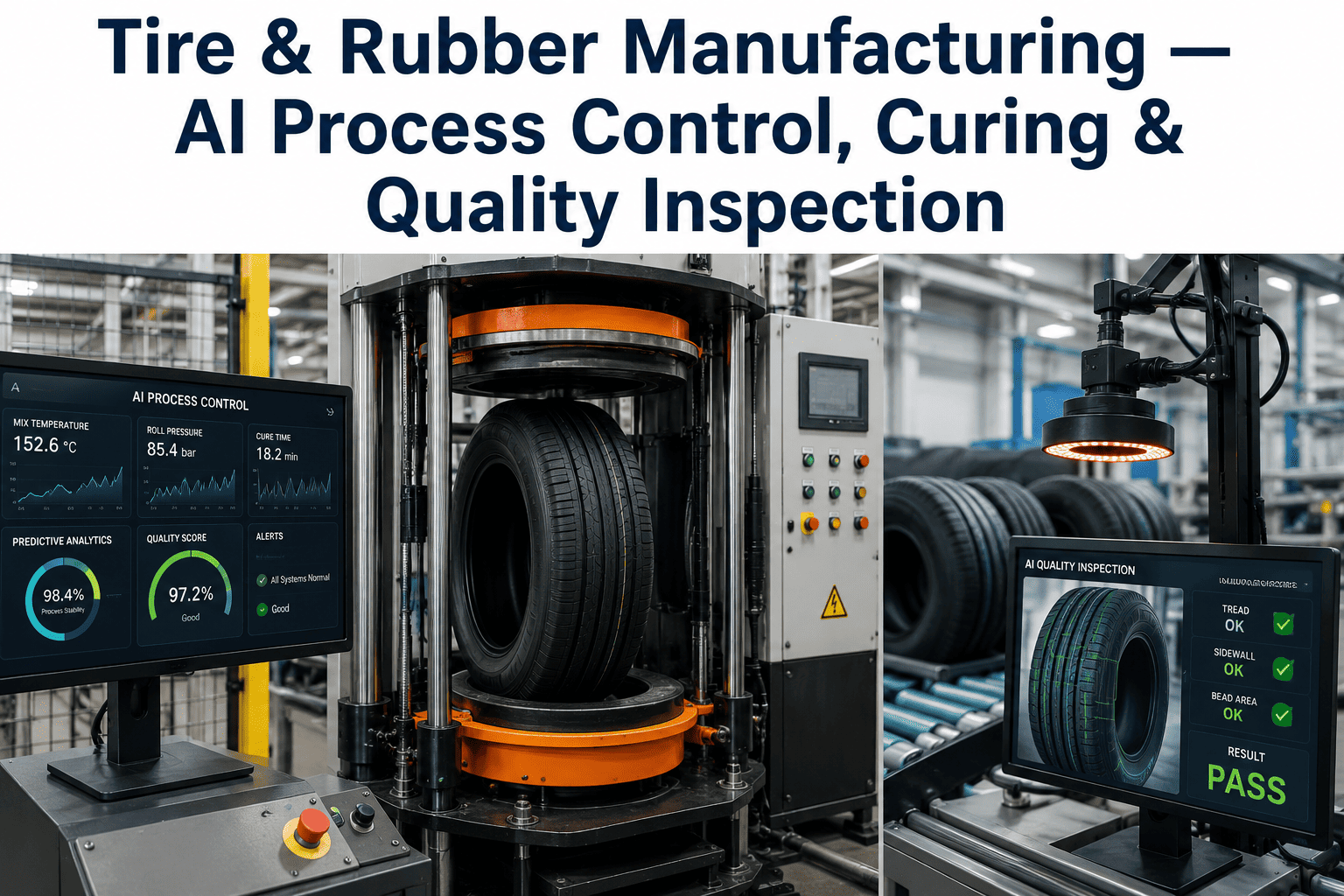
A tire looks finished the moment it comes out of the curing press, but whether it's actually good can't be judged by looking at it. Uniformity, balance, and internal structure only reveal themselves under specialized testing — force-variation measurement, x-ray inspection, roundness checks — performed after a process that's already locked in whatever happened during mixing, extrusion, building, and curing. For a process engineer, that means the real leverage sits upstream, at the process parameters that determine uniformity long before a finished tire ever reaches final test. This piece walks through where tire quality is actually decided, what curing parameters look like across tire types, and how AI process control turns final-test failures back into upstream corrections. A short walkthrough shows how it applies to your own curing data.
Tire & Rubber Manufacturing
Catching Tire Uniformity Problems Before the Curing Press, Not After
Force variation, porosity, and surface defects trace back to mixing, extrusion, and curing parameters. See how AI process control connects final test failures to their upstream cause.
Why Uniformity Is the Metric That Matters Most
Every tire that comes off a curing press passes through visual inspection, x-ray examination for internal flaws, and uniformity testing for balance and roundness before it ships. That final gate is thorough, but it's also the most expensive place in the process to discover a problem — by the time a tire reaches force-variation testing, the rubber compound has been mixed, the components have been built up on a drum, and the tire has already spent 8 to 20 minutes in a curing press at 150 to 180°C under 12 to 25 bar of pressure. Every one of those upstream steps is a place where the eventual after-cure uniformity was actually decided, which means a process engineer chasing a uniformity problem purely at final test is investigating the symptom several stages removed from the cause.
150-180°C
typical curing press temperature range
12-25 bar
curing press pressure range, depending on tire size
8-20 min
cure time depending on tire size and compound
3
core final-test checks: visual, x-ray, and uniformity/roundness
Where Uniformity Actually Gets Decided
Tire manufacturing engineering has known for decades that after-cure uniformity is a composite of contributions from two distinct sources: the "tire room effect," meaning everything that happens during building and component assembly, and the "curing room effect," meaning everything introduced during vulcanization itself. Advanced uniformity-correction methods work by measuring the before-cure radial runout, predicting how it will interact with the curing room effect, and aligning the tire's loading angle in the mold specifically to cancel out the two contributions against each other. That's a sophisticated technique, but it's fundamentally a correction applied after the fact — the more durable fix is reducing the size of the tire room effect at its source, upstream in building and mixing, so there's less to correct for in the first place.
1
Mixing — batch-to-batch consistency in the rubber compound sets the baseline material properties every later stage depends on.
2
Extrusion — tread and sidewall profile consistency here directly affects dimensional uniformity later in the build.
3
Tire Building — component placement and splice location on the building drum are the primary source of the "tire room effect" in after-cure force variation.
4
Curing — temperature and pressure uniformity across the mold determine the "curing room effect" contribution to final uniformity.
5
Final Inspection — visual, x-ray, and force-variation testing catch what made it through, but by this point correction options are limited to post-cure adjustment or scrap.
Trace Your Uniformity Root Cause
Connect Your Final-Test Failures Back to Their Process Origin
A demo reviews your building and curing data against final uniformity results to isolate where variation is actually introduced.
Reactive Correction Versus Upstream Process Control
Post-cure correction techniques exist for a reason — some level of after-cure adjustment will always be part of a well-run tire plant's toolkit, particularly for tires that fall just outside spec on a single harmonic. But relying on post-cure correction as the primary uniformity strategy, rather than a backstop, tends to mask upstream process drift that keeps producing the same defect pattern batch after batch.
Post-cure correction only
Fixes individual tires, doesn't reduce recurrence
Statistical sampling at final test
Flags trends after a full production run is affected
Real-time building & curing parameter monitoring
Flags process drift within the current shift, before it compounds
Curing Parameters by Tire Category
Curing time and pressure vary meaningfully by tire size and compound, which means a single fixed curing recipe applied across a mixed product line is itself a source of variation. The table below reflects the general parameter ranges process engineers work within, though exact values are compound- and mold-specific.
| Tire Category | Typical Cure Time | Pressure Range |
|---|
| Passenger/light truck | 8-12 minutes | 12-18 bar |
| Medium/heavy truck | 12-16 minutes | 16-22 bar |
| Off-road/industrial | 16-20 minutes | 20-25 bar |
A process engineer managing multiple curing presses across this range needs visibility into whether each individual press is actually holding its assigned recipe, since a press running slightly outside its target temperature or pressure window can produce tires that pass visual inspection but carry a systematic uniformity bias that only shows up in force-variation testing — by which point dozens of tires from that press may already be affected.
What AI Process Control Adds to Tire Manufacturing
Batch-to-batch compound consistency tracking
Flags mixing variation before it propagates into extrusion and building.
Building drum splice and placement monitoring
Tracks component placement consistency, the primary driver of the tire room effect in after-cure uniformity.
Per-press curing parameter monitoring
Verifies each curing press is holding its assigned temperature and pressure recipe in real time, not just at scheduled maintenance checks.
Final-test-to-process correlation
Links a force-variation failure back to the specific building drum or curing press that produced it, closing the loop that post-cure correction alone can't.
Common Process Control Gaps in Tire Plants
1
Treating post-cure correction as the primary quality strategy. It's a valid backstop for individual tires, but leaning on it as the main line of defense hides recurring upstream drift.
2
Applying one curing recipe assumption across a mixed product line. Passenger, truck, and off-road tires need distinct temperature and pressure profiles, and monitoring that doesn't distinguish between them misses press-specific drift.
3
Disconnecting final-test data from building-drum records. Without that link, a recurring force-variation pattern gets re-diagnosed from scratch every time it appears instead of being traced to its source drum or splice pattern.
4
Auditing curing press parameters only during scheduled maintenance. A press drifting slightly out of its target window between maintenance cycles can produce a steady stream of borderline-uniformity tires that never trigger an obvious alarm.
Frequently Asked Questions
What's the difference between the "tire room effect" and "curing room effect" in uniformity?
The tire room effect refers to uniformity variation introduced during building and component assembly, primarily from splice location and component placement on the drum. The curing room effect refers to variation introduced during vulcanization, primarily from temperature and pressure consistency across the mold. Distinguishing between the two is what allows a process engineer to target the actual source of a uniformity problem instead of applying a generic fix.
A demo can show how this breakdown applies to your own uniformity data.Does upstream process monitoring replace the need for post-cure correction?
No. Post-cure correction remains a useful tool for individual tires that fall just outside spec on a specific harmonic. What upstream monitoring changes is the volume of tires that need correction in the first place, by catching and fixing the process drift that was causing the pattern to recur across many tires rather than one.
How much does curing recipe vary between tire categories?
Meaningfully. Passenger and light truck tires typically cure in 8 to 12 minutes at 12 to 18 bar, while larger truck and off-road tires can require 16 to 20 minutes at up to 25 bar. A plant running a mixed product line across shared curing presses needs monitoring that verifies each press against its specific assigned recipe rather than a single blended standard.
Can this be added without replacing existing curing press equipment?
Yes. Process parameter monitoring typically integrates with existing press controllers and building-drum sensors rather than requiring new curing equipment, which means most plants can add this visibility layer without a capital equipment replacement cycle.
What's a realistic first step for a plant just starting this kind of program?
Most plants start by connecting final-test uniformity data to building-drum and curing-press records for their highest-volume tire line, since that's where the fastest, most measurable reduction in recurring defects tends to show up. Expansion to additional lines typically follows once that first connection proves out.
Support can help scope a starting point for your specific product mix.
Ready When You Are
Close the Loop Between Final Test and Process Parameters
Book a session and see how AI process control connects your uniformity results back to their upstream cause.