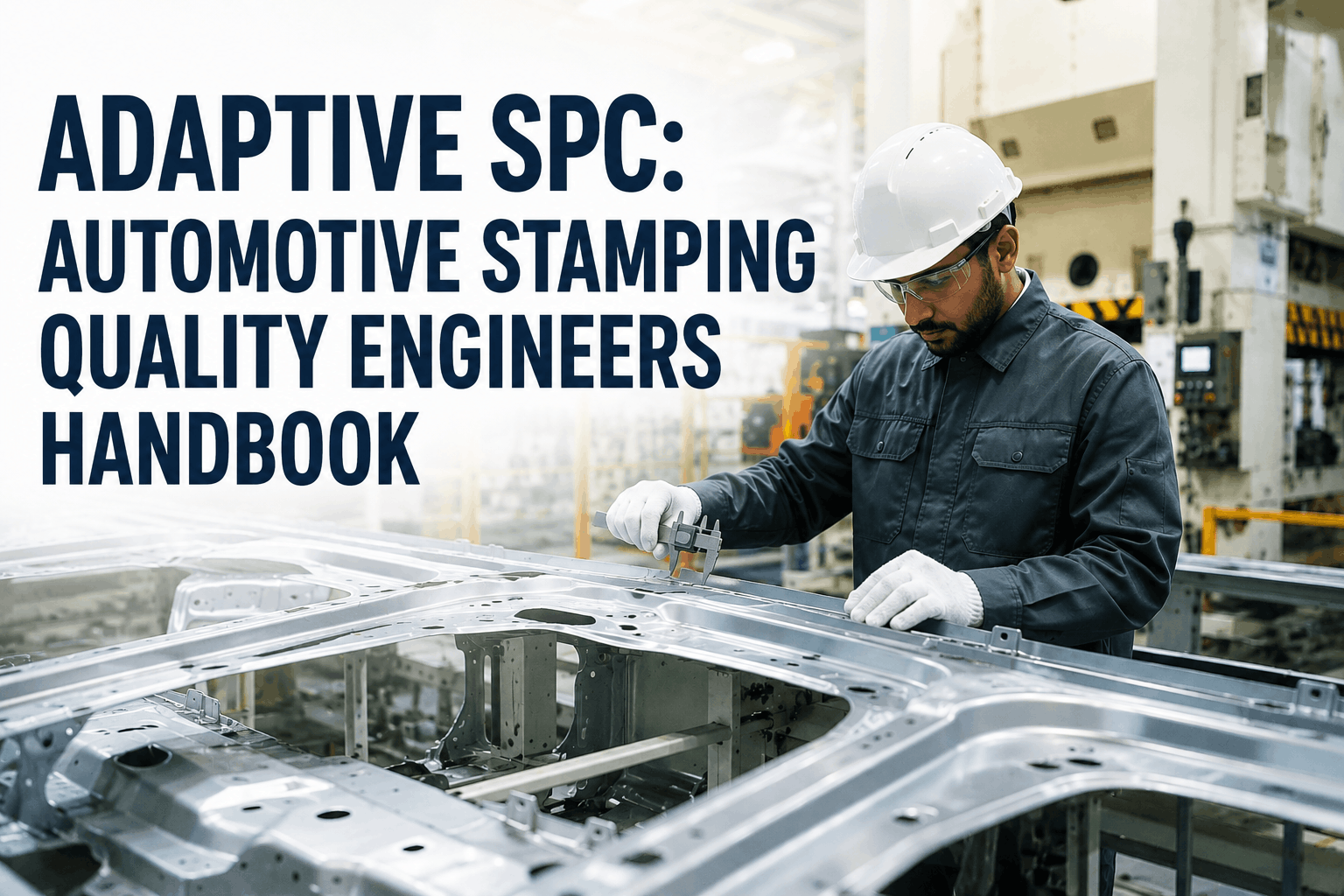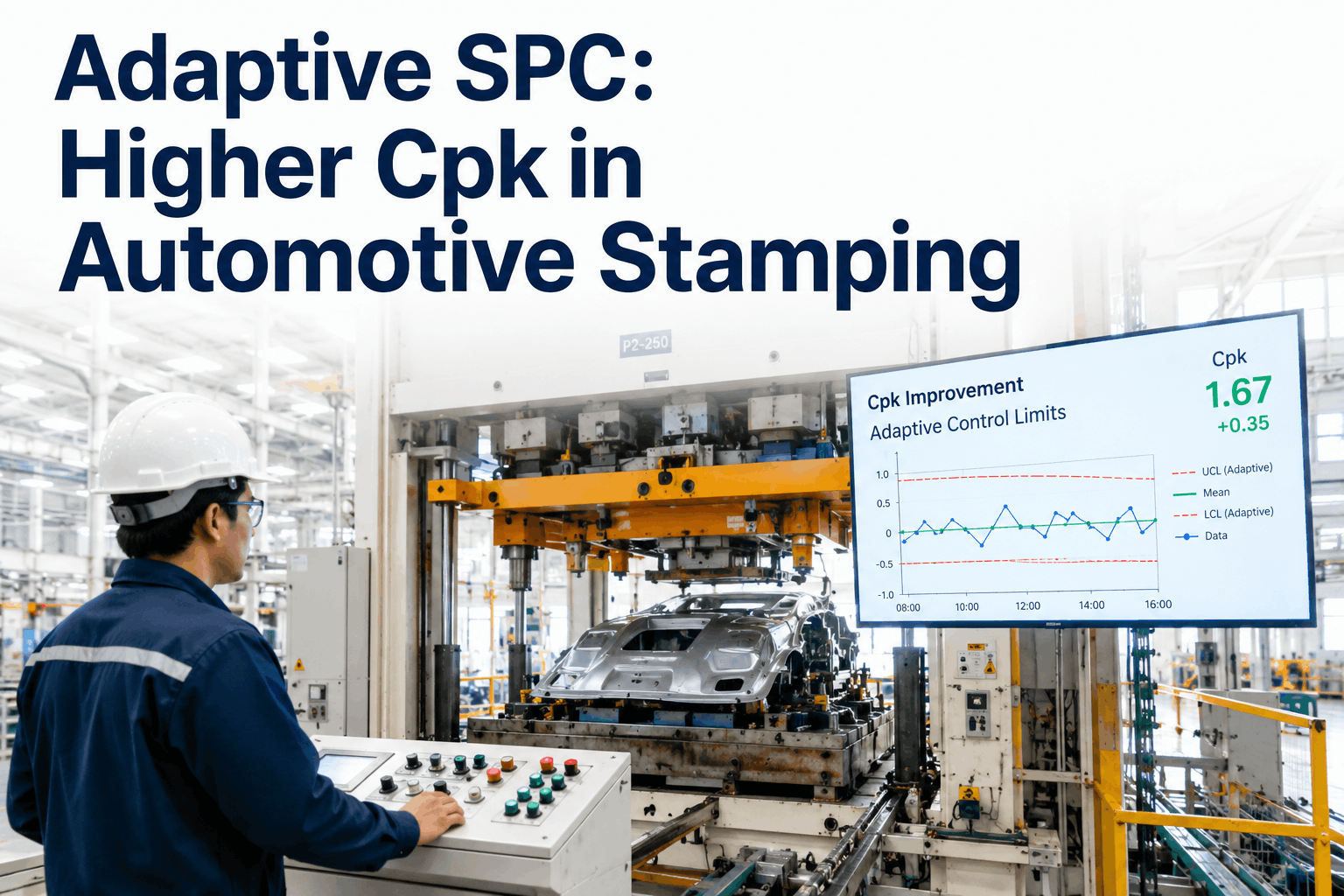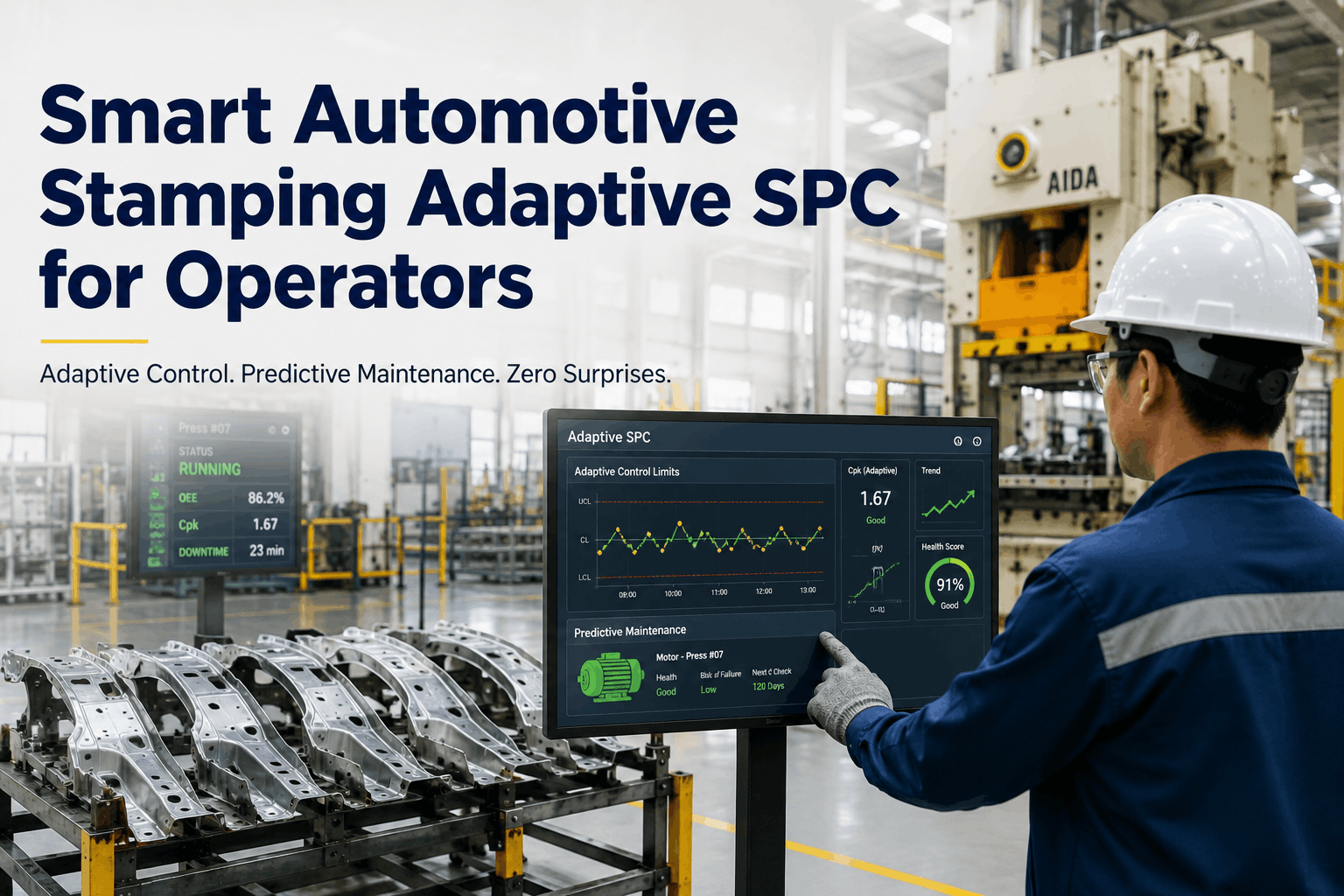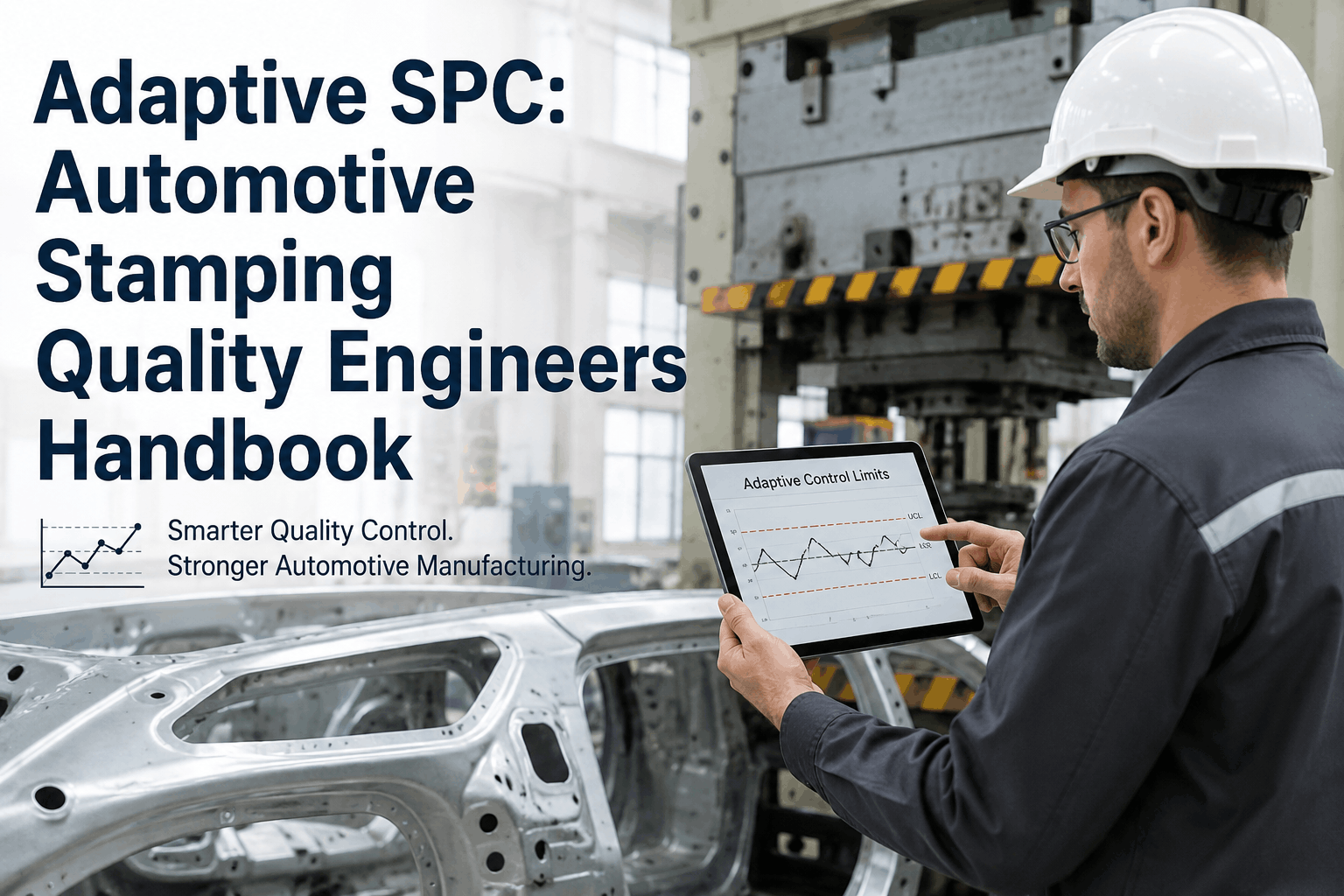
The AIAG SPC 3rd Edition is scheduled for release in July 2026 — and for quality engineers in automotive stamping, it will formalise what leading Tier-1 suppliers have already moved to in practice: adaptive, AI-augmented statistical process control that moves beyond static Shewhart charts toward dynamic control limits, ML-driven root-cause identification, and real-time Cpk tracking against IATF 16949's tightening capability requirements. The challenge for quality engineers is not whether to modernise their SPC methodology — the competitive and regulatory pressure makes that inevitable. The challenge is how to execute the migration from static control limit charts to adaptive SPC without disrupting ongoing IATF 16949 compliance, without requiring a full MES replacement, and with a defensible audit trail throughout the transition. This handbook addresses that challenge directly. Book a Free Cpk & Compliance Audit to assess your stamping SPC against IATF 16949 2026 expectations.
The Technical Case Against Static Control Limits in Stamping
Static control limits are a statistical approximation of process behaviour at a specific point in time. In automotive stamping, where die wear is continuous, coil mechanical properties vary batch-to-batch, and press condition drifts with temperature and lubrication state, that approximation becomes increasingly inaccurate with every shift that passes after the baseline was calculated. Quality engineers who rely on static limits face three compounding technical problems.
AIAG SPC 2nd Edition recommends recalculating control limits when significant process changes occur. In practice, stamping control limits are often recalculated quarterly or at PPAP — meaning the limits in use may be based on die and coil conditions that no longer exist. As the process drifts from its baseline, the proportion of out-of-control signals attributable to common-cause variation (legitimate normal variation now flagged as special-cause) increases. Net-Inspect's IATF 16949 analysis identifies manual spreadsheet-based SPC as the leading source of false alarms and compliance gaps at Tier-1 stamping suppliers.
Die wear in stamping generates correlated changes across multiple characteristics simultaneously — part height, flange angle, burr depth, and surface finish all change as a function of the same wear mechanism. Monitoring each characteristic with independent univariate control charts cannot detect this correlation structure. By the time any single characteristic crosses its individual control limit, the underlying wear mechanism has already progressed through multiple covariate signatures that multivariate SPC methods (T², MEWMA, PCA monitoring) would have detected hundreds of strokes earlier.
IATF 16949:2026 aligns with ISO 9001:2026's increased emphasis on software quality, data-driven decision-making, and risk management. The AIAG SPC 3rd Edition (July 2026) will formalise AI-augmented adaptive SPC as a recognised methodology. Quality engineers who continue using static Shewhart charts will face increasing audit scrutiny — not because static charts violate the current standard, but because auditors will increasingly ask how the quality system responds to process changes between control limit recalculations.
Adaptive SPC Technical Architecture: How It Works
Adaptive SPC for automotive stamping is not a replacement for Shewhart methodology — it is an extension that addresses the statistical limitations of static limits while maintaining full compatibility with IATF 16949 documentation requirements. The architecture has three interdependent components. Book a Cpk audit to see adaptive SPC architecture applied to your specific stamping characteristics.
When a detection rule fires on an adaptive chart, the signal is classified by an ML model trained on historical out-of-control events and their confirmed root causes. The classifier outputs a probability-ranked list of candidate root causes with the supporting signal evidence — giving the quality engineer a structured starting point for investigation rather than an undifferentiated alarm.
From SPC Signal to Predictive Maintenance: The Engineering Connection
The value of adaptive SPC for maintenance engineering is not just faster detection — it is the quantification of remaining useful life (RUL) that enables a CMMS work order to be created at the right moment. Talk to an iFactory SPC specialist about connecting adaptive SPC to your CMMS maintenance workflow.
IATF 16949 Compliance: What Adaptive SPC Documentation Looks Like
Quality engineers migrating to adaptive SPC frequently ask the same question: how do we document adaptive limits for IATF 16949 audits? The answer is straightforward — the documentation requirements are the same; the content is more rigorous. Book a Cpk compliance audit to review your current SPC documentation against IATF 16949 requirements.
On-Premise or Cloud: iFactory Deploys Both Ways
FAQ: Adaptive SPC for Quality Engineers in Automotive Stamping
This is the technically correct first question — and it is one that operators rarely ask but quality engineers always should. Adaptive limits assume that observed variation reflects process variation, not measurement variation. If your Gauge R&R exceeds 10–30% of tolerance (the AIAG MSA threshold), adaptive limits will recalibrate to include measurement variation as legitimate process variation, potentially masking real process changes. MSA must be validated before adaptive SPC deployment. iFactory's Cpk compliance audit includes a measurement system capability assessment — evaluating whether your current gauging provides sufficient discrimination for stroke-by-stroke Cpk monitoring at stamping production rates. For high-speed inline gauging, repeatability (%R&R) requirements are typically tighter than for manual CMM measurement because the gauge must distinguish 0.01–0.05mm process variation at production speed. Book a Cpk audit to include MSA validation in the assessment scope.
The smoothing parameter λ in EWMA-based adaptive limits controls the trade-off between limit stability and adaptation speed. For automotive stamping, the selection depends on the dominant variation source: λ = 0.05–0.10 is appropriate for high-wear environments where gradual die wear is the primary variation source — slower adaptation reduces false alarms from normal wear while still tracking the trend; λ = 0.15–0.25 is appropriate for coil-change-dominated variation where the process genuinely shifts between batches and limits need to re-baseline relatively quickly; and λ = 0.30+ approaches non-adaptive behaviour and is rarely appropriate for stamping. iFactory's adaptive SPC deployment process includes a λ optimisation step — running retrospective simulation on your historical data to identify the λ value that minimises false alarm rate while maximising the probability of detecting known historical process problems at or before their historical detection point.
PPAP capability studies (Cpk requirements from PPAP submission) are calculated under controlled conditions during the approved study period — these are a fixed record. Adaptive SPC operates in the production monitoring phase that follows PPAP approval. The transition is managed by establishing the initial adaptive SPC baseline from the same data used for PPAP — so the adaptive limits at production start reflect the approved process capability. As production proceeds, the adaptive limits update to reflect actual production variation, which may differ from PPAP conditions. iFactory maintains both records: the static PPAP capability study (immutable reference) and the rolling adaptive SPC record. IATF 16949 auditors see both — the PPAP evidence and the ongoing production monitoring methodology — as separate, complementary records. The July 2026 AIAG SPC 3rd Edition update is expected to provide specific guidance on the PPAP-to-production-monitoring handover for adaptive methods.
The ML root-cause classifier is initialised from a pre-trained base model covering common stamping defect patterns (die wear, coil variation, lubrication issues, setup deviations) and then fine-tuned to your specific die geometries, part families, and historical defect records. The fine-tuning process uses your historical SAP QM or MES corrective action records as labelled training data — matching historical SPC signal patterns to confirmed root causes. Fine-tuning requires a minimum of 50–100 confirmed root-cause events per defect category for reliable classification (typically available from 12–18 months of MES/QM records). During the initial parallel operation period, the classifier's predictions are validated against quality engineer investigations before autonomous classification is activated. Classification confidence scores are always available to quality engineers — the AI provides a probability-ranked list, not a hidden single answer. Contact support to discuss your specific defect library and classification training requirements.
iFactory's Cpk & Compliance Audit is a structured technical assessment covering five areas: (1) Cpk gap analysis — current Cpk values per critical characteristic vs. IATF 16949 minimums and OEM customer-specific targets (1.33 and 1.67 thresholds); (2) Control limit methodology assessment — static vs. adaptive, recalculation frequency, and false alarm rate estimate from your current charts; (3) MSA status review — Gauge R&R results for your inline or CMM gauging against production measurement requirements; (4) IATF 16949 documentation gap analysis — review of current SPC records against Clauses 8.5.1.1, 9.1.1, 9.1.1.1, and 10.2; and (5) Adaptive SPC migration scope estimate — what would change, what remains the same, and the expected Cpk improvement trajectory based on comparable deployments. The audit is delivered as a written report within 5 working days of data receipt. Most quality engineers use it as the technical justification document for their adaptive SPC modernisation business case. Book your free Cpk & Compliance Audit here.
.png)