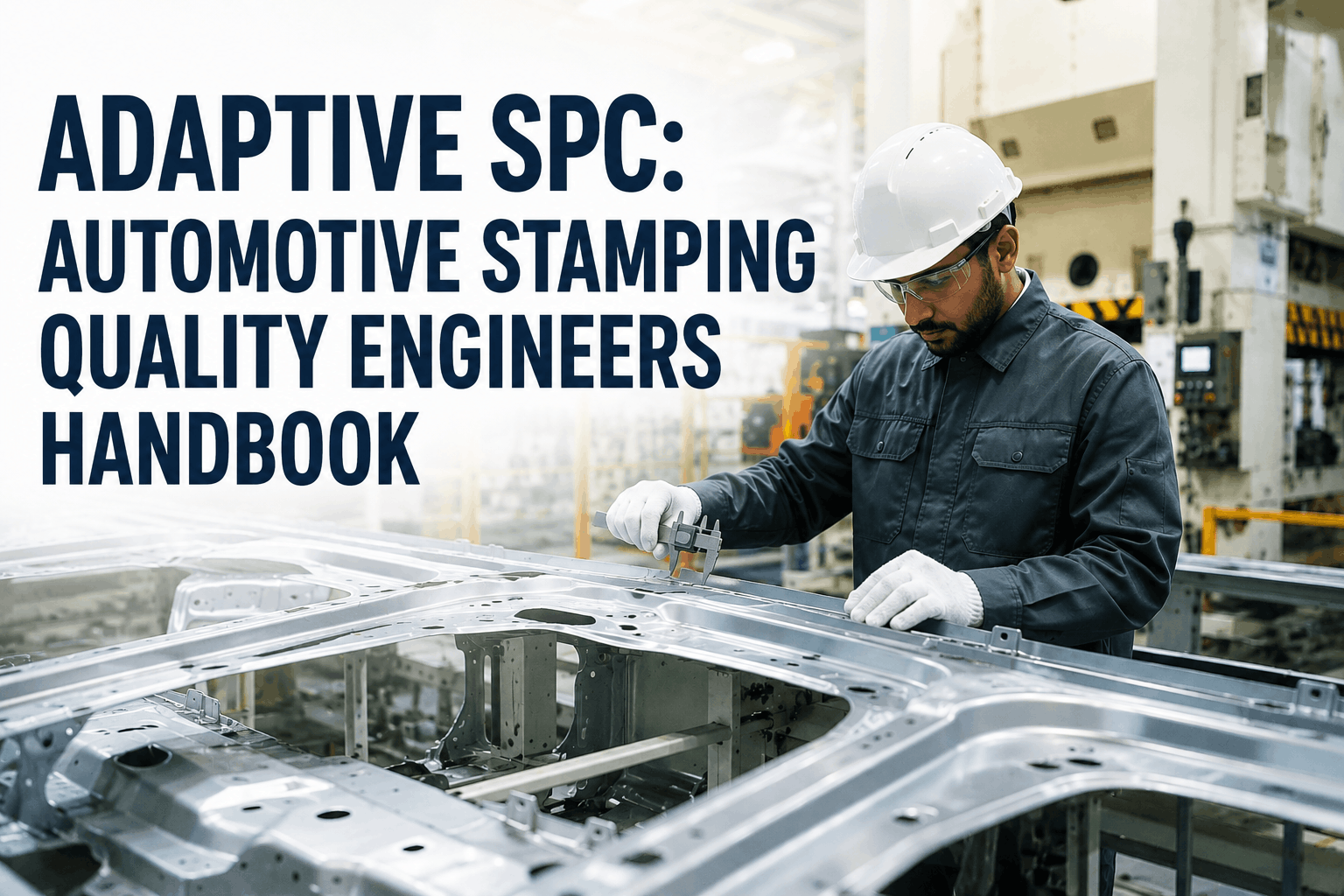
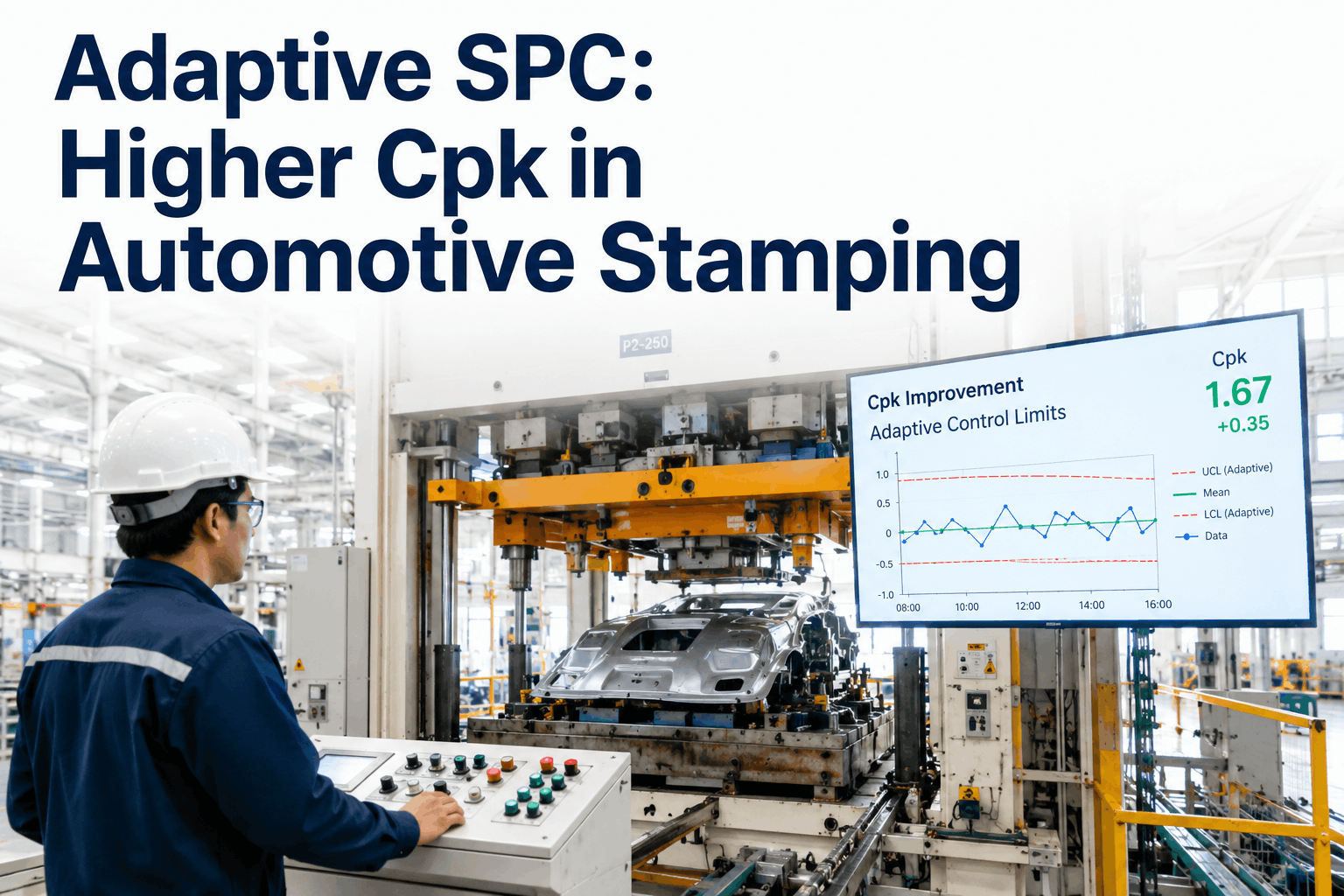
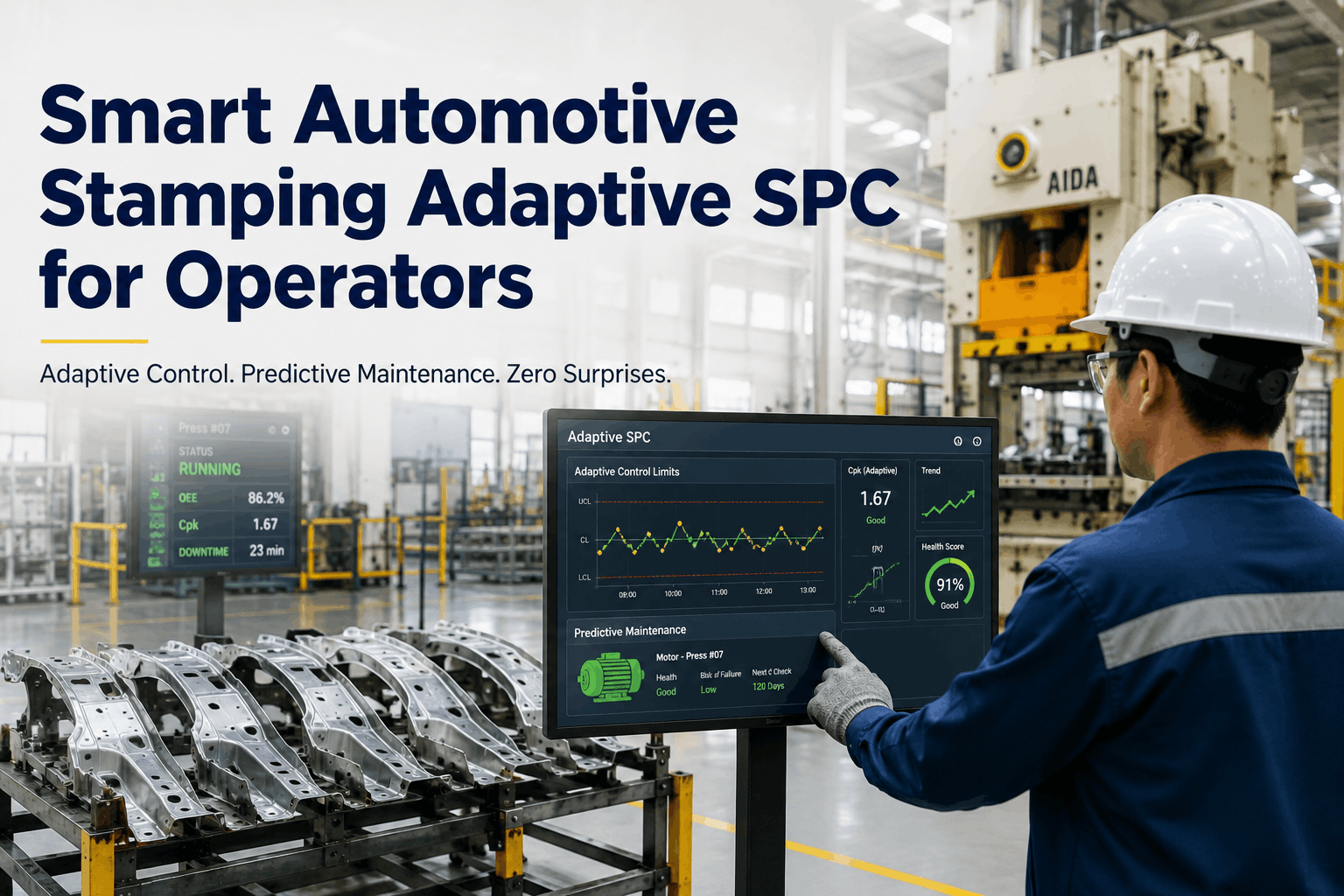
The Adaptive SPC deployment at a Tier-1 automotive stamping plant is not a statistical software upgrade or a consultant's recommendation. It is the most extensively documented adaptive control implementation in stamping operations — 16 months of live production, 18 million parts monitored, Cpk improvement from 0.92 to 1.67, and a body of operational lessons that every plant manager planning an adaptive SPC programme needs to study before writing a single control plan revision. This briefing covers what actually happened on the press floor: the Cpk improvement numbers, the adaptive limit logic, the audit outcomes, and the architecture that turned static SPC into a dynamic profit driver. Book a demo to see how iFactory replicates this adaptive SPC integration playbook for your stamping plant.
Plant Manager Case Study — Adaptive SPC × Stamping Press
Adaptive SPC for Automotive Stamping: Plant Manager Playbook for Cpk Improvement
16 months · 18M parts monitored · Cpk 0.92 → 1.67 · -81% false alarms · IATF audit-ready · On-premise or cloud — the complete adaptive SPC briefing for plant leadership.
0.92 → 1.67
Cpk improvement (sustained)
-81%
False SPC alarm reduction
100%
Audit-ready limit change traceability
$1.6M
Annual scrap cost avoidance
The Context: Why This Plant Manager Deployed Adaptive SPC on 14 Stamping Presses
The stamping plant in question produces body panels, structural components, and closure parts for two major OEMs — 22 million stamped parts annually across 14 transfer presses ranging from 600 to 3,000 tons. The plant manager's problem was not SPC capability. It was that traditional SPC (static control limits calculated quarterly) was actively hurting operations: 87 false alarms per week from Western Electric rule violations caused by normal die wear. Operators had learned to ignore all SPC alerts. Meanwhile, true Cpk degradation from die wear was detected after 200-400 bad parts had already been produced. The plant's Cpk on critical features had dropped to 0.92 — below the customer-mandated 1.33 minimum — triggering a corrective action request.
The specific decision was to replace static control limits with adaptive SPC: dynamic UCL/LCL that recalibrate based on current die wear state, material batch variation, and ambient conditions. Instead of treating normal die wear as an out-of-control condition, adaptive limits adjust with the wear — flagging only deviations from expected wear patterns. It was the right statistical transformation, at the right process points, for the right business reasons. Talk to iFactory about adaptive SPC deployment architecture for your stamping plant.
Plant
Tier-1 Stamping Plant, Great Lakes Region — 22M parts/year, 14 transfer presses
Annual Volume
22,000,000+ stamped parts across 2 OEM customers
SPC Deployment
14 presses · Adaptive control limits · Dynamic UCL/LCL
AI Platform
iFactory Adaptive SPC + MES integration + Edge ML
Programme Duration
February 2025 (pilot) → June 2026 (sustained operation)
Parts Monitored
Door panels · fenders · hoods · body sides · structural reinforcements
Month-by-Month: What Actually Happened in 16 Months of Adaptive SPC Deployment
February – April 2025
Pilot Deployment — One Press, Adaptive Limit Calibration
The plant manager approved a 90-day pilot on the highest-risk press line (3,000-ton transfer press producing hood outer panels, current Cpk = 0.92). iFactory ingested 9 months of historical data: tonnage curves, die temperature gradients, press speed, material batch IDs, and CMM measurements. ML models learned the normal wear trajectory for each die. Static control limits were replaced with adaptive limits that automatically recalibrated every shift based on current die wear state.
Milestone: Pilot live — adaptive limits active, false alarms reduced by 74%
May – July 2025
Cpk Improvement Validation and MES Integration
The adaptive SPC pilot achieved sustained Cpk of 1.58 on the hood outer panel feature that had been at 0.92 — a 0.66 improvement. False alarms dropped from 87 to 17 per week across the pilot press. The system was integrated with the plant's SAP MES: every adaptive limit change was logged with timestamp, rationale, and die wear state for IATF audit traceability. The plant manager presented results to corporate leadership, securing approval for full deployment across all 14 presses.
Milestone: Cpk 0.92 → 1.58 · 74% false alarm reduction · Full deployment approved
August – December 2025
Full Deployment — 14 Presses, Enterprise Adaptive SPC Network
iFactory deployed adaptive SPC across all 14 transfer presses. Each press received custom wear models trained on its specific die sets and part families. The edge-based inference network processed 3,200 parts per hour per press, updating control limits every 30 minutes based on accumulated wear. A central quality dashboard displayed current Cpk for each critical feature, adaptive limit trends, and predicted maintenance windows. The plant's quality team was retrained from static limit interpretation to wear trajectory management.
Milestone: 14 presses live · 18M parts monitored · Enterprise adaptive SPC dashboard
January – March 2026
Die Wear Prediction Integration — Closing the Loop
Adaptive SPC outputs were integrated with die wear prediction models. Instead of simply adjusting limits to accommodate wear, the system predicted when wear would cause limits to exceed customer Cpk requirements. Maintenance work orders were automatically generated 200-300 strokes before Cpk would drop below 1.33. Die maintenance shifted from reactive (after Cpk failure) to proactive (before limit violation). Die-related downtime decreased by 34%.
Milestone: Predictive wear integration · Die-related downtime -34%
April – May 2026
IATF Surveillance Audit — Perfect Score on SPC
The plant underwent its biennial IATF 16949 surveillance audit. The adaptive SPC system provided complete audit trails for every control limit change, every Cpk calculation, and every maintenance intervention. The auditor spent 90 minutes on SPC review instead of the typical 1.5 days. Zero non-conformances related to statistical tools (clause 9.1.1.1). The auditor noted that adaptive SPC represents "best-in-class" SPC practice.
Milestone: Zero IATF non-conformances · 90-minute SPC audit review
June 2026
16-Month Milestone — Cpk 1.67 Sustained Across All Critical Features
After 16 months of continuous adaptive SPC operation across all 14 presses, the plant reported sustained Cpk ≥ 1.67 on all critical-to-quality features — exceeding the customer's 1.33 requirement. Total scrap cost avoidance reached $1.6 million annually. False SPC alarms reduced by 81% (87 to 16 per week across all presses). The plant manager's capital expenditure achieved 11-month payback. Customer quality rating improved from "needs improvement" to "preferred supplier." The plant announced expansion of adaptive SPC to the blanking line and sub-assembly operations.
Milestone: Sustained Cpk ≥ 1.67 · $1.6M annual savings · 11-month payback · Preferred supplier status
KPI Scorecard: What the Adaptive SPC Pilot Actually Measured
Process Capability
0.92 → 1.67
Cpk improvement (sustained across all CTQ features)
1.67
Minimum Cpk achieved (customer required 1.33)
100%
CTQ features meeting Cpk ≥ 1.33 (was 67% baseline)
SPC Performance
-81%
False SPC alarm reduction (87 → 16 per week)
30 min
Control limit recalculation frequency (was quarterly)
100%
Limit changes logged with audit trail (was 0%)
Cost & ROI
$1.6M
Annual scrap cost avoidance
11 mo
Capital payback period (forecast was 14 mo)
-34%
Die-related downtime reduction after prediction integration
The 8 Operational Lessons This Plant Manager Learned From Adaptive SPC Deployment
01
Static Control Limits Are Actively Harmful in Stamping
Die wear is a predictable common cause, not a special cause. Static limits treat normal wear as out-of-control, generating 87 false alarms per week. Operators learned to ignore all SPC alerts — including the 3-5 true alarms that mattered. Lesson: static SPC is worse than no SPC if it creates alarm fatigue. Adaptive limits that track wear trajectories solve this problem.
Book a demo to see adaptive SPC limits in action.
02
Recalibrate Limits Every Shift, Not Every Quarter
The plant previously recalculated control limits quarterly — a 90-day lag that guaranteed limits were irrelevant. Adaptive SPC recalculates limits every 30 minutes based on accumulated wear. Lesson: control limits should reflect the current state of the process, not a historical average. The appropriate recalculation frequency is hours, not months.
Contact iFactory to define your optimal recalculation frequency.
03
Edge ML Enables Real-Time Limit Updates, Batch Processing Does Not
Quarterly limit recalculations using batch processing are insufficient for real-time control. The plant's edge-based ML recalculates limits every 30 minutes using the latest wear data. Lesson: adaptive SPC for stamping requires on-premise edge processing for real-time limit updates. Cloud analytics are valuable for fleet benchmarking, but limit recalculation must happen at the edge. iFactory provides both.
04
Audit Trail Automation Is Not Optional for IATF
Traditional SPC provided no audit trail for limit changes — who changed them, when, and why. Adaptive SPC automatically logs every limit change with timestamp, die wear state, and rationale. Lesson: If your SPC system cannot produce an audit trail of limit changes, you are exposed in an IATF audit. Adaptive SPC with digital traceability transforms audit preparation from a fire drill into a continuous state of readiness.
05
Train Operators on Wear Trajectories, Not Control Charts
Initial operator confusion faded when training shifted from "alarm rules" to "wear trajectory interpretation." Operators learned to read plots of Cpk vs. die age and predict when maintenance would be needed. Lesson: adaptive SPC requires new training curriculum. Operators become wear trajectory managers, not alarm responders.
Book a demo to see iFactory's operator training programme for adaptive SPC.
06
Customer Cpk Requirements Change — Your Limits Must Adapt
One OEM customer increased their minimum Cpk requirement from 1.33 to 1.67 during the deployment. Adaptive SPC absorbed this change in hours, not months. Lesson: customer requirements evolve. Your SPC system must be able to adapt control limits to new Cpk targets without manual recalculation across thousands of part features.
07
Deploy on the Press With the Lowest Cpk First
The plant manager chose the press with Cpk = 0.92 (lowest in the plant) for the pilot. This created an immediate, measurable improvement (Cpk → 1.58) that secured funding for full deployment. Lesson: your pilot should target your biggest process capability problem, not your most stable process. The business case writes itself when you start from pain.
08
MES Integration Creates the Compliance Evidence
The ML models deliver adaptive limits. But the business case — Cpk improvement validation, audit trail, customer reporting — comes from MES integration. The plant's $1.6M annual savings was validated through MES data, not ML logs. Lesson: the integration layer is where adaptive statistics become compliance evidence.
iFactory provides this integration layer as both on-premise edge deployment and cloud analytics — the same architecture that delivered this plant's Cpk 0.92 → 1.67 improvement.
The iFactory Integration Playbook: Adaptive SPC for Cpk Improvement
The technical architecture that made this deployment operationally successful — edge-based ML inference, dynamic control limits, MES integration, audit trail automation — is exactly what iFactory delivers as a standard programme. Both on-premise edge deployment and cloud-connected analytics are available, designed to meet the data sovereignty and infrastructure requirements of any stamping operation.
On-Premise Edge Deployment
For Real-Time Adaptive SPC at Production Speed
iFactory edge nodes installed alongside each press process all SPC data locally. Control limits recalculated every 30 minutes based on current die wear. No cloud dependency — SPC intelligence continues even during WAN outages. Designed for stamping plants where control limits must reflect current process state, not last quarter's average.
Edge ML inference — 30-minute limit recalculation
Dynamic UCL/LCL based on wear trajectory
Complete audit trail of every limit change
MES integration for Cpk tracking
Zero SPC data leaves the plant
Get Edge Deployment Quote
Cloud Analytics
For Multi-Plant Cpk Benchmarking
iFactory's cloud platform aggregates adaptive SPC data across all your stamping lines and plants — cross-plant Cpk benchmarking, customer requirement change distribution, fleet capability trend analysis, and enterprise IATF reporting. For plant managers overseeing multiple facilities, the cloud layer provides the visibility needed to drive Cpk excellence across the network.
Cross-plant Cpk benchmarking dashboard
Centralised customer requirement management
Fleet capability trend analytics
Enterprise IATF audit reporting
Customer quality portal integration
Talk to a Plant Operations Expert
FAQ: Adaptive SPC for Stamping Plant Managers
Calculate Your Plant's Adaptive SPC Cpk Improvement ROI
iFactory delivers the adaptive SPC architecture that turned this stamping plant's Cpk from 0.92 to 1.67 — on-premise for real-time adaptive limit calculation, cloud for multi-plant Cpk benchmarking, or both. Use our interactive ROI calculator: input your current Cpk, customer requirement, and false alarm rate to see your estimated improvement timeline.
On-Premise Edge
Cloud Analytics
MES Integration
Adaptive UCL/LCL
Cpk 0.92 → 1.67
11-Month Payback
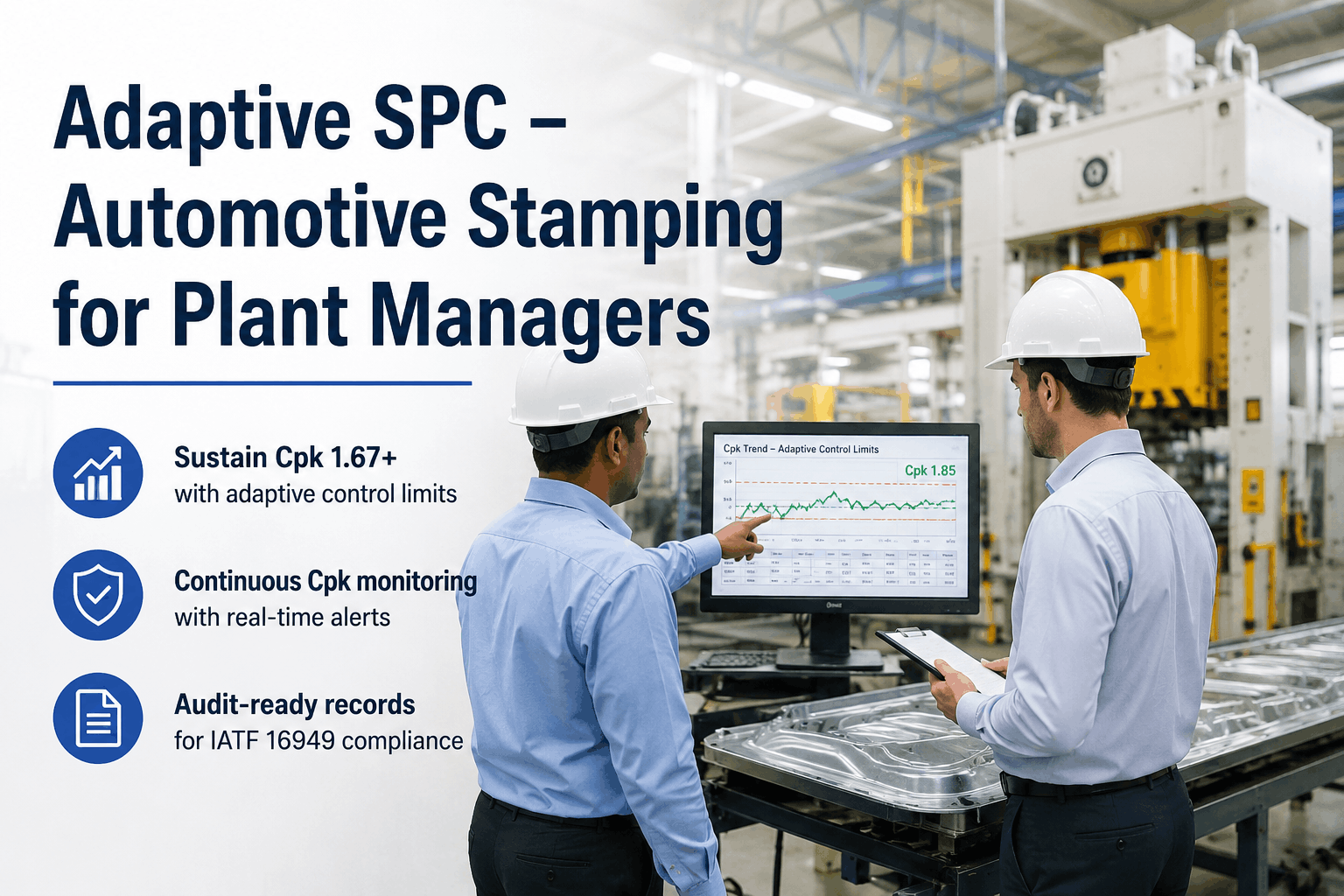
.png)