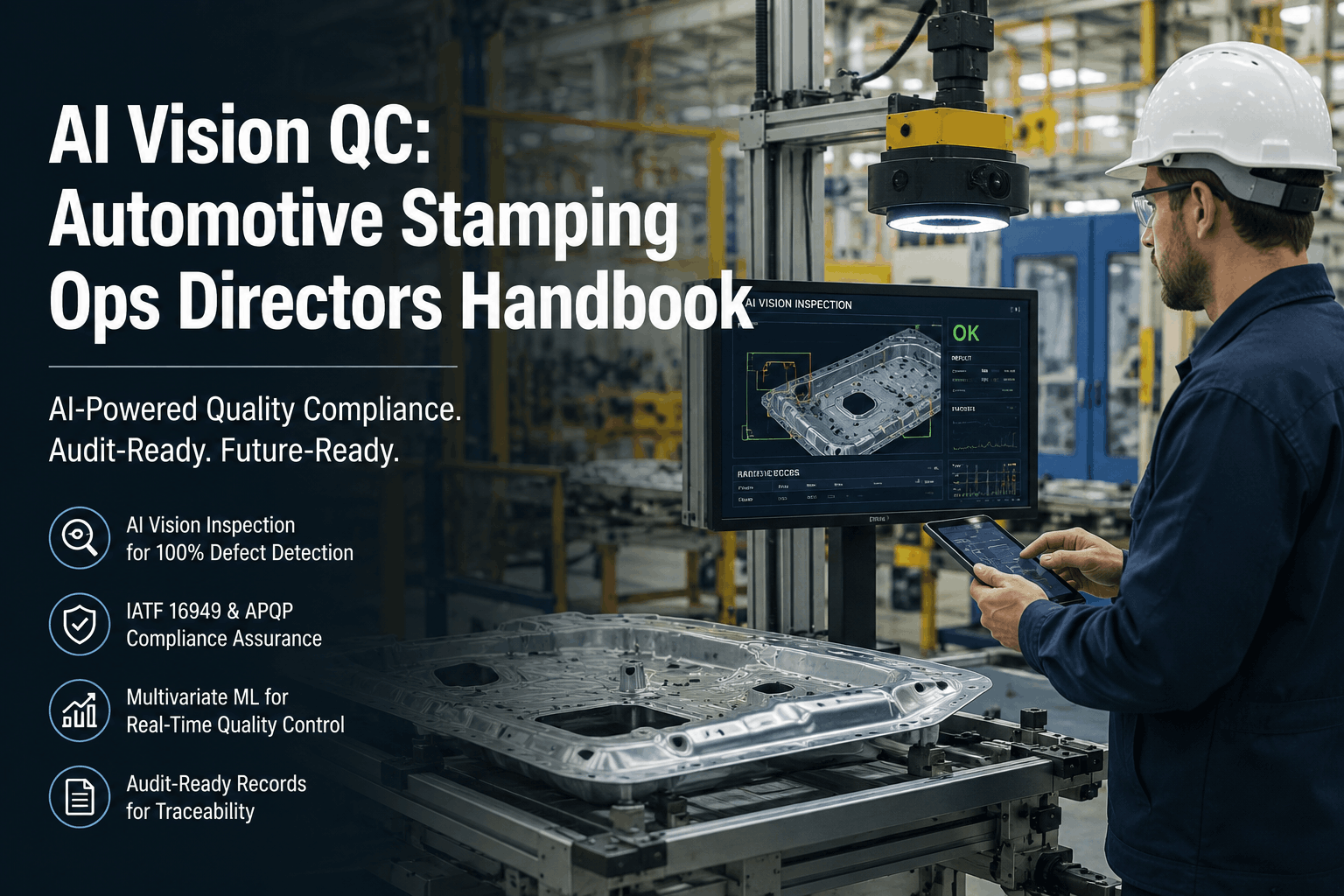
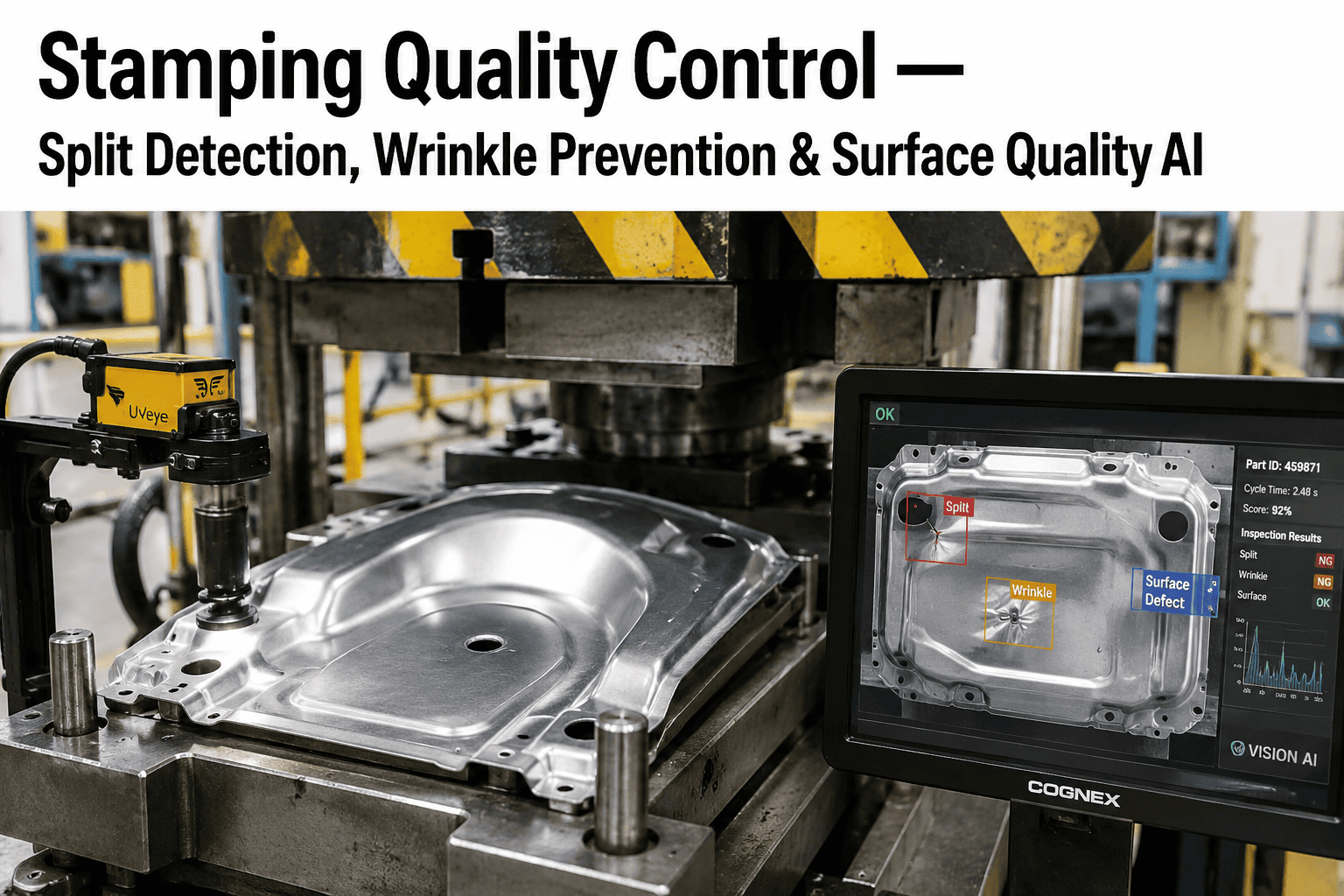
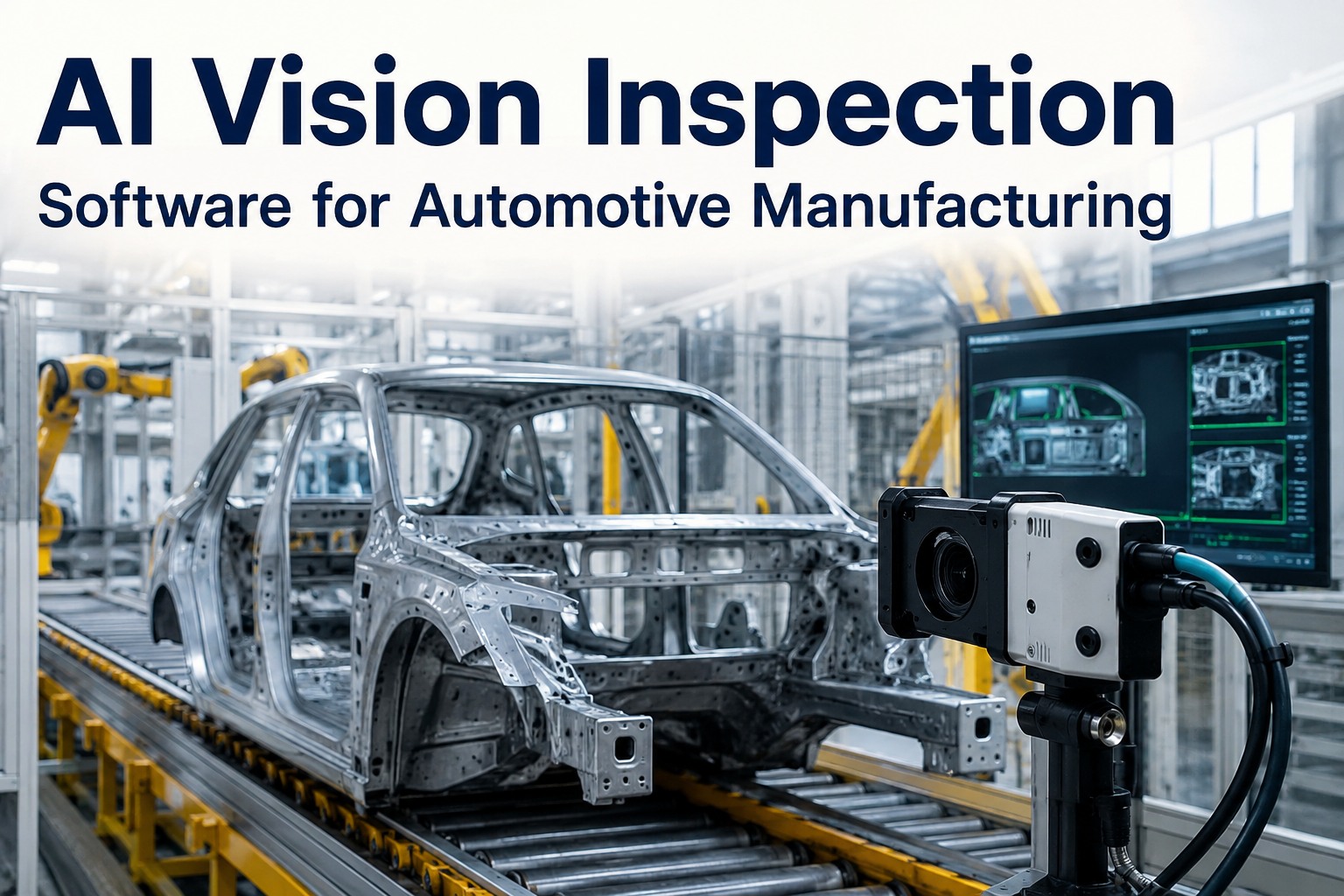
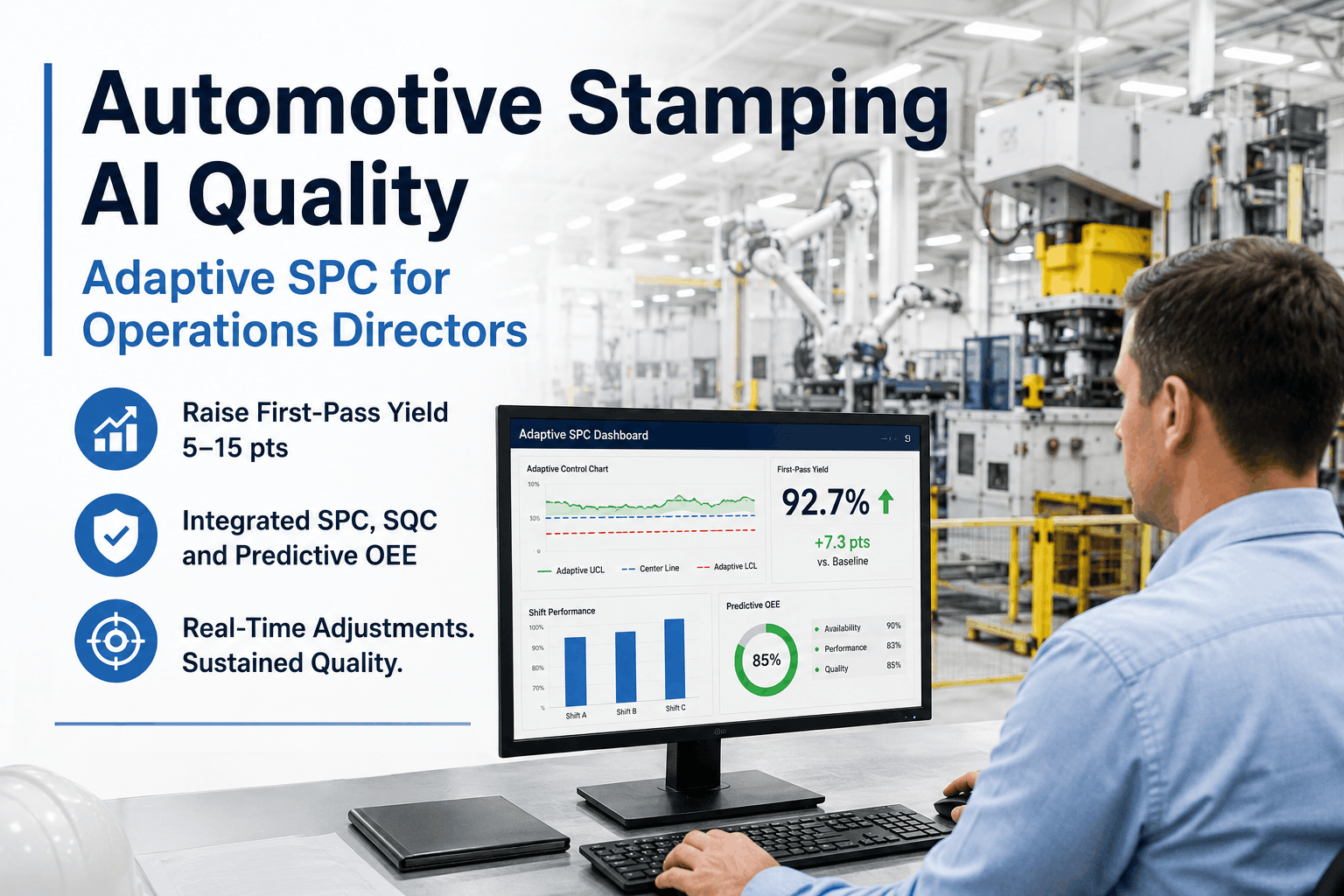
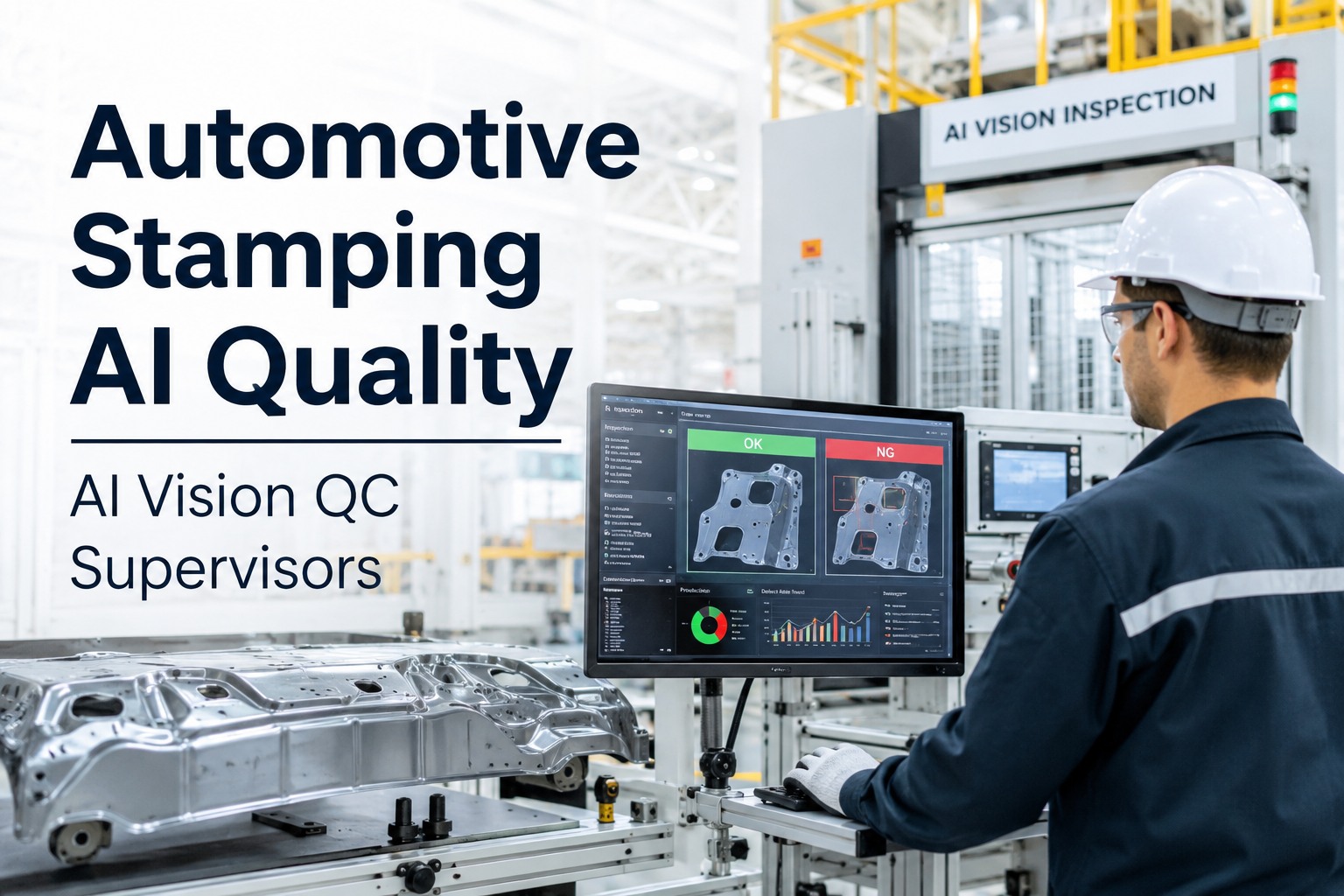
The stamping network in question comprises three plants producing body panels, closure parts, structural components, and chassis elements for five major OEMs — 65 million stamped parts annually across 22 transfer presses. The operations director's problem was not defect detection technology. It was that manual and traditional automated inspection could not scale compliance across three plants: audit preparation consumed 6 weeks per plant per year, APQP for new programmes took 14-18 weeks from die design to PPAP approval, and inconsistent inspection standards across plants created customer quality complaints. The network averaged 12 IATF non-conformances per year across 5 surveillance audits.
The specific decision was to deploy AI Vision Compliance: a standardised AI vision platform across all three plants with multivariate ML defect detection, automated audit trail generation, and APQP integration. It was the right compliance transformation, at the right network scale, for the right business reasons. Talk to iFactory about AI vision compliance deployment architecture for your stamping network.
Network
3 stamping plants, Midwest and Southeast US — 65M parts/year, 22 transfer presses
Annual Volume
65,000,000+ stamped parts across 5 OEM customers
Vision Deployment
22 presses · 66 cameras · 3 plants · Standardised platform
AI Platform
iFactory AI Vision + MES integration + Multivariate ML + Audit automation
Programme Duration
June 2024 (plant 1 pilot) → June 2026 (3-plant full deployment)
Parts Inspected
Door panels · hoods · fenders · liftgates · body sides · chassis structural · reinforcements
Month-by-Month: What Actually Happened in 24 Months of AI Vision Compliance Deployment
June – September 2024
Pilot Deployment — Plant 1, 8 Presses, Multivariate ML Training
The operations director approved a 90-day pilot at the highest-volume plant (22M parts/year, 8 presses). iFactory installed 24 cameras at three inspection points per press. Multivariate ML models were trained on 75,000 labelled images across 31 defect classes — including surface defects, dimensional deviations, and material flaws. The system was integrated with the plant's SAP MES for per-part quality record creation. Baseline compliance metrics established: 12 audit findings in previous IATF cycle, APQP cycle 16 weeks.
Milestone: Pilot live — 99.3% detection accuracy, MES integration complete
October – December 2024
Audit Trail Automation and IATF Readiness Validation
The AI vision system's automated audit trail was validated against IATF 16949 clause 7.5.3 (documented information) and clause 9.1.1.1 (statistical tools). Every inspection generated a tamper-evident digital record with defect classification, inspection timestamp, operator ID, and part image. The plant's quality team conducted a mock IATF audit using the system — completing the SPC and inspection evidence review in 2 hours vs. typical 2 days. The operations director approved expansion to all three plants.
Milestone: Audit automation validated · Mock audit 2-hour completion · Full network approval
January – June 2025
Plants 2 and 3 Deployment — Standardised Compliance Platform
iFactory deployed the standardised AI vision platform across Plants 2 and 3 (14 additional presses, 42 cameras). The multivariate ML models were transferred and calibrated for each plant's specific part families and defect profiles. Centralised compliance dashboards provided real-time inspection status, defect trends, and audit readiness scores across all three plants. The network quality team was retrained on standardised inspection protocols and audit evidence generation.
Milestone: 3 plants live · 22 presses · 66 cameras · Centralised compliance dashboard
July – October 2025
IATF Surveillance Audit — Zero Major Non-Conformances
The network underwent its biennial IATF 16949 surveillance audits across all three plants. The AI vision system provided complete, instant audit trails for every inspection record, every SPC calculation, and every corrective action. The auditor completed the quality management system review for all three plants in 4 days total — historically 2 days per plant. Zero major non-conformances were cited. Four minor findings were addressed within 48 hours using audit trail data. The operations director noted that audit preparation time decreased from 6 weeks per plant to 2 days per plant.
Milestone: Zero major non-conformances · Audit prep 6 weeks → 2 days per plant
November 2025 – March 2026
APQP Integration — New Programme Launch Acceleration
The AI vision platform was integrated with the network's APQP workflow. For a new hood programme launching across all three plants, the system enabled: (1) die design validation using simulated inspection data, (2) PPAP part inspection at 3x normal speed, and (3) automated customer quality portal submission. APQP cycle compressed from 14 weeks (historical average) to 5 weeks. The customer approved PPAP on first submission — the network's first zero-rework PPAP in 8 years.
Milestone: APQP 14 → 5 weeks · Zero-rework PPAP approval
June 2026
24-Month Milestone — Sustained Compliance, APQP Excellence, $3.2M Savings
After 24 months of continuous AI vision compliance operation across all three plants, the network reported: zero major IATF non-conformances across 5 surveillance audits (was 12 per year); APQP cycle reduced from 14 weeks to 5 weeks (64% compression); 48 million parts inspected with complete digital audit trails; defect detection accuracy sustained at 99.5% across all defect classes. Total compliance and APQP cost avoidance reached $3.2 million annually. The network was upgraded to "Self-Certification" status with two OEM customers — reducing their required audit frequency from quarterly to annually.
Milestone: Zero major non-conformances (24 months) · APQP 14 → 5 weeks · $3.2M savings · Self-certification status
KPI Scorecard: What the AI Vision Compliance Pilot Actually Measured
IATF Compliance
0
Major non-conformances (24 months across 3 plants)
12 → 0
Annual non-conformances reduction
6 wks → 2 days
Audit preparation time per plant
Self-certification
Customer audit frequency: quarterly → annually
APQP & Programme Launch
14 → 5 wks
APQP cycle compression (-64%)
0
PPAP rework rounds (first zero-rework in 8 years)
3x
PPAP part inspection speed improvement
Detection & Audit Trail
99.5%
Defect detection accuracy (multivariate ML)
48M
Parts inspected with digital audit trail
$3.2M
Annual compliance + APQP cost avoidance
The 8 Operational Lessons This Operations Director Learned From AI Vision Compliance Deployment
01
Standardise the Platform Across All Plants Before Scaling
The network deployed a standardised AI vision platform across all three plants — same camera specifications, same ML models, same audit trail format. This enabled cross-plant compliance benchmarking and reduced training costs by 60%. Lesson: resist plant-by-plant customisation. Standardisation accelerates scaling and simplifies multi-plant audit management.
Schedule an AI Quality Roadmap Session to discuss platform standardisation.
02
Automated Audit Trails Are Not Optional for Multi-Plant IATF
Manual audit evidence collection across three plants consumed 18 weeks per year. The AI vision system's automated, tamper-evident per-part records eliminated this entirely. Lesson: if your quality system cannot produce an instant, auditable record for any part produced in the last 24 months, you are exposed. Automated audit trails are a compliance necessity, not a convenience feature.
Contact iFactory to discuss audit trail automation for your network.
03
Multivariate ML Detects Defects That Single-Feature Inspection Misses
Traditional vision inspection checks single features. Multivariate ML correlates 30+ feature dimensions simultaneously — detecting subtle interactions that single-feature inspection misses. The network achieved 99.5% detection accuracy (vs. 92% for single-feature systems). Lesson: for stamping compliance, invest in multivariate ML. Surface defects alone are not enough.
04
APQP Integration Delivers Faster Time-to-Revenue Than Defect Detection
The network saved $1.5M annually from APQP compression (14→5 weeks) — more than from defect detection savings. The AI vision system accelerated die design validation, PPAP inspection, and customer submission. Lesson: when building your business case, include APQP acceleration benefits. They often exceed defect reduction savings.
Schedule an AI Quality Roadmap Session to model APQP compression for your programmes.
05
Customer Self-Certification Is the Ultimate Compliance ROI
Two OEM customers upgraded the network to self-certification status, reducing their audit frequency from quarterly to annually. This saved 8 customer audit days per year and improved the network's supplier rating. Lesson: AI vision compliance data is a customer-facing asset. Use it to negotiate reduced customer audit frequency and improved commercial terms.
06
Edge Inference Enables Real-Time Detection, Cloud Enables Multi-Plant Benchmarking
The network used edge nodes for real-time defect detection (sub-100ms) and cloud aggregation for cross-plant compliance benchmarking. Lesson: choose the right deployment model for each use case. Real-time detection requires on-premise edge. Multi-plant analytics require cloud. iFactory provides both.
iFactory delivers this hybrid architecture as standard.
07
Deploy at the Plant With the Worst IATF History First
The operations director chose the plant with 8 major non-conformances in the previous audit cycle for the pilot. This created immediate compliance improvement that justified network rollout. Lesson: your pilot should target your biggest compliance risk, not your best plant. The business case writes itself when you start from audit findings.
08
MES Integration Creates Enterprise Compliance, Not Plant-Level Silos
The AI vision system wrote inspection records to each plant's MES, but the compliance dashboard aggregated across all three MES instances. Lesson: integrate AI vision with MES at each plant, but build a separate compliance layer for enterprise reporting. Plant-level systems should feed a central compliance dashboard that directors can use for multi-plant audit management.
The iFactory Integration Playbook: AI Vision Compliance for Stamping Networks
The technical architecture that made this compliance deployment operationally successful — multivariate ML detection, automated audit trails, APQP integration, edge inference for real-time detection, cloud analytics for multi-plant benchmarking — is exactly what iFactory delivers as a standard programme. Both on-premise edge deployment and cloud-connected analytics are available, designed to meet the data sovereignty and infrastructure requirements of any stamping network.
On-Premise Edge Deployment
For Real-Time Defect Detection at Production Speed
iFactory edge nodes installed alongside each press process all vision data locally. Sub-100ms inference enables immediate defect diversion and real-time audit record creation. No cloud dependency — inspection intelligence continues even during WAN outages. Designed for stamping plants where every part needs an auditable quality record.
Multivariate ML — 99.5% detection accuracy
Automated, tamper-evident per-part audit records
Real-time defect diversion to scrap bin
MES integration for per-part quality records
Zero inspection data leaves the plant
Get Edge Deployment Quote
Cloud Analytics
For Multi-Plant Compliance Benchmarking
iFactory's cloud platform aggregates AI vision compliance data across all your stamping plants — cross-plant IATF readiness scoring, centralised APQP workflow, fleet quality trend analysis, and enterprise customer reporting. For operations directors overseeing multiple facilities, the cloud layer provides the visibility needed to drive compliance excellence across the network.
Cross-plant IATF readiness dashboard
Centralised APQP workflow management
Fleet quality trend analytics
Enterprise customer quality portal
Multi-plant audit evidence repository
Talk to an Operations Expert
FAQ: AI Vision Compliance for Stamping Operations Directors
Schedule Your AI Quality Compliance Roadmap Session
iFactory delivers the AI vision compliance architecture that turned this stamping network's IATF non-conformances from 12 per year to zero — on-premise for real-time defect detection and audit records, cloud for multi-plant compliance benchmarking and APQP management, or both. Schedule a complimentary AI Quality Roadmap Session: we will assess your network's current compliance posture and deliver a phased deployment plan with ROI projections.
On-Premise Edge
Cloud Analytics
MES Integration
Multivariate ML
99.5% Detection
Zero Non-Conformances
APQP 14→5 Weeks