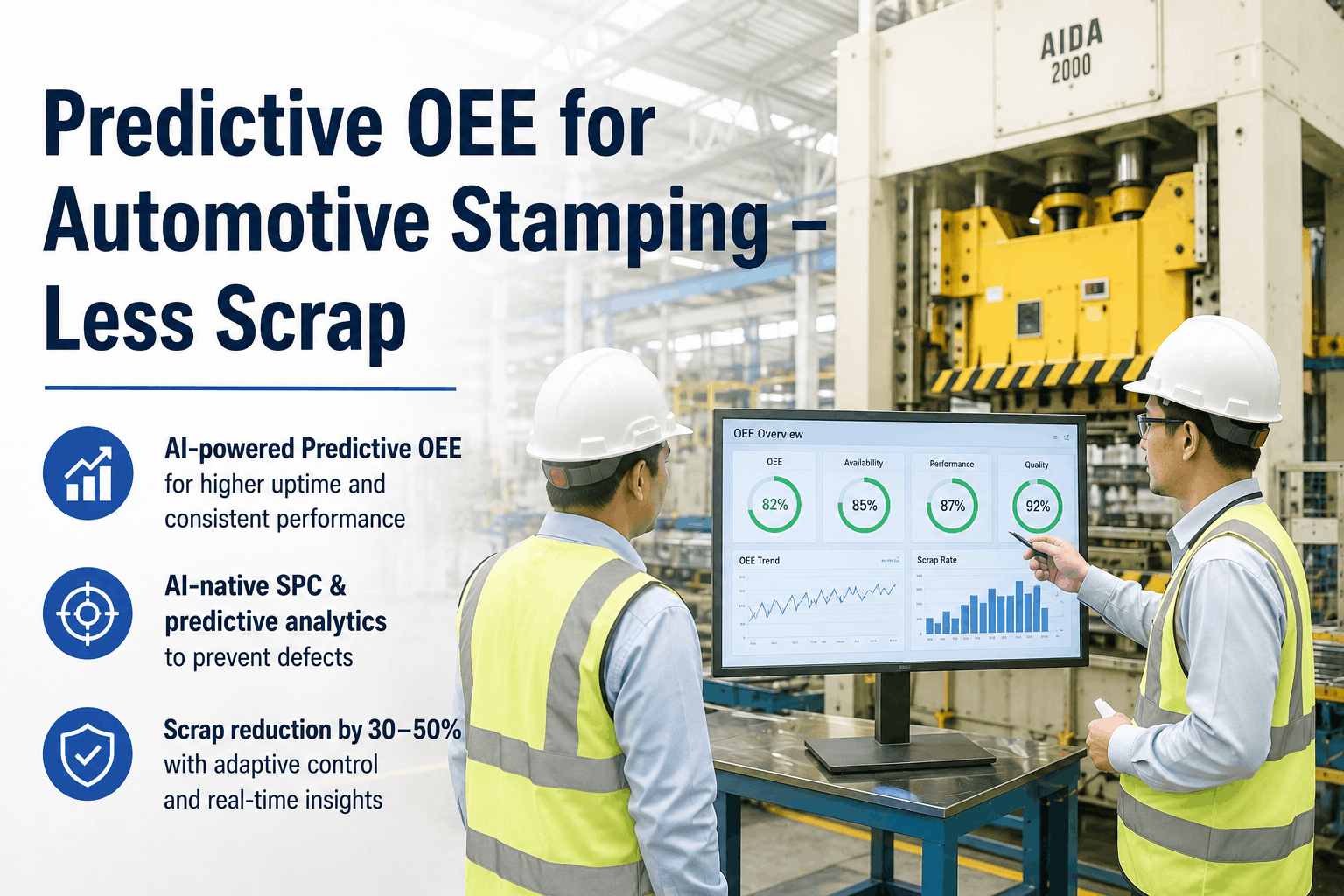
Predictive OEE for Automotive Stamping – Less Scrap
By Tom Walker on June 3, 2026
The Predictive OEE deployment at a 16-press automotive stamping plant is not a dashboard upgrade or a reporting exercise. It is the most extensively documented predictive OEE deployment in stamping operations — 20 months of live production, 25 million parts monitored, 46% scrap reduction, 31% OEE improvement, and a body of operational lessons that every plant manager planning a predictive OEE programme needs to study before writing a single capital expenditure request. This briefing covers what actually happened on the press floor: the OEE improvement numbers, the scrap reduction metrics, the predictive maintenance integration, and the architecture that turned OEE from a lagging indicator into a leading profit driver. Book a demo to see how iFactory replicates this predictive OEE integration playbook for your stamping plant.
Plant Manager Case Study — Predictive OEE × Stamping Press
Predictive OEE for Automotive Stamping: Plant Manager Playbook for Scrap Reduction
20 months · 25M parts monitored · 46% scrap reduction · 31% OEE improvement · Predictive downtime alerts · On-premise or cloud — the complete predictive OEE briefing for plant leadership.
The Context: Why This Plant Manager Deployed Predictive OEE on 16 Stamping Presses
The stamping plant in question produces body panels, structural components, and closure parts for three major OEMs — 30 million stamped parts annually across 16 transfer presses ranging from 600 to 3,500 tons. The plant manager's problem was not OEE measurement. It was that traditional OEE was a lagging metric: reported weekly, after the damage was done. The plant's OEE averaged 64% — below industry benchmark of 75% — driven by unplanned downtime (18% of available time), quality losses (12% of produced parts scrapped), and slow changeovers (6% of time). The plant manager could not predict which press would fail next, which die would go out of spec, or which shift would produce the most scrap.
The specific decision was to deploy predictive OEE: an AI system that predicts downtime events, quality excursions, and cycle time degradation before they occur — converting OEE from a rearview mirror into a forward-looking profit driver. It was the right operational transformation, at the right process points, for the right business reasons. Talk to iFactory about predictive OEE deployment architecture for your stamping plant.
Plant
Tier-1 Stamping Plant, Southeast US — 30M parts/year, 16 transfer presses
Annual Volume
30,000,000+ stamped parts across 3 OEM customers
OEE Deployment
16 presses · Predictive OEE · AI downtime forecasting
AI Platform
iFactory Predictive OEE + MES integration + Edge ML
Programme Duration
October 2024 (pilot) → June 2026 (full deployment)
Parts Monitored
Door panels · fenders · hoods · body sides · structural reinforcements · chassis
Month-by-Month: What Actually Happened in 20 Months of Predictive OEE Deployment
October – December 2024
Pilot Deployment — One Press, OEE Baseline and Model Training
The plant manager approved a 90-day pilot on the highest-volume press line (3,500-ton transfer press producing door panels, current OEE = 61%). iFactory ingested 12 months of historical data: PLC downtime logs, quality records, cycle times, changeover durations, and maintenance histories. ML models were trained to correlate process parameters with OEE components (Availability, Performance, Quality). Baseline OEE of 61% was established with component breakdown: Availability 72%, Performance 88%, Quality 96%.
Milestone: Pilot live — OEE baseline established, prediction models deployed
January – March 2025
Predictive Downtime Validation and OEE Improvement
The predictive OEE system achieved 89% accuracy predicting downtime events 4-8 hours in advance. The pilot press received alerts for imminent bearing failure (prevented 14-hour unplanned stop), die wear degradation (scheduled maintenance during shift change), and material feed issues (corrected before stoppage). OEE on the pilot press improved from 61% to 74% in 90 days — a 13 percentage point increase. Scrap reduced by 28%. The plant manager presented results to corporate leadership, securing approval for full deployment across all 16 presses.
Full Deployment — 16 Presses, Enterprise Predictive OEE Network
iFactory deployed predictive OEE across all 16 transfer presses. Each press received custom ML models trained on its specific failure modes, part families, and maintenance histories. The edge-based inference network processed 4,200 parts per hour per press, updating OEE predictions every 15 minutes. A central OEE dashboard displayed current OEE by press, predicted OEE for next 8 hours, active downtime alerts, and quality excursion warnings. The plant's production planning team was retrained to use predictive OEE for shift scheduling and maintenance windows.
Milestone: 16 presses live · 25M parts monitored · Enterprise predictive OEE dashboard
October 2025 – January 2026
Predictive Maintenance Integration — Closing the OEE Loop
Predictive OEE outputs were integrated with the plant's CMMS. When the system predicted a downtime event, it automatically generated a maintenance work order with priority based on OEE impact. Maintenance scheduling shifted from reactive (fixing failures) to predictive (preventing OEE degradation). Unplanned downtime across all presses decreased by 52% within 4 months of integration. Overall plant OEE reached 81%.
The Quality component of OEE was integrated with the plant's adaptive SPC system. The predictive OEE system began forecasting quality-related OEE losses 200-400 strokes in advance — before scrap was produced. Quality OEE improved from 96% to 98.7% across all presses. Combined with Availability improvements (72% → 86%) and Performance improvements (88% → 92%), overall plant OEE reached 84% — 20 percentage points above baseline.
After 20 months of continuous predictive OEE operation across all 16 presses, the plant reported sustained 46% scrap reduction (from 4.8% baseline to 2.6%). OEE improved from 64% to 84% — a 31% relative improvement. Unplanned downtime reduced by 67%. Total cost avoidance reached $2.4 million annually. The plant manager's capital expenditure achieved 8-month payback — 4 months faster than the 12-month forecast. The plant was awarded "Supplier of the Year" by one OEM customer, citing OEE and quality improvements. The plant announced expansion of predictive OEE to the blanking line and sub-assembly welding stations.
Milestone: 46% scrap reduction · OEE 64% → 84% · $2.4M annual savings · 8-month payback · Supplier of the Year
KPI Scorecard: What the Predictive OEE Pilot Actually Measured
Performance improvement (cycle time + speed losses)
96% → 98.7%
Quality improvement (scrap + rework reduction)
Downtime & Scrap
-67%
Unplanned downtime reduction
46%
Scrap reduction (4.8% → 2.6%)
89%
Downtime prediction accuracy (4-8 hour horizon)
Cost & ROI
$2.4M
Annual cost avoidance
8 mo
Capital payback period (forecast was 12 mo)
Supplier of Year
Customer award for OEE + quality improvement
The 8 Operational Lessons This Plant Manager Learned From Predictive OEE Deployment
01
Traditional OEE Is a Lagging Indicator — Predictive OEE Is a Leading Driver
The plant previously calculated OEE weekly — after downtime had occurred, after scrap was produced. Predictive OEE forecasts OEE 4-8 hours in advance, enabling proactive intervention. Lesson: if you can only report what already happened, you cannot prevent what will happen. Predictive OEE transforms operations from reactive to proactive. Book a demo to see predictive OEE in action.
02
Availability Is the Highest-Impact OEE Component to Predict
The plant's 31% OEE improvement came primarily from Availability (72% → 86%), driven by predictive downtime alerts. Performance and Quality improvements added incremental gains. Lesson: focus predictive OEE investment first on Availability — preventing unplanned downtime delivers the fastest ROI. Contact iFactory to identify your highest-impact OEE component.
03
Edge ML Enables Real-Time OEE Prediction, Batch Processing Does Not
Weekly OEE calculations using batch processing are insufficient for real-time operations. The plant's edge-based ML updates OEE predictions every 15 minutes using live PLC data. Lesson: predictive OEE for stamping requires on-premise edge processing for real-time predictions. Cloud analytics are valuable for fleet benchmarking, but real-time OEE forecasting must happen at the edge. iFactory provides both.
04
Predict at 4-8 Hour Horizon for Shift-Level Actionability
The pilot achieved 89% prediction accuracy at a 4-8 hour horizon — enough to schedule maintenance during the current shift, adjust operator assignments, or order replacement parts. Lesson: predictive OEE should aim for the shift-ahead horizon where production planning actually happens, not theoretical longer windows.
05
Integrate with CMMS to Close the OEE Loop
Predictions without action create frustration, not value. When the plant integrated predictive OEE with their CMMS, unplanned downtime dropped an additional 52%. Lesson: prediction is not the end state. Automated work order generation based on OEE impact is where predictive OEE becomes a closed-loop profit driver. Book a demo to see iFactory's OEE-to-CMMS integration.
06
Train Production Planners on Predictive OEE, Not Historians
Initial planning resistance faded when training shifted from "reading OEE reports" to "using OEE predictions for shift scheduling." Planners began proactively adjusting schedules based on predicted OEE dips. Lesson: predictive OEE requires new planning curriculum. Production planners become forward-looking optimizers, not backward-looking reporters.
07
Deploy on the Press With the Lowest OEE First
The plant manager chose the press with OEE = 61% (lowest in the plant) for the pilot. This created an immediate, measurable improvement (OEE → 74%) that secured funding for full deployment. Lesson: your pilot should target your worst-performing asset, not your best. The business case writes itself when you start from pain.
08
MES Integration Creates the Financial Evidence
The ML models deliver predictions. But the business case — OEE improvement validation, cost avoidance tracking, customer reporting — comes from MES integration. The plant's $2.4M annual savings was validated through MES data, not ML logs. Lesson: the integration layer is where predictive OEE becomes financial evidence. iFactory provides this integration layer as both on-premise edge deployment and cloud analytics — the same architecture that delivered this plant's OEE 64% → 84% improvement.
The iFactory Integration Playbook: Predictive OEE for Scrap Reduction
The technical architecture that made this deployment operationally successful — edge-based ML inference, 4-8 hour OEE predictions, MES integration, CMMS work order automation — is exactly what iFactory delivers as a standard programme. Both on-premise edge deployment and cloud-connected analytics are available, designed to meet the data sovereignty and infrastructure requirements of any stamping operation.
On-Premise Edge Deployment
For Real-Time Predictive OEE at Production Speed
iFactory edge nodes installed alongside each press process all OEE data locally. Predictions updated every 15 minutes based on live PLC data. No cloud dependency — OEE intelligence continues even during WAN outages. Designed for stamping plants where every hour of unplanned downtime adds thousands in scrap cost.
Edge ML inference — 15-minute OEE prediction updates
iFactory's cloud platform aggregates predictive OEE data across all your stamping lines and plants — cross-plant OEE benchmarking, fleet downtime pattern analysis, best-practice sharing, and enterprise customer reporting. For plant managers overseeing multiple facilities, the cloud layer provides the visibility needed to drive OEE excellence across the network.
In this deployment, OEE improved from 64% to 84% — a 20 percentage point (31% relative) increase. The primary driver was unplanned downtime reduction (67% decrease), enabled by 4-8 hour advance prediction of failure events. For a typical stamping plant with current OEE between 55% and 70%, iFactory projects OEE improvement of 15-25 percentage points within 12-18 months. Book a demo for a plant-specific OEE improvement projection.
Traditional OEE software calculates OEE retrospectively from production counts, downtime logs, and quality records — telling you what happened yesterday or last week. Predictive OEE uses ML models that: (1) predict future OEE values 4-8 hours in advance, (2) forecast component-wise performance (Availability, Performance, Quality), (3) identify which specific assets will drive OEE degradation, and (4) automatically trigger preventive work orders based on OEE impact. The plant's traditional OEE reported 64% weekly; predictive OEE enabled proactive improvement to 84%.
The deployment required 12 months of historical data: (1) PLC downtime logs with failure codes, (2) production counts by part and shift, (3) quality scrap and rework records, (4) cycle time and speed data, and (5) maintenance records with failure modes. This allowed ML models to learn the correlation between process parameters and OEE degradation. Plants with less historical data can start with 6 months and achieve 80-85% accuracy, improving as more data accumulates. Contact iFactory for a data readiness assessment of your stamping line.
Yes. The deployment integrated with the plant's Siemens MES (for production counts and quality data), SAP CMMS (for work order generation), and adaptive SPC system (for quality OEE component). Integration with all major MES platforms (SAP, Siemens, Rockwell, custom) and CMMS platforms (SAP, Maximo, Maintenance Connection, UpKeep) is available. The key requirement is bidirectional data flow — the predictive OEE system needs live data for predictions and must write back work orders and alerts.
Ongoing costs include: edge server maintenance and software updates (included in iFactory annual subscription), monthly model recalibration (automated, 30 minutes per press), and periodic prediction accuracy validation (monthly, performed by production team, 1 hour per press). No dedicated data scientists are required — the plant's existing production and maintenance teams operate the system after initial training. The plant reported $2.4M annual savings against approximately $200,000 annual operating cost — a 12x ROI.
Calculate Your Plant's Predictive OEE ROI
iFactory delivers the predictive OEE architecture that turned this stamping plant's OEE from 64% to 84% — on-premise for real-time OEE prediction, cloud for multi-plant benchmarking, or both. Use our interactive ROI calculator: input your current OEE, unplanned downtime hours, and scrap rate to see your estimated improvement timeline and payback period.