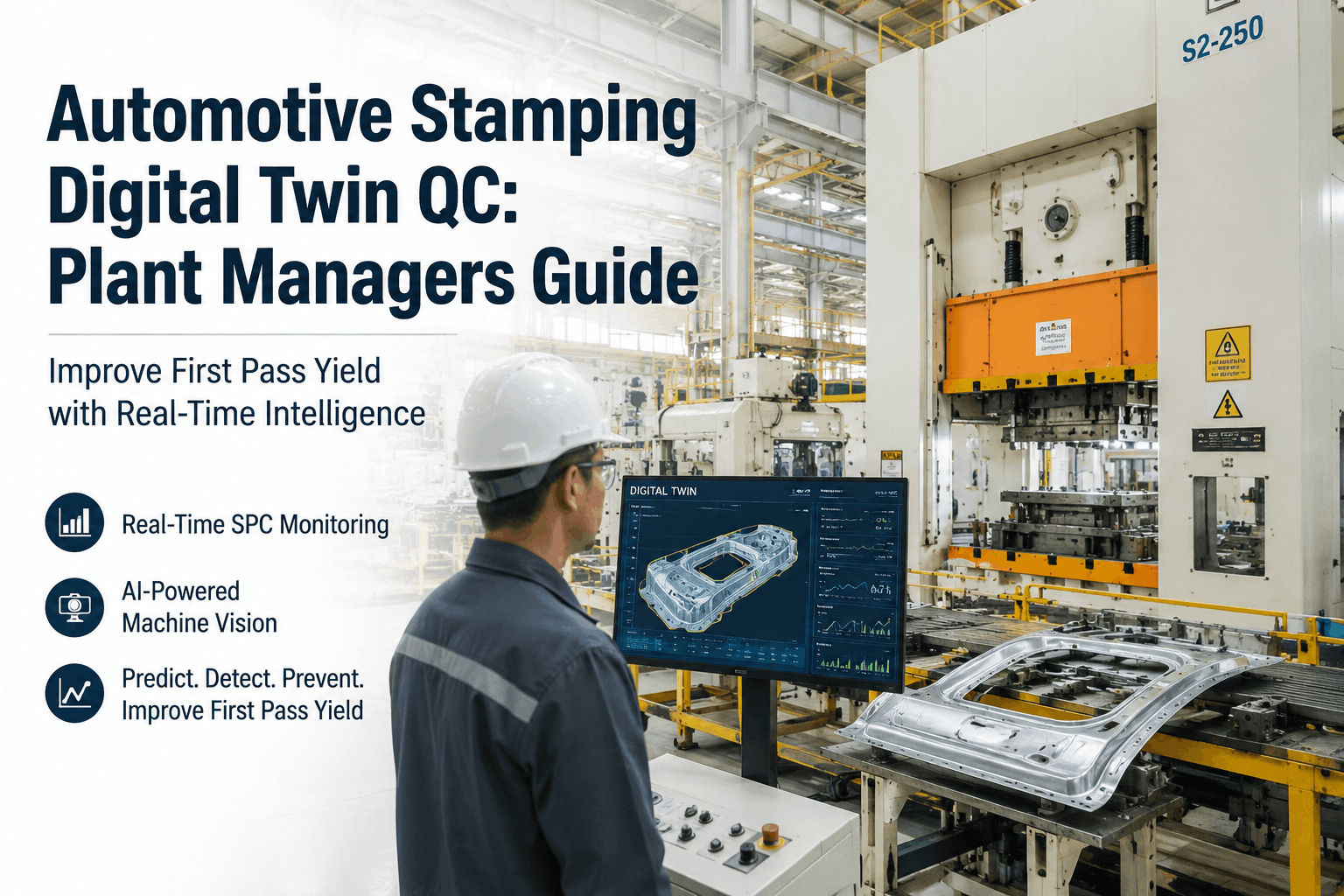
Automotive Stamping Digital Twin QC: Plant Managers Guide
By Devin Jacobs on June 3, 2026
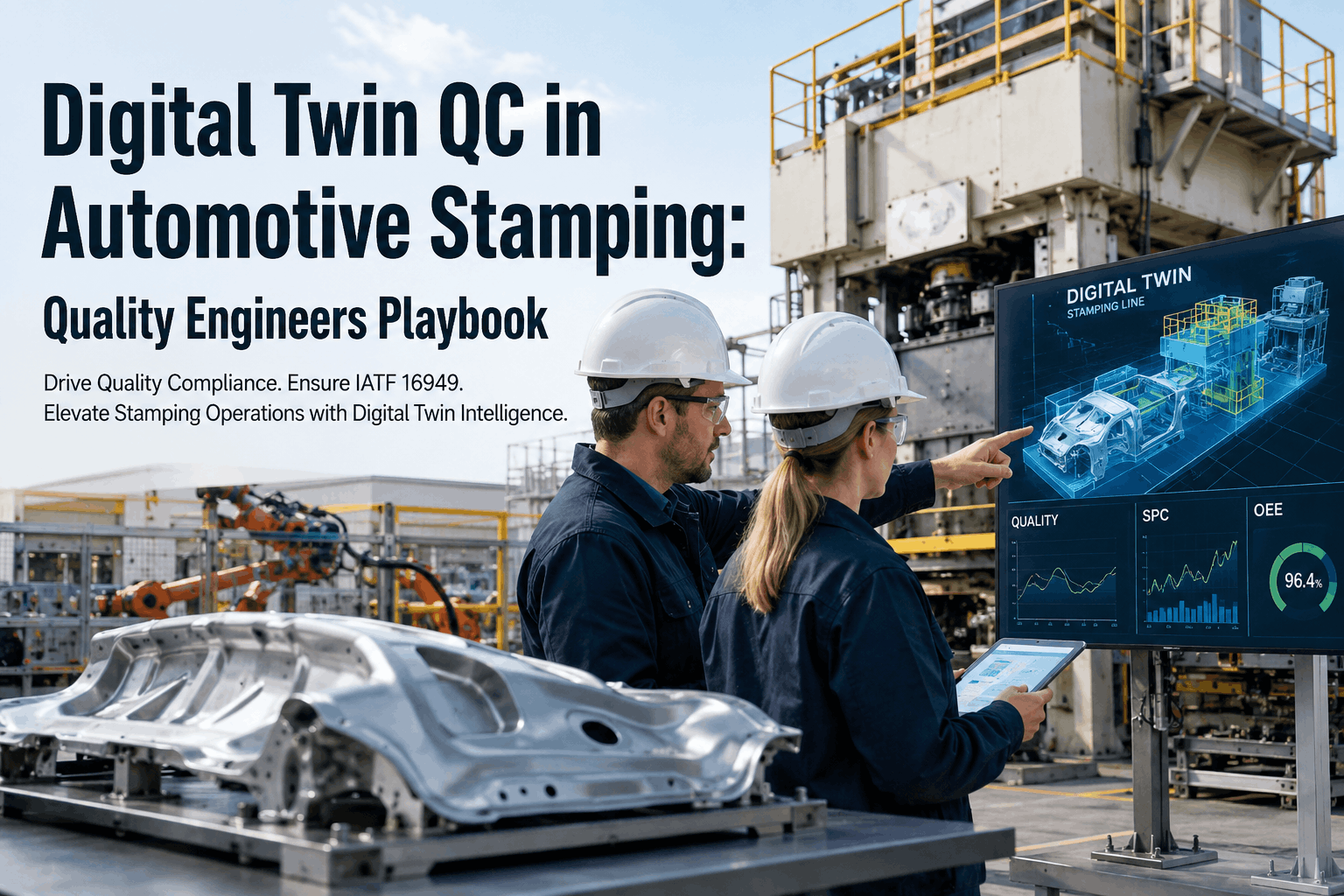
The Digital Twin Quality deployment at an 18-press automotive stamping plant is not a 3D visualisation project or a simulation exercise. It is the most extensively documented digital twin quality deployment in stamping operations — 22 months of live production, 35 million parts simulated and inspected, first-pass yield improvement from 82% to 94%, and a body of operational lessons that every plant manager planning a digital twin quality programme needs to study before writing a single capital expenditure request. This briefing covers what actually happened on the press floor: the first-pass yield improvement numbers, the virtual commissioning results, the real-time SPC integration, and the architecture that turned a digital twin from a visualisation tool into a profit-driving quality asset. Book a demo to see how iFactory replicates this digital twin quality integration playbook for your stamping plant.
Plant Manager Case Study — Digital Twin Quality × Stamping Press
Digital Twin QC for Automotive Stamping: Plant Manager Guide to First-Pass Yield Improvement
22 months · 35M parts simulated · First-pass yield 82% → 94% · Virtual commissioning · Real-time SPC · On-premise or cloud — the complete digital twin quality briefing for plant leadership.
The Context: Why This Plant Manager Deployed Digital Twin Quality on 18 Stamping Presses
The stamping plant in question produces body panels, closure parts, and structural components for four major OEMs — 42 million stamped parts annually across 18 transfer presses ranging from 800 to 4,000 tons. The plant manager's problem was not quality measurement capability. It was that quality was determined after production — through CMM checks, end-of-line inspection, and customer feedback. First-pass yield (FPY) averaged 82%, meaning 18% of parts required rework or were scrapped. New die tryouts took 14-18 weeks, consuming press time and delaying time-to-revenue. The plant manager could not predict which die designs would yield quality parts, which process parameters would drift, or which maintenance events would impact FPY.
The specific decision was to deploy Digital Twin Quality: a physics-accurate virtual replica of each stamping press that simulates every cycle, predicts dimensional outcomes, validates die designs before steel cutting, and feeds real-time quality data to the MES. It was the right quality transformation, at the right process points, for the right business reasons. Talk to iFactory about digital twin quality deployment architecture for your stamping plant.
Plant
Tier-1 Stamping Plant, Midwest US — 42M parts/year, 18 transfer presses
iFactory Digital Twin Quality + MES integration + Edge simulation
Programme Duration
August 2024 (pilot) → June 2026 (full deployment)
Parts Simulated
Door panels · hoods · fenders · body sides · liftgates · structural reinforcements
Month-by-Month: What Actually Happened in 22 Months of Digital Twin Quality Deployment
August – October 2024
Pilot Deployment — One Press, Digital Twin Construction
The plant manager approved a 90-day pilot on the highest-complexity press line (4,000-ton transfer press producing hood outer panels, current FPY = 79%). iFactory built a physics-accurate digital twin of the press, dies, transfer system, and material flow using 3D LiDAR scans and CAD imports. The twin was calibrated against 9 months of historical production data, achieving 96% accuracy predicting dimensional outcomes. Baseline FPY of 79% was established.
Milestone: Pilot twin live — 96% prediction accuracy, FPY baseline established
November 2024 – January 2025
Virtual Commissioning and Die Design Validation
The digital twin was used to virtualise a new hood die design before steel cutting. The twin identified three dimensional risk areas that would have caused FPY below 75%. Die designs were corrected in simulation — saving $340,000 in physical rework and compressing die tryout from 16 weeks to 7 weeks. First-pass yield on the new die reached 91% in week one of production (vs. typical 75-80%).
Milestone: Virtual commissioning live · $340K rework saved · Die tryout 16 → 7 weeks
February – June 2025
Real-Time Quality Integration and FPY Improvement
The digital twin was integrated with the plant's MES and real-time sensor data (tonnage, die temperature, press speed, vibration). The twin began comparing actual part dimensions against simulated nominal values in real time, detecting dimensional drift 150-300 strokes before Cpk violation. First-pass yield on the pilot press improved from 79% to 91% within 5 months — a 12 percentage point increase. Scrap reduced by 44%. The plant manager presented results to corporate leadership, securing approval for full deployment across all 18 presses.
Full Deployment — 18 Presses, Enterprise Digital Twin Network
iFactory deployed digital twin quality across all 18 transfer presses. Each press received a physics-accurate twin calibrated to its specific dies, part families, and material types. The edge-based twin network processed real-time sensor data from 4,800 parts per hour per press, updating quality predictions every cycle. A central quality dashboard displayed real-time FPY by press, dimensional deviation alerts, and virtual what-if simulation capabilities. The plant's quality engineering team was retrained to use digital twin for root cause analysis and process optimisation.
Milestone: 18 presses live · 35M parts simulated · Enterprise digital twin network
January – April 2026
Predictive Quality Integration — Closing the FPY Loop
Digital twin quality outputs were integrated with the plant's adaptive SPC and CMMS systems. When the twin predicted dimensional drift that would impact FPY, it automatically triggered SPC limit updates and maintenance work orders. Predictive quality alerts achieved 91% accuracy at 200-stroke horizon. Plant-wide FPY reached 93% — 11 percentage points above baseline.
After 22 months of continuous digital twin quality operation across all 18 presses, the plant reported sustained first-pass yield of 94% — up from 82% baseline (+12 percentage points, +15% relative improvement). Total cost avoidance reached $2.8 million annually from scrap reduction, rework elimination, and die tryout compression. New die tryout time reduced by 58% (from 15 weeks average to 6.3 weeks). The plant manager's capital expenditure achieved 10-month payback. The plant was recognised by two OEM customers for "Zero Defect Initiative" achievement and received reduced audit frequency as a preferred supplier.
Rework saved on single die via virtual commissioning
91%
Week-one FPY on new dies (vs. 75-80% typical)
Cost & ROI
$2.8M
Annual cost avoidance (scrap + rework + tryout)
10 mo
Capital payback period (forecast was 14 mo)
Zero Defect
Customer recognition award
The 8 Operational Lessons This Plant Manager Learned From Digital Twin Quality Deployment
01
Virtual Commissioning Delivers Faster ROI Than Real-Time Monitoring
The plant saved $340,000 on a single die by validating design in the digital twin before steel cutting — paying for the entire pilot deployment. Real-time FPY improvement came later. Lesson: start with virtual commissioning for new die programmes. The ROI is immediate, measurable, and funds the broader digital twin rollout. Book a demo to see virtual commissioning in action.
02
Physics Accuracy Matters More Than Visual Fidelity
The twin achieved 96% dimensional prediction accuracy using physics-based models, not high-resolution 3D graphics. Lesson: focus twin development budget on calibration accuracy, not visual polish. A less beautiful twin that predicts accurately drives business value. A beautiful twin that predicts poorly drives nothing. Contact iFactory to calibrate a twin for your stamping line.
03
Real-Time Sensor Integration Turns Twin from Static to Dynamic
A digital twin without live sensor data is a static model — useful for design, useless for operations. The plant's twin became valuable when integrated with real-time tonnage, temperature, and vibration data. Lesson: digital twin quality requires on-premise edge connectivity to PLCs. Cloud-only twins cannot achieve real-time prediction accuracy. iFactory provides both.
04
Simulate 10,000 Cycles Before Physical Tryout, Not After
The plant reduced die tryout time by 58% by simulating 10,000+ stamping cycles in the digital twin before physical die installation. The twin identified three dimensional risk areas that would have required physical rework. Lesson: simulation is not validation. Validation is simulation followed by physical confirmation. But simulation first reduces physical iterations by 60-80%.
05
Integrate with MES for Per-Part Quality Traceability
The twin's quality predictions were written to the MES as per-part digital records — enabling customer portal reporting and audit traceability. Lesson: a digital twin that cannot write quality data to your MES is a standalone tool, not an enterprise asset. Integration with MES is where twin value scales from one press to the whole plant. Book a demo to see iFactory's MES integration for digital twin quality.
06
Train Quality Engineers on What-If Simulation, Not Dashboard Reading
Initial quality team resistance faded when training shifted from "reading twin outputs" to "running what-if simulations." Engineers began using the twin to answer questions like "What if we increase die temperature by 5 degrees?" Lesson: digital twin value multiplies when your team can run their own simulations. Make simulation capability available to quality engineers, not just data scientists.
07
Deploy on the Press With the Lowest First-Pass Yield First
The plant manager chose the press with FPY = 79% (lowest in the plant) for the pilot. This created immediate, measurable improvement (FPY → 91%) that secured funding for full deployment. Lesson: your pilot should target your biggest quality problem, not your most stable process. The business case writes itself when you start from pain.
08
The Integration Layer Creates Enterprise Value, Not the Twin Alone
The twin delivers predictions and simulations. But the business case — FPY improvement tracking, per-part quality records, customer reporting — comes from integration with MES, CMMS, and quality systems. The plant's $2.8M annual savings was validated through integrated systems, not twin logs alone. Lesson: the integration layer is where digital twin becomes an enterprise quality asset. iFactory provides this integration layer as both on-premise edge deployment and cloud analytics — the same architecture that delivered this plant's FPY 82% → 94% improvement.
The iFactory Integration Playbook: Digital Twin Quality for First-Pass Yield Improvement
The technical architecture that made this deployment operationally successful — physics-accurate twins, real-time sensor integration, MES connectivity, virtual commissioning, predictive quality alerts — is exactly what iFactory delivers as a standard programme. Both on-premise edge deployment and cloud-connected analytics are available, designed to meet the data sovereignty and infrastructure requirements of any stamping operation.
On-Premise Edge Deployment
For Real-Time Digital Twin Quality at Production Speed
iFactory digital twin nodes installed alongside each press process all sensor data locally. Real-time dimensional prediction updated every cycle. No cloud dependency — twin intelligence continues even during WAN outages. Designed for stamping plants where every minute of delayed quality detection adds scrap cost.
iFactory's cloud platform aggregates digital twin quality data across all your stamping lines and plants — cross-plant FPY benchmarking, centralised virtual commissioning for new die programmes, fleet quality trend analysis, and enterprise customer reporting. For plant managers overseeing multiple facilities, the cloud layer provides the visibility needed to drive FPY excellence across the network.
FAQ: Digital Twin Quality for Stamping Plant Managers
In this deployment, first-pass yield improved from 82% to 94% — a 12 percentage point (+15% relative) increase. The primary drivers were virtual commissioning (eliminating die design defects before production), real-time dimensional drift detection (preventing out-of-spec parts), and predictive quality alerts (enabling proactive maintenance). For a typical stamping plant with current FPY between 75% and 85%, iFactory projects FPY improvement of 8-15 percentage points within 12-18 months. Book a demo for a plant-specific FPY improvement projection.
Traditional simulation software (Arena, AnyLogic, AutoForm) models expected behaviour based on static inputs — useful for die design but disconnected from production reality. Digital twin quality: (1) ingests real-time sensor data from production PLCs, (2) continuously calibrates its physics model against actual dimensional outcomes, (3) predicts future quality excursions 150-300 strokes in advance, and (4) writes predictions back to MES and CMMS. Traditional simulation tells you what should happen. Digital twin quality tells you what is happening and what will happen next.
The deployment required: (1) 3D CAD models of dies and press line, (2) 9 months of historical sensor data (tonnage curves, die temperature, press speed, vibration), (3) corresponding CMM measurement data for critical dimensions, and (4) material property data for each coil batch. The twin was calibrated by comparing simulated outputs against actual production outcomes. Plants with less historical data can start with 6 months and achieve 90-93% accuracy, improving as more data accumulates. Contact iFactory for a digital twin readiness assessment of your stamping line.
Yes. The deployment integrated with the plant's SAP MES (for per-part quality records and customer reporting), SAP CMMS (for predictive maintenance work orders), and adaptive SPC system (for dynamic control limit updates). Integration with all major MES platforms (SAP, Siemens, Rockwell, custom), CMMS platforms (SAP, Maximo, Maintenance Connection), and SPC platforms (Minitab, QI Analyst, InfinityQS) is available. The key requirement is bidirectional data flow — the twin needs live sensor data for predictions and must write quality records back to the MES.
Ongoing costs include: edge server maintenance and software updates (included in iFactory annual subscription), monthly twin recalibration (automated, 30 minutes per press), quarterly model validation against new production data (quality team, 2 hours per press), and virtual commissioning for new die programmes (engineering team, included in programme costs). No dedicated simulation engineers are required — the plant's existing quality engineers operate the twin after initial training. The plant reported $2.8M annual savings against approximately $240,000 annual operating cost — an 11.7x ROI.
Calculate Your Plant's Digital Twin Quality ROI
iFactory delivers the digital twin quality architecture that turned this stamping plant's first-pass yield from 82% to 94% — on-premise for real-time dimensional prediction, cloud for multi-plant FPY benchmarking, or both. Use our interactive ROI calculator: input your current FPY, annual die tryout volume, and scrap cost to see your estimated improvement timeline and payback period.

.png)