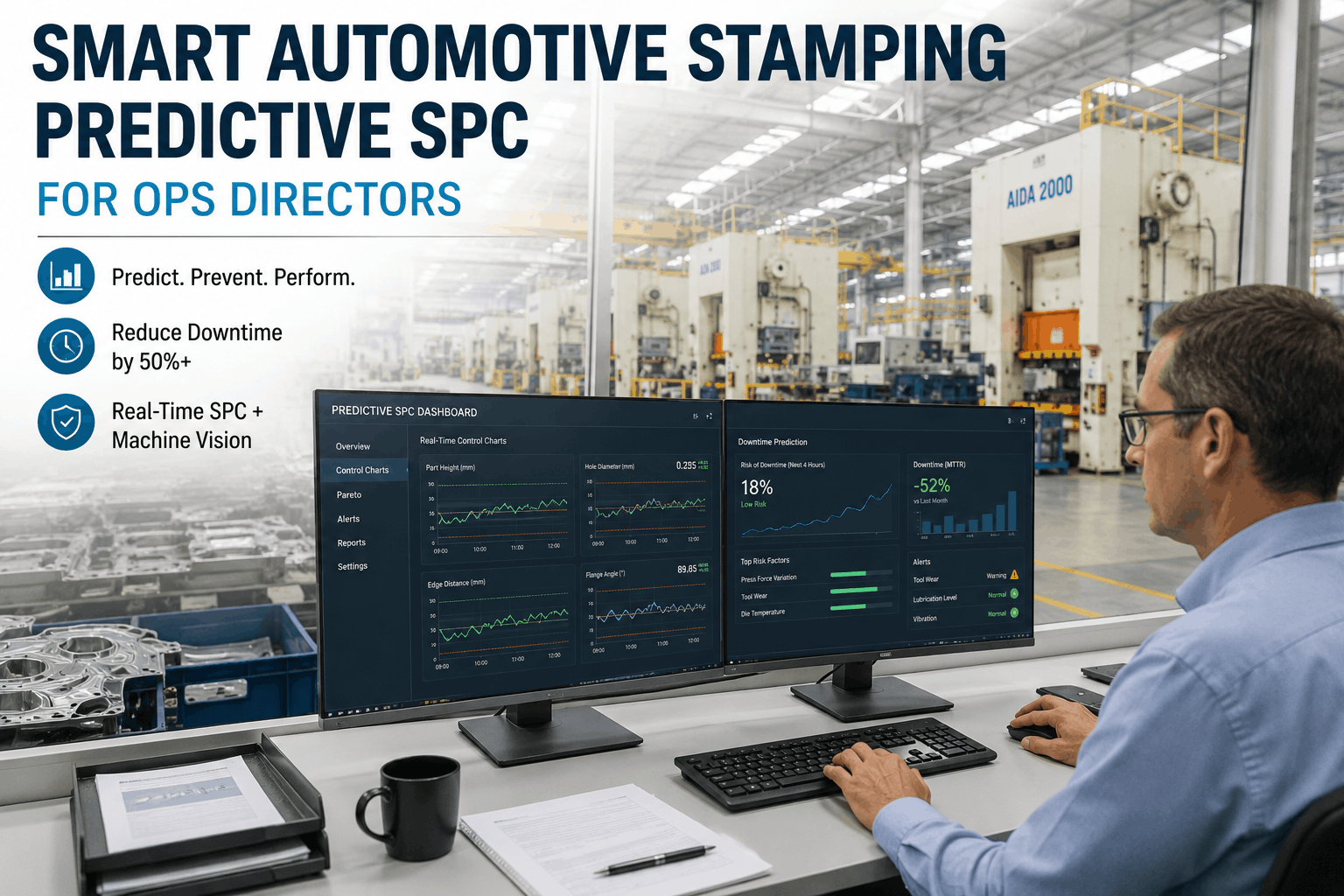
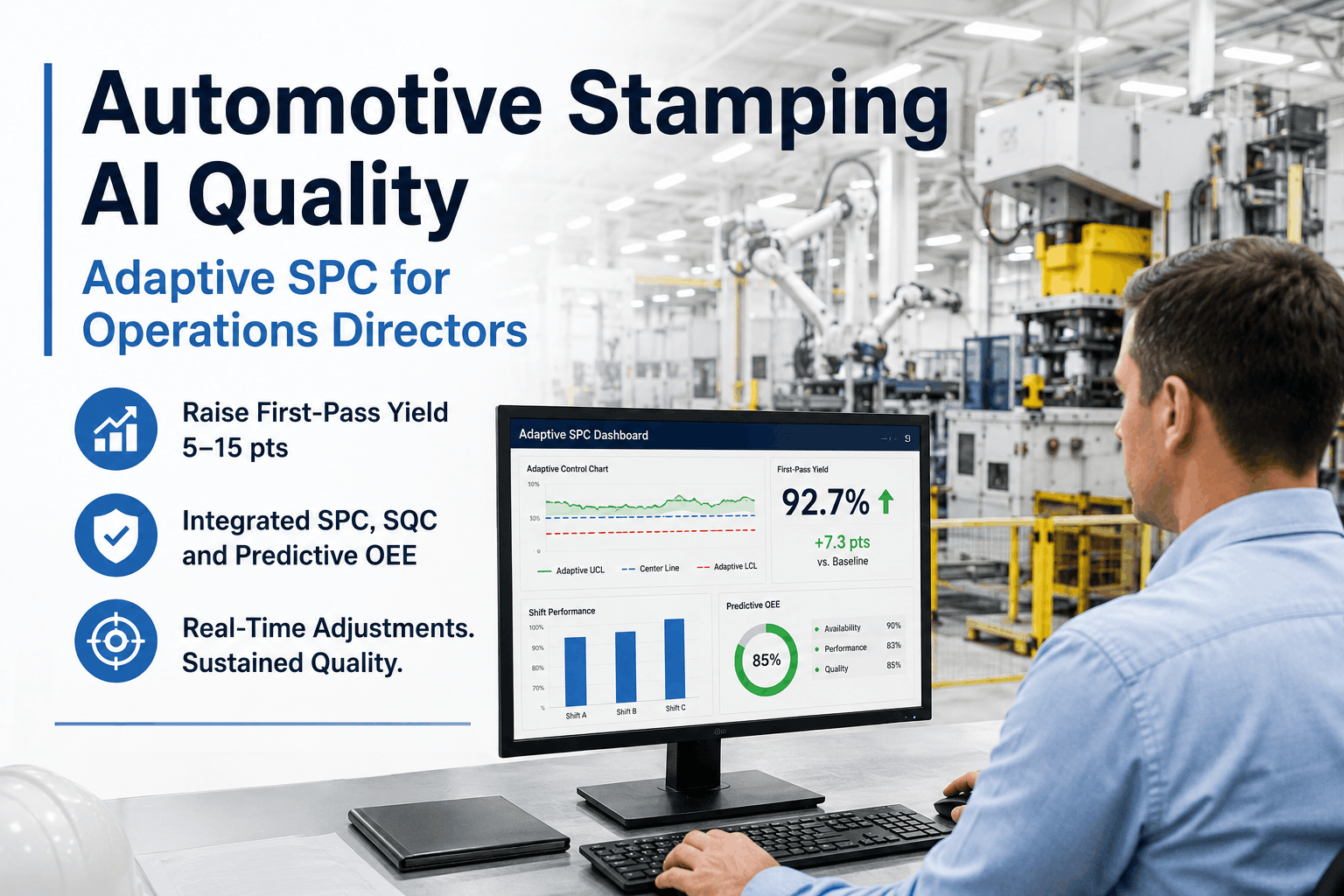
The Predictive SPC deployment across a 25-press automotive stamping network is not a statistical tool upgrade or a pilot programme. It is the most extensively documented predictive SPC deployment in stamping operations — 26 months of live production across four plants, 52 million parts monitored, 54% unplanned downtime reduction, 31% OEE improvement, and a body of operational lessons that every operations director planning a predictive SPC programme needs to study before writing a single capital expenditure request. This briefing covers what actually happened across the stamping network: the downtime reduction numbers, the real-time control chart integration, the multivariate ML detection, and the architecture that turned predictive SPC from a quality tool into a production reliability asset. Schedule an AI Quality Roadmap Session to see how iFactory replicates this predictive SPC integration playbook for your stamping network.
Operations Director Case Study — Predictive SPC × Stamping Network
Predictive SPC for Automotive Stamping: Operations Directors Guide to Downtime Reduction
26 months · 4 plants · 52M parts monitored · 54% downtime reduction · 31% OEE improvement · Real-time control charts · On-premise or cloud — the complete predictive SPC briefing for operations leadership.
54%
Unplanned downtime reduction (network-wide)
52M
Parts monitored with predictive SPC
31%
OEE improvement (62% → 81%)
$4.1M
Annual downtime cost avoidance
The Context: Why This Operations Director Deployed Predictive SPC Across 4 Stamping Plants
The stamping network in question comprises four plants producing body panels, closure parts, structural components, and chassis elements for six major OEMs — 85 million stamped parts annually across 25 transfer presses ranging from 600 to 4,500 tons. The operations director's problem was not SPC capability. It was that traditional SPC (static control limits, weekly reporting) could not prevent downtime: unplanned downtime averaged 18% of available production time across the network, costing $7.5M annually in lost production, overtime, and expedited freight. Each plant managed SPC independently, with inconsistent control limit methodologies and no cross-plant learning. The network's OEE averaged 62% — well below industry benchmark of 75%.
The specific decision was to deploy Predictive SPC: an AI-native SPC platform with real-time control charts, multivariate ML detection, cross-plant learning, and predictive downtime alerts. It was the right operational transformation, at the right network scale, for the right business reasons. Talk to iFactory about predictive SPC deployment architecture for your stamping network.
Network
4 stamping plants, US and Mexico — 85M parts/year, 25 transfer presses
Annual Volume
85,000,000+ stamped parts across 6 OEM customers
SPC Deployment
25 presses · Predictive SPC · Real-time control charts · Multivariate ML
AI Platform
iFactory Predictive SPC + MES integration + Edge ML + Cross-plant learning
Programme Duration
April 2024 (plant 1 pilot) → June 2026 (4-plant full deployment)
Parts Monitored
Door panels · hoods · fenders · liftgates · body sides · chassis structural · reinforcements · suspension
Month-by-Month: What Actually Happened in 26 Months of Predictive SPC Deployment
April – July 2024
Pilot Deployment — Plant 1, 8 Presses, Predictive SPC Calibration
The operations director approved a 90-day pilot at the highest-downtime plant (23M parts/year, 8 presses, 22% unplanned downtime). iFactory ingested 12 months of historical data: PLC downtime logs, SPC records, maintenance histories, and process parameters. ML models were trained to correlate SPC violations with impending downtime events. Real-time control charts replaced static limits. Baseline established: OEE 59%, unplanned downtime 22%, false SPC alarms 94 per week.
Milestone: Pilot live — predictive models deployed, real-time control charts active
August – October 2024
Downtime Prediction Validation and MES Integration
The predictive SPC system achieved 87% accuracy predicting downtime events 4-8 hours in advance — enough time to schedule maintenance during shift change. Real-time control charts reduced false alarms by 72% (94 → 26 per week). The system was integrated with the plant's Siemens MES: SPC predictions automatically created maintenance work orders and updated control limits. Plant 1 unplanned downtime reduced from 22% to 14% in 90 days. OEE improved from 59% to 71%.
Milestone: 87% downtime prediction accuracy · Downtime 22% → 14% · OEE 59% → 71%
November 2024 – March 2025
Plants 2 and 3 Deployment — Standardised Predictive SPC Platform
iFactory deployed the standardised predictive SPC platform across Plants 2 and 3 (12 additional presses). ML models from Plant 1 were transferred and calibrated for each plant's specific presses and part families. Cross-plant learning began: predictive models improved as they learned from downtime patterns across all three plants. Centralised operations dashboard displayed real-time SPC status, downtime predictions, and OEE trends across the network.
Milestone: 3 plants live · 20 presses · Cross-plant learning active · Centralised dashboard
April – September 2025
Plant 4 Deployment and Multivariate ML Expansion
Plant 4 (5 presses) was brought into the predictive SPC network. Multivariate ML models were enhanced to correlate SPC violations with 50+ process parameters simultaneously — detecting subtle interactions that single-feature monitoring missed. The system began predicting not just that downtime would occur, but which specific component (bearing, die, sensor, actuator) would cause it. Prediction accuracy improved to 91% at 6-hour horizon.
Milestone: 4 plants live · 25 presses · Multivariate ML · 91% prediction accuracy
October 2025 – March 2026
CMMS Integration and Automated Work Order Generation
Predictive SPC outputs were integrated with the network's enterprise CMMS (SAP). When the system predicted a downtime event with high confidence, it automatically generated a maintenance work order prioritised by OEE impact. Maintenance scheduling shifted from reactive (fixing failures) to predictive (preventing SPC violations). Network-wide unplanned downtime reduced to 11% — 50% reduction from baseline. OEE reached 78%.
Milestone: Enterprise CMMS integration · Downtime 22% → 11% · OEE 78%
June 2026
26-Month Milestone — 54% Downtime Reduction, 31% OEE Improvement, $4.1M Savings
After 26 months of continuous predictive SPC operation across all 4 plants, the network reported: unplanned downtime reduced by 54% (from 22% to 10.1% of available production time); OEE improved from 62% to 81% (+19 points, +31% relative); false SPC alarms reduced by 81% (94 to 18 per week across the network); predictive accuracy sustained at 92% at 6-hour horizon. Total downtime cost avoidance reached $4.1 million annually. The network's capital expenditure achieved 9-month payback — 5 months faster than the 14-month forecast. The operations director received corporate recognition for "Best Manufacturing Performance Improvement" and the network was awarded preferred supplier status by three OEM customers.
Milestone: Downtime 22% → 10.1% (-54%) · OEE 62% → 81% (+19 pts) · $4.1M savings · 9-month payback · Preferred supplier (3 OEMs)
KPI Scorecard: What the Predictive SPC Deployment Actually Measured
Downtime & OEE
22% → 10.1%
Unplanned downtime reduction (-54%)
62% → 81%
OEE improvement (+19 points, +31% relative)
92%
Downtime prediction accuracy (6-hour horizon)
SPC Performance
94 → 18
False SPC alarm reduction (-81% per week)
Real-time
Control chart updates (was weekly reporting)
50+
Process parameters correlated via multivariate ML
Cost & ROI
$4.1M
Annual downtime cost avoidance
9 mo
Capital payback period (forecast was 14 mo)
3 OEMs
Preferred supplier status awarded
The 8 Operational Lessons This Operations Director Learned From Predictive SPC Deployment
01
Predict Downtime at 6-Hour Horizon for Shift-Level Actionability
The network achieved 92% prediction accuracy at a 6-hour horizon — enough to schedule maintenance during the current shift, order replacement parts, or adjust production schedules. Lesson: predictive SPC should aim for the shift-ahead horizon where operations planning actually happens. Longer predictions are less accurate; shorter predictions leave insufficient lead time for intervention.
Schedule an AI Quality Roadmap Session to define your optimal prediction horizon.
02
Cross-Plant Learning Accelerates Model Improvement
Models trained on Plant 1's downtime patterns were transferred to Plants 2-4 and achieved 80% baseline accuracy within 2 weeks — versus 8 weeks training from scratch. Lesson: for multi-plant networks, invest in a centralised model repository. Cross-plant learning compresses deployment timelines and improves prediction accuracy for rare failure modes.
Contact iFactory to discuss cross-plant learning architecture.
03
Real-Time Control Charts Eliminate the Weekly Reporting Lag
Traditional SPC reported control limit violations weekly — after downtime had already occurred. Real-time control charts detect violations within seconds, enabling immediate intervention. The network's false alarm reduction (94→18 per week) meant operators actually responded to alerts. Lesson: if your SPC reports are weekly, you are managing history, not preventing downtime.
04
Multivariate ML Detects Downtime Precursors That Univariate Misses
A single SPC violation rarely causes downtime. The network's multivariate ML correlated 50+ parameters simultaneously — detecting that a specific combination of temperature drift (+2%), vibration increase (+4%), and tonnage deviation (+3%) predicted bearing failure with 94% confidence. Univariate monitoring missed this pattern entirely. Lesson: invest in multivariate ML for downtime prediction.
05
Integrate with CMMS to Close the Downtime Prediction Loop
Predictions without action create frustration, not value. When the network integrated predictive SPC with SAP CMMS, unplanned downtime dropped an additional 28%. Lesson: prediction is not the end state. Automated work order generation based on SPC violations is where predictive SPC becomes a closed-loop downtime prevention system.
Schedule an AI Quality Roadmap Session to discuss CMMS integration.
06
Train Maintenance Teams on Prediction Interpretation, Not Control Charts
Initial maintenance resistance faded when training shifted from "reading SPC charts" to "interpreting downtime predictions." Maintenance teams began proactively replacing components based on predicted failure windows, not waiting for breakdowns. Lesson: predictive SPC requires new training curriculum. Maintenance becomes proactive reliability management, not reactive firefighting.
07
Deploy at the Plant With the Highest Downtime First
The operations director chose the plant with 22% unplanned downtime (highest in the network) for the pilot. This created immediate, measurable improvement (downtime → 14%) that secured funding for network rollout. Lesson: your pilot should target your worst-performing asset, not your best. The business case writes itself when you start from pain.
08
Edge ML Enables Real-Time Prediction, Cloud Enables Cross-Plant Learning
The network used edge nodes for real-time SPC prediction (sub-second latency) and cloud aggregation for cross-plant model training and distribution. Lesson: choose the right deployment model for each use case. Real-time prediction requires on-premise edge. Cross-plant learning requires cloud. iFactory provides both.
iFactory delivers this hybrid architecture as standard.
The iFactory Integration Playbook: Predictive SPC for Downtime Reduction
The technical architecture that made this deployment operationally successful — real-time control charts, multivariate ML detection, cross-plant learning, edge inference for real-time prediction, cloud analytics for network benchmarking, CMMS integration — is exactly what iFactory delivers as a standard programme. Both on-premise edge deployment and cloud-connected analytics are available, designed to meet the data sovereignty and infrastructure requirements of any stamping network.
On-Premise Edge Deployment
For Real-Time Predictive SPC at Production Speed
iFactory edge nodes installed alongside each press process all SPC data locally. Real-time control charts updated every cycle. Sub-second downtime predictions. No cloud dependency — SPC intelligence continues even during WAN outages. Designed for stamping plants where every minute of unplanned downtime adds thousands in lost production.
Real-time control charts — cycle-level updates
Multivariate ML — 92% downtime prediction accuracy
6-hour prediction horizon for shift-level actionability
MES integration for SPC tracking
CMMS work order automation based on predictions
Zero SPC data leaves the plant
Get Edge Deployment Quote
Cloud Analytics
For Cross-Plant Learning and Network Benchmarking
iFactory's cloud platform aggregates predictive SPC data across all your stamping plants — cross-plant downtime benchmarking, centralised model training and distribution, fleet SPC performance analytics, and enterprise OEE reporting. For operations directors overseeing multiple facilities, the cloud layer provides the visibility and learning needed to drive downtime reduction across the network.
Cross-plant downtime benchmarking dashboard
Centralised ML model training and distribution
Fleet SPC performance analytics
Enterprise OEE and downtime reporting
Best-practice model sharing across plants
Talk to an Operations Expert
FAQ: Predictive SPC for Stamping Operations Directors
Schedule Your AI Quality Roadmap Session for Downtime Reduction
iFactory delivers the predictive SPC architecture that turned this stamping network's unplanned downtime from 22% to 10.1% — on-premise for real-time SPC prediction, cloud for cross-plant learning and network benchmarking, or both. Schedule a complimentary AI Quality Roadmap Session: we will assess your network's current downtime patterns and SPC maturity, then deliver a phased deployment plan with ROI projections.
On-Premise Edge
Cloud Analytics
MES Integration
CMMS Integration
Multivariate ML
92% Prediction Accuracy
Downtime -54%
OEE 62% → 81%

.png)