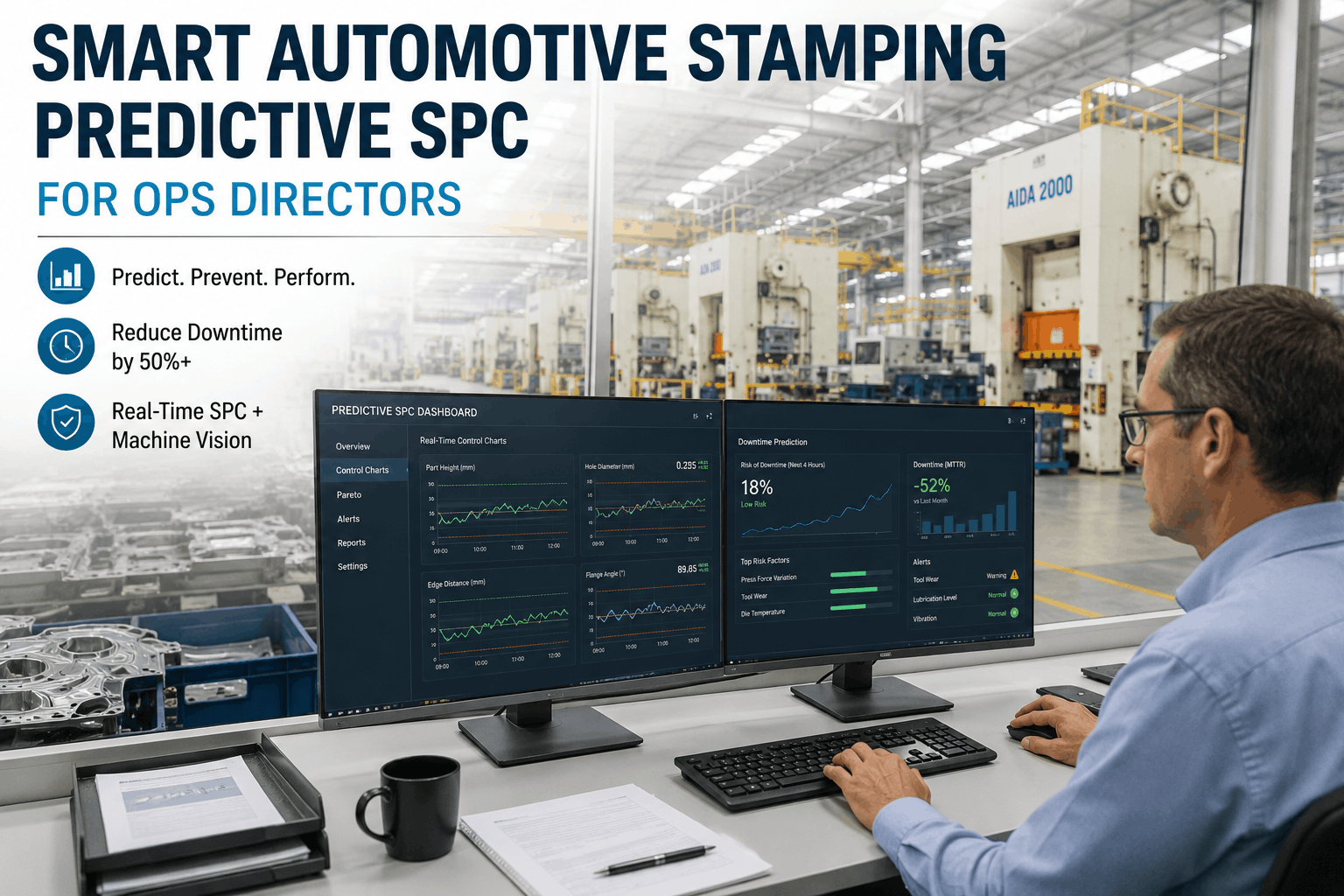
If you supervise a stamping shift, downtime is the silent line item that quietly destroys your OEE. Every unplanned stop — a die crack, a broken pin, a quality hold, a jam clearance, an unscheduled maintenance call — drops both the Availability factor and the Performance factor of OEE in the same hit. Traditional SPC tells you a problem is occurring; predictive SPC tells you a problem is approaching. Watching tonnage signature drift hours before a die actually fails. Catching tool wear patterns that signal punch breakage three shifts away. Suppressing nuisance alerts that drive unnecessary line stops. Across a typical 12–18 month deployment, predictive SPC cuts unplanned downtime by 50% or more — and the downtime that does happen recovers faster because the AI has already attributed the cause. This is the supervisor's guide to using predictive SPC specifically to reduce downtime on the stamping line. iFactory delivers it on a turnkey on-premise NVIDIA appliance or fully managed cloud — same predictive AI, your deployment choice.
Automotive Stamping: Predictive SPC for Less Downtime
How shift supervisors cut unplanned downtime 50%+ in stamping operations with predictive SPC — catching die failures hours early, suppressing nuisance stops, and accelerating fault recovery when stops do happen.
Where Stamping Downtime Actually Comes From
Before predictive SPC can help, it's worth being honest about where the downtime hours are actually being lost. A typical press shop downtime Pareto shows the same top categories everywhere — die and tool issues dominate, followed by quality holds, jams, and unscheduled maintenance. Each category has a different cause profile and a different predictive-SPC opportunity.
Notice the structure — the top four downtime categories (die/tool failures, quality holds, jams, unscheduled maintenance) account for roughly 80% of unplanned downtime hours, and all four have direct predictive SPC coverage. The bottom two categories (changeovers and material issues) are partial or outside scope. This is why a 50%+ downtime reduction is realistic with predictive SPC — the math works out across the categories that actually matter.
Curious what your specific stamping downtime Pareto actually looks like? Request a downtime category audit from iFactory support — we'll analyze 90 days of your downtime log against the six categories and identify which ones predictive SPC can move the most, returned within 5 business days.
Six Downtime Drivers Predictive SPC Mitigates
Each of the top downtime categories has a specific predictive-SPC mechanism that catches the issue before it stops the line. Here are the six biggest opportunity drivers and what predictive SPC actually does about each.
Die Cracks & Failures
LSTM models track tonnage signature shape drift; subtle changes hours before catastrophic die failure trigger predictive maintenance scheduling.
Punch Breakage
Autoencoder catches subtle force-displacement signature changes that indicate punch dulling or stress concentration before breakage.
Nuisance Quality Alerts
Confidence-fusion suppresses low-confidence alerts during routine variation; alerts now fire only when high-confidence drift is detected.
Jam & Feed Issues
Multivariate models correlate feed-system signals with prior jam events; recommend operator inspection before next jam occurs.
Unscheduled Maintenance
RUL (Remaining Useful Life) models forecast component failures days ahead; maintenance scheduled into planned windows instead of stopping production.
Slow Fault Recovery
When a stop does happen, AI has already captured the upstream signal pattern and attributes the cause — operator sees diagnosis immediately, not after troubleshooting.
Want to see which of these six drivers matter most for your specific press shop? Request a Shift-Floor Demo — bring your top downtime categories and the iFactory team will show how each one gets caught or shortened by the predictive SPC layer, with a projected downtime-hour savings estimate. Sessions available this week.
MTBF and MTTR — The Two Numbers That Move
For supervisors, the two metrics that really matter are Mean Time Between Failures (MTBF) — how often does the line stop — and Mean Time To Repair (MTTR) — how long does the recovery take. Predictive SPC moves both in the right direction. Here's what the typical change looks like across a 12–18 month deployment.
Before Predictive SPC
After Predictive SPC (12 mo)
The Die Life Curve — Predictive Maintenance vs Reactive
One of the highest-impact predictive SPC use cases in stamping is die life management. Traditional die maintenance is reactive — the die runs until it breaks or produces a bad part, then maintenance happens. Predictive die management uses tonnage signature drift to forecast die degradation, scheduling maintenance into planned windows. The die actually runs longer because problems are addressed before they cascade.
The economics of the die life curve are important. Reactive maintenance philosophy produces shorter total die life because the catastrophic failure typically damages adjacent components, requires unplanned downtime, and consumes more reactive engineering time. Predictive maintenance produces 25–40% longer total die life — each intervention is targeted, scheduled into a planned window, and avoids the cascade damage.
Reactive Stops vs Predictive Intervention — The Time Cost Difference
Stop, diagnose, repair, restart
- When intervention happens — after the line has stopped
- Operator workflow — stop, lock out, investigate, root cause, repair, restart
- Average stop duration — 45–90 minutes per event
- Production impact — 100% production loss during stop
- Customer impact — potential delivery miss for orders in flight
- Fault attribution — manual investigation, time-consuming
- Recovery confidence — uncertain — issue may recur soon
Predict, schedule, intervene, continue
- When intervention happens — at next break or planned window
- Operator workflow — AI alerts → schedule into planned window → targeted intervention
- Average intervention duration — 8–20 minutes per event
- Production impact — minimal — fits into existing breaks
- Customer impact — none — production continues until planned
- Fault attribution — AI provides root cause with confidence score
- Recovery confidence — high — model verifies post-intervention
Want to see what predictive intervention actually looks like compared to reactive stops on your specific operations? Request a Shift-Floor Demo — iFactory's team will walk through both workflows on representative die failure events, showing exactly where the time difference comes from. Sessions available this week.
IATF 16949 & Downtime Reporting — Built Automatically
Every downtime event captured with full attribution
- Event start / end timestamps with operator and shift attribution
- Root cause classification with AI confidence score
- Maintenance action taken with parts consumed log
- Recovery verification with predictive monitoring confirmation
- Customer-Specific Requirement reporting (Q1, BIQS, PIST, SQA)
- MTBF / MTTR trend metrics auto-computed
- Predictive intervention log — what was prevented and when
- Tamper-evident electronic records aligned to audit requirements
For the supervisor, the impact is on the shift report — downtime data, root cause attribution, intervention summary, and Q1/BIQS/PIST submissions all generate from the same data stream the AI layer is producing. The supervisor reviews and approves rather than assembling.
Two Real Downtime Reduction Outcomes
Mid-size structural component supplier with reactive die maintenance culture
A Tier 1 stamping supplier producing structural body components on 12 progressive die lines. Die maintenance was reactive — dies ran until catastrophic failure, typical event consumed 4–6 hours of unplanned downtime including damage cleanup. MTBF averaged 32 hours. Annual unplanned downtime exceeded 1,400 hours across the press shop, with die failures the dominant contributor.
OEM press shop where SPC false alarms drove unnecessary line stops
A high-volume vehicle OEM press shop with traditional SAP MII SPC firing alerts on minor variation that often turned out to be no-action. Operators stopped the line to investigate, found nothing wrong, restarted. Each false-alarm stop consumed 15–25 minutes. Over a year, false-alarm stops alone consumed about 480 hours of capacity.
Neither scenario matches your situation? Send your top downtime categories and current MTBF/MTTR to iFactory support and the automotive team will return a customised projection — predictive coverage map, projected MTBF improvement, and 12-month deployment roadmap — typically within 3 business days, no obligation.
iFactory's Stamping Deployment — On-Premise or Cloud
Same predictive SPC stack on either model. Same LSTM models, same RUL forecasting, same automatic IATF audit trail. The decision depends on your data residency rules, IT capacity, and budget posture.
iFactory On-Premise Appliance Default for press shops with CSR data-residency rules
- Pre-configured NVIDIA AI server — racked, software-loaded, ready to plug in.
- Sub-50ms inference at the press — fits cycle times on high-speed transfer presses.
- All production data stays inside the plant — CSR-compliant by design.
- Works during WAN outages — predictive coverage continues uninterrupted.
iFactory Cloud For multi-plant fleet benchmarking and cloud-first IT
- Fully managed — no rack, no facility requirements.
- Same predictive SPC stack — LSTM, autoencoder, RUL forecasting.
- Cross-plant downtime benchmarking across all press shops in one tenant.
- Fastest deployment — first plant live in 2–4 weeks.
See predictive SPC reducing downtime on a real press line — this week.
The iFactory shift-floor demo is a 30-minute walkthrough showing predictive die-life monitoring, RUL forecasting, and nuisance-alert suppression running on a representative press configuration. Bring your top downtime categories and MTBF/MTTR baseline; we'll show where the lift comes from. On-premise appliance or fully managed cloud, your call on deployment.
Frequently Asked Questions
How realistic is a 50%+ unplanned downtime reduction?
Very realistic, and we see it consistently across mid-to-high-volume stamping operations. The math works because the top four downtime categories — die/tool failures, quality holds, jams, unscheduled maintenance — represent roughly 80% of unplanned downtime hours, and all four have direct predictive SPC coverage. Even moderate reductions in each category compound to the 50%+ overall figure within 12–18 months.
What happens to my maintenance team's role?
The role evolves from reactive firefighting to scheduled execution. Maintenance teams spend less time on emergency die repairs and more time on planned, targeted interventions. Most teams report higher job satisfaction because work happens in predictable windows with clear scope rather than during high-pressure unplanned stops. Crew sizes typically stay the same; effectiveness improves significantly.
How does AI distinguish real drift from normal variation?
Three layers. Traditional Western Electric and Nelson Rules catch the obvious patterns. LSTM time-series forecasting catches subtler drift trends. Autoencoder anomaly detection catches unusual patterns that don't fit either category. Then confidence-fusion combines them — only high-confidence drift triggers operator action, suppressing the false alarms that drove unnecessary stops under traditional SPC.
Do I have to buy NVIDIA servers separately?
No. iFactory's on-premise appliance ships fully loaded — pre-configured NVIDIA AI server, software pre-installed, network gear, cabling, edge devices for press-side inference. You provide rack space, line power, and Ethernet. For cloud deployment, there's no hardware investment at all.
How quickly do MTBF and MTTR move?
MTTR moves first — typically within 4–6 weeks, because AI-driven fault attribution accelerates diagnosis the moment the predictive layer is live. MTBF moves more gradually — usually 3–6 months — because it requires the predictive interventions to actually compound. Full 12-month metrics typically show MTBF doubling or better, MTTR cut by 30–50%.
Does this work for tandem presses, transfer presses, and progressive dies?
Yes — all three press types. Tonnage signature analysis adapts to the press type and cycle structure. Progressive die operations particularly benefit because the multi-station nature means more signals to monitor and more opportunities for predictive intervention. Tandem and transfer presses deploy the same way; the AI adapts to the cycle structure.
Can we deploy at one press first before going to the full shop?
Yes — and this is the recommended approach. Start with the press contributing the most downtime hours. Validate the predictive coverage, prove the MTBF/MTTR improvement, build operator and maintenance trust. Then expand to remaining presses in 2–4 week waves per press. Full press shop deployment for an 8–14 press operation typically completes in 3–4 months.
Unplanned downtime is the silent OEE killer. Predictive SPC is the fix.
Every supervisor on a scorecard knows what those unplanned downtime hours actually cost — capacity loss, customer pressure, maintenance overtime, scorecard hits. Predictive SPC catches die failures hours early, suppresses nuisance stops, and accelerates fault recovery when stops do happen. iFactory's shift-floor demo is the fastest way to see what 50%+ downtime reduction looks like on your press configuration.
.png)