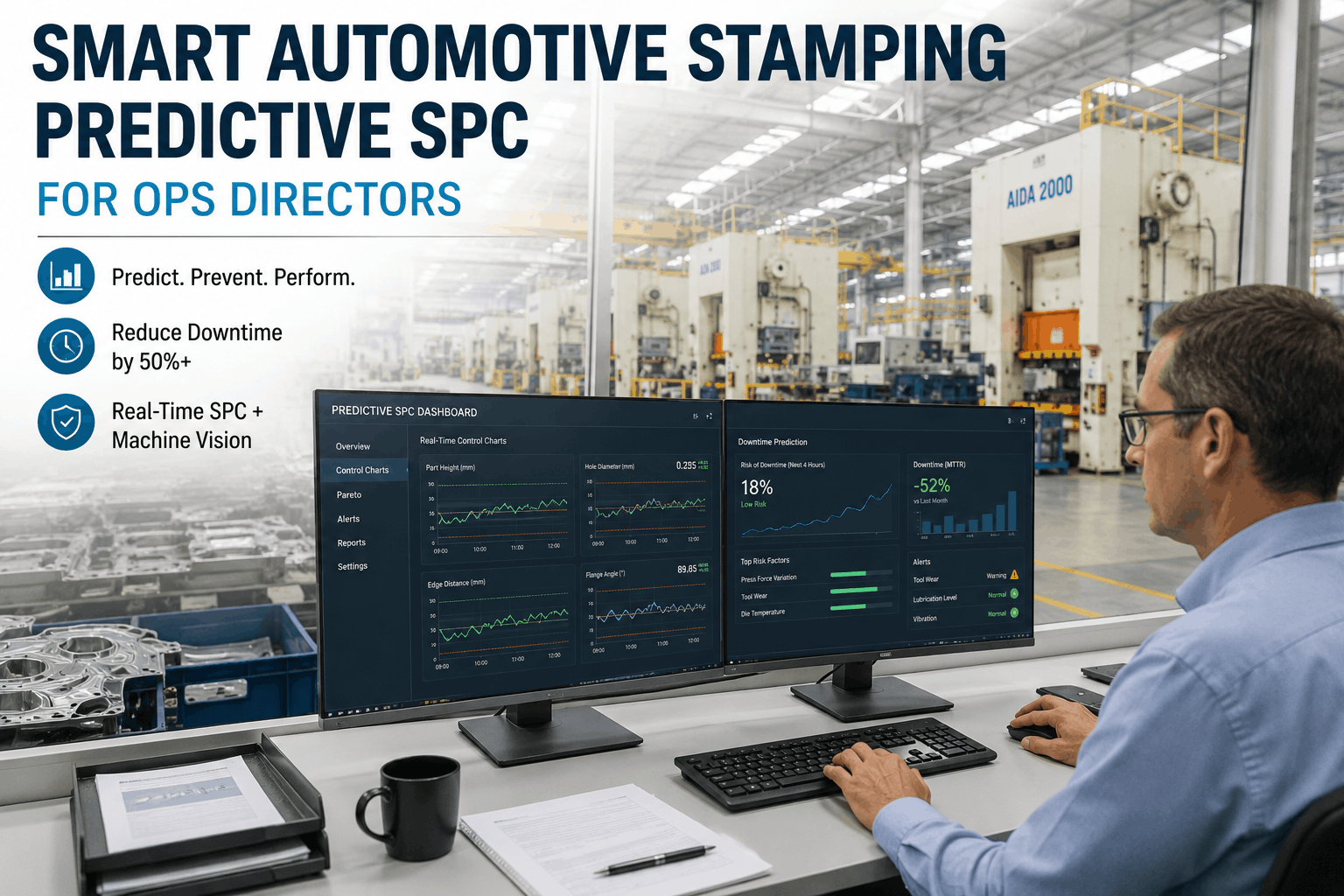
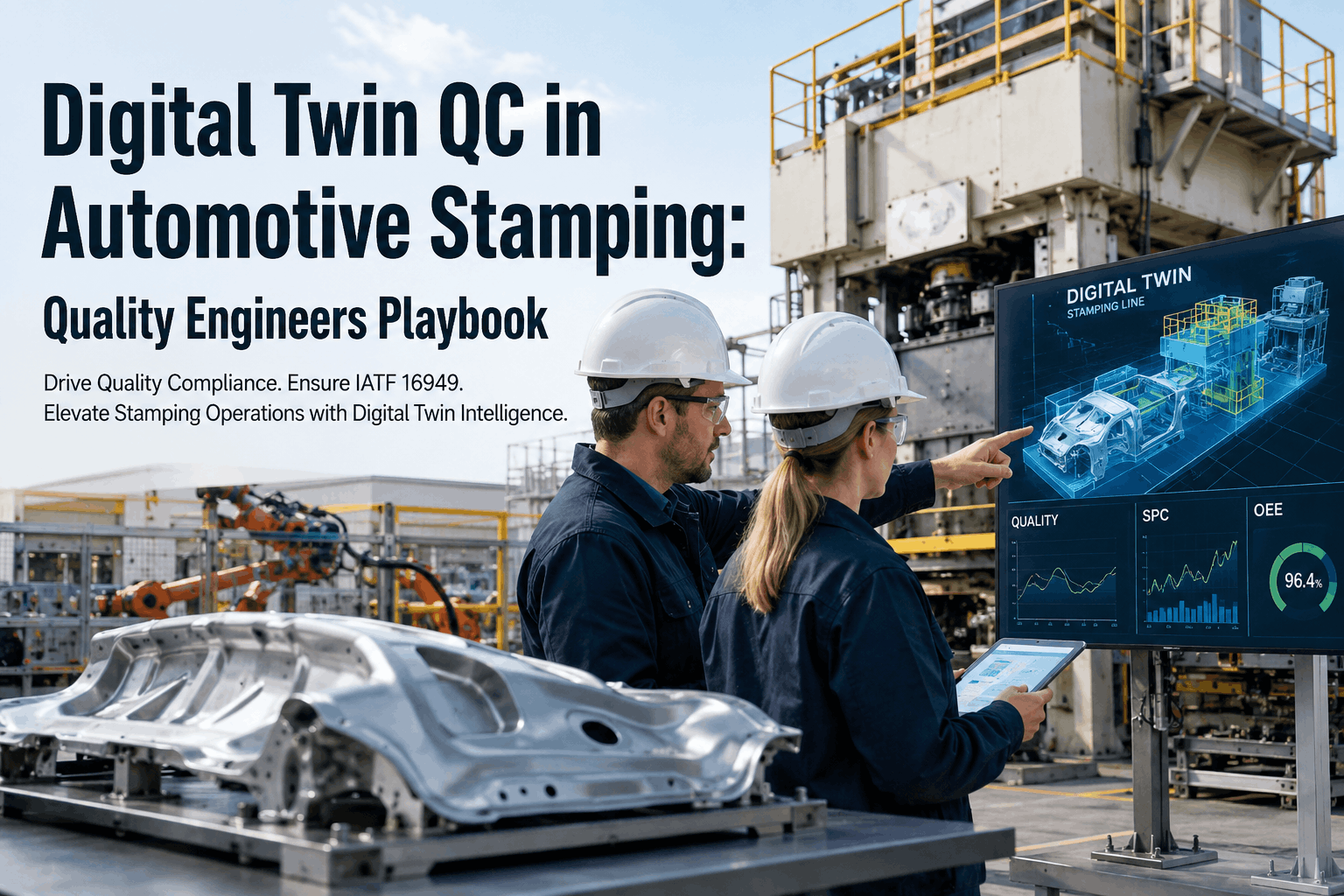
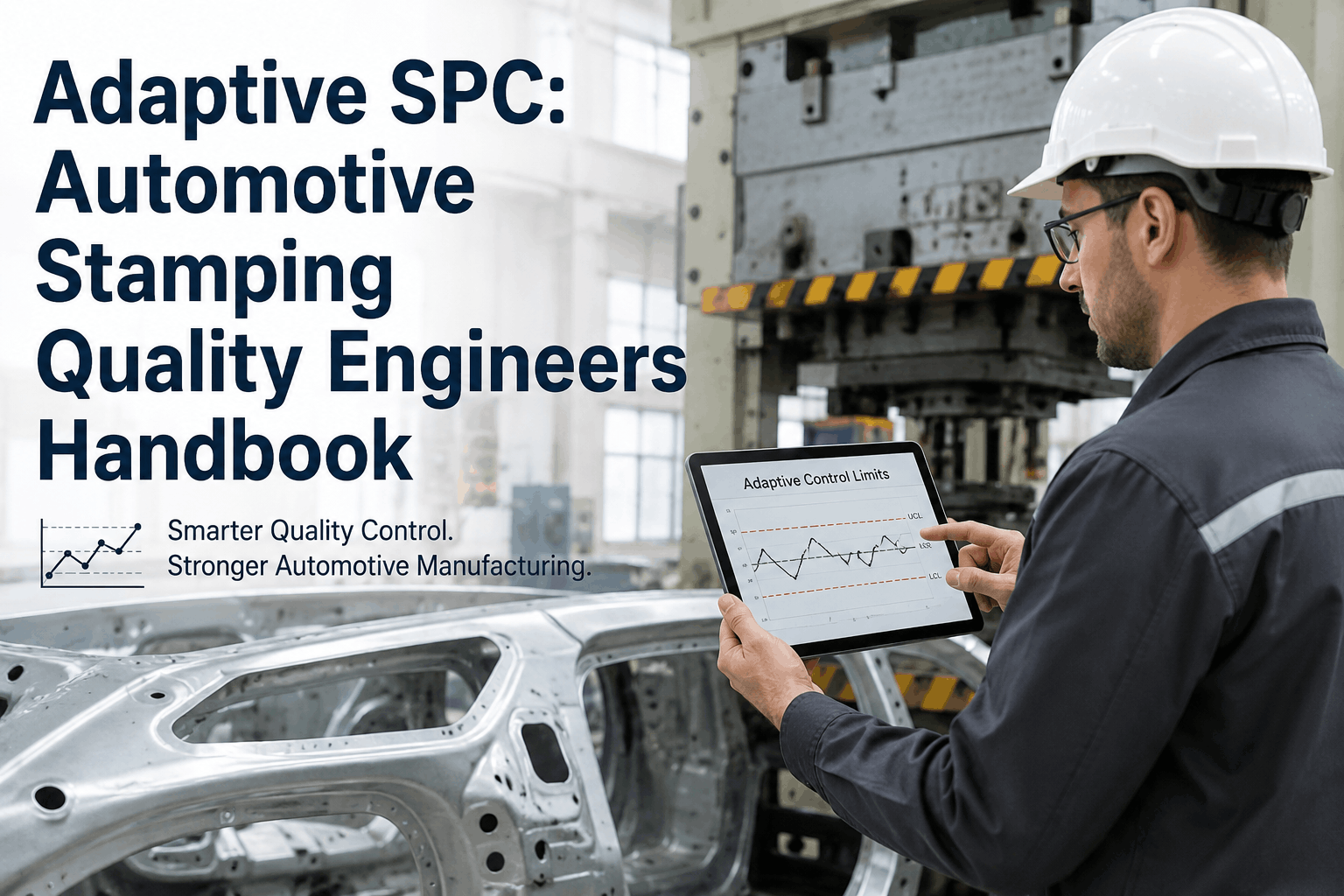
Quality engineers in automotive stamping operations face a problem that sits at the intersection of statistical rigour and real-time urgency. You own the Cpk data, the IATF 16949 compliance records, and the SPC chart reviews — but the systems generating that data are built for retrospective analysis, not predictive action. A Cp of 1.33 calculated from last week's CMM sample tells you the process was capable. It tells you nothing about whether stroke 2,847 is about to breach the control limit. Predictive OEE software for automotive stamping closes this gap: it connects the statistical rigour of engineering-grade SPC with real-time machine data, AI-driven process monitoring, and automated IATF traceability — giving quality engineers the tools to prevent downtime and scrap rather than document them after the fact. Get a free Cpk & compliance audit for your stamping operation — book with an iFactory engineer.
Predictive OEE · Quality Engineers · Stamping
From Cpk Reports That Document Problems
to AI That Prevents Them.
iFactory Predictive OEE gives quality engineers real-time SPC with AI violation prediction, per-stroke Cpk tracking, IATF 16949 compliance automation, and press-level downtime prediction — on-premise or cloud.
The Quality Engineer's Dilemma in Automotive Stamping
Most quality engineers in stamping operations are operating a fundamentally backwards quality system. The measurement data — tonnage, dimensional checks, surface inspection — is real. The analysis — SPC charts, Cpk calculations, capability studies — is statistically sound. But the timing is wrong. You are measuring quality after it has already varied, not before it varies. Traditional SPC tells you a process has gone out of control after the control limit is breached. Predictive OEE tells you the control limit is about to be breached — and why — before the non-conforming part is produced.
The Quality Engineer's Measurement Gap — Traditional vs. Predictive
Process begins drifting at stroke 1,800
↓
200 strokes of drift — undetected
↓
Stroke 2,000: CMM sample pulled
↓
Out-of-spec: Cpk drops below 1.33
↓
200 suspect parts. Sort and quarantine. Root cause investigation. CAPA required.
vs.
Process begins drifting at stroke 1,800
↓
Stroke 1,812: AI detects multivariate drift pattern — 0 non-conforming parts yet
↓
Quality engineer receives alert: tonnage trend + die cushion correlation identified. Predicted Cpk drop in 40 strokes.
↓
Process adjusted at stroke 1,820. Cpk maintained above 1.33. Zero non-conforming parts.
7 Engineering-Grade Capabilities Quality Engineers Actually Need
01
Real-Time Cpk Monitoring — Per Stroke, Not Per Sample
Traditional Cpk is calculated from periodic samples — every 25 parts, every 2 hours. This produces capability snapshots, not capability monitoring. iFactory calculates Cp and Cpk from every stroke using the sensor data stream — giving you a live capability index that moves with the process, not with your sampling schedule. When Cpk begins drifting toward your action threshold (typically 1.33–1.67 depending on CTQ criticality), AI generates an alert before it crosses it. Downtime reduction of 50%+ is achievable when predictive OEE closes this Cpk monitoring gap in stamping.
Cpk calculated every stroke · Alert before threshold breach, not after
02
Multivariate SPC — Beyond Single-Variable Control Charts
The interaction effects that cause most stamping quality failures are invisible to univariate control charts. A tonnage reading alone is not actionable. A die cushion pressure reading alone is not actionable. The combination of tonnage trending up 2.3% while die cushion pressure trending down 1.8% over the same 50-stroke window — correlated with the springback deviation pattern in your historical data — that is the failure signature. Hotelling's T² multivariate SPC with AI enhancement detects this combined signal. Proactive predictive SPC using time-series forecasting can assess whether upcoming data points will breach control limits and act before issues arise (ArXiv, 2025).
Hotelling T² multivariate detection · Interaction effects visible · 40% fewer false alarms
03
Press Downtime Prediction — 14–60 Days Before Failure
Predictive OEE is not just about quality — it is about the availability losses that destroy your OEE denominator. AI vibration and current signature analysis on press drives, die cushion actuators, and guide bearings detects degradation signatures 14–60 days before failure. This converts the quality engineer's role from documenting downtime events to preventing them: each predicted failure is a CMMS work order created automatically, scheduled in the next maintenance window, and closed before the press ever stops. Most availability losses in manufacturing happen due to unplanned machine stops — predictive OEE addresses this at the source.
14–60 day advance warning · 71% unplanned downtime reduction documented · Auto CMMS work order
04
Gauge R&R and Measurement System Analysis Integration
Before AI SPC means anything, the measurement system it reads from must be capable. iFactory integrates with CMM output, in-line gauging systems, and torque tools to calculate Gauge R&R metrics automatically — flagging measurement systems whose variation consumes more than the AIAG-recommended 10% of total process variation. For quality engineers managing IATF 16949 MSA requirements, this replaces the annual manual MSA study with continuous measurement system health monitoring that identifies gauge drift as it develops.
Continuous MSA monitoring · Gauge drift detected in real time · AIAG compliance automated
05
PPAP and Process Capability Documentation
PPAP submission requires 30-piece capability studies, initial process studies (Ppk ≥ 1.67 minimum), and measurement system analysis reports. iFactory generates these automatically from production data — pulling the correct subgroup of parts, calculating Ppk from the actual distribution, and formatting the output for PPAP submission. For new model launches and engineering change requests, capability studies that previously took 4–8 hours of engineer time are generated in minutes from iFactory's continuous data stream.
PPAP capability study: 4–8 hrs → minutes · Automatic Ppk calculation from production data
06
AI-Assisted Root Cause Analysis — From Alert to 8D in Hours
When a quality deviation occurs, the quality engineer's most time-consuming activity begins: identifying what changed. iFactory's root cause AI analyses the full parameter record at the time of the deviation — tonnage curve, die cushion pressure, material feed rate, lubrication status, tool wear index — and ranks the most probable root causes by correlation strength. The 8D report is pre-populated with the deviation data, the identified root cause candidates, and the production order and lot numbers affected. What previously took 2–3 days of parameter trawling is completed in 2–3 hours.
8D pre-populated from AI root cause · 2–3 days → 2–3 hours per investigation
07
IATF 16949 Section 10.2 Compliance Automation
IATF 16949 requires documented SPC records, corrective action traceability, and per-characteristic control chart maintenance for all critical CTQs. iFactory generates these records automatically — every control chart data point timestamped and linked to the production order, every violation logged with operator response, every CAPA linked to its originating deviation event. For IATF surveillance audits, the complete compliance package is retrievable from SAP QM in seconds. IATF 16949 compliance work that consumes an estimated 15–20% of a quality engineer's time is largely automated.
IATF compliance automated · Audit package: 3 days → 30 seconds · SAP QM integration
Downtime Reduction KPIs: What Quality Engineers Report
71%
Unplanned downtime reduction — automotive parts manufacturer, 12 lines, 14 months (Oxmaint / verified case study)
58%→82%
OEE improvement — same manufacturer, $2.9M production capacity recovered, zero added headcount
10:1
Average ROI within 2 years — Deloitte research on AI-driven predictive maintenance in manufacturing
$50K
Cost per minute of automotive stamping line stoppage — the number that makes every prevented failure financially visible
The Free Cpk & Compliance Audit: What iFactory Reviews
Quality engineers running stamping operations often have the data to prove capability — but not the infrastructure to maintain it continuously. iFactory's free Cpk and compliance audit identifies the specific gaps between your current SPC practices and what predictive OEE can deliver. Book your free Cpk & compliance audit — iFactory engineers review your stamping operation specifically.
Process Capability
Current Cp/Cpk values per CTQ characteristic
Sampling frequency vs. detection capability gap
Control limit calculation methodology (static vs. dynamic)
Special cause detection rate — false alarms vs. true violations ratio
SPC Infrastructure
Data collection method (manual, automated, mixed)
Chart update frequency vs. stroke rate gap
MSA status — last Gauge R&R study date and %GR&R
Reaction plan documentation and operator training status
IATF 16949 Compliance
Section 10.2 corrective action traceability completeness
Control plan-to-SPC chart alignment per characteristic
PPAP capability study currency and Ppk levels
Audit record retrieval time — current vs. benchmark
Predictive Opportunity
Available sensor data not currently used in SPC
Historical deviation patterns suitable for AI model training
Downtime events with predictable precursor signatures
Estimated annual value at risk from current gaps
iFactory Deployment: On-Premise & Cloud for Quality Engineers
Quality data — process capability records, deviation histories, SPC control charts — is legally sensitive in IATF-regulated environments. iFactory gives quality engineers the choice of where this data resides and how it is accessed. Ask our quality team about the deployment model that fits your plant's IT governance and IATF compliance requirements.
On-Premise
Quality Data Sovereignty
All SPC records, capability data, and IATF documentation stored inside plant network
Sub-20ms per-stroke AI inference — real-time Cpk without cloud latency
No external transmission of CTQ data or process capability records
Tamper-evident audit log — satisfies IATF 16949 record integrity requirements
NVIDIA edge appliance or existing plant server — operational in 48 hours
Discuss On-Premise Setup
Cloud
Multi-Plant Quality Analytics
Cross-plant Cpk benchmarking — compare capability across stamping lines and facilities
Enterprise quality KPI dashboards for quality directors and OEM supplier portals
AI model improvement from fleet-wide process data across all stamping operations
PPAP and APQP documentation accessible from engineering and supplier quality teams
Ideal for Tier 1 suppliers managing stamping quality across multiple plants
Discuss Cloud Setup
FAQ: Predictive OEE for Automotive Stamping Quality Engineers
How is predictive OEE different from the SPC software quality engineers already use?
Traditional SPC software — whether standalone or within SAP QM — collects measurement data, calculates control statistics, and displays control charts. It is fundamentally a recording and notification system: it tells you that a violation occurred. Predictive OEE adds three capabilities that conventional SPC cannot provide: (1) per-stroke AI monitoring that detects drift trends before control limits are breached, (2) multivariate correlation analysis that identifies interaction-effect failure signatures invisible to single-variable charts, and (3) press health monitoring that predicts equipment failures that will cause the next availability loss. The quality engineer's role shifts from reviewing reports of what happened to receiving predictions of what is about to happen — and having enough lead time to intervene.
How does iFactory calculate Cpk in real time — CMM measurement data is not available per stroke?
iFactory uses a two-tier approach. For dimensions requiring CMM measurement, the AI models the correlation between CMM dimensional results and in-process sensor parameters (tonnage profile shape, die cushion pressure, blank positioning) — calibrated from historical paired data. This allows the AI to infer dimensional quality from sensor data between CMM sample intervals. The inferred Cpk is flagged as an estimate, not a hard measurement, and is used to trigger increased sampling or operator alerts when the AI predicts capability degradation. When CMM data arrives (from in-line gauging or offline measurement), it recalibrates the model. For characteristics that can be directly measured in-line (tonnage, force, position via LVDT), Cpk is calculated from actual measurements every stroke.
What level of IATF 16949 compliance evidence does iFactory generate automatically?
iFactory generates the following IATF 16949 compliance documentation automatically: Section 9.1 (monitoring and measurement) — per-characteristic control charts with timestamped data points linked to production orders; Section 10.2 (nonconformity and corrective action) — quality notifications created in SAP QM when violations occur, linked to the specific stroke, production order, and process parameters at the time of deviation; MSA monitoring records for connected measurement systems; and PPAP process capability data (Ppk, Pp) generated on-demand from the continuous data stream for any time window. The IATF audit package — all records for a specified production order or time period — is retrievable from SAP QM in under 30 seconds. This replaces the 2–3 day manual record reconstruction that characterises most IATF surveillance audit preparation processes.
How does the free Cpk and compliance audit work — what do we need to provide?
The audit requires: (1) a 30–60 minute structured interview with your quality engineer and a stamping line supervisor covering current SPC practices, CTQ characteristics, sampling methods, and recent deviation history; (2) export of 3–6 months of SPC data from your current system (Excel, SAP QM, or other format); and (3) a list of the top 5–10 process-driven downtime events from the same period. No live system access is required. iFactory's quality engineering team analyses the data and delivers a written assessment within 5 business days covering: current Cpk levels and gaps vs. IATF requirements, detection lag analysis (average strokes between deviation start and detection), estimated annual cost of current capability gaps, and a prioritised predictive OEE deployment recommendation.
Book the free Cpk audit — no system access or commitment required.
How does iFactory integrate with our existing SAP QM environment for quality records?
iFactory connects to SAP QM via standard OData and BAPI interfaces — no custom ABAP development required for standard quality scenarios. Quality inspection results are posted to SAP QM inspection lots automatically, linked to the production order. Quality notifications are created for violations that meet your defined threshold criteria. Corrective action records are created with the iFactory root cause analysis data pre-populated. PPAP process capability data is accessible from SAP QM on demand. The integration supports both SAP ECC QM and SAP S/4HANA QM, meaning it works during your S/4HANA migration transition period without requiring a separate migration project for the quality data integration.
What ROI should a quality engineer present to management to justify predictive OEE investment?
The strongest quality engineer business case combines three financial arguments: (1) Downtime avoidance — an automotive stamping line stoppage costs upwards of $50,000 per minute. If predictive OEE prevents 4 unplanned stops per year of 30 minutes each, the calculation is straightforward: $6M+ in avoided downtime cost per year. (2) Scrap and rework reduction — at 47.8% scrap reduction achievable with AI-SPC (ResearchGate 2026 stamping study), a plant with $500K annual scrap saves $239K annually from the quality improvement alone. (3) IATF compliance labour efficiency — 15–20% of a quality engineer's time on documentation, audit prep, and record retrieval: automating this recovers 6–8 hours per week per quality engineer for value-added analysis. At fully-loaded labour cost of $90–$120K per engineer, that is $13,500–$24,000 per year in recovered engineering productivity per headcount. iFactory's free Cpk audit quantifies these numbers for your specific operation.
Predictive OEE · Quality Engineers · Stamping
Get Your Free Cpk & Compliance Audit.
See the Gaps AI Can Close.
iFactory quality engineers review your stamping SPC practices, Cpk levels, and IATF compliance infrastructure — delivering a written assessment and predictive OEE recommendation within 5 business days. No system access required. On-premise or cloud.
Real-Time Cpk per Stroke
Multivariate SPC
On-Premise & Cloud
IATF 16949 Automation
SAP QM Integration


.png)