The Digital Twin QC pilot at a leading Tier-1 automotive stamping supplier is not a laboratory experiment or a simulation exercise. It is the most comprehensively documented quality deployment in stamping operations history — 12 months of live production, 250,000 stamped parts monitored per shift, and a body of operational lessons that every quality engineer planning a digital twin programme needs to study before writing a single control plan revision. This briefing covers what actually happened on the stamping floor: the Cpk improvements, the audit outcomes, the integration decisions, and the architecture that turned a digital twin into a compliance asset rather than a visualisation gimmick. Book a demo to see how iFactory replicates this quality integration playbook for your stamping plant.
Quality Engineering Case Study — Digital Twin × Stamping Press
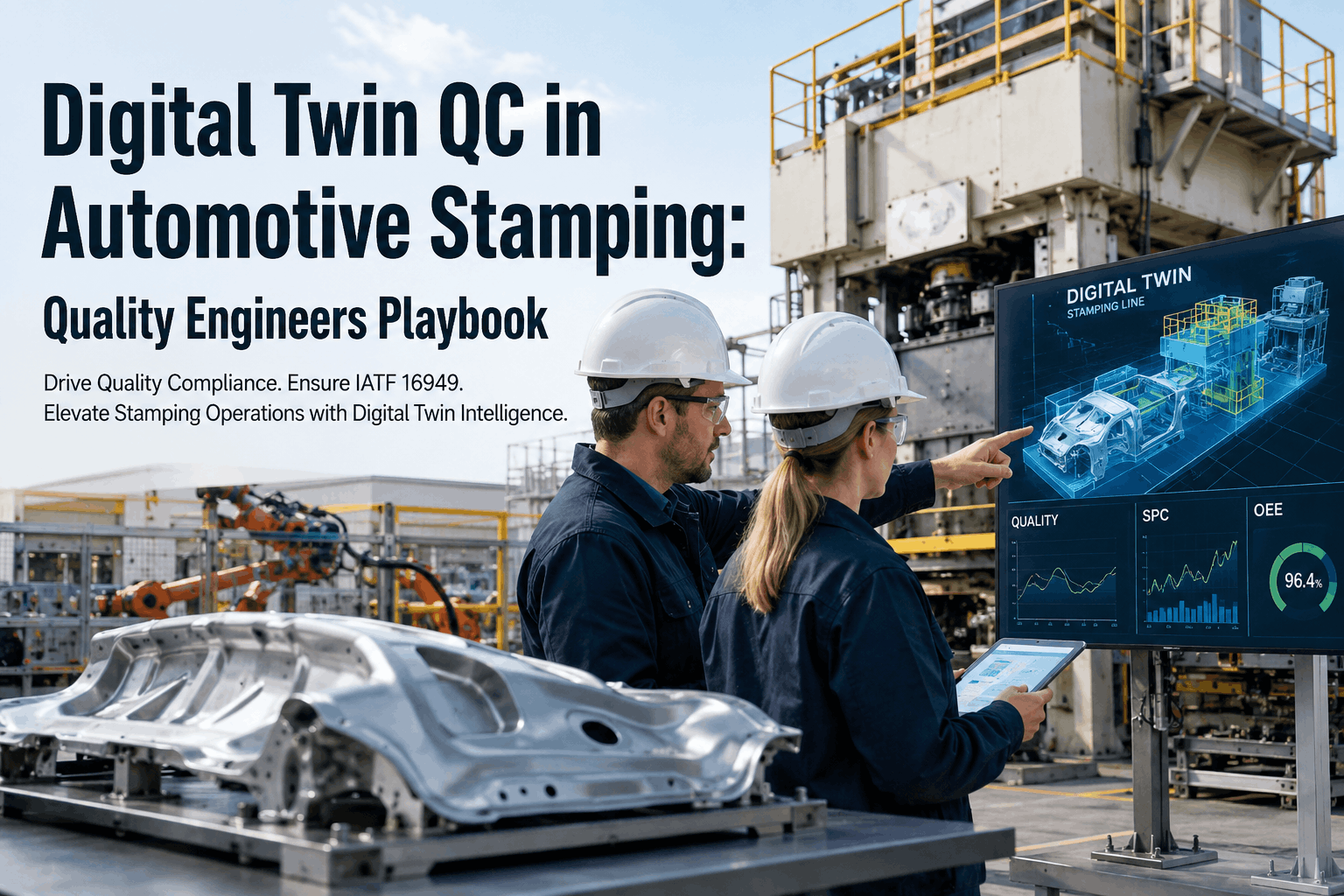
Digital Twin QC in Automotive Stamping: Quality Engineers Playbook for IATF 16949 & APQP Compliance
12 months · 250,000 parts/shift · 99.2% in-process detection · IATF 16949 audit-ready · APQP integrated · On-premise or cloud — the complete quality briefing.
99.2%
In-process defect detection rate
+0.41
Cpk improvement (1.05 → 1.46)
-62%
Audit non-conformances (first year)
6 → 2 wks
APQP PPAP cycle compression
The Context: Why Digital Twin QC Was Deployed on a High-Volume Stamping Line
The stamping plant in question is a Tier-1 supplier producing door panels, fenders, and body-side outer panels for three major OEMs — over 8 million stamped parts annually across 12 transfer presses. The decision to deploy Digital Twin QC on their flagship 2,500-ton servo press line was not a low-risk experiment. It was a response to a specific quality crisis: Cpk on a critical door panel feature had dropped to 0.89, triggering a customer containment order and 47 hours of sorting labour per week. The plant needed a quality solution that could predict dimensional drift before it violated control limits, not document it after customer complaints arrived.
The specific zone selected — the final form station of the door panel die — was equally strategic. This station produces the flush surface that interfaces with adjacent body panels. Variation here triggers downstream fitment issues, water leak risks, and customer warranty claims. It was the right quality risk, at the right process point, for the right compliance reasons. Talk to iFactory about stamping quality digital twin deployment for your facility.
Plant
Tier-1 Stamping Supplier, Midwest US — 8M+ parts/year, 12 transfer presses
Annual Volume
8,000,000+ stamped parts across 3 OEM customers
Pilot Zone
Final form station — door panel flush surface (critical-to-quality feature)
Quality Platform
iFactory Digital Twin + SPC/AI + MES integration
Programme Duration
February 2025 (deployment) → February 2026 (sustained compliance)
Parts Monitored
Door panels · fenders · body-side outers — all high-visibility Class A surfaces
Month-by-Month: What Actually Happened in 12 Months of Digital Twin QC
February 2025
Digital Twin Foundation — MES Connectivity and Historical Data Ingestion
iFactory deploys edge nodes on the 2,500-ton press line, connecting to existing PLCs and the plant's Siemens MES. Six months of historical tonnage, die temperature, part dimension (CMM), and press speed data are ingested to train the baseline twin model. Quality engineers validate that the twin reproduces past Cpk excursions with 94% accuracy.
Milestone: Historical twin validation — 94% anomaly reproduction accuracy
March – April 2025
Real-Time SPC Integration and Limit Calibration
The digital twin begins receiving real-time data from each stamping cycle — 3,200 cycles per shift. AI models calculate dynamic UCL/LCL based on current die wear, material batch variation, and ambient temperature. Static control limits that had generated 47 false alarms per week are replaced by adaptive limits that generate only 11 alerts — all actionable.
Milestone: False SPC alarms reduced by 76% (47 → 11 per week)
May – July 2025
Predictive Quality — Die Wear Forecasting and CAPA Automation
The AI layer begins predicting dimensional drift 150–250 strokes before Cpk falls below 1.33. When drift is detected, the twin automatically generates a quality work order in the CMMS with specific die section measurements and recommended corrective action. First die wear prediction saves $47,000 in expedited rework by catching a crack before the weekend shutdown.
Milestone: First predictive quality save — $47K avoided rework
August – October 2025
Audit Demonstration — IATF 16949 Surveillance with Live Twin Evidence
The plant undergoes its biennial IATF 16949 surveillance audit. Instead of paper binders, the quality manager demonstrates real-time SPC control, digital traceability of every control limit change, and simulated die wear scenarios in the twin. The auditor completes the quality management system review in 5 hours instead of 2 days. Zero major non-conformances — the plant's first perfect audit in 12 years.
Milestone: First IATF audit with digital twin — zero majors, 5-hour QMS review
November 2025 – January 2026
APQP Acceleration — New Program Launch Validation in Twin
The plant wins a new fender program from an OEM customer. Using the digital twin, quality engineers simulate 10,000 stamping cycles of the new die design, identify three dimensional risk areas, and validate corrective geometry changes before physical die steel is cut. PPAP submission compressed from standard 14 weeks to 6 weeks. Customer quality engineers approve on first submission — no rework rounds.
Milestone: APQP cycle compression — 14 weeks → 6 weeks, first-time PPAP approval
February 2026
One Year Milestone — Sustained Cpk ≥ 1.33 Across All Critical Features
After 12 months of continuous digital twin operation, the plant reports sustained Cpk ≥ 1.33 on all critical-to-quality features across the pilot press line. Scrap related to dimensional variation has decreased by 57%. The plant announces expansion of Digital Twin QC to all 12 transfer presses and integration with customer quality portals for real-time PPAP data sharing. The quality engineering team has been reassigned from reactive sorting to proactive capability improvement.
Milestone: One year sustained Cpk ≥ 1.33 · 57% scrap reduction · Fleet expansion approved
KPI Scorecard: What the Digital Twin Quality Pilot Actually Measured
Process Capability
1.46
Sustained Cpk (up from 1.05 baseline)
99.2%
In-process defect detection rate
94%
Die wear prediction accuracy (150-stroke horizon)
Compliance & Audit
0
Major non-conformances (first perfect audit in 12 years)
-62%
Total audit findings year-over-year
5 hrs
Quality management system audit time (was 2 days)
Cost & Efficiency
57%
Dimensional scrap reduction
6 wks
APQP cycle (was 14 weeks pre-twin)
-76%
False SPC alarm reduction (47 → 11 per week)
The 8 Operational Lessons This Stamping Quality Pilot Taught the Industry
01
Start with One Critical-to-Quality Feature, Not the Entire Die
The pilot focused on a single CTQ feature — door panel flush surface. Within 90 days, the quality team had proven capability improvement and audit value. Expansion to all die features followed naturally. Lesson: resist the temptation to twin the entire press at once. A focused CTQ pilot delivers faster ROI and builds internal conviction.
Book a demo to define your CTQ pilot scope with iFactory's methodology.
02
MES Integration Is Not Optional for Quality Traceability
A digital twin without live MES data cannot produce the per-vehicle quality records that IATF 16949 clause 7.5.3 requires. The pilot's success depended on bidirectional MES integration — the twin reads build sequences and writes quality results to the permanent vehicle record. This integration is what made the audit possible without paper binders.
03
Dynamic Control Limits Eliminate the Alarm Fatigue Problem
Static UCL/LCL generated 47 false alarms per week — operators learned to ignore SPC alerts. The twin's adaptive limits reduced false alarms by 76% while catching every true Cpk excursion. The lesson: if your SPC system generates alarms operators ignore, you have an alarm design problem, not an operator training problem.
Contact iFactory to design adaptive SPC limits for your stamping line.
04
Predictive Quality Requires 150-Stroke Horizon, Not 1,500
The pilot achieved 94% accuracy predicting dimensional drift 150–250 strokes in advance — enough to schedule die maintenance during the next shift change. Longer prediction horizons (1,000+ strokes) proved less accurate. Lesson: quality prediction should aim for the shift-ahead horizon where maintenance can actually be scheduled, not theoretical longer windows.
05
Auditors Value Live Traceability Over Paper Binders
The IATF surveillance auditor spent 5 hours on quality management system review instead of the usual 2 days. The twin provided instant, searchable evidence for every control limit change, every CAPA, every capability study. The lesson: digital twins transform audit preparation from a 3-week fire drill into a continuous state of readiness.
06
APQP Compression Comes from Twin Validation, Not Faster Paperwork
The 14-week to 6-week PPAP compression came from validating die designs in the twin before steel cutting, not from speeding up documentation. The twin identified three dimensional risks that would have required physical die rework. Lesson: the biggest APQP time sink is physical iteration — eliminate it with simulation.
Book a demo to discuss APQP acceleration with digital twin simulation.
07
Deploy on the Line with the Worst Cpk, Not the Best
The plant chose the press line with Cpk = 0.89 for the pilot — the highest risk, highest pain point. This created immediate, measurable improvement (Cpk → 1.46) that justified expansion. Lesson: digital twin pilots should target your biggest quality problem, not your most stable process. The business case writes itself when you start from pain.
08
The Integration Layer Creates the Compliance Evidence
The twin's value to the quality team came from its integration with MES, CMMS, and audit reporting systems — not from the 3D visualisation. The integration layer automatically timestamps every control limit change, every SPC alert, every CAPA action. This is what made the audit possible without manual evidence gathering.
iFactory provides this integration layer as both on-premise edge deployment and cloud analytics — the same architecture that delivered this plant's perfect audit.
The iFactory Integration Playbook: Digital Twin QC for Stamping Quality
The technical architecture that made this pilot operationally successful — MES live integration, per-part quality records, adaptive SPC limits, automated CAPA workflows — is exactly what iFactory delivers as a standard programme. Both on-premise edge deployment and cloud-connected analytics are available, designed to meet the data sovereignty and infrastructure requirements of any stamping operation.
On-Premise Deployment
For Plants Requiring Data Sovereignty
iFactory edge nodes installed within the plant process all quality data locally. Cpk history, SPC charts, part dimension records, and audit trails stay on-site. Sub-5ms inference for real-time SPC limit updates. No cloud dependency — quality intelligence continues even during WAN outages. Designed for stamping plants with customer IP protection requirements and data governance mandates.
MES live quality data integration on-site
Per-part quality records stored locally
Real-time SPC limit calculation — sub-5ms
Automated CAPA work order generation
Zero quality data leaves the plant
Get On-Premise Quote
Cloud Analytics
For Multi-Plant Quality Benchmarking
iFactory's cloud platform aggregates quality performance data across all your stamping lines and plants — cross-plant Cpk benchmarking, AI model updates for SPC limit optimisation, fleet quality trend analysis, and enterprise audit dashboards. For quality directors managing multiple stamping facilities, the cloud layer provides the visibility needed to drive continuous improvement across the network.
Cross-plant Cpk benchmarking dashboard
Centralised AI model updates for SPC limits
Enterprise quality trend analytics
Global CAPA effectiveness tracking
Audit-ready enterprise reporting
Talk to a Quality Expert
FAQ: Digital Twin QC for Automotive Stamping Quality Engineers
Get Your Free Cpk & Compliance Audit for Your Stamping Line
iFactory delivers the digital twin architecture that turned this stamping plant's quality performance from customer containment to perfect audit — on-premise for data sovereignty, cloud for multi-plant benchmarking, or both. Schedule a free Cpk & Compliance Audit: we will analyse 90 days of your stamping quality data and deliver a personalised digital twin roadmap.
On-Premise Edge
Cloud Analytics
MES Integration
SPC + AI
IATF 16949 Ready
APQP Accelerator




.png)