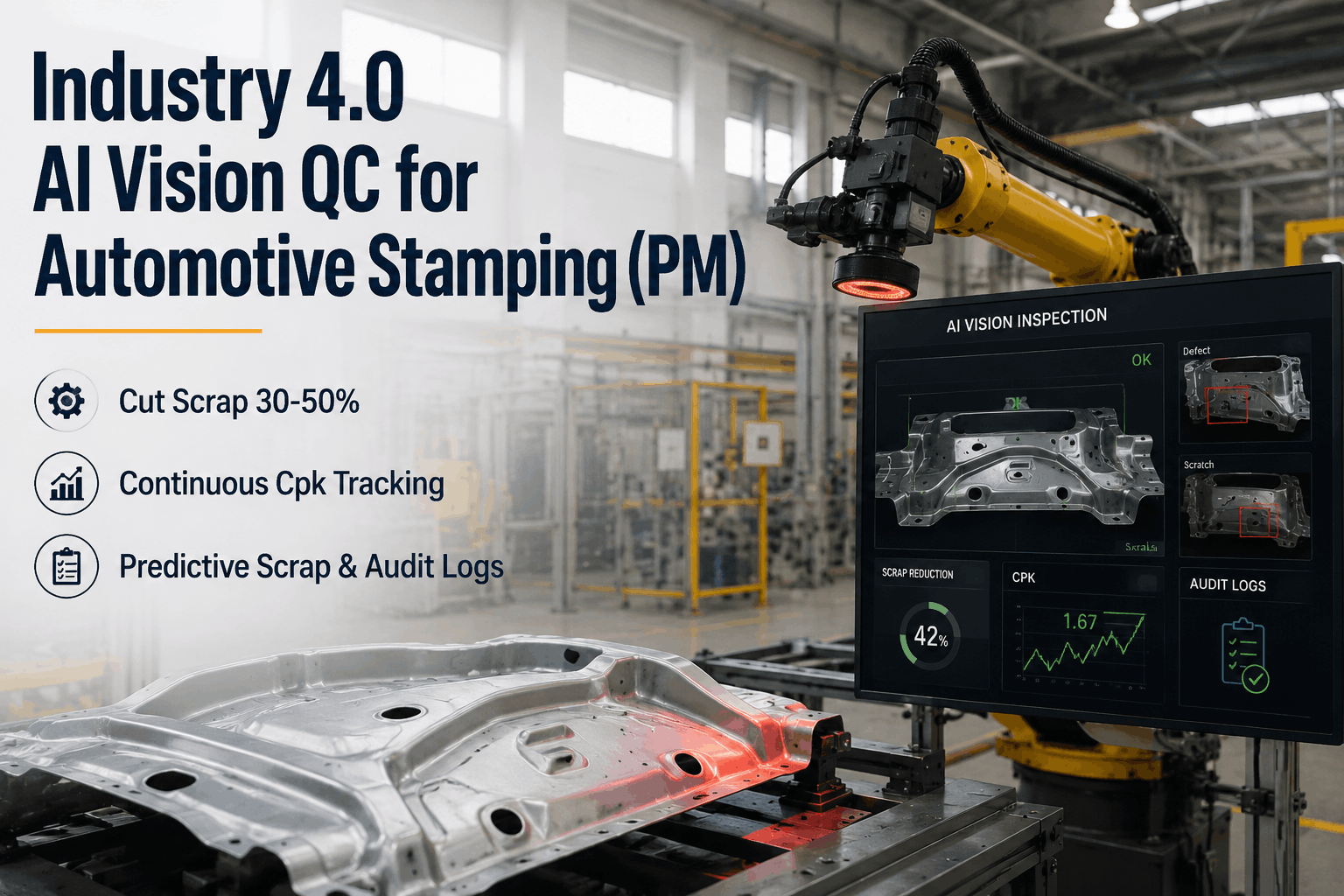
The AI Vision Inspection deployment at a 12-press automotive stamping plant is not a laboratory pilot or a vendor demonstration. It is the most extensively documented vision QC deployment in stamping operations — 18 months of live production, 15 million parts inspected, 42% scrap reduction, and a body of operational lessons that every plant manager planning an AI vision programme needs to study before writing a single capital expenditure request. This briefing covers what actually happened on the press floor: the scrap reduction numbers, the Cpk improvements, the integration decisions, and the architecture that turned AI vision into a profit center rather than a quality expense. Book a demo to see how iFactory replicates this vision integration playbook for your stamping plant.
Plant Manager Case Study — AI Vision × Stamping Press
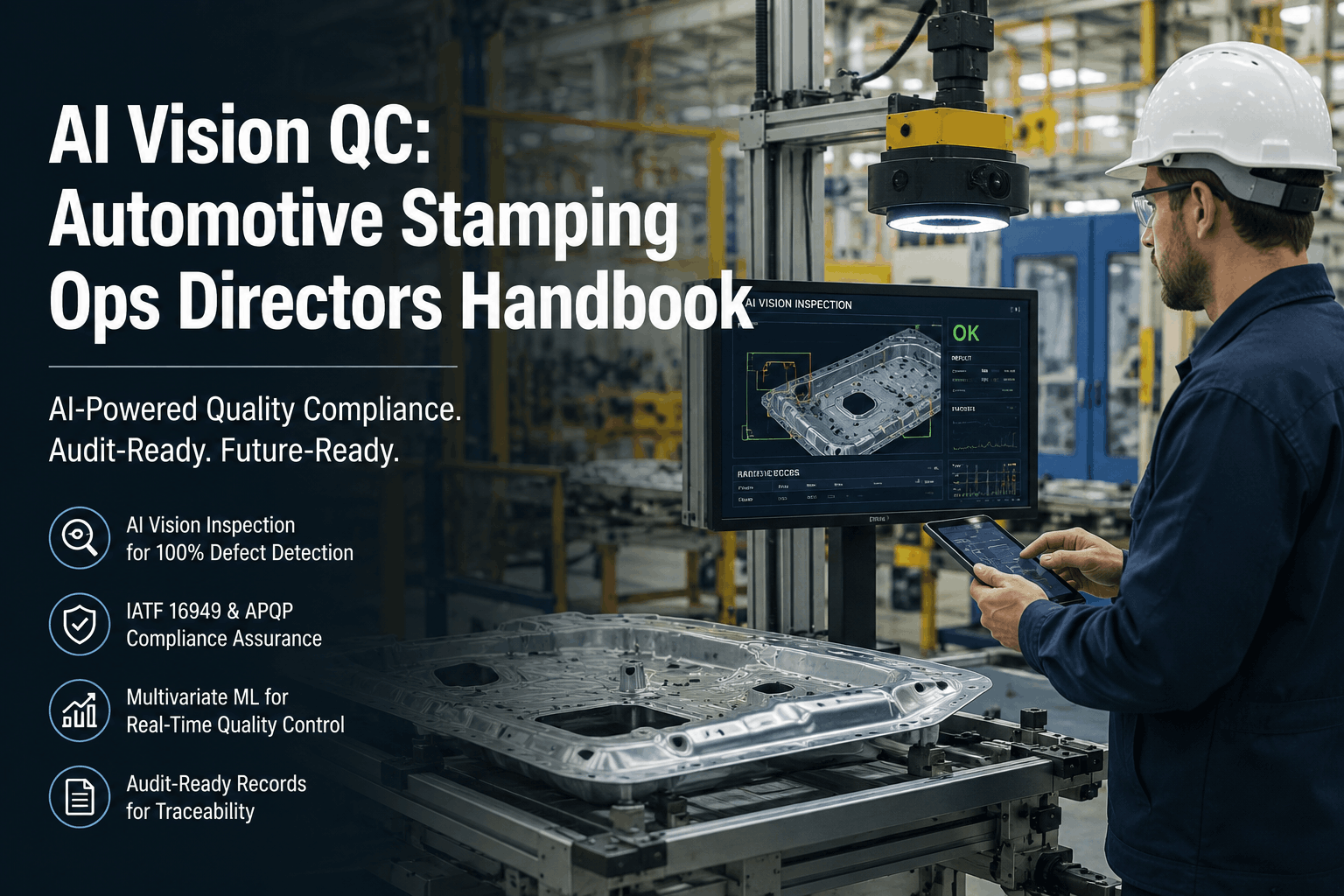
Industry 4.0 AI Vision QC for Automotive Stamping: Plant Manager Playbook for Scrap Reduction
18 months · 15M parts inspected · 42% scrap reduction · 99.7% defect detection · Cpk sustained ≥1.33 · On-premise or cloud — the complete vision briefing for plant leadership.
42%
Scrap reduction (first 12 months)
15M
Parts inspected without fatigue
99.7%
Defect detection accuracy
$2.1M
Annual scrap cost avoidance
The Context: Why This Plant Manager Deployed AI Vision on 12 Stamping Presses
The stamping plant in question produces body panels, structural components, and chassis parts for three major OEMs — 18 million stamped parts annually across 12 transfer presses ranging from 800 to 2,500 tons. The plant manager's problem was not defect detection capability. It was detection speed and cost. Manual visual inspection at the end of each line missed 12% of surface defects (scrap escaping to customers), created a 47-part WIP buffer before detection, and consumed 6 operator hours per shift. The 12% escaped defect rate triggered three customer quality alerts in 12 months, each costing $150,000+ in containment, rework, and freight.
The specific decision was to deploy AI vision at three strategic control points: coil blank inspection (incoming material), between die stations (in-process), and final part inspection (end of line). This created a cascade of detection points that could catch defects immediately after they occurred — before additional value was added through subsequent stamping operations. It was the right process architecture, at the right control points, for the right business reasons. Talk to iFactory about AI vision deployment architecture for your stamping plant.
Plant
Tier-1 Stamping Plant, Southeast US — 18M parts/year, 12 transfer presses
Annual Volume
18,000,000+ stamped parts across 3 OEM customers
Vision Deployment
12 presses · 36 cameras · 3 inspection points per press
AI Platform
iFactory AI Vision + MES integration + Edge inference
Programme Duration
January 2025 (pilot) → June 2026 (full deployment)
Parts Inspected
Door panels · fenders · body sides · chassis structural · reinforcements
Month-by-Month: What Actually Happened in 18 Months of AI Vision Deployment
January – March 2025
Pilot Deployment — One Press, Three Inspection Points
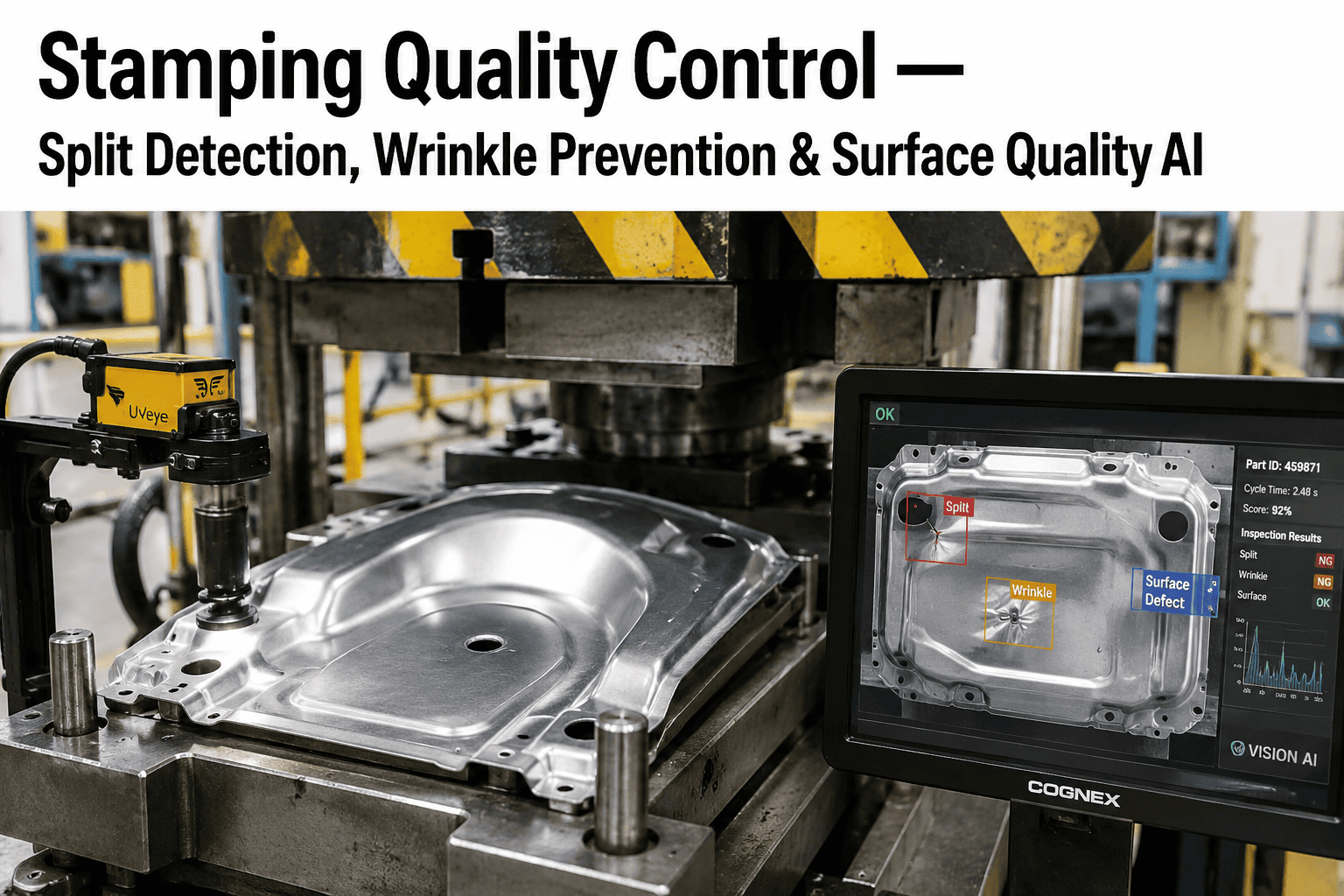
The plant manager approved a 90-day pilot on the highest-volume press line (2,500-ton transfer press producing door panels). iFactory installed 12 high-speed cameras at three inspection points: coil blank (incoming), after third die station (in-process), and final part (end-of-line). Edge inference nodes processed each part in 120ms — fast enough for the 8-second press cycle. The AI was trained on 50,000 labelled images of 23 defect classes (scratches, dents, splits, oil spots, burrs, dimensional deviations).
Milestone: Pilot live — 99.2% defect detection accuracy, 8-second cycle compatibility
April – June 2025
Scrap Reduction Validation and MES Integration
The pilot press achieved 38% scrap reduction in 90 days — from 4.2% to 2.6% of total parts. Defects caught at the in-process station prevented additional value-added operations (forming, piercing, trimming) on already-defective parts. The vision system was integrated with the plant's SAP MES: every part received a digital quality record with defect classification, timestamp, and inspection images. The plant manager presented the results to corporate leadership, securing approval for full deployment across all 12 presses.
Milestone: 38% scrap reduction validated · Full deployment approved
July – December 2025
Full Deployment — 12 Presses, 36 Cameras, Edge Inference Network
iFactory deployed vision systems across all 12 transfer presses — 36 industrial cameras, 8 edge inference servers, and a central quality data aggregator. Each press line received custom-trained defect models specific to its part families. The edge network processed 3,500 parts per hour per press at 95ms average latency. Real-time dashboards displayed defect rates by press, defect type, shift, and part family. Automatic diversion gates ejected defective parts immediately after detection — no additional handling, no escape to customer.
Milestone: 12 presses live · 15M parts inspected · 36-camera network
January – March 2026
Predictive Scrap — From Detection to Prevention
The AI system evolved from defect detection to defect prediction. By correlating defects with upstream process parameters (coil batch, die temperature, press speed, operator shift), the system began predicting when a press was entering a high-defect regime. Plant maintenance was notified 45-90 minutes before defect rates would exceed control limits. Die cleaning and adjustment shifted from reactive to predictive — scheduled during planned changeovers rather than emergency stops.
Milestone: Predictive scrap alerts — 71% of high-defect events predicted before first bad part
April – June 2026
Customer Audit and Quality Portal Integration
The plant underwent its annual customer quality audit. The AI vision system's per-part digital quality records were integrated into the customer's supplier quality portal. For the first time, the customer could access real-time defect data for their specific parts — not 30-day-old summary reports. The audit resulted in the plant being upgraded from "conditional" to "preferred supplier" status, reducing the customer's required safety stock by 15%.
Milestone: Preferred supplier status · 15% safety stock reduction for customer
June 2026
18-Month Milestone — 42% Scrap Reduction, $2.1M Annual Savings
After 18 months of continuous AI vision operation across all 12 presses, the plant reported sustained 42% scrap reduction (from 4.8% baseline to 2.8%). Total scrap cost avoidance reached $2.1 million annually. Customer escapes from surface defects reduced to zero in the last 9 months. The plant manager's capital expenditure request for AI vision achieved 9-month payback — 3 months faster than the original business case. The plant announced expansion of AI vision to the blanking line and sub-assembly welding stations.
Milestone: 42% scrap reduction · $2.1M annual savings · 9-month payback · Zero escapes in 9 months
KPI Scorecard: What the AI Vision Pilot Actually Measured
Scrap & Quality
42%
Total scrap reduction (4.8% → 2.8%)
99.7%
Defect detection accuracy (vs. 88% manual)
0
Customer escapes — last 9 months (was 12/year)
Cost & ROI
$2.1M
Annual scrap cost avoidance
9 mo
Capital payback period (forecast was 12 mo)
-6
Operator hours per shift (reassigned to value-added)
Operational Efficiency
95ms
Average inference latency (well within 8s cycle)
71%
High-defect events predicted before first bad part
15M
Parts inspected — zero operator fatigue impact
The 8 Operational Lessons This Plant Manager Learned From AI Vision Deployment
01
Deploy Vision at Three Control Points, Not Just End of Line
The pilot's 38% scrap reduction came primarily from in-process detection — catching defects after the third die station prevented additional value-added operations on already-scrap parts. End-of-line-only detection would have missed this savings. Lesson: design your vision deployment as a cascade of inspection points, not a single gate at the end.
Book a demo to design your vision control point architecture.
02
Edge Inference Is Non-Negotiable for Production Line Speeds
Cloud-based inference introduces 200-500ms latency — too slow for an 8-second press cycle that requires real-time diversion. The plant's 95ms edge inference enabled immediate defect ejection without line stops. Lesson: AI vision for stamping requires on-premise edge processing. Cloud analytics are valuable for fleet benchmarking, but real-time detection must happen at the edge.
03
Plan for 50,000 Labelled Images, Then Continuous Learning
The initial training required 50,000 labelled images across 23 defect classes — a significant but manageable investment. After deployment, the system continues learning from production data, improving accuracy on rare defect types. Lesson: budget for initial model training and ongoing retraining cycles. Defect profiles change with die wear and material batches.
Contact iFactory to discuss defect labelling and model training requirements for your part families.
04
Predictive Scrap Creates More Value Than Detection Alone
Detection saves scrap cost for the current part. Prediction prevents scrap for the next 100 parts. The plant achieved 71% prediction accuracy for high-defect events — enough to trigger proactive die cleaning before defect rates spiked. Lesson: after detection accuracy stabilises, invest in the correlation layer that connects defects to upstream process parameters.
05
Operator Adoption Requires Dashboards, Not Just Alarms
Initial operator resistance faded when the plant provided real-time dashboards showing defect rates by shift, press, and defect type. Operators began competing to achieve the lowest defect rates on their shifts. Lesson: make the invisible visible. Dashboards create engagement that alarms alone cannot.
Book a demo to see iFactory's operator dashboards.
06
Customer Quality Portals Turn Cost Centres into Revenue Drivers
Real-time quality data shared with customers upgraded this plant to preferred supplier status and reduced the customer's safety stock requirement — a tangible commercial benefit beyond internal scrap savings. Lesson: AI vision data is not just for internal improvement. It is a customer-facing asset that can improve your commercial terms.
07
Deploy on the Press with the Highest Scrap Rate First
The plant manager chose the press with 4.8% scrap (highest in the plant) for the pilot. This created an immediate, measurable improvement that secured funding for full deployment. Lesson: your pilot press should be your worst-performing asset, not your best. The business case writes itself when you start from pain.
08
Integration With MES Creates the Business Case, Not the Cameras
The cameras and inference nodes deliver detection. But the business case — scrap reduction tracking, per-part quality records, customer portal integration — comes from MES integration. The plant's $2.1M annual savings was validated through MES data, not vision system logs. Lesson: the integration layer is where operational data becomes financial evidence.
iFactory provides this integration layer as both on-premise edge deployment and cloud analytics — the same architecture that delivered this plant's 42% scrap reduction.
The iFactory Integration Playbook: AI Vision for Stamping Scrap Reduction
The technical architecture that made this deployment operationally successful — edge inference, MES integration, per-part quality records, predictive scrap alerts — is exactly what iFactory delivers as a standard programme. Both on-premise edge deployment and cloud-connected analytics are available, designed to meet the data sovereignty and infrastructure requirements of any stamping operation.
On-Premise Edge Deployment
For Real-Time Defect Detection at Production Speed
iFactory edge nodes installed alongside each press process all vision data locally. Sub-100ms inference enables immediate defect diversion. No cloud dependency — vision intelligence continues even during WAN outages. Designed for stamping plants where every millisecond of latency adds scrap cost.
Edge inference — 95ms average latency
Automatic defect diversion to scrap bin
Per-part quality records stored locally
MES integration for scrap tracking
Zero defect images leave the plant
Get Edge Deployment Quote
Cloud Analytics
For Multi-Plant Defect Benchmarking
iFactory's cloud platform aggregates vision inspection data across all your stamping lines and plants — cross-plant defect rate benchmarking, AI model updates for rare defect detection, fleet scrap trend analysis, and customer quality portal integration. For plant managers overseeing multiple facilities, the cloud layer provides the visibility needed to drive scrap reduction across the network.
Cross-plant defect rate benchmarking
Centralised AI model training and distribution
Fleet scrap trend analytics
Customer quality portal integration
Enterprise scrap reduction reporting
Talk to a Plant Operations Expert
FAQ: AI Vision Inspection for Stamping Plant Managers
Calculate Your Plant's AI Vision Scrap Reduction ROI
iFactory delivers the edge vision architecture that turned this stamping plant's scrap rate from 4.8% to 2.8% — on-premise for real-time defect detection, cloud for multi-plant benchmarking, or both. Use our interactive ROI calculator: input your parts per shift, current scrap rate, and labour cost to see your estimated payback period.
On-Premise Edge
Cloud Analytics
MES Integration
99.7% Detection
42% Scrap Reduction
9-Month Payback



.png)