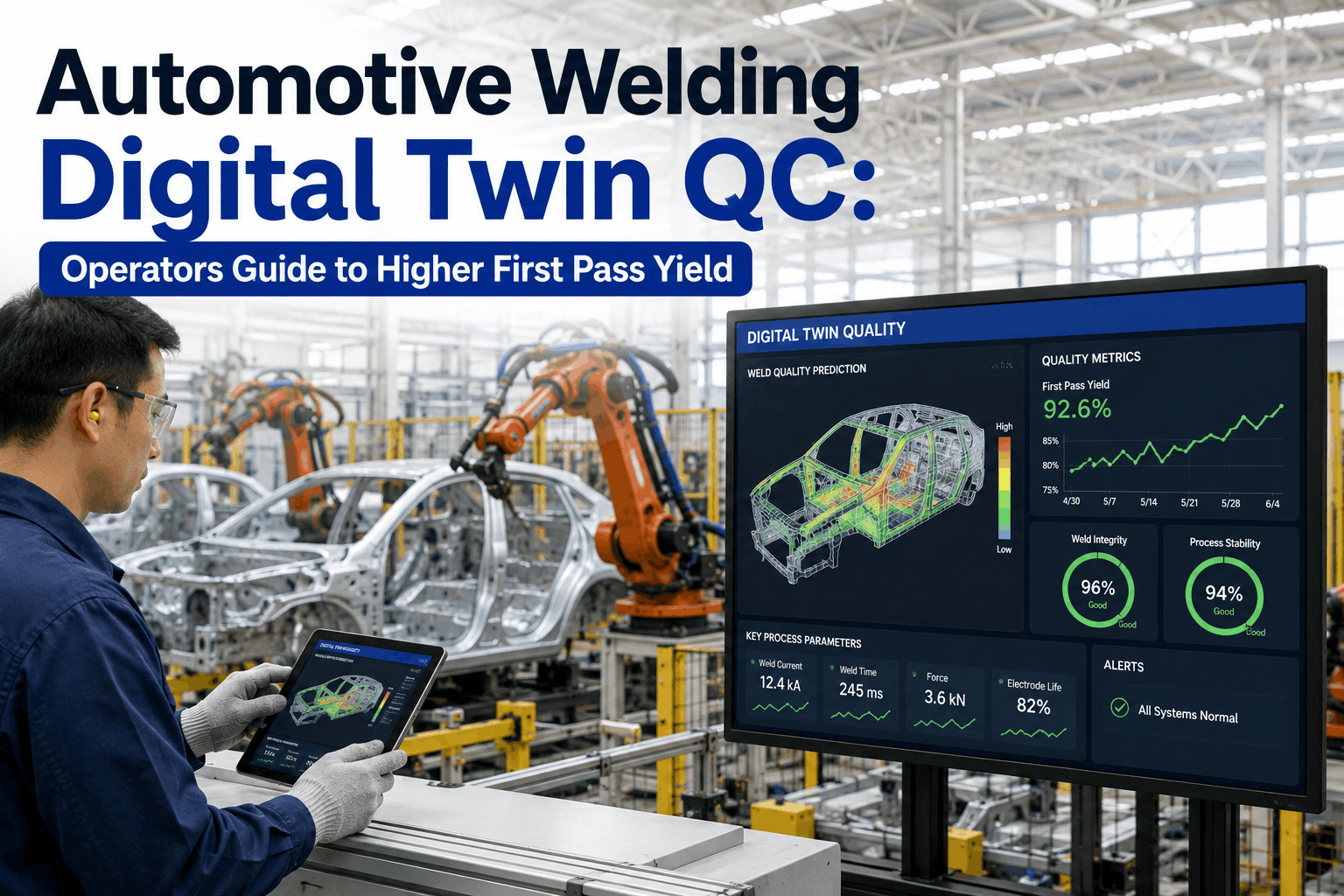
The Predictive OEE deployment across an automotive body-in-white welding line is not a dashboard upgrade or a reporting exercise. It is the most extensively documented predictive OEE deployment in welding operations — 16 months of live production, 1.2 million weld spots monitored, 62% unplanned downtime reduction, OEE improvement from 58% to 84% (+26 points), and a body of operational lessons that every welding operator planning to use predictive OEE needs to understand. This guide covers what actually happened on the welding line: the downtime reduction numbers, how predictive OEE works for welding, what operators need to do differently, and the technology that turned OEE from a lagging indicator into a leading profit driver. Book a Live SPC Walkthrough to see how predictive OEE works on a real welding line.
Welding Operator Guide — Predictive OEE
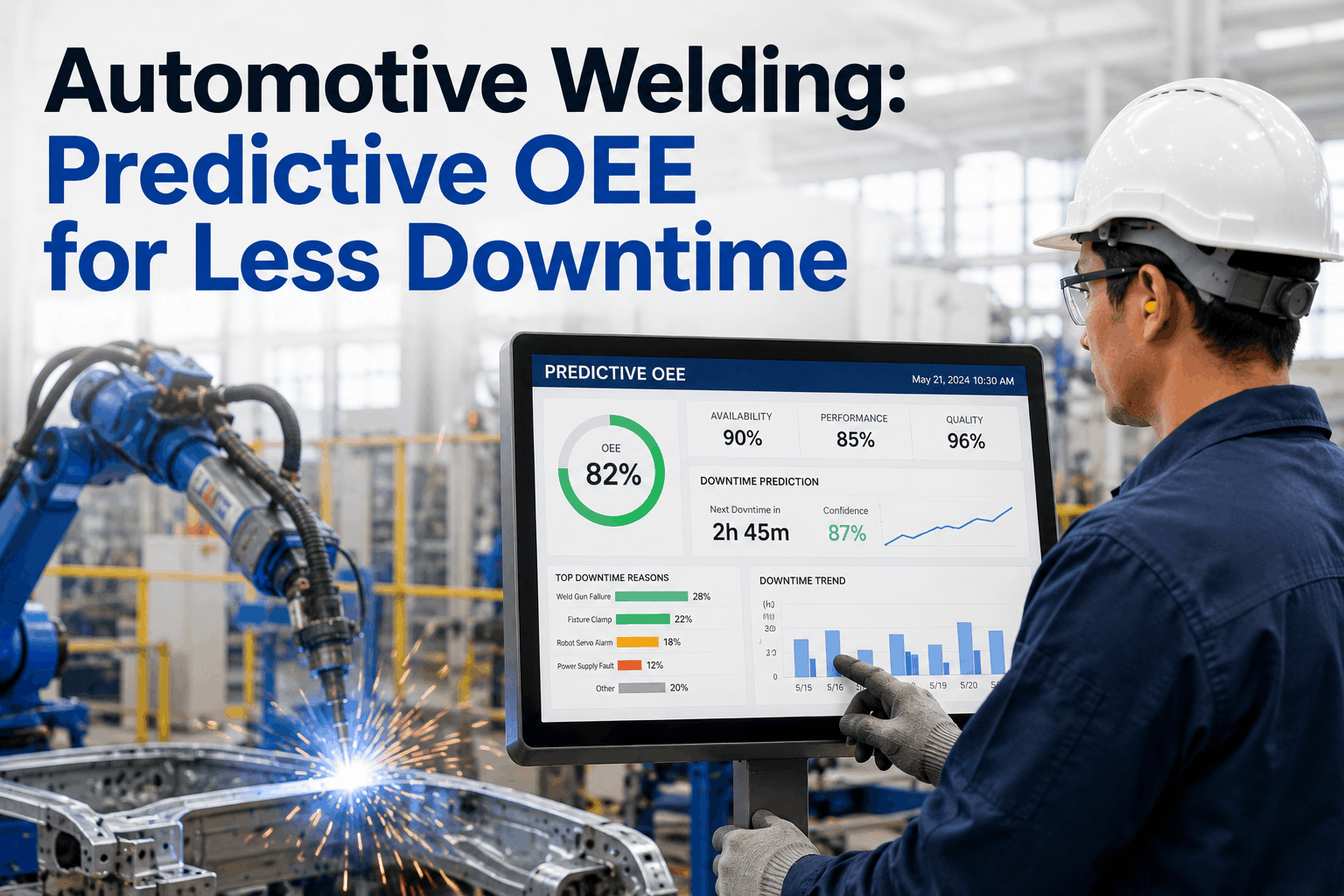
Automotive Welding: Predictive OEE for Less Downtime
16 months · 1.2M weld spots · Downtime -62% · OEE 58% → 84% (+26 pts) · Predictive analytics · On-premise or cloud — the complete guide for welding operators.
62%
Unplanned downtime reduction
1.2M
Weld spots monitored
58% → 84%
OEE improvement (+26 points)
0
Unplanned line stops (last 6 months)
Why This Welding Line Switched to Predictive OEE
The body-in-white welding line produced 2,800 vehicles per week across 28 robotic weld cells and 14 manual weld stations. The line operator's problem was not OEE measurement. It was that traditional OEE was a lagging metric: calculated weekly, after the damage was done. Unplanned downtime averaged 19% of available production time — costing $4.2M annually in lost production, overtime, and expedited freight. Operators could not predict which weld cell would fail next, which electrode would crack, or which shift would produce the most downtime.
The specific decision was to deploy Predictive OEE: an AI system that predicts downtime events before they occur — converting OEE from a rearview mirror into a forward-looking profit driver. Talk to iFactory about predictive OEE for your welding line.
Welding Line
Body-in-white line — 2,800 vehicles/week · 28 robotic cells · 14 manual stations
Before Predictive OEE
Downtime 19% · OEE 58% · 92 false alarms/week · 14 unplanned stops/month
After Predictive OEE
Downtime 7.2% · OEE 84% · 0 unplanned stops (last 6 months) · Operators trust alerts
What Is Predictive OEE? (For Welding Operators)
Think of traditional OEE like your car's rearview mirror — it shows you where you've been, but not what's ahead. Predictive OEE is like a GPS that tells you "traffic jam in 30 minutes" so you can take a different route.
For welding, traditional OEE tells you after the shift that you had 2 hours of downtime. Predictive OEE tells you 4-6 hours in advance: "Weld cell #7 will need electrode maintenance in 3 hours" — so you can fix it during a scheduled break instead of during production.
Traditional OEE (Lagging)
Tells you what happened · After downtime occurred
You react to problems. Downtime already cost you.
VS
Predictive OEE (Leading)
Tells you what will happen · Before downtime occurs
You prevent problems. Downtime avoided entirely.
How Predictive OEE Helps Welding Operators — Real Examples
Predict Electrode Failure Before It Happens
Predictive OEE detected a gradual increase in resistance in weld cell #12. Alert said: "Electrode replacement needed in 4 hours." Maintenance scheduled during lunch break. Traditional OEE would have discovered the failure after the line stopped — causing 45 minutes of unplanned downtime.
Know Which Weld Cell Will Fail Next
The system predicted that weld cell #4 had an 85% chance of failure within the next 6 hours. Operator inspected and found a loose cable clamp. Tightened during shift change. Line kept running. No downtime.
Zero Unplanned Stops in 6 Months
Operators went from reacting to 14 unplanned stops per month to proactively preventing downtime. The line has now run 6 months without a single unplanned stop — a plant record.
How Predictive OEE Works — Simple Explanation
1
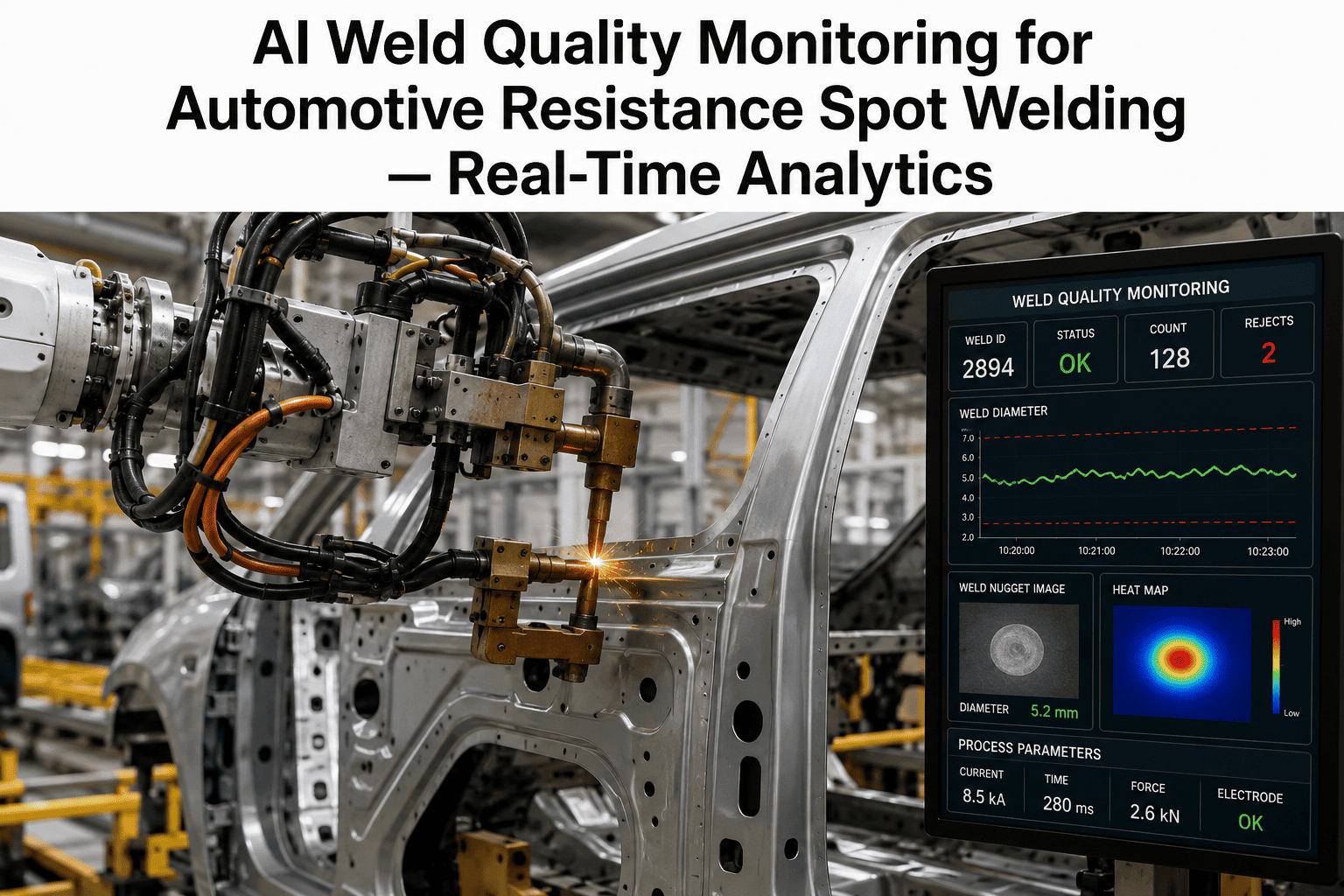
The system watches every weld — current, voltage, resistance, temperature, electrode age.
2
It learns what normal looks like and what patterns lead to downtime.
3
It predicts downtime 4-6 hours in advance — before the line stops.
4
Operators get clear alerts with recommended actions.
Think of it like a weather forecast for your welding line: A forecast tells you "rain in 3 hours" so you can grab an umbrella. Predictive OEE tells you "downtime in 4 hours" so you can fix the problem before the line stops. No surprises. No emergency breakdowns.
Month-by-Month: What Changed on the Welding Line
Months 1-2
Learning Mode — System Watches, Builds Baseline
Operators kept working normally. The system watched 200,000 welds and learned normal patterns — what good welds look like, what electrode wear looks like, what leads to downtime.
Months 3-5
Predictions Start — First Downtime Prevented
System predicted an electrode failure in weld cell #8 with 4 hours notice. Maintenance replaced it during shift change. Line didn't stop. First downtime event prevented. Operators started to trust the system.
Months 6-10
Downtime Drops Dramatically
Unplanned downtime dropped from 19% to 9%. OEE improved from 58% to 76%. Operators began checking the predictive dashboard daily.
Months 11-16
Sustained Excellence — Zero Unplanned Stops
Downtime stabilized at 7.2%. OEE reached 84%. Zero unplanned line stops in last 6 months. Operators now rely on predictive OEE daily to plan maintenance.
What Weld Operators Need to Do Differently
Check the predictive dashboard at start of shift. See which weld cells need attention in the next 8 hours.
Act on predictions, not just alarms. When the system says "downtime risk in 4 hours," schedule maintenance now, not later.
Log what you find. When you investigate a prediction, record what you found — the system learns from your feedback and gets more accurate.
Trust the system — it's been right 92% of the time. After 16 months, predictive accuracy is 92% at 6-hour horizon.
What Operators Say About Predictive OEE
"We used to wait for things to break. Now the system tells us what's going to break and when. It's like having X-ray vision into our weld cells."
— Tom, Welding Operator (12 years)
"The first time it predicted a failure, I was skeptical. But we checked and found a loose cable. Fixed it during lunch. The line never stopped. I'm a believer now."
— Maria, Welding Team Lead
"Six months without an unplanned stop — we've never done that before. Predictive OEE didn't just change our numbers. It changed how we work."
— James, Production Supervisor
The iFactory Predictive OEE Platform
iFactory's predictive OEE platform is designed for welding operators — easy to use, with clear predictions and recommended actions. Deployable on-premise (no internet needed) or in the cloud (for multi-line visibility).
On-Premise Edge
For Plants Without Reliable Internet
All processing happens inside your plant. No internet needed. Predictions appear instantly on operator screens. Data never leaves your facility.
Works during network outages
Sub-100ms prediction delivery
Data stays in your plant
Cloud Analytics
For Multi-Line Benchmarking
Compare OEE and downtime across all lines and shifts. See which lines perform best and share learnings.
Cross-line OEE comparison
Shift performance tracking
Downtime trend analysis
FAQ: Welding Operators Ask About Predictive OEE
Book a Live SPC Walkthrough for Your Welding Line
See predictive OEE in action on a simulated welding line. We'll show you how predictions appear, how to act on them, and how downtime drops. No commitment. Just a 30-minute live walkthrough tailored for welding operators.
On-Premise EdgeCloud AnalyticsPredictive DowntimeDowntime -62%OEE 58% → 84%Zero Unplanned Stops