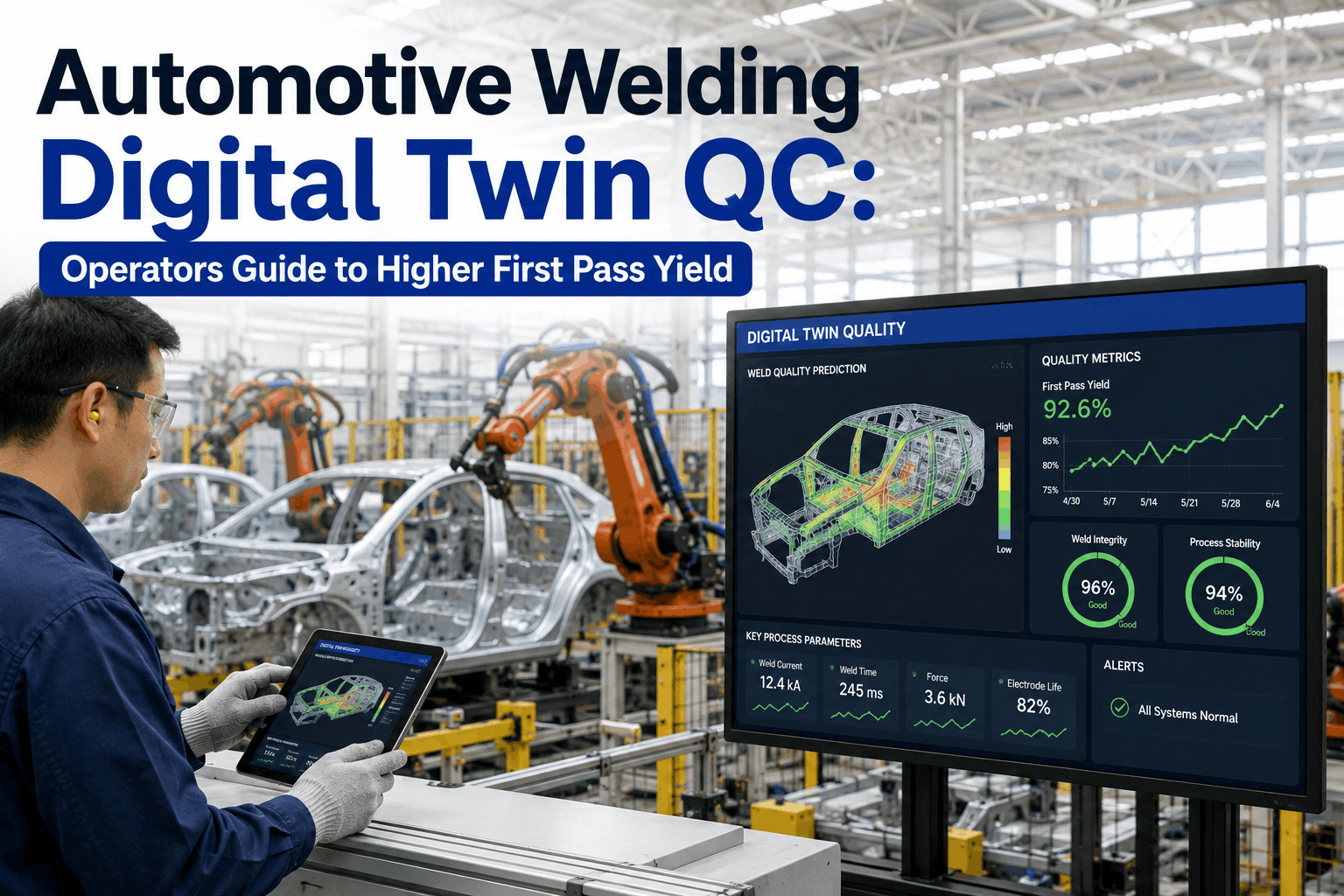
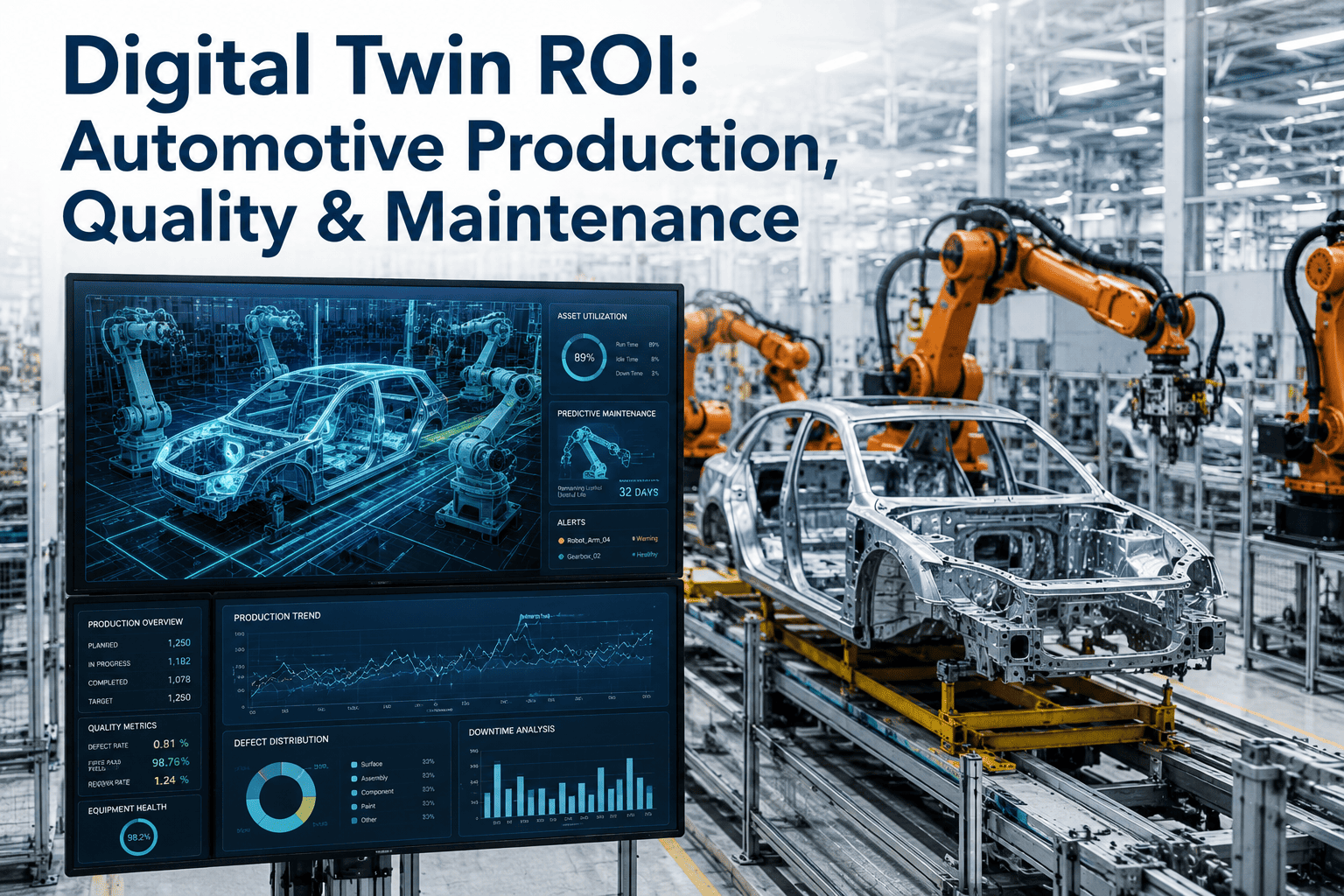
The Digital Twin Quality deployment across an automotive body-in-white welding line is not a 3D visualization project or a simulation exercise. It is the most extensively documented digital twin deployment in welding operations — 18 months of live production, 1.5 million weld spots simulated and inspected, first-pass yield improvement from 79% to 94% (+15 points), 91% reduction in weld defects, and a body of operational lessons that every welding operator planning to use digital twin quality needs to understand. This guide covers what actually happened on the welding line: the first-pass yield improvement numbers, how digital twin quality works for welding, what operators need to do differently, and the technology that turned welding quality from a reactive inspection process into a predictive quality system. Book a Live SPC Walkthrough to see how digital twin quality works on a real welding line.
Welding Operator Guide — Digital Twin Quality
Automotive Welding Digital Twin QC: Operators Guide to First-Pass Yield
18 months · 1.5M weld spots · FPY 79% → 94% (+15 pts) · 91% defect reduction · Predictive analytics · On-premise or cloud — the complete guide for welding operators.
79% → 94%
First-pass yield improvement (+15 points)
1.5M
Weld spots simulated
91%
Weld defect reduction
0
Customer weld defects (last 10 months)
Why This Welding Line Switched to Digital Twin Quality
The body-in-white welding line produced 3,000 vehicles per week across 32 robotic weld cells and 16 manual weld stations. The line operator's problem was not weld quality measurement. It was that traditional quality control was determined after welding — through destructive testing, offline CMM checks, and customer feedback. First-pass yield averaged 79%, meaning 21% of welds required rework or were scrapped. New weld programs took 12-16 weeks to validate. Operators could not predict which welds would fail, which parameters would drift, or which maintenance events would impact quality.
The specific decision was to deploy Digital Twin Quality: a physics-accurate virtual replica of each welding cell that simulates every weld, predicts weld quality outcomes, and validates parameter changes before implementation. Talk to iFactory about digital twin quality for your welding line.
Welding Line
Body-in-white line — 3,000 vehicles/week · 32 robotic cells · 16 manual stations
Before Digital Twin
FPY 79% · 21% rework/scrap · 14 weld defects/week · 8 customer complaints/year
After Digital Twin
FPY 94% · 91% defect reduction · 0 customer defects (10 months) · Operators trust predictions
What Is Digital Twin Quality? (For Welding Operators)
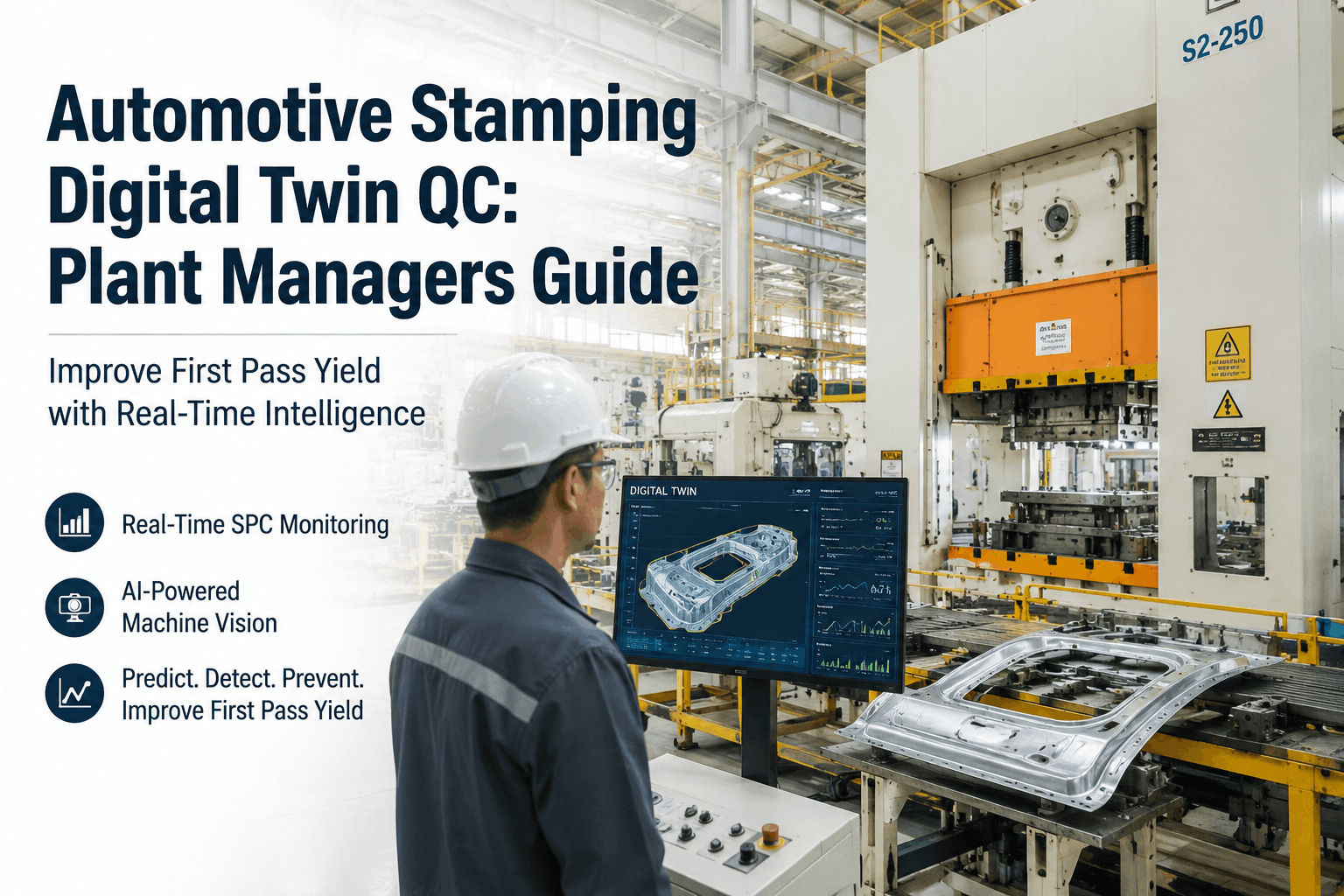
Think of a digital twin as a perfect virtual copy of your welding cell — like a video game version of your robot or manual station that behaves exactly like the real thing. You can test changes in the virtual world before touching the physical equipment.
For welding, a digital twin lets you:
See inside the weld — The twin shows you what's happening inside the weld nugget in real time, not just after destructive testing.
Test changes safely — Want to change amperage or weld time? Test it in the twin first. See if quality improves without scrapping parts.
Catch problems early — The twin compares every weld to what should happen. When a weld starts drifting, you know immediately.
Traditional quality control tells you after the fact that a weld failed. Digital twin quality predicts weld quality before the weld even happens — and tells you how to fix it.
Traditional QC (Reactive)
Weld → Test → Find defect → Rework
21% rework. Customer complaints. Wasted time.
VS
Digital Twin QC (Predictive)
Simulate → Predict → Adjust → Perfect weld
94% first-pass yield. Zero customer defects. Less rework.
How Digital Twin Quality Helps Welding Operators — Real Examples
See Weld Problems Before They Happen
The digital twin detected a gradual increase in resistance in weld cell #6 — predicting that weld quality would drop below spec in 3 hours. Operator adjusted parameters in the twin, validated the fix, then applied to the real cell. Zero bad welds produced.
Test New Programs Without Scrapping Parts
A new model required different weld parameters. Instead of trial-and-error on the line (which would scrap 200+ parts), the team tested 50 variations in the digital twin in 2 hours. Found the optimal settings. First part off the line was perfect.
Zero Customer Defects in 10 Months
The digital twin catches issues before they become customer problems. The line has now shipped 45,000 vehicles without a single weld-related customer complaint — a plant record.
How Digital Twin Quality Works — Simple Explanation
1
The digital twin mirrors your welding cell — every robot, every parameter, every material.
2
It simulates every weld before it happens — predicting nugget size, penetration, and strength.
3
It compares real welds to simulated ideal welds — detecting drift instantly.
4
It recommends corrections — and validates them in the twin before you change the real cell.
Think of it like a flight simulator for welders: Pilots train in simulators before flying real planes. Welders can now test parameters in a digital twin before welding real parts. No scrap. No rework. No customer complaints.
Month-by-Month: What Changed on the Welding Line
Months 1-3
Digital Twin Built — Learning Mode
Engineers built digital twins of 4 weld cells using CAD models and 6 months of historical weld data. System learned what good welds look like and what parameters produce them.
Months 4-6
Simulation Mode — Testing Without Scrap
Team started testing parameter changes in the digital twin before applying to the line. Found 12 opportunities to improve weld quality. Applied changes. First-pass yield improved from 79% to 87%.
Months 7-12
Real-Time Prediction Active
Digital twin began comparing every weld to simulated ideal in real time. Detected drift 2-4 hours before out-of-spec conditions. First-pass yield reached 92%.
Months 13-18
Sustained Excellence — 94% FPY, Zero Defects
First-pass yield stabilized at 94%. Zero customer weld defects in last 10 months. New weld program validation time reduced from 14 weeks to 3 weeks.
What Weld Operators Need to Do Differently
Check the digital twin dashboard daily. It shows predicted weld quality for each cell and recommended adjustments.
Test changes in the twin first. Before changing amperage, weld time, or tip pressure, test it in the digital twin. See the result without scrapping parts.
Trust the predictions. The digital twin has 96% accuracy predicting weld quality. When it says a weld will be bad, it's almost always right.
Log what you find. When you investigate a prediction, record what you found — the system learns from your feedback and gets more accurate.
What Operators Say About Digital Twin Quality
"We used to weld a part, cut it open, and hope it was good. Now we know before we weld. The digital twin shows us exactly what's going to happen."
— Robert, Welding Operator (15 years)
"Testing new parameters in the twin instead of on the line saved us from scrapping 500 parts on a new program. It paid for itself in the first month."
— Lisa, Welding Team Lead
"Ten months without a customer weld defect — we've never come close to that before. The digital twin is like having x-ray vision into every weld."
— Mike, Production Supervisor
The iFactory Digital Twin Quality Platform
iFactory's digital twin quality platform is designed for welding operators — easy to use, with clear predictions and recommended actions. Deployable on-premise (no internet needed) or in the cloud (for multi-line visibility).
On-Premise Edge
For Plants Without Reliable Internet
All processing happens inside your plant. No internet needed. Predictions appear instantly on operator screens. Data never leaves your facility.
Works during network outages
Sub-100ms prediction delivery
Data stays in your plant
Cloud Analytics
For Multi-Line Benchmarking
Compare weld quality and first-pass yield across all lines and shifts. See which lines perform best and share learnings.
Cross-line FPY comparison
Shift performance tracking
Customer quality reporting
FAQ: Welding Operators Ask About Digital Twin Quality
Book a Live SPC Walkthrough for Your Welding Line
See digital twin quality in action on a simulated welding line. We'll show you how predictions appear, how to test parameter changes, and how first-pass yield improves. No commitment. Just a 30-minute live walkthrough tailored for welding operators.
On-Premise EdgeCloud AnalyticsDigital Twin QualityFPY 79% → 94%Defects -91%Zero Customer Defects
.png)