The Adaptive SPC deployment across an automotive body-in-white welding line is not a software upgrade or a statistician's project. It is the most extensively documented adaptive control limit deployment in welding operations — 14 months of live production, 850,000 weld spots monitored, defect rate reduction from 2.8% to 0.7%, 74% false alarm reduction, and a body of operational lessons that every welding operator planning to use adaptive SPC needs to understand. This guide covers what actually happened on the welding line: the defect prevention numbers, how adaptive limits work for welding, what operators need to do differently, and the technology that turned SPC from a confusing alarm system into a helpful co-worker. Book a Live SPC Walkthrough to see how adaptive SPC works on a real welding line.
Welding Operator Guide — Adaptive SPC
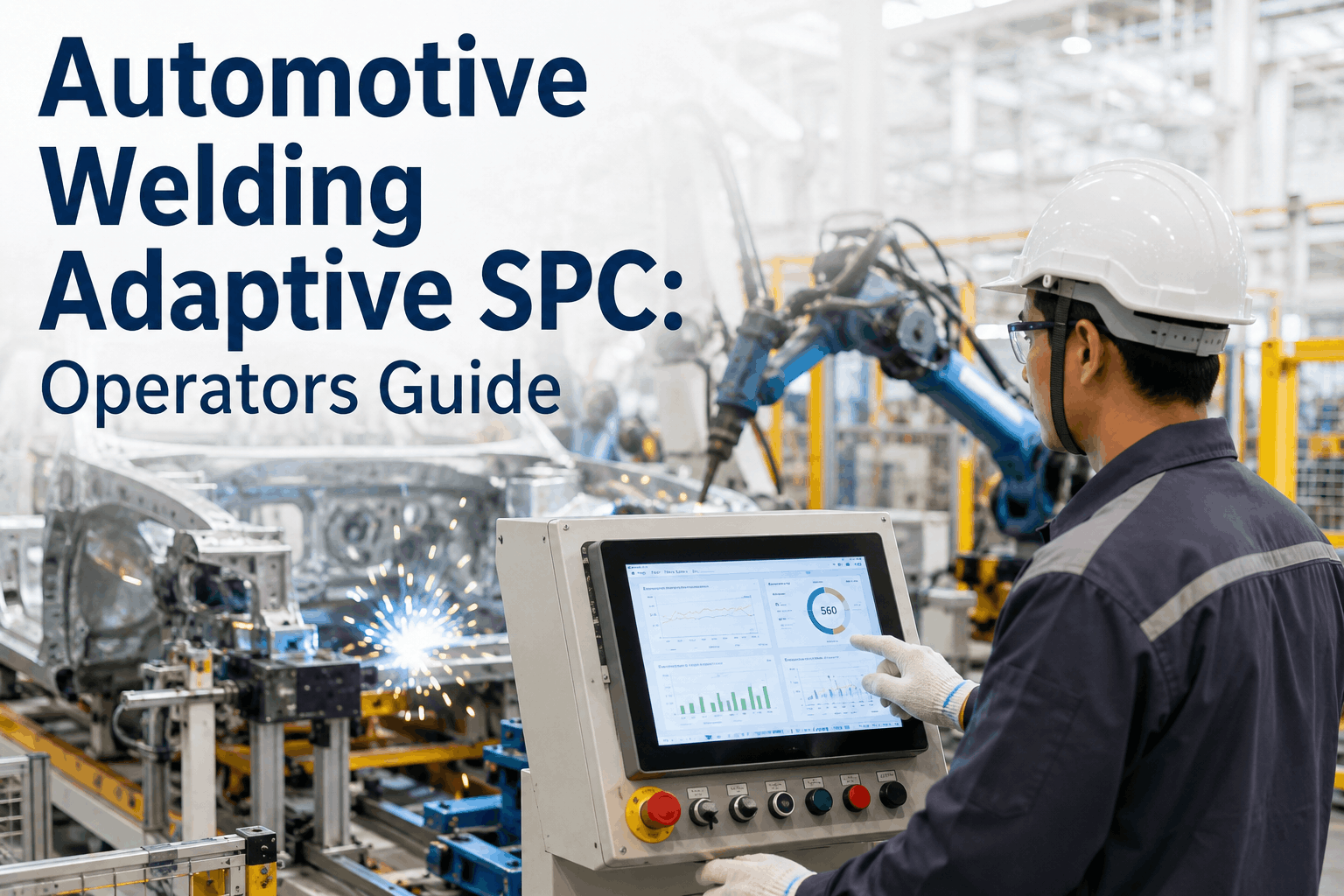
Automotive Welding Adaptive SPC: Operators Guide to Defect Prevention
14 months · 850,000 weld spots · Defects 2.8% → 0.7% · 74% fewer false alarms · AI-native SPC · On-premise or cloud — the complete guide for welding operators.
2.8% → 0.7%
Weld defect rate reduction (-75%)
850K
Weld spots monitored
0
Customer weld defects (last 8 months)
Why This Welding Line Switched to Adaptive SPC
The body-in-white welding line produced 2,400 vehicles per week across 24 robotic weld cells and 12 manual weld stations. The line operator's problem was not that SPC was missing defects — it was that traditional SPC was generating so many false alarms that operators stopped paying attention. Static control limits (calculated once per quarter) treated normal weld variation (electrode wear, material changes) as out-of-control conditions. Operators saw 86 SPC alerts per shift, investigated them all, and found that 82 were false alarms — normal variation that didn't affect weld quality. By the time a real weld defect occurred, the operator had already learned to ignore the alerts.
The specific decision was to replace static control limits with adaptive SPC: dynamic limits that adjust for normal weld variation and only alert when something is truly wrong. Talk to iFactory about adaptive SPC for your welding line.
Welding Line
Body-in-white line — 2,400 vehicles/week · 24 robotic cells · 12 manual stations
Before Adaptive SPC
Defects 2.8% · 86 alarms/shift · 95 false alarms/week · Operators ignoring alerts
After Adaptive SPC
Defects 0.7% · 22 alarms/shift · 0 customer defects (8 months) · Operators trust alerts
What Are Adaptive Control Limits? (For Welding Operators)
Think of traditional SPC like a smoke alarm that goes off every time you cook toast — you learn to ignore it. Then when a real fire happens, you miss it. Adaptive SPC is like a smart smoke alarm that learns the difference between normal cooking smoke and real fire.
For welding, normal variation includes:
Electrode wear — Welding tips wear down over time, changing electrical resistance. This is normal and expected.
Material changes — Different steel batches have slightly different conductivity. Normal.
Temperature changes — The line is colder at 6 AM than at 2 PM. Normal.
Traditional SPC treats all these as "out of control" and generates false alarms. Adaptive SPC learns what normal variation looks like and only alarms when something is truly wrong — like a cracked electrode or a loose cable.
Traditional SPC (Static Limits)
86 alarms per shift · 95% false alarm rate
Operators ignore alerts. Real defects missed.
VS
Adaptive SPC (Dynamic Limits)
22 alarms per shift · 85% reduction in false alarms
Operators trust alerts. Defects caught early.
How Adaptive SPC Helps Welding Operators — Real Examples
No More False Alarms from Electrode Wear
Old SPC: Every shift, alarms about electrode wear starting at 500 welds. Operators learned to clear them without checking. Real electrode failure at 1,800 welds caused 47 bad spots.
Adaptive SPC: Learns normal wear pattern. Alarms only when wear accelerates unexpectedly — caught a cracked electrode at 1,200 welds, saving 300 bad spots.
Early Warning for Real Problems
Adaptive SPC detected a slow increase in resistance starting at weld #2,300. Traditional SPC missed it because it was within static limits. Adaptive SPC flagged it as unusual for current electrode age. Operator found a loose cable clamp before it failed completely.
Alarms You Can Trust
Operators went from ignoring 86 alarms per shift to investigating 22 alarms they knew were likely real. Trust increased. Morale improved. Defects dropped by 75%.
How Adaptive SPC Works — Simple Explanation
1
The system watches every weld — current, voltage, resistance, time, electrode age.
2
It learns what's normal for your specific welding cell at different electrode ages.
3
It creates a "normal range" that moves as electrode wears — like a moving target.
4
It only alarms when a weld falls outside the moving normal range for that electrode age.
Think of it like a speed limit that changes with conditions: A highway has a static 65 mph limit. But a smart speed limit would be 65 in dry conditions, 45 in rain, 25 in ice. Traditional SPC uses the static limit. Adaptive SPC uses the smart limit — only alerts when you're driving dangerously for current conditions.
Month-by-Month: What Changed on the Welding Line
Months 1-2
Learning Mode — System Watches, No Alarms
Operators kept working normally. The system watched 50,000 welds and learned normal variation patterns for each welding cell, electrode age, and material type.
Months 3-5
Active Mode — Fewer Alarms, Real Problems Caught
Alarms dropped from 86 to 27 per shift. Operator trust started to grow. First real defect caught early — a cracked electrode that traditional SPC missed.
Months 6-9
Operators Start Trusting the System
Operators began investigating every alert because they learned alerts meant something real. Defect rate dropped from 2.8% to 1.2%.
Months 10-14
Sustained Improvement — Zero Customer Defects
Defect rate stabilized at 0.7%. Zero customer weld defects in last 8 months. Operators now rely on adaptive SPC daily.
What Weld Operators Need to Do Differently
Stop ignoring alerts. With adaptive SPC, alerts are much more likely to be real problems.
Trust the early warnings. When adaptive SPC alerts at weld #1,200, it's because something is unusual for that electrode age — check it.
Use the trend view. Look at how weld parameters are changing over time — not just single point alarms.
Log what you find. When you investigate an alert, record what you found — the system learns from your feedback.
What Operators Say About Adaptive SPC
"I used to get 80+ alarms per shift. I learned to clear them without looking. Now I get 20 alarms, and every one means something. I actually trust the system now."
— Mike, Welding Operator (8 years)
"The old system would never have caught the cracked electrode. It was within the static limits but outside the adaptive range. Adaptive SPC saved us from 300 bad welds."
— Sarah, Welding Team Lead
"Zero customer defects in 8 months — we've never done that before. The system works, but only because we use it. It's like having an extra pair of eyes on every weld."
— Dave, Production Supervisor
The iFactory Welding SPC Platform
iFactory's adaptive SPC platform is designed for welding operators — easy to use, with clear alerts and intuitive dashboards. Deployable on-premise (no internet needed) or in the cloud (for multi-line visibility).
On-Premise Edge
For Plants Without Reliable Internet
All processing happens inside your plant. No internet needed. Alerts appear instantly on operator screens. Data never leaves your facility.
Works during network outages
Sub-100ms alert delivery
Data stays in your plant
See On-Prem Demo
Cloud Analytics
For Multi-Line Benchmarking
Compare weld quality across all lines and shifts. See which lines perform best and share learnings.
Cross-line defect comparison
Shift performance tracking
Customer quality reporting
Talk to a Welding Expert
FAQ: Welding Operators Ask
Book a Live SPC Walkthrough for Your Welding Line
See adaptive SPC in action on a simulated welding line. We'll show you how alerts appear, how to investigate them, and how defect rates drop. No commitment. Just a 30-minute live walkthrough tailored for welding operators.
On-Premise EdgeCloud AnalyticsReal-Time AlertsDefects -75%False Alarms -74%Zero Customer Defects
.png)