
For automotive Plant Managers, welding downtime is the operational metric that decides every other metric. A body-in-white plant running 60 jobs-per-hour with 4,500 weld points per body executes roughly 270,000 welds per shift across 200–300 robotic weld guns. Every minute of welding downtime represents $1,500–$8,000 in lost throughput depending on plant configuration — and most weld-related downtime today is reactive rather than predictive. Electrode wear gets discovered when weld quality fails; weld controller faults get diagnosed after the line stops; missed welds get caught at downstream inspection where rework cost is 3–8× the in-line correction cost. Predictive SPC for automotive welding changes that pattern. AI-driven multivariate analysis of every weld signature (current, voltage, electrode force, weld time, water flow) catches drift hours before failure thresholds. AI Vision verifies every weld nugget appearance inline. Predictive electrode wear models schedule dressing proactively. Plant Managers running these systems report 50%+ unplanned downtime reduction within 12 months — measured in plant OEE, customer scorecard improvement, and direct dollar throughput recovery. iFactory AI delivers this on a pre-configured NVIDIA appliance running on-premise inside the plant, integrated natively with major weld controller brands (Bosch, ARO, Centerline, Nimak, Stäubli), and live in 6–12 weeks. This page is the Plant Manager's guide to predictive SPC for automotive welding, the ROI framework that justifies the investment, and what implementation actually looks like.
Predictive SPC: Less Downtime in Automotive Welding
The automotive Plant Manager's guide to cutting weld-related downtime 50%+ through AI-powered predictive SPC and AI Vision inspection. Real-time control charts on every weld gun · electrode wear prediction · missed-weld detection · live OEE dashboard. Pre-configured NVIDIA appliance, integrated with major weld controllers, live in 6–12 weeks.
Where Welding Downtime Actually Goes — And Where AI Reclaims It
Plant Manager intuition on welding downtime is usually directionally correct but often miscalibrated on magnitude. The actual breakdown of unplanned welding downtime in modern automotive BIW operations follows a predictable pattern across plants, and the AI capabilities that address each component differ significantly. The visualization below shows where the hours actually go — and which AI mechanisms recover each category.
For a typical mid-volume BIW plant running 200,000 vehicles per year, this translates to recovering 80–140 production hours annually — at the plant's effective production value per hour, the savings typically run $3M–$11M in throughput recovery alone, before counting reduced electrode consumption and quality cost avoidance.
Want a sized plant-specific projection of where your welding downtime goes and what's recoverable? Calculate Your Plant ROI — iFactory's automotive team will build a customized downtime breakdown and recovery projection for your specific plant configuration, weld gun count, and current OEE. Sessions available this week.
Predictive SPC for Welding — How It Actually Works
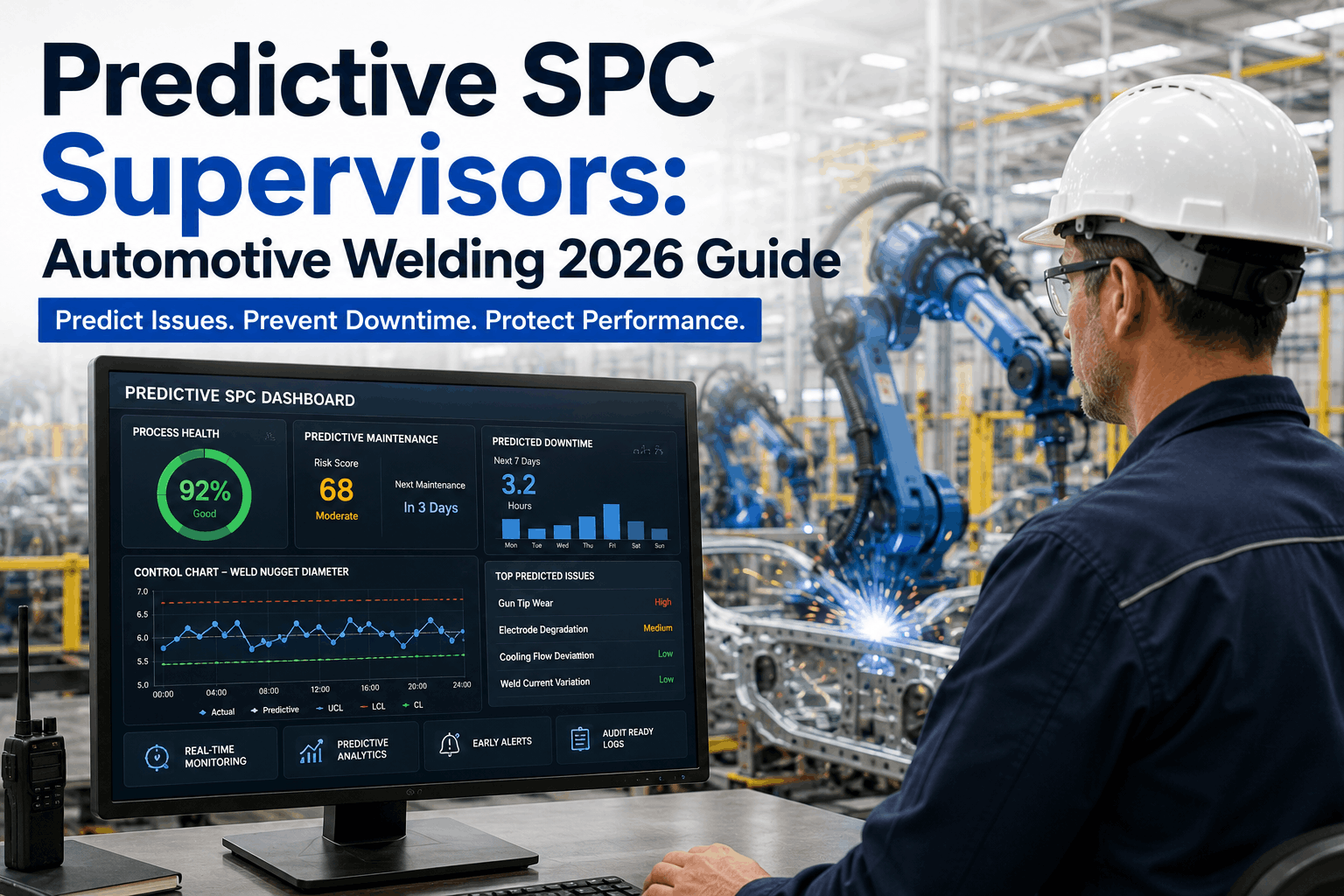
"Predictive SPC" in welding contexts often gets confused with traditional SPC running on weld parameters. The actual difference is fundamental — traditional SPC plots parameters against fixed control limits and flags violations after they occur; predictive SPC uses multivariate AI to predict parameter trajectories and electrode wear curves hours ahead, surfacing issues while they're still preventable. The contrast shows up directly in operator and Plant Manager daily experience.
The visualization tells the operational story clearly. Traditional SPC catches the parameter drift at USL breach — by then the electrode is worn, weld quality has been degrading for the last hour, and the line must stop for emergency dressing. Predictive SPC catches the same drift signature 4 hours earlier through multivariate trajectory analysis. The plant schedules dressing during a planned changeover window — no unplanned line stop, no quality hold, no scrap. Same problem, same outcome avoided, completely different downtime impact.
AI Vision + Predictive SPC — The Two-Layer Weld Quality Pipeline
Two AI layers working together on every weld
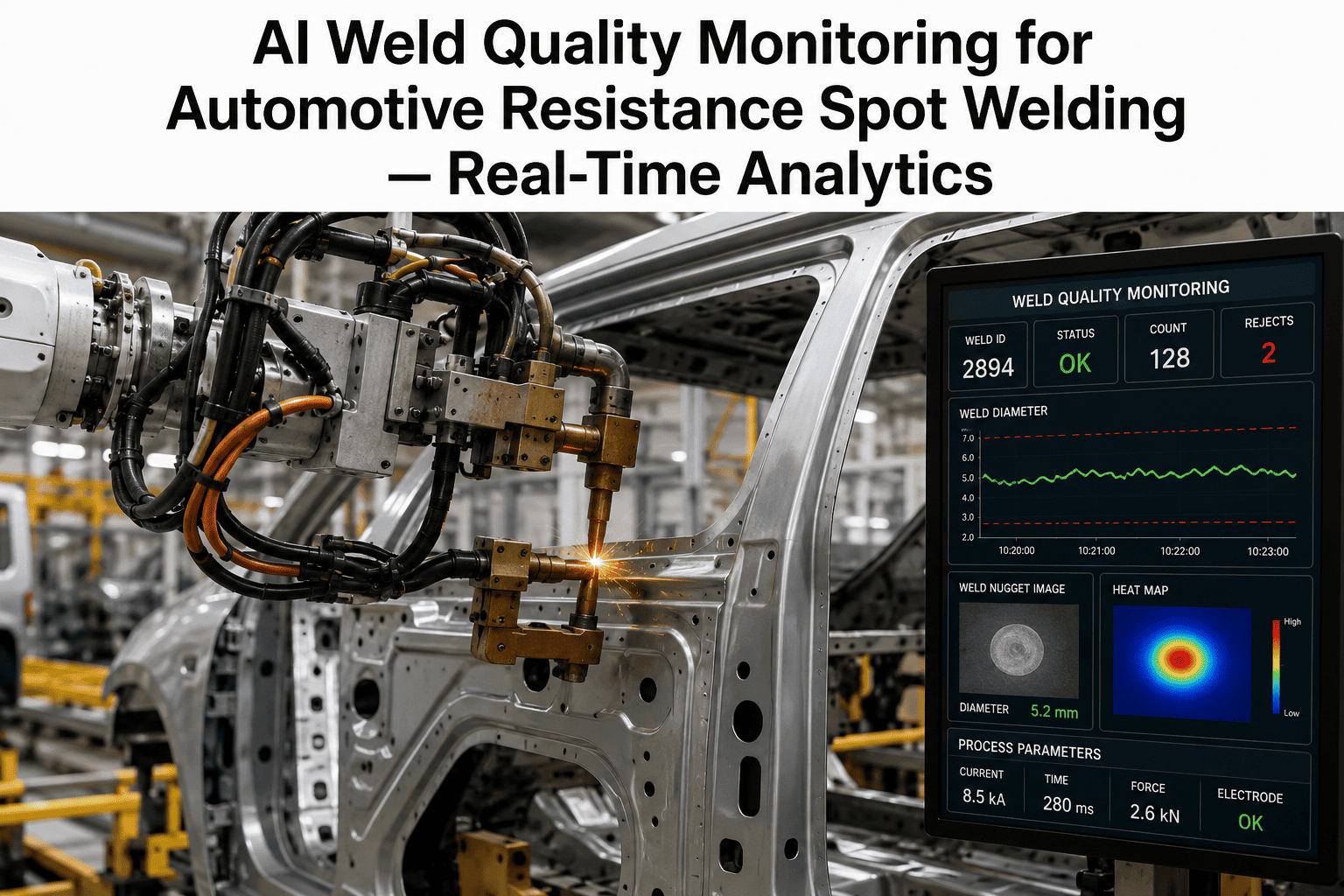
The full pipeline combines two AI capabilities — Predictive SPC on weld controller parameters (current, voltage, force, time, water flow) and AI Vision Inspection on weld nugget appearance. Together they catch both process-level drift before it becomes scrap and appearance-level defects in-line. Each weld passes through both checks within the cycle time of the next weld, with no slowdown to production speed.
Want to see the predictive SPC + AI Vision weld pipeline running on representative scenarios from your plant? Calculate Your Plant ROI — sessions include live demonstration tailored to your weld gun types, controller brands, and production volumes. Sessions available this week.
The Plant Manager ROI Framework — Four Calculation Categories
How welding predictive SPC pays back at the plant level
The ROI framework for Plant Managers reduces to four measurable categories. Each can be sized from current-state operational data, and together they typically deliver payback in 6–14 months on the platform investment for a mid-volume to high-volume BIW plant.
1. Throughput Recovery
Eliminated unplanned downtime translates directly to additional vehicles produced per shift at the existing capital base. The largest single category for high-throughput plants.
2. Quality Cost Avoidance
Weld defects caught in-line by AI Vision cost 3–8× less than downstream rework. Predictive SPC prevents the deviation entirely on the upstream side.
3. Consumable Reduction
Predictive electrode wear models extend tip life by avoiding premature dressing. Typical reduction in electrode/cap consumption runs 35–45%.
4. Labor Productivity
Maintenance and operator time shifts from reactive emergency intervention to scheduled proactive work. Labor productivity improves without headcount change.
For a typical mid-volume BIW plant (60 JPH, 200K vehicles annually, 250 weld guns), the combined ROI across the four categories runs $4.5M–$12M in year one, with payback on a typical $1.4M–$2.5M platform investment in 4–10 months depending on starting OEE baseline.
Want the four-category ROI calculation built for your specific plant configuration? Send your plant size, weld gun count, current OEE, and JPH to iFactory support and the automotive team will return a complete ROI projection across all four categories — typically within 3 business days, no obligation.
Six Weld Downtime Causes — And How Each Gets Addressed
Electrode Wear & Premature Dressing
LSTM model predicts electrode wear curve per gun based on weld count, current/force signatures, and historical patterns. Dressing scheduled proactively during planned windows.
Weld Quality Holds & Investigations
AI Vision verifies every weld nugget appearance inline. Predictive SPC catches parameter drift before quality holds trigger. Holds drop dramatically with fewer false negatives.
Weld Controller Faults
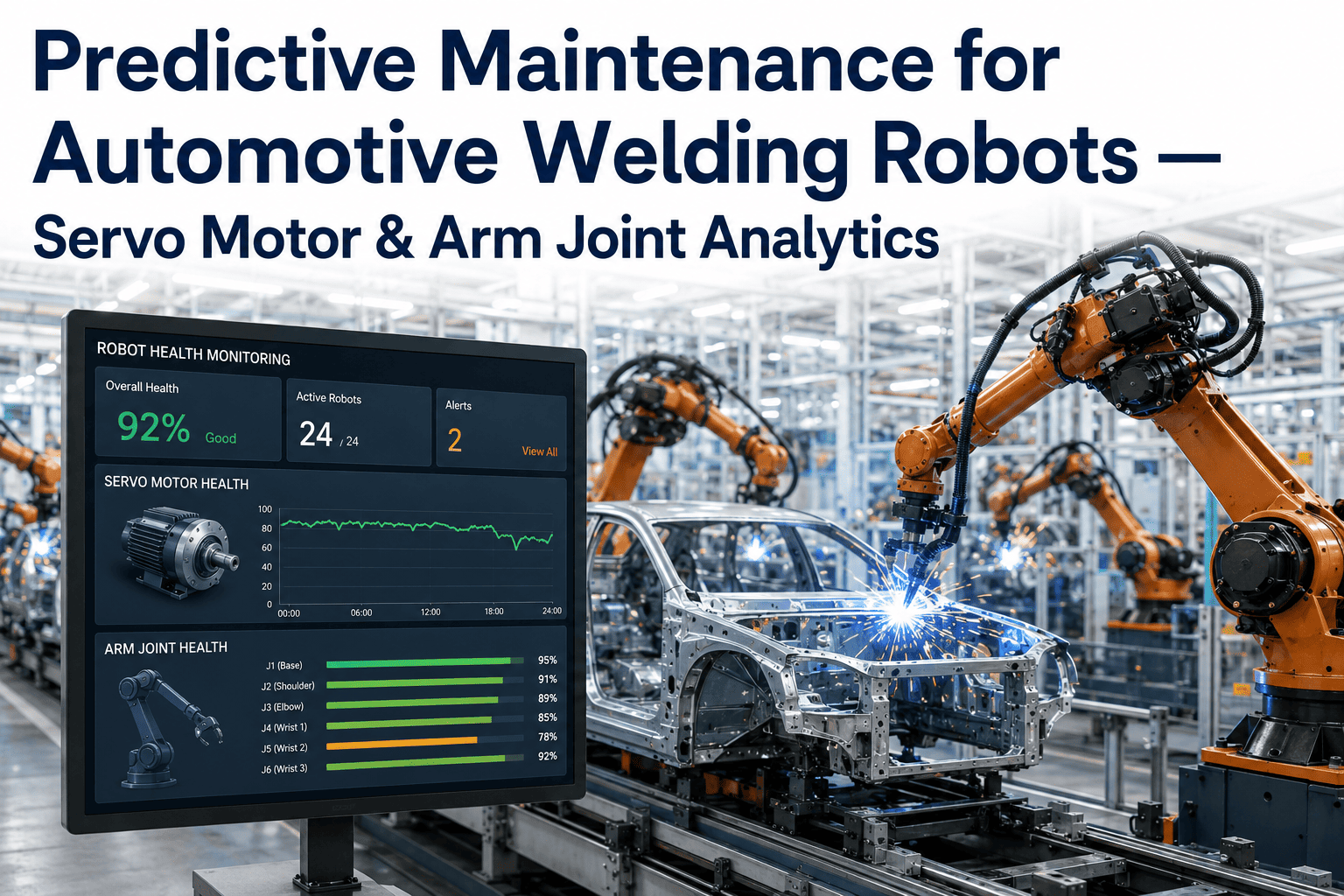
Multivariate models detect controller fault signatures (transformer aging, water flow issues, contactor wear) 4–24 hours before actual fault. Maintenance scheduled, not reactive.
Robot Dressing Coordination
Coordinated dressing schedule across multiple robots in same cell minimizes total line stop time. AI predicts which guns need dressing in same window.
Material Lot Variation
SPC correlates downstream weld quality issues to specific incoming sheet metal lots. Material-specific adaptive limits handle lot-to-lot variation automatically.
Missed Welds & Sequence Errors
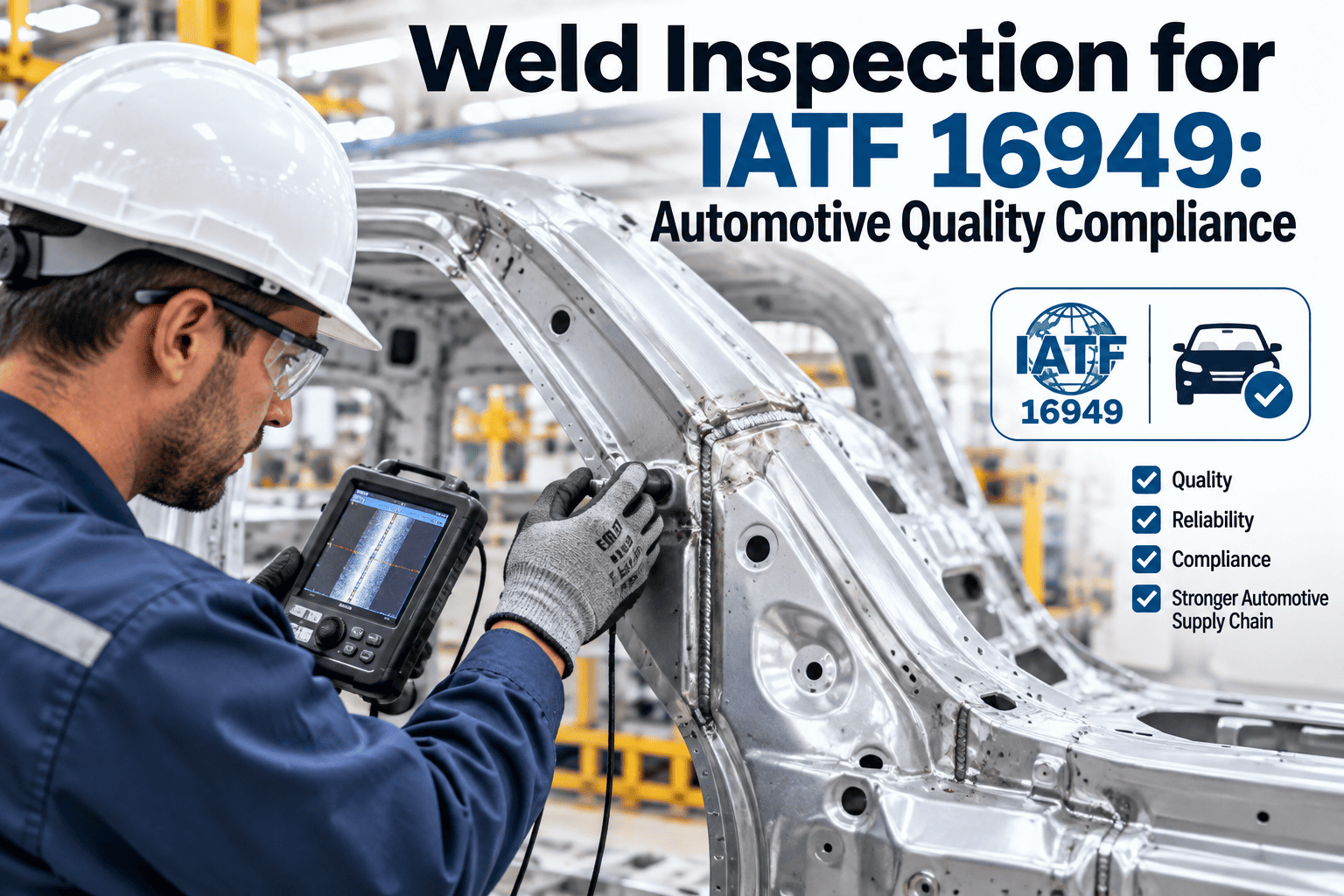
AI Vision verifies weld presence and sequence completion before vehicle leaves station. Missed welds caught at the cell, not at downstream BIW inspection.
IATF 16949, AIAG & Automotive Customer Requirements — Built In
Pre-built workflows for automotive quality frameworks
- IATF 16949 — automotive quality management system requirements
- ISO 9001 — quality management system foundation
- AWS D8.7M / D17.2 — automotive weld quality standards
- AWS D16.4 — robotic welding system specification
- PPAP — Production Part Approval Process automation
- AIAG SPC manual — full Western Electric & Nelson Rules
- Customer-Specific Requirements — Ford, GM, FCA, VW, Toyota
- FMEA + Control Plan integration — automotive standard
The Compliance Layer assembles weld quality audit evidence continuously as production runs, eliminating manual evidence assembly for IATF audits, PPAP submissions, and customer scorecard responses. Audit prep typically drops from 1–3 weeks of manual work to 2–4 hours of review and approval per audit cycle.
Two Real Plant Manager Welding Outcomes
High-volume body-in-white plant with 280 weld guns and chronic electrode wear-related downtime
A high-volume BIW plant producing 240,000 vehicles annually across 14 lines with 280 robotic weld guns. Unplanned weld-related downtime ran 8–12% with electrode wear and quality holds as the dominant categories. Plant OEE sat at 76% — below corporate target of 85%. Each percent of downtime represented roughly $1.2M in lost throughput annually.
Tier 1 plant with stamping and welding operations and chronic weld quality holds
A Tier 1 automotive supplier operating integrated stamping and welding operations producing structural assemblies for two OEM customers. Weld quality holds averaged 4–6 hours per shift across the operation. Customer scorecards reflected the quality variance, putting one OEM relationship in yellow status. Plant Manager P&L pressure included both throughput and customer scorecard impact.
Neither scenario matches your plant? Send your plant configuration, weld gun count, current OEE, and JPH to iFactory support and the automotive team will return a customised welding ROI analysis with 12-month roadmap — typically within 3 business days, no obligation.
iFactory's Welding Deployment — On-Premise or Cloud
Same AI-native platform on either deployment model. Same predictive SPC, AI Vision, electrode wear models, OEE dashboard. For automotive welding specifically, on-prem is the strongly recommended default because of inference latency requirements at production speed and IATF audit boundary considerations.
iFactory On-Premise Appliance Strong default for automotive welding operations
- Pre-configured NVIDIA AI server — racked, software-loaded, ready to plug in.
- <50ms end-to-end inference — keeps up with 60+ JPH BIW lines.
- Integrated with weld controllers — Bosch, ARO, Centerline, Nimak, Stäubli native.
- Works during WAN outages — plant continues at full rate.
iFactory Cloud For multi-plant operations with established cloud governance
- Fully managed — no rack, no facility requirements.
- Same welding intelligence — predictive SPC, AI Vision, OEE dashboard.
- Cross-plant OEE benchmarking across all welding operations.
- Fastest deployment — first plant live in 2–4 weeks.
Welding downtime decides plant economics. Predictive SPC decides welding downtime.
Plant OEE, customer scorecards, P&L throughput, electrode consumption, quality cost — all of them trace back to how welding operations behave hour by hour. Predictive SPC + AI Vision running on a pre-configured NVIDIA appliance turns reactive welding operations into proactive ones, with 50%+ unplanned downtime reduction typical within 12 months. The plant ROI calculation sizes the migration concretely for your specific operation.
Frequently Asked Questions
How does predictive SPC handle different weld controller brands?
iFactory integrates natively with major automotive weld controller brands — Bosch, ARO, Centerline, Nimak, Stäubli, Harms+Wende — via OPC UA, EtherNet/IP, PROFINET, and direct ladder/PLC interfaces. The deployment team configures the specific controller integrations during the 6–12 week installation. The predictive SPC models work across mixed controller fleets in the same plant, with adaptive limits tuning per gun rather than per controller brand.
What's the accuracy of electrode wear prediction in practice?
For mature deployments, electrode wear prediction accuracy runs 85–92% within a ±4 hour window — meaning the prediction of when dressing will be needed lands within 4 hours of the actual optimal dressing time 85–92% of the time. False positives (predicting dressing earlier than needed) typically run 5–8%; false negatives (missing the dressing window) run under 3%. Accuracy continues improving as the learning loop matures with more weld history.
Does AI Vision work on all weld types?
AI Vision works well on visible-surface welds (spot welds, MIG, MAG, laser) where the nugget or bead is accessible to camera inspection. For welds with restricted access or sub-surface inspection needs (some friction-stir, some heavy structural), AI Vision is complemented by ultrasonic inspection integration. The deployment team assesses camera access during the initial site visit and recommends the appropriate inspection strategy per weld location.
How does the Plant Manager OEE dashboard look?
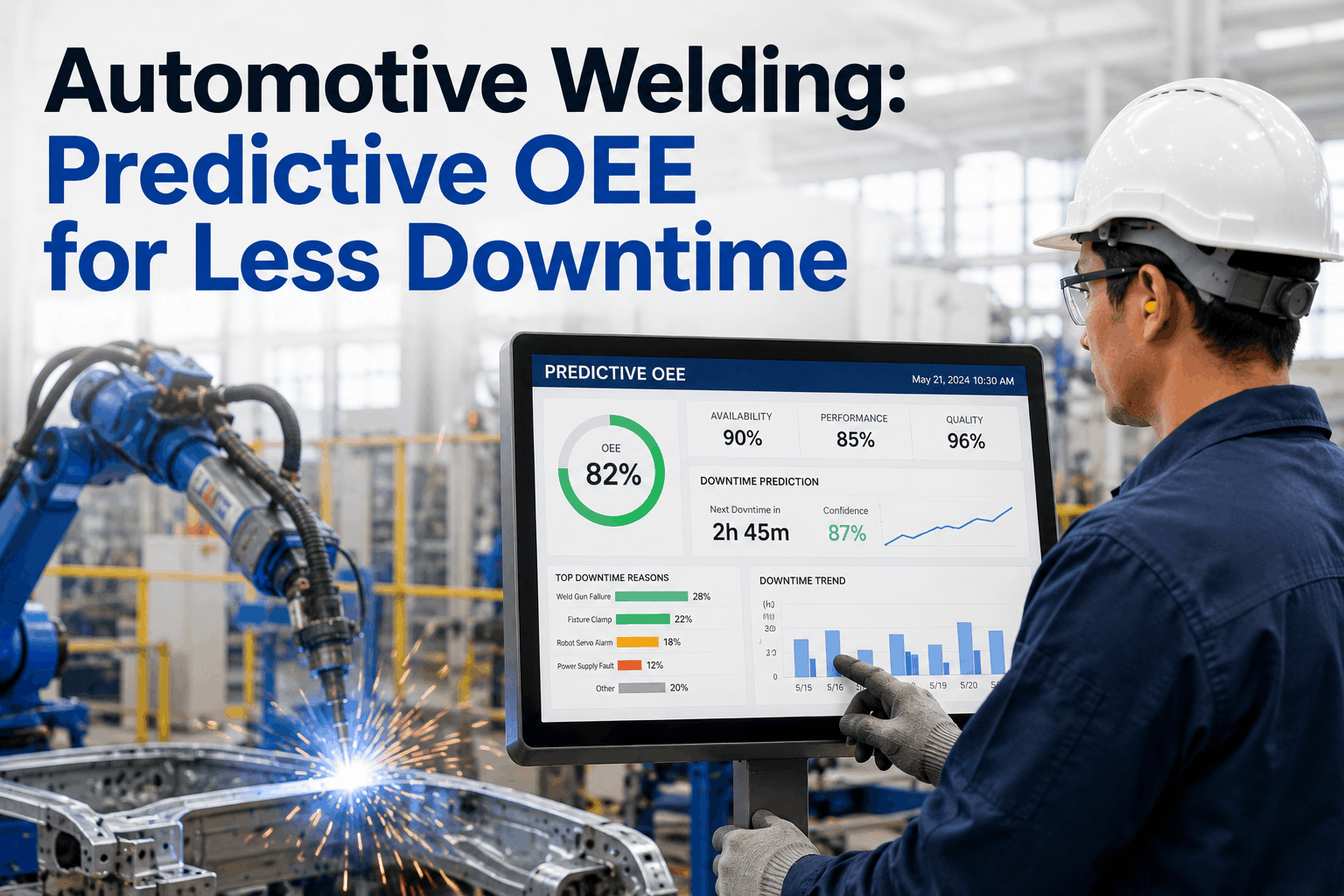
The Plant Manager dashboard shows live OEE across all lines, broken down into Availability/Performance/Quality factors with click-through to weld-gun-level detail. Predictive alerts surface 2–48 hours ahead of operational events. Comparison views across lines, shifts, and product mix support root-cause analysis. Custom KPIs (cost per vehicle, scrap cost, electrode cost per 1000 welds) can be added during deployment.
Do I have to buy NVIDIA servers separately?
No. iFactory's on-premise appliance ships fully loaded — pre-configured NVIDIA AI server, software pre-installed, network gear, cabling, industrial cameras for weld inspection, edge devices for line-side inference. You provide rack space, line power, Ethernet, and weld controller / PLC integration points. The deployment team handles all installation and configuration. For cloud, no hardware investment at all.
Can we deploy on one weld cell first before plant-wide?
Yes — and it's the recommended approach. Start with the cell where downtime cost is highest (typically a critical-path BIW cell with high JPH). Validate the predictive SPC accuracy and OEE improvement on that cell. Then expand cell-by-cell in 2–4 week waves. Full plant deployment for a typical 250–400 weld gun operation completes in 4–6 months end-to-end with the OEE dashboard live plant-wide by month 3.
How does the ROI calculation actually work?
iFactory's automotive team builds a four-category ROI projection using your inputs — plant size, JPH, weld gun count, current OEE, electrode consumption baseline, quality hold frequency, customer scorecard status. The projection covers throughput recovery, quality cost avoidance, consumable reduction, and labor productivity for years 1–3 with confidence bands. Most plants see year-one ROI of 3–7× the platform investment with payback in 4–10 months.
The Plant Manager's choice is whether welding stays reactive or becomes predictive.
Welding downtime is the largest controllable lever in BIW plant economics. Predictive SPC + AI Vision running on a pre-configured NVIDIA appliance turns it from a daily emergency into a managed schedule — 50%+ unplanned downtime reduction within 12 months, payback in 4–10 months, customer scorecards moving from yellow to green. The next step is sizing the calculation against your specific plant — sessions available this week.
.png)

