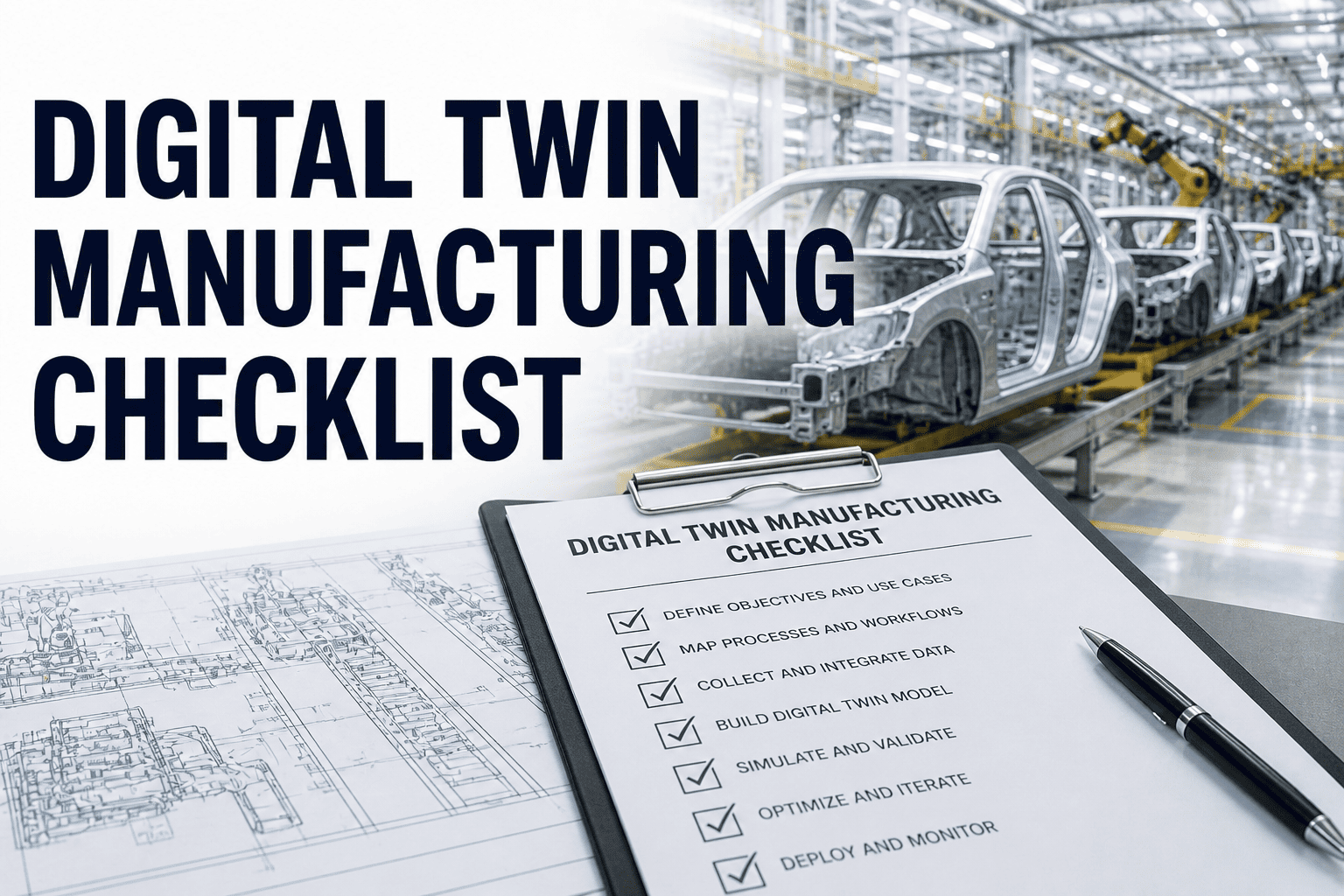
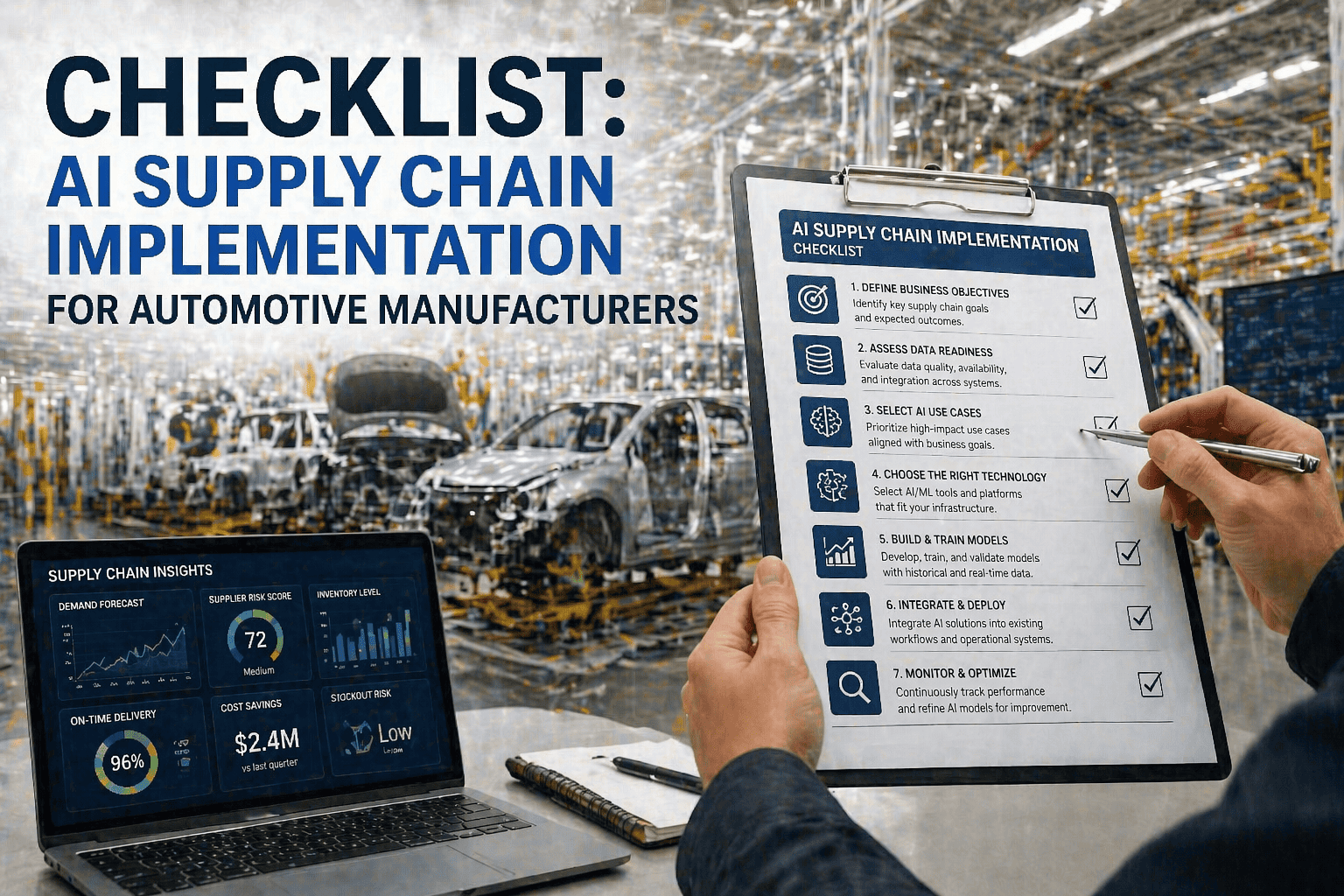
Most automotive manufacturers investing in AI for their Manufacturing Execution System never see production-scale results — not because the technology fails, but because the prerequisites were never met. Only 42% of manufacturers have moved beyond pilot-stage AI, and the primary blocker is undiagnosed readiness gaps in data infrastructure and OT-IT integration. This checklist gives your team a structured, honest assessment of where you stand across every dimension that determines whether your MES AI implementation succeeds or stalls. Book a demo to walk through this checklist with an iFactory engineer.
Practical Implementation Guide
Checklist: AI-Ready MES Implementation for Automotive Manufacturers
6 readiness dimensions. 30 checkpoints. Everything your team must validate before committing to an AI-MES deployment.
Your Readiness Score
0–40%
Not Ready
Critical gaps block deployment
41–70%
Partially Ready
Pilot possible, scale not yet
71–100%
AI-Ready
Full deployment viable
95%
of enterprise AI programs fail to reach production due to readiness gaps (MIT, 2025)
42%
of manufacturers have moved beyond pilot-stage AI (Capgemini, 2025)
2.3x
faster AI time-to-value with shop-floor digital upskilling (BCG)
How to Use This Checklist
Work through all six dimensions in sequence — each builds on the one before. For each checkpoint, mark it as Complete, In Progress, or Gap. Count your Complete checkpoints at the end of each section to calculate your section score. If any section scores below 60%, address those gaps before proceeding to AI-MES deployment. Not sure how to score your current state? Talk to an iFactory expert — we conduct complimentary readiness assessments for automotive manufacturers.
Sensor data is captured at ≥1 Hz frequency from all critical equipment
AI models for predictive maintenance and quality require high-frequency time-series data. Slow polling rates create blind spots between readings.
Historical MES data is available for at least 12 months per production line
Machine learning models need sufficient historical context to detect failure patterns and seasonal variation in production cycles.
Data schemas are standardized — no conflicting naming conventions across equipment generations
Inconsistent tag names, unit conventions, and timestamp formats between equipment vintages require expensive normalization before AI can run.
Data completeness rate is above 95% — missing values are flagged, not silently dropped
Silent data gaps corrupt model training. A documented imputation strategy is required before AI deployment.
A data historian (OSIsoft PI, Wonderware, or equivalent) is in place and accessible
AI platforms require a reliable time-series data store. Scattered CSV exports from individual machines do not constitute a data historian.
OPC-UA or MQTT protocol is adopted on ≥70% of production equipment
Proprietary PLC protocols (Siemens S7, Allen-Bradley DF1) require custom driver development. OPC-UA standardization dramatically reduces integration cost and time.
Network segmentation separates OT and IT environments with controlled data bridge
Direct OT-IT connectivity without segmentation is a cybersecurity risk. A DMZ or data diode architecture allows data flow while protecting control systems.
Edge computing nodes are deployed or planned for latency-sensitive decisions
Quality holds, safety alerts, and closed-loop process adjustments require sub-5ms decisions. Cloud-only architectures cannot meet this latency requirement.
MES data flows into ERP (SAP or equivalent) with latency under 15 minutes
Batch ERP updates create planning blind spots. AI scheduling optimization requires near-real-time MES-ERP synchronization to be effective.
A unified data architecture document exists covering all OT, MES, and ERP data flows
AI vendors need this to scope integration accurately. Plants without architecture documentation routinely underestimate integration effort by 3–5x.
MES exposes a REST or GraphQL API for external system integration
File-based integration (CSV exports, FTP drops) cannot support real-time AI analytics. API connectivity is a hard prerequisite for production-grade AI.
MES can receive write-back signals — not just serve as a data source
AI recommendations (quality holds, maintenance alerts, schedule changes) must be executable via the MES. Read-only integration limits AI to reporting, not action.
MES version is current — no end-of-life platform without upgrade plan
Legacy MES platforms (pre-2018) often lack the API surface and event streaming capabilities AI requires. Confirm vendor support status before starting integration.
Quality, traceability, and production order data are stored in MES (not just paper or standalone systems)
AI quality models require digital access to inspection results, defect codes, and rework records. Paper-based quality systems are a critical blocker.
MES downtime and OEE data is captured automatically — not manually entered by operators
Manually entered downtime data is systematically incomplete and biased. AI OEE models trained on manual data inherit those errors and produce unreliable recommendations.
OT engineers understand both physical systems and data pipelines (not separate teams)
The OT-IT seam is the most common place AI projects stall. Engineers who can work both sides reduce integration timelines by 40–60%.
Shift operators are comfortable using digital MES terminals and dashboard tools
AI alert systems and recommendation dashboards require operators to engage with digital interfaces. Workforce digital literacy directly impacts how quickly AI generates ROI.
A named change-management owner is assigned for the AI-MES implementation
The #1 root cause of pilot stalls is missing plant-floor change-management ownership — not technology failure. This person must have both authority and shop-floor credibility.
3–5 measurable KPIs are defined before deployment (OEE %, MTBF, first-pass yield, etc.)
Without pre-deployment baselines, it is impossible to prove AI ROI or identify underperforming models. Define KPIs before signing any vendor contract.
Leadership sponsor is identified at plant director or VP Manufacturing level
Companies where the CEO or plant director personally oversees AI governance report the strongest financial outcomes. Executive sponsorship is a performance variable, not just a formality.
First use case is scoped to a single line or process — not a plant-wide rollout
Broad-scope initial deployments are the second most common cause of AI project failure. Start with the highest-value, narrowest-scope use case and prove ROI before scaling.
OT cybersecurity assessment completed in the past 12 months
As OT networks link to IT, the attack surface grows dramatically. OT cybersecurity investment grew 39% in 2025 following a 210% surge in targeted industrial cyber incidents.
EU AI Act risk classification assessed for planned AI use cases (high-risk vs. limited-risk)
Predictive maintenance, quality inspection, and worker-safety AI are classified as high-risk under Annex III — requiring documented conformity assessment before deployment.
Data residency and sovereignty requirements documented for all production data streams
Cloud AI deployments must comply with data sovereignty laws. Sensitive production data (process parameters, IP-containing quality data) may require on-premises or regional processing.
Scoring Your Results
0–12 checkpoints
Not Ready
13–21 checkpoints
Partially Ready
22–30 checkpoints
AI-Ready
Who should fill out this readiness checklist?
This checklist requires cross-functional input. Ideally, your Plant Operations Manager, IT/OT Engineering Lead, and Quality Manager should complete this assessment together to prevent blind spots.
What if our facility scores "Not Ready" on the assessment?
A "Not Ready" score is protective—it saves you from investing in an AI pilot that is mathematically destined to stall. Use the identified gaps as a roadmap. Focus on standardizing data schemas and establishing API connectivity first.
How long does an AI-MES integration typically take once we are "AI-Ready"?
Once structural prerequisites are met, an initial pilot on a single production line typically takes 8–12 weeks from project kickoff to live, actionable recommendations on the shop floor.
Do we need to migrate to a Cloud MES to implement AI?
Not necessarily. While cloud infrastructures simplify scaling, modern on-premise MES platforms can fully support edge-based AI deployments, provided they have REST/GraphQL API accessibility and proper OT-IT network segmentation.
iFactory Assessment
Not Sure Where You Stand? We'll Walk Through It With You.
iFactory engineers conduct complimentary MES AI readiness assessments for automotive manufacturers — mapping your current data infrastructure, OT-IT architecture, and MES capabilities against this checklist before any commercial discussion.
No Commitment Required
Automotive-Specific
MES + SAP Expertise
OT-IT Integration