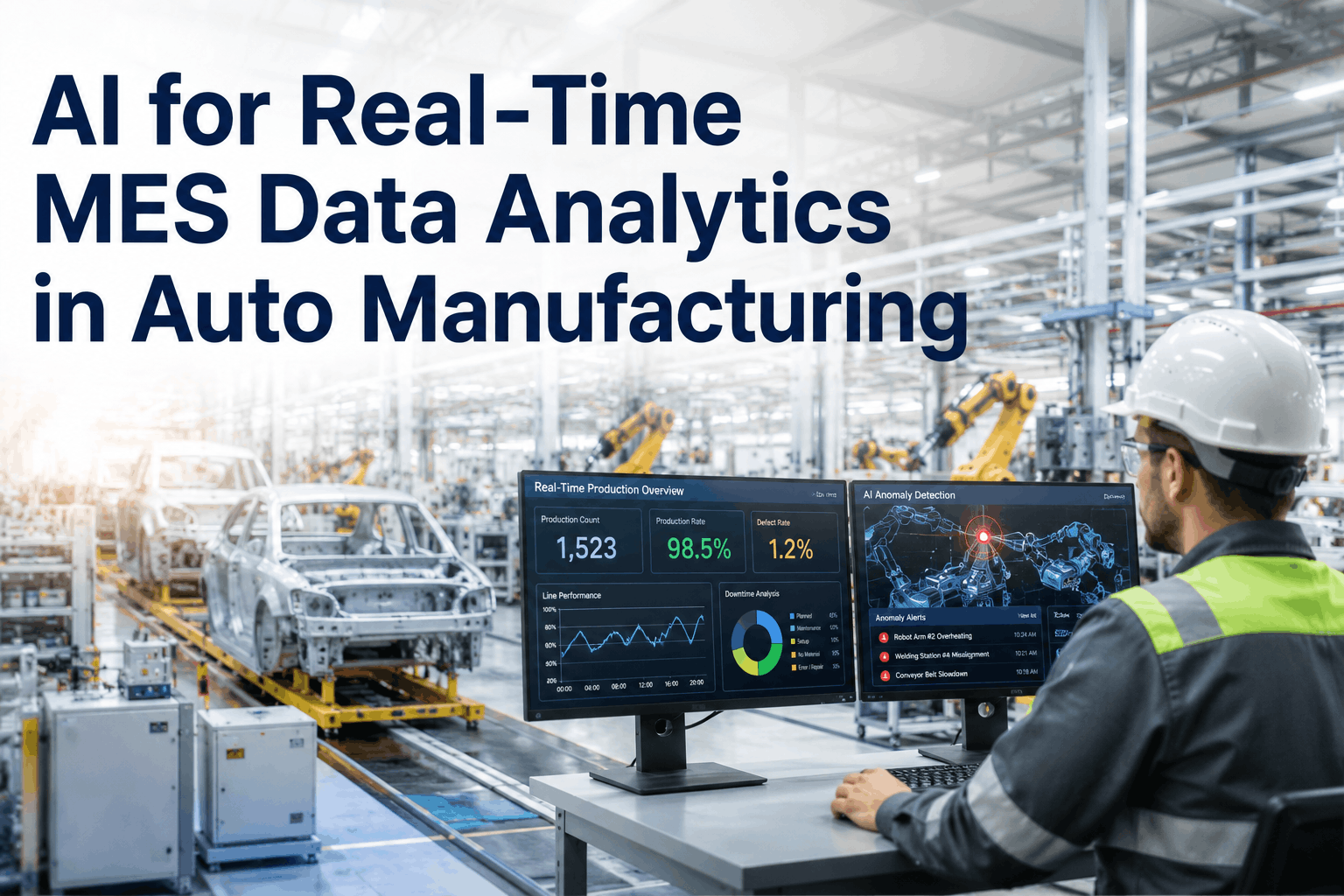
Your Manufacturing Execution System generates thousands of data points every minute — machine cycle times, quality check results, material consumption, operator actions, yield rates. Yet most automotive plants make production decisions based on reports generated hours ago, or worse, yesterday. That gap between data generated and insight acted upon is where production losses, quality escapes, and unplanned downtime are born. AI-powered real-time MES data analytics closes that gap permanently. See how iFactory transforms MES data into real-time production intelligence — book a demo.
AI for Real-Time MES Data Analytics in Auto Manufacturing
Turn your shop floor data stream into live decisions. AI analytics layers on top of your existing MES and ERP to detect problems, predict failures, and optimize output — before your shift manager even gets the alert.
The Problem: MES Data is Everywhere. Insight is Nowhere.
Modern automotive plants run on data. A single assembly line can generate over 2 million data points per shift from PLCs, sensors, vision systems, and operator inputs feeding into the MES. The problem is not data volume — it is data utility. Most automotive manufacturers operate with fragmented data ecosystems where MES, ERP, WMS, and quality systems run as separate islands, and the shop floor data that could drive real decisions never surfaces in time to matter.
MES tracks shop floor execution. ERP manages planning and finance. Neither system talks to the other in real time. A production schedule change in SAP takes hours to reflect on the factory floor — creating ghost allocations, material waste, and missed targets.
Quality defects are discovered at the end-of-line check or, worse, in warranty returns. By the time a process drift is flagged in the MES, hundreds of non-conforming parts have already moved downstream. The cost of late detection is 10–100x the cost of early prevention.
Unplanned downtime costs automotive manufacturers an estimated $50 billion annually across the industry. Most MES systems record the failure — they do not predict it. Without AI pattern recognition, the warning signs in vibration data, temperature cycles, and cycle time drift go unnoticed until the machine stops.
Most automotive plants run a mix of equipment generations — some PLCs from the 1990s feeding data into modern MES platforms. Inconsistent data schemas, proprietary protocols, and manual data entry points create gaps that no dashboard can fix without intelligent data normalization.
How AI Transforms MES Data Into Real-Time Production Intelligence
AI does not replace your MES. It amplifies it. By sitting as an intelligence layer between your MES, ERP, IoT sensors, and quality systems, AI continuously processes the full data stream — normalizing formats, detecting anomalies, identifying patterns, and surfacing decisions that would otherwise take a human analyst hours to find. Here is what that looks like across five core production functions:
AI monitors process parameters — torque, temperature, weld energy, dimensional measurements — in real time and detects statistical drift before it produces a nonconforming part. Instead of sampling 5% of output, every unit is effectively quality-checked against a live process model. Plants using this approach report 35% improvement in first-pass quality rates.
Machine learning models trained on historical failure data analyze vibration signatures, thermal patterns, and cycle time deviations to predict equipment failures 2–6 weeks in advance. Maintenance teams shift from calendar-based PMs to condition-based interventions — reducing unplanned downtime by 30–50% and cutting maintenance costs by 25–40%.
When MES data feeds directly into AI scheduling models, production plans respond to actual floor conditions — not yesterday's plan. A bottleneck detected at Station 12 at 9:47 AM triggers automatic resequencing upstream before a line stop cascades. SAP HANA's AI layer, for example, provides real-time inventory replenishment recommendations by integrating live MES consumption data with ERP demand signals.
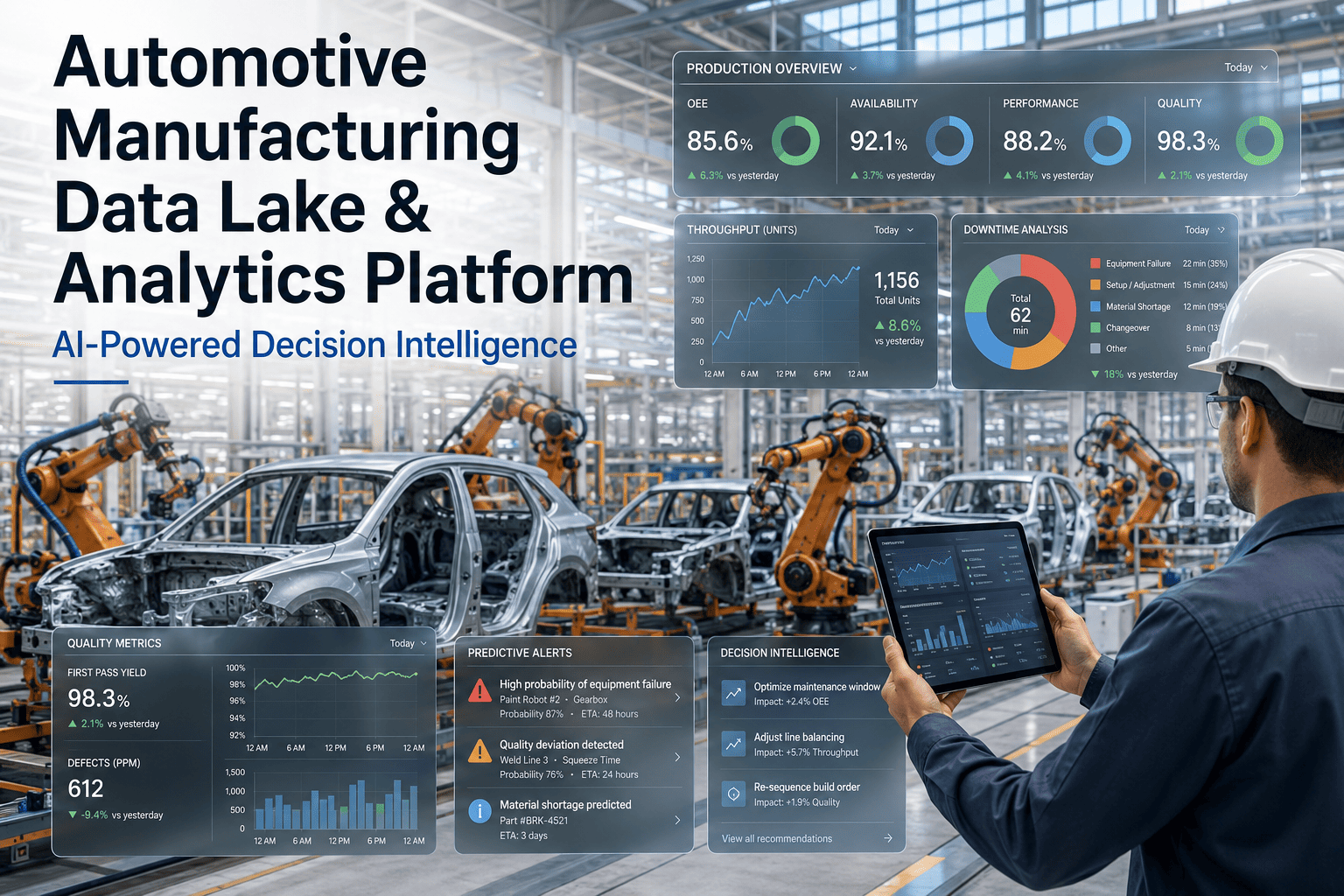
AI continuously calculates real Overall Equipment Effectiveness — not the reported OEE that obscures micro-stoppages and speed losses. By analyzing every second of machine state data, AI identifies the true top 5 losses on each line with statistical certainty, enabling engineering resources to focus where gains are largest.
AI middleware bridges the ERP planning layer and MES execution layer in real time. Production order status, material consumption, and quality results flow upward to SAP instantly — eliminating end-of-shift batch updates that leave planners flying blind. A global automotive manufacturer using integrated SAP MES reported a 20% improvement in production efficiency from this synchronization alone.