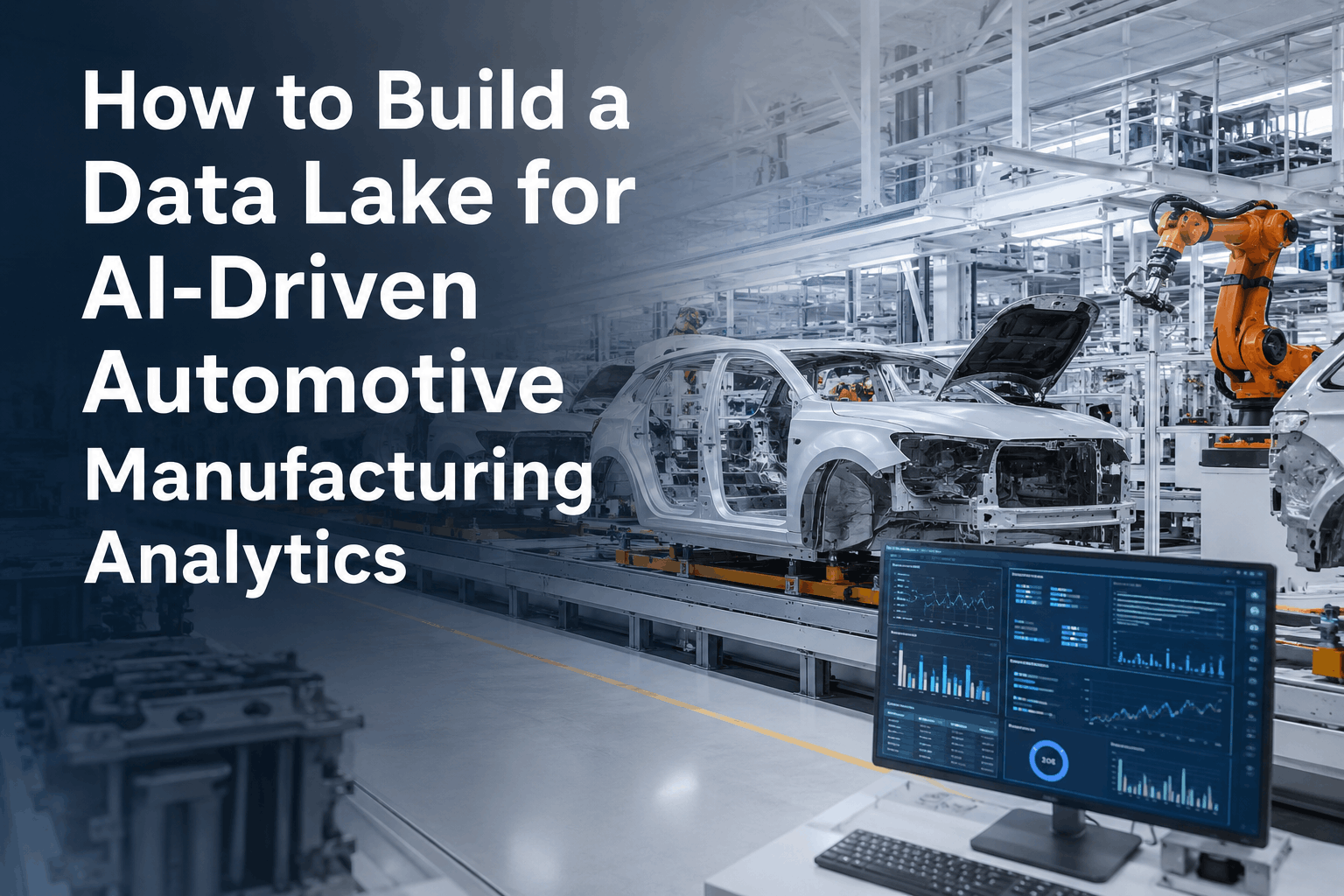
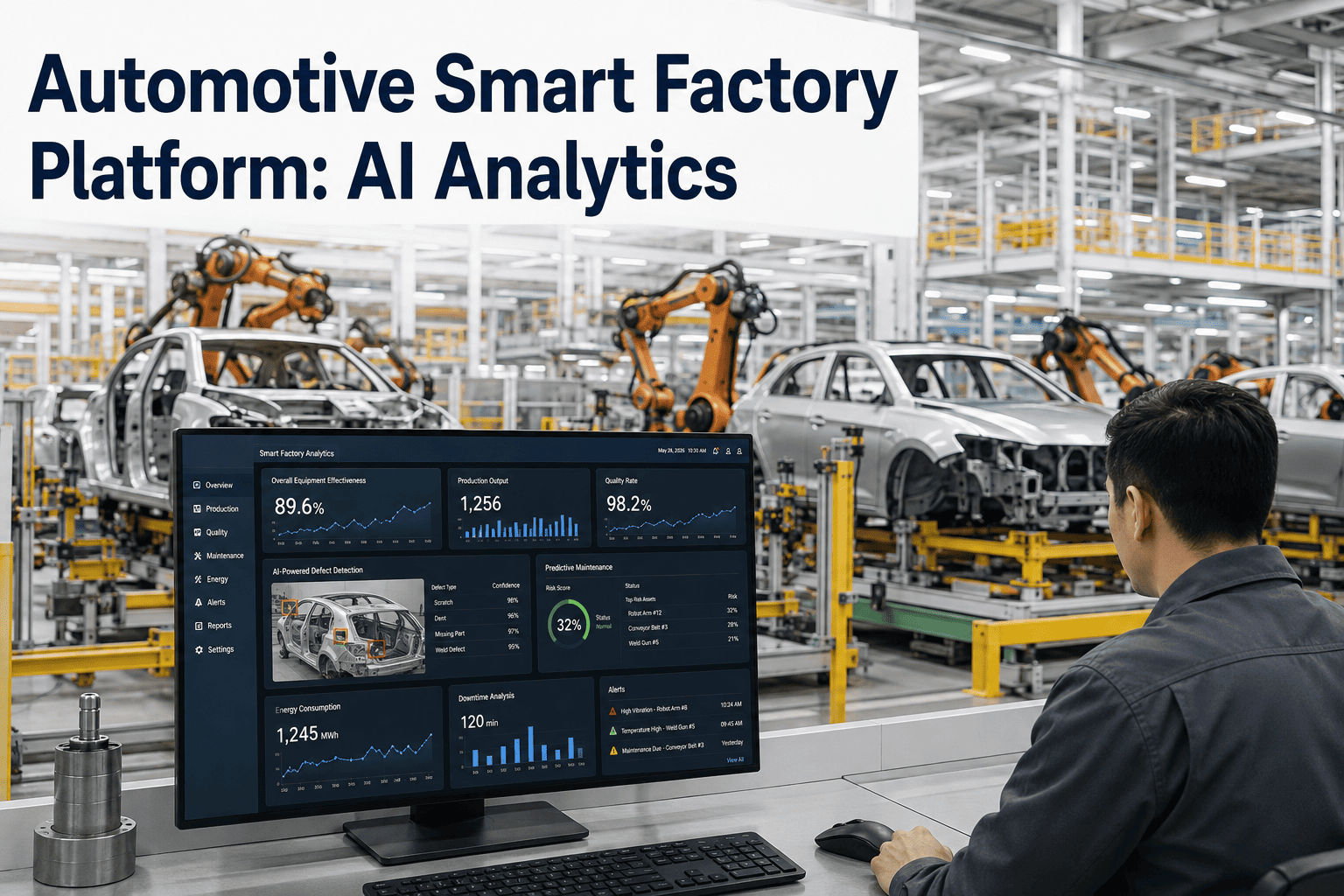
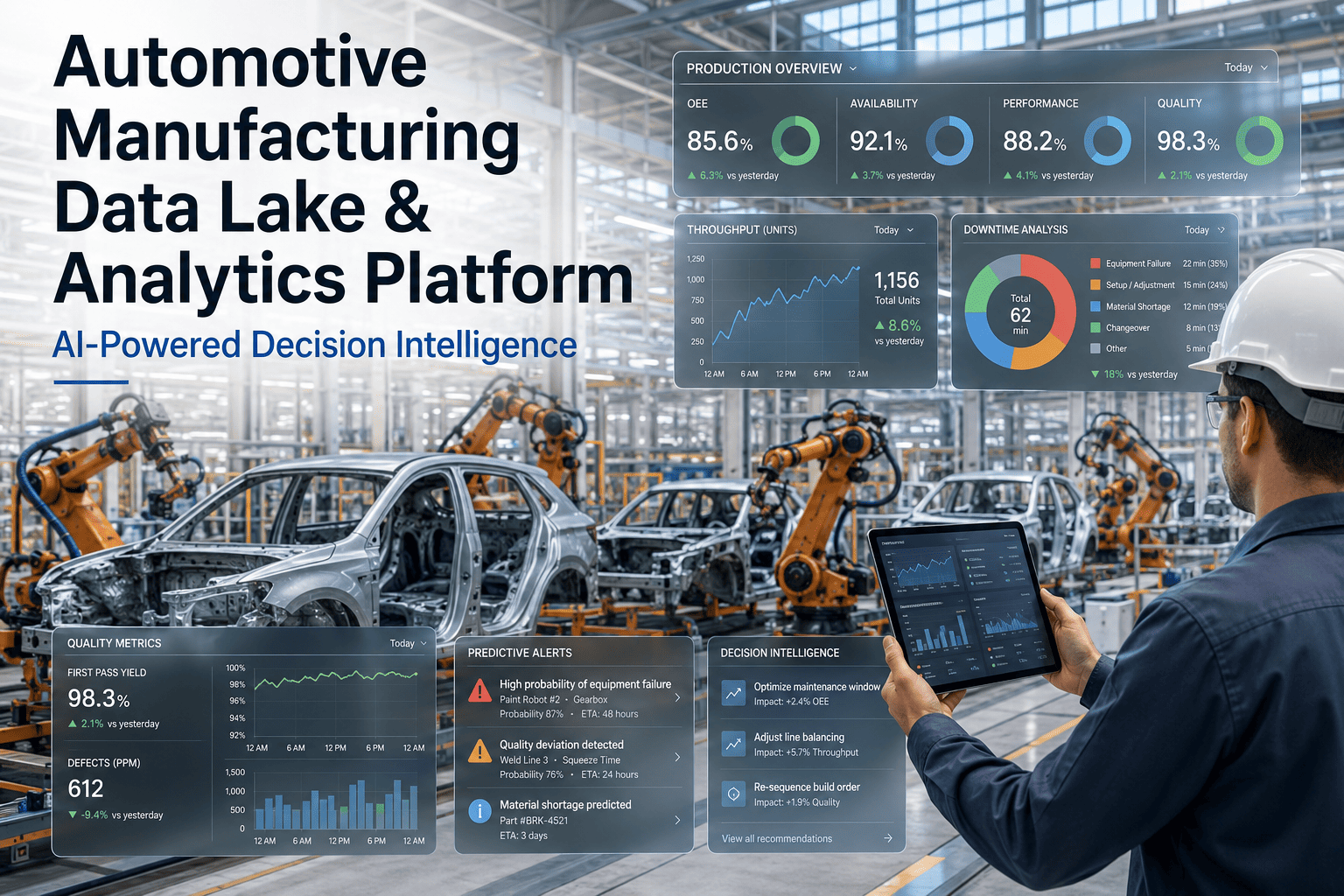
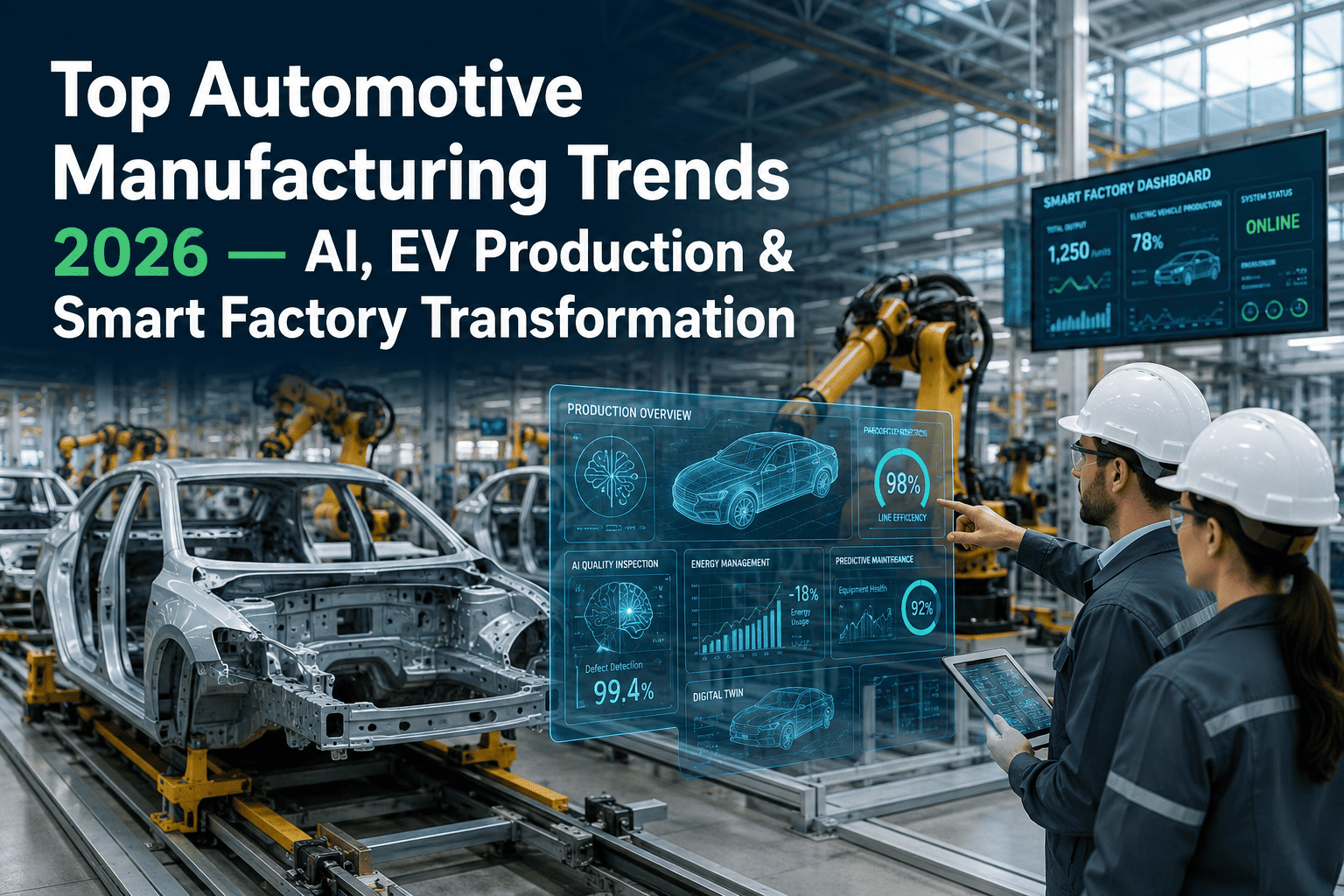
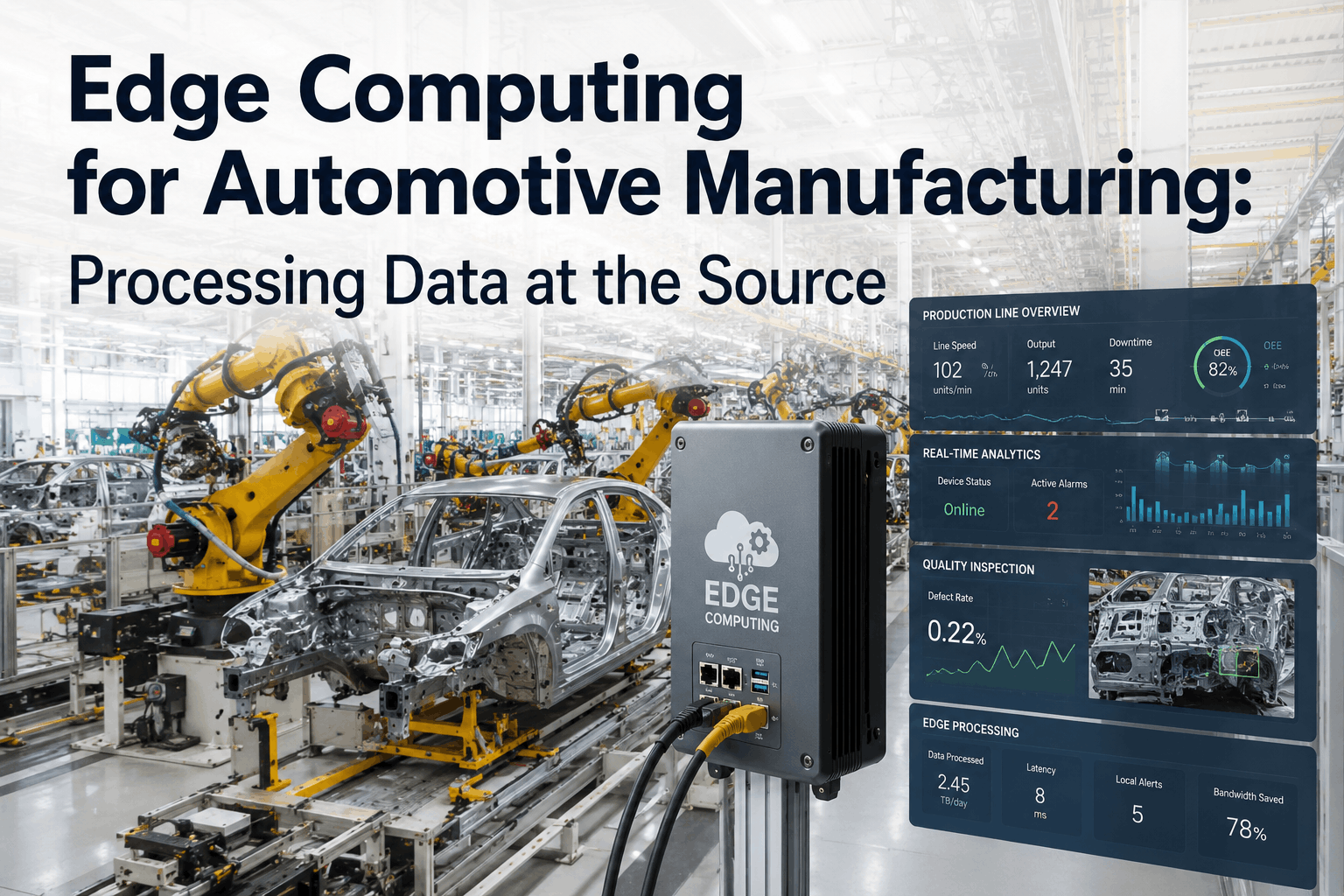
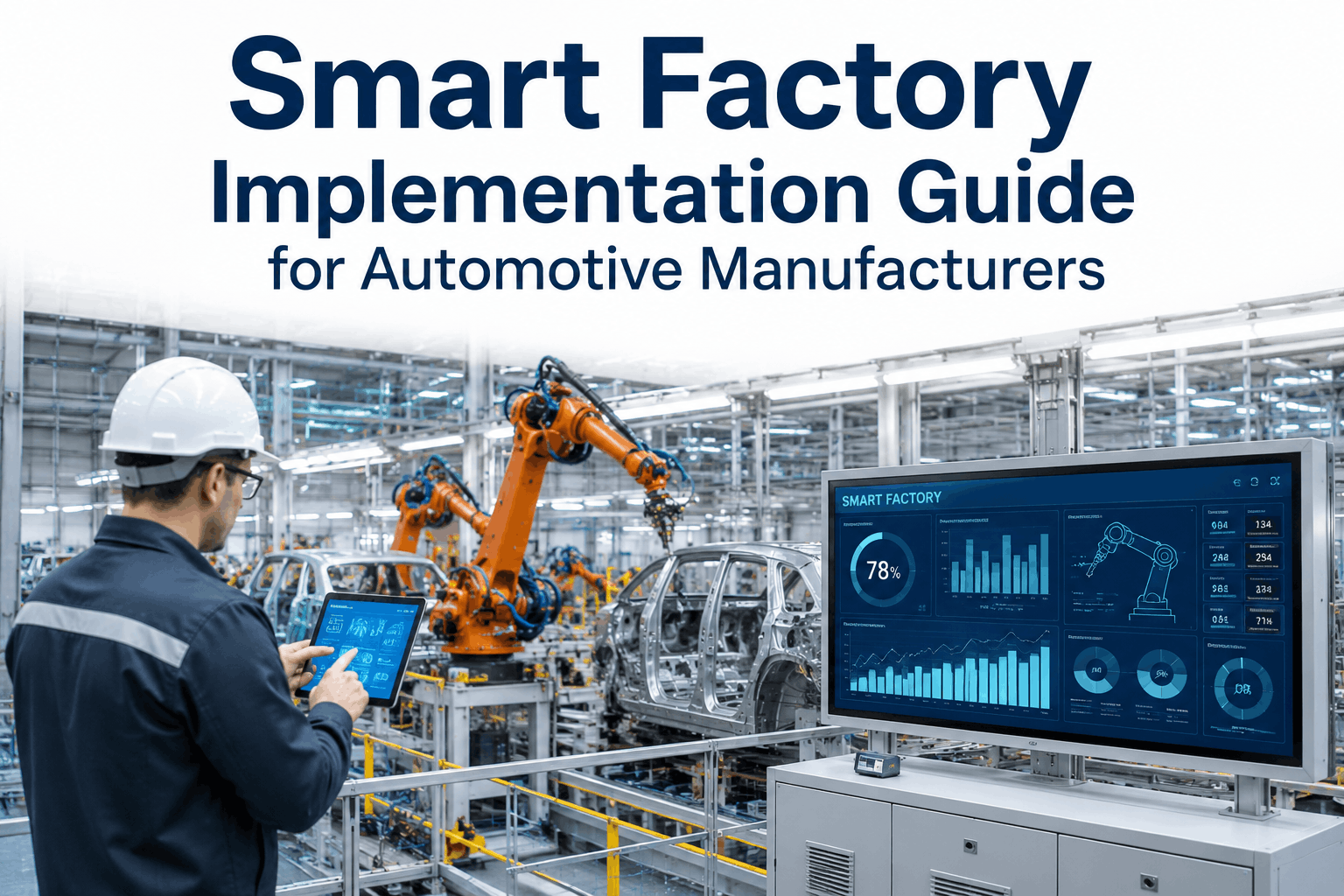
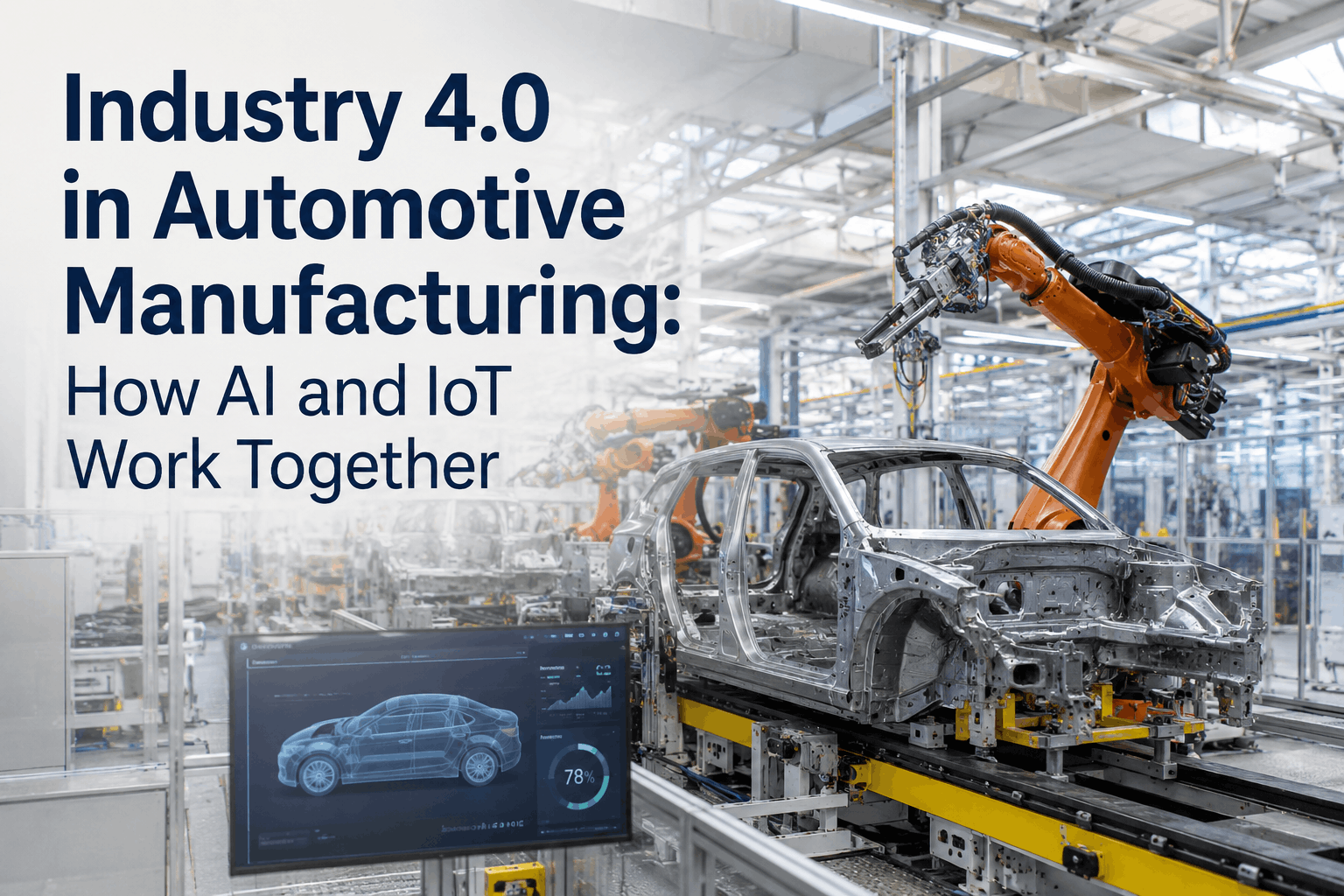
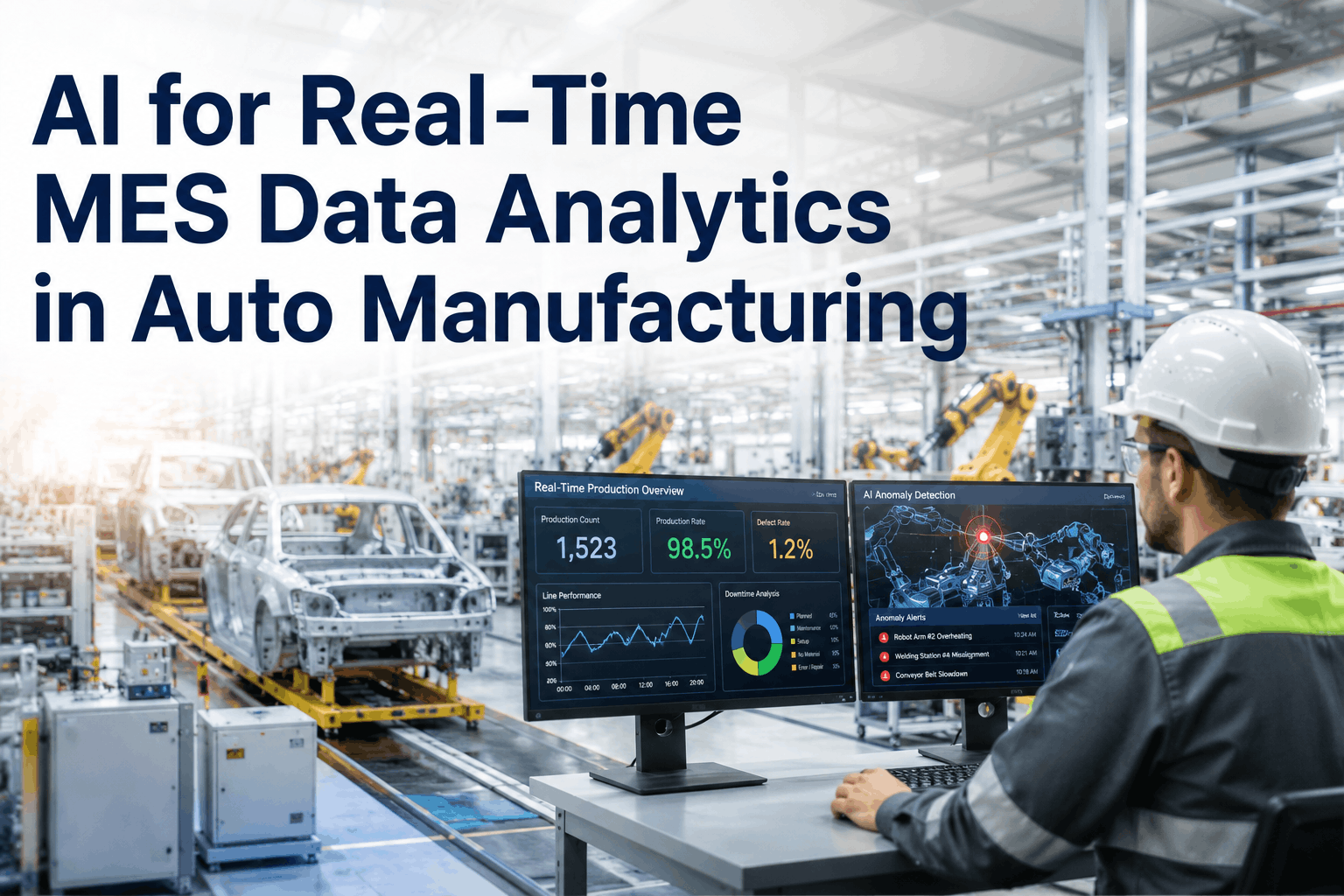
A modern automotive plant generates more data in a single shift than most enterprises process in a month. Stamping press vibration signatures. Welding robot cycle logs. CMM dimensional results. IoT energy consumption readings. MES production confirmations. SAP quality notifications. Vision inspection images. All of it flows continuously — and most of it is never used for anything beyond the operational system that generated it. A data lake changes this. Built correctly for automotive manufacturing, a data lake becomes the unified intelligence foundation that connects every data source across the plant to the AI models that turn raw sensor readings into predictive maintenance alerts, quality predictions, energy savings, and production optimisation decisions. Talk to an iFactory expert about building your automotive manufacturing data lake — book a demo.
Data Lake + AI + Automotive Manufacturing
Your Plant Generates the Data.
AI Needs a Lake to Swim In.
iFactory builds and connects automotive manufacturing data lakes — unifying machine, quality, energy, and ERP data into a single AI-ready foundation. On-premise or cloud.
What Is a Manufacturing Data Lake — and Why Does Automotive Need One?
A data lake is a scalable storage architecture designed to hold large volumes of structured, semi-structured, and unstructured data in its raw form — using a schema-on-read approach that allows AI and analytics systems to query and structure data at the time of use, rather than requiring rigid pre-processing before storage. In automotive manufacturing, this matters because production data does not arrive in tidy, uniform formats. IoT sensor streams are time-series. Inspection images are unstructured. MES logs are semi-structured event data. SAP records are highly structured relational data. A data lake holds all of it — without forcing every source into a single schema before it is needed.
The industrial AI market reached $43.6 billion in 2024 and is growing at 23% CAGR toward $153.9 billion by 2030. The gap between manufacturers who are winning with AI and those still running disconnected data systems is widening. The data lake is the infrastructure difference. See how iFactory structures your manufacturing data lake in weeks, not months — book a demo.
The Manufacturing Data Problem: Silos That Kill AI Value
Where Automotive Manufacturing Data Lives Today — and Why AI Can't Reach It
M
MES
Production orders, OEE, downtime events, shift data
Accessible via MES only — no cross-system correlation
S
SAP / ERP
Production plans, cost actuals, quality notifications, supplier data
Batch-updated — stale by shift end
I
IoT / SCADA
Machine telemetry, sensor streams, energy readings
Real-time but siloed — no link to quality or ERP context
Q
CAQ / Vision
Inspection images, defect records, CMM measurements
Images stored locally — not linked to production orders
C
CMMS
Work orders, maintenance history, failure codes
No connection to real-time machine sensor data
L
Data Lake
All of the above — unified, correlated, AI-ready
One foundation. Every source. Every AI use case.
Only 20% of data leaders express high confidence in their organisation's data analysis capability — despite the majority having deployed cloud-native tools. The gap is architecture, not tools.
The 5-Layer Architecture: Building an Automotive Manufacturing Data Lake
Automotive Manufacturing Data Lake — Layer Architecture
Consumption Layer — Where AI Creates Value
Predictive maintenance models, quality prediction AI, energy optimisation, OEE analytics, and production scheduling algorithms consume unified data from the lake. Dashboards, SAP integration, and operator interfaces surface insights at the point of decision.
Predictive MaintenanceQuality AIOEE AnalyticsSAP CO Actuals
Data Governance — Quality, Security, Lineage
Data cataloguing, access control, lineage tracking, and quality validation ensure every data asset is trustworthy and traceable. IATF 16949 traceability requirements are met automatically — every quality record linked to its production order, operator, and timestamp.
Data CatalogueAccess ControlLineage TrackingIATF Traceability
Processing Layer — Batch and Real-Time
Both batch processing (end-of-shift ERP reconciliation, daily quality trend analysis) and real-time streaming (IoT sensor anomaly detection, inline inspection results) are supported in a unified processing framework. Lakehouse architecture enables both workloads on consolidated datasets without separate pipelines.
Stream ProcessingBatch ETLEvent-Driven PipelinesData Transformation
Storage Layer — Raw, Curated, Aggregated
Three storage zones: raw zone (all incoming data in original format — sensor streams, inspection images, log files), curated zone (cleaned and enriched data ready for analysis), and aggregated zone (pre-computed metrics for dashboards and reporting). Schema-on-read means raw data is preserved and reusable for future AI models not yet designed.
Raw ZoneCurated ZoneAggregated ZoneSchema-on-Read
Ingestion Layer — Every Data Source, One Pipeline
IoT sensors (OPC-UA, MQTT), MES events (REST API), SAP data (OData, BAPI), vision inspection images, CMMS records, and external supplier data all ingest through a unified pipeline. Legacy machines connect via non-intrusive IoT sensor retrofit — no OEM-specific APIs required. iFactory manages this layer as part of the platform deployment.
OPC-UA / MQTTSAP ODataREST APIsIoT Retrofit
What AI Uses Your Data Lake For: 6 Automotive Analytic Use Cases
01
Predictive Maintenance Across Every Asset
AI correlates IoT sensor streams with CMMS maintenance history to predict equipment failures before they occur. The data lake enables this because the failure pattern might span weeks of sensor data — far beyond what any real-time system holds in memory. Historical failure signatures from similar equipment across multiple plants can be used to train models for a new asset type. Leading organisations achieve 10:1 to 30:1 ROI within 12–18 months from predictive maintenance alone.
10:1–30:1 ROI within 12–18 months
02
Cross-Source Quality Root Cause Analysis
A quality escape cannot be root-caused from a single data source. The defect is in the inspection system. The production parameters that caused it are in the MES. The supplier lot that contributed is in SAP MM. The machine that drifted is in IoT. Only the data lake — which holds all four sources in correlated form — enables AI to find the actual root cause rather than the nearest data point to the defect event.
Root cause in minutes — not days of manual cross-system search
03
OEE Trend Analysis and Bottleneck Prediction
Shift-level OEE data alone tells you what happened. The data lake's historical depth — months of per-minute production data correlated with maintenance events, supplier delivery patterns, and quality holds — enables AI to identify which factors predict OEE decline before the shift where it occurs. Bottleneck predictions become preventive actions rather than retrospective explanations.
15–20% OEE improvement from AI predictive analytics
04
Supply Chain Risk and Yield Correlation
When a supplier's material lot generates elevated defect rates, that signal exists in the inspection data. The supplier's delivery history, on-time rate, and previous quality escapes are in SAP. Correlating these in the data lake — automatically, at lot arrival — enables AI to flag high-risk incoming material before it enters the line, not after it generates warranty claims six months later.
Supplier risk flagged at goods receipt — not 6 months later
05
Energy Consumption per Production Order
IoT energy data and MES production order data arrive in the data lake simultaneously. AI correlates them to calculate per-order, per-product, and per-line energy consumption — enabling product cost calculations that include actual energy input rather than standard cost assumptions. For OEMs under CSRD and carbon reporting obligations, this is the data foundation that makes Scope 3 downstream emissions reporting accurate rather than estimated.
Actual energy cost per vehicle — not standard cost allocation
06
Digital Twin Calibration and Simulation
Digital twins require continuous calibration against actual production behaviour to remain accurate. The data lake provides the historical production data that keeps digital twin simulations aligned with reality — enabling scenario planning (what happens if supplier X is 3 days late? what is the OEE impact of scheduling this maintenance window?) to be answered from real production patterns rather than theoretical specifications.
Digital twin predictions accurate to within 5–10% of actual production
Build vs. Buy: Data Lake Architecture Decision Framework
Data Lake Architecture Decision — Automotive Manufacturing Context
Build Custom (DIY)
Full architectural control
No vendor dependency
12–24 months to production-ready state
Requires specialist data engineering team
OT/IT integration expertise needed separately
No automotive-specific data models out of the box
iFactory Platform
6–12 weeks to first AI insights
Pre-built automotive data connectors (SAP, MES, OPC-UA)
Automotive-specific AI models pre-trained
On-premise or cloud deployment
No specialist data engineering required
IATF 16949 traceability built in
Generic Cloud Platform
Scalable cloud infrastructure
Strong tooling ecosystem
No automotive OT integration pre-built
AI models require manufacturing domain expertise to build
Data sovereignty concerns for on-premise requirements
6–18 months for automotive-specific configuration
iFactory Deployment: On-Premise & Cloud
Data lakes hold some of the most sensitive operational data in a manufacturing enterprise — production volumes, quality rates, equipment performance, energy costs, and supplier performance that reveal competitive capability to anyone with access. iFactory provides both deployment models so your data architecture matches your governance requirements, not the other way around. Ask our team which deployment architecture fits your plant's IT and compliance requirements.
On-Premise Data Lake
All production data stored and processed inside your plant or data centre
No external data transmission — full OT network isolation maintained
Edge AI inference for real-time analytics without cloud latency
Meets OEM data sovereignty, ITAR, and audit requirements
Runs on NVIDIA appliance or your existing server infrastructure
Discuss On-Premise Setup
Cloud Data Lake
Enterprise analytics across multiple plants in a single unified lake
Cross-plant OEE benchmarking, quality trend comparison, fleet performance
Continuous AI model improvement from multi-plant production data
Accessible to headquarters, sustainability, and executive teams
CSRD and ESG reporting enabled from unified energy and quality data
Discuss Cloud Setup
Implementation Roadmap: From Data Silos to AI-Ready Lake
Weeks 1–2
Data Source Inventory & Connector Configuration
Map every data source — MES, SAP, IoT, CMMS, CAQ, vision systems. Configure iFactory's pre-built connectors for each system. Establish data ingestion pipelines. First data flowing into the lake within 48 hours of deployment start.
Weeks 3–4
Data Model & Correlation Layer
Define the automotive data model — linking production orders, quality events, machine telemetry, and supplier data through shared keys (order number, timestamp, station ID). Curated zone built and validated. Cross-source queries execute without manual data preparation.
Weeks 5–8
AI Model Deployment & First Use Cases
Predictive maintenance, quality root cause, and OEE analytics AI models deployed against the live data lake. First alerts and insights delivered to operators. Baseline performance metrics established for ROI measurement.
Month 3+
Continuous Expansion & Value Compounding
Additional AI use cases activated as data depth grows. AI models improve with every production run as the lake accumulates historical patterns. Digital twin calibration enabled. Cross-plant analytics activated for multi-site deployments. ROI compounds over time.
FAQ: Data Lake for AI-Driven Automotive Manufacturing Analytics
What is the difference between a data lake and a data warehouse for automotive manufacturing?
A data warehouse stores structured data in a pre-defined schema — useful for reporting against known questions (monthly OEE by line, quarterly defect rates by supplier). A data lake stores all data types — structured MES records, semi-structured IoT time-series, unstructured inspection images — in raw form, with schema applied at query time. For AI in automotive manufacturing, the data lake is more valuable because AI models need the flexibility to correlate data types that were not originally connected (sensor drift + quality defect + supplier lot + process parameter), and to reuse raw historical data for future models not yet designed. The modern approach is a lakehouse — combining the flexible storage of a data lake with the query performance of a data warehouse — which is the architecture iFactory deploys.
How long does it take to build a manufacturing data lake with iFactory?
iFactory's pre-built automotive connectors for SAP (OData/BAPI), MES systems (REST, OPC-UA), IoT protocols (MQTT, Modbus), and CMMS platforms enable data to start flowing into the lake within 48 hours of deployment start. A production-ready data lake with the first AI use cases live typically completes in 6–8 weeks — compared to 12–24 months for custom-built data lake projects. The speed difference comes from pre-built automotive data models (production order, quality event, machine telemetry schemas already defined) and pre-trained AI models that begin generating value from day one rather than requiring months of data accumulation before training can begin.
Can a manufacturing data lake work with legacy machines and systems that don't have modern APIs?
Yes. Legacy machines from 1990s-era equipment through modern CNC centres connect through non-intrusive IoT sensor retrofit — clip-on current sensors, wireless vibration accelerometers, pressure transducers — installed in under 30 minutes per asset without stopping production. These sensors communicate via standard protocols (WiFi, LoRaWAN, 4G) to iFactory's ingestion layer, making legacy equipment a first-class data source in the lake. SAP systems running older releases connect through BAPI interfaces that remain compatible across SAP versions. No machine or system is architecturally excluded from the data lake by age or lack of native API.
How does iFactory handle data governance and IATF 16949 traceability in the data lake?
iFactory's data model links every quality event, inspection result, and production record to its production order, material lot, operator ID, machine station, and timestamp automatically — creating the per-unit traceability that IATF 16949 requires as a byproduct of normal data lake operation, not as a separate compliance programme. Data lineage tracking records where every data element originated, how it was transformed, and which AI models consumed it. Access controls restrict quality and production data to authorised roles. When an OEM requests production records for a specific VIN or batch under warranty investigation, the answer is available from the data lake in seconds rather than assembled over days from scattered source systems.
What is the ROI of a manufacturing data lake investment?
The ROI of a manufacturing data lake is the aggregate ROI of all AI use cases it enables — because the data lake itself is infrastructure, not an application. Predictive maintenance alone delivers 10:1–30:1 ROI within 12–18 months for leading organisations. Quality root cause acceleration (hours instead of days per investigation) saves 3–5 engineer-hours per quality event. Energy optimisation using correlated IoT and production data delivers 12–28% energy savings. The compounding effect: each additional AI use case activated against the same data lake costs a fraction of the first, because the infrastructure, governance, and data pipelines are already in place.
Book a demo to model the data lake ROI for your specific plant configuration.
Is iFactory's data lake available on-premise for plants with data sovereignty requirements?
Yes. iFactory provides both on-premise and cloud-based deployment models. On-premise deployment runs on a pre-configured NVIDIA appliance or existing server infrastructure inside the plant network — all data is processed and stored within the facility, with no external transmission required. This satisfies OEM data sovereignty requirements, ITAR constraints, and audit obligations that prohibit production data from leaving the plant network. Cloud deployment is available for multi-plant enterprise analytics where cross-site benchmarking and centralised reporting are the priority. The same AI models and data lake architecture are available in both deployment modes — the difference is where the data lives and is processed.
Talk to our team about the right deployment model for your plant.
Data Lake + AI + iFactory
Turn Your Plant's Data Silos
Into an AI Intelligence Foundation.
iFactory builds automotive manufacturing data lakes that connect MES, SAP, IoT, CMMS, and quality systems into a single AI-ready foundation — on-premise or cloud — with first insights in weeks, not months.
Pre-Built SAP + MES Connectors
On-Premise & Cloud
6–8 Week Deployment
IATF 16949 Traceability
AI-Ready from Day One