Ask five different teams in a typical automotive plant what yesterday's OEE was and there's a real chance you get five different numbers — quality has one dataset, maintenance has another, the ERP has a third, and none of them were built to talk to each other. That fragmentation isn't a reporting inconvenience, it's the reason executive decisions get made on stale, partial pictures of what's actually happening on the floor. A unified data lake doesn't just store more data, it gives quality, production, maintenance, and supply chain information one shared source of truth that every dashboard and every model pulls from consistently. For a VP of Operations trying to make plant-wide calls with confidence, that consistency is worth more than almost any individual dashboard feature — book a demo to see a unified view built from your actual plant data sources.
Digital Twin & Smart Factory · Operations Leadership
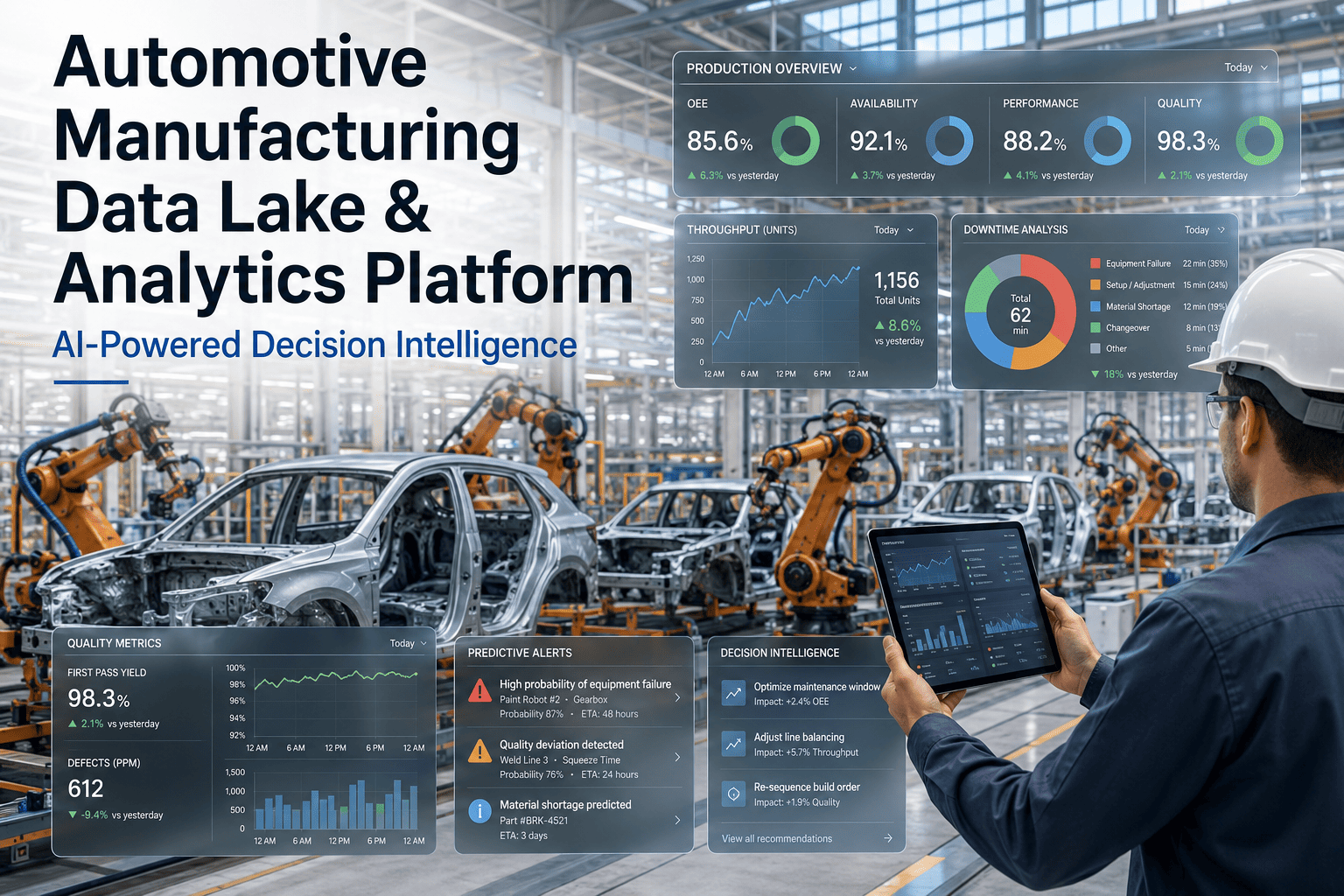
Automotive Manufacturing Data Lake & Analytics Platform
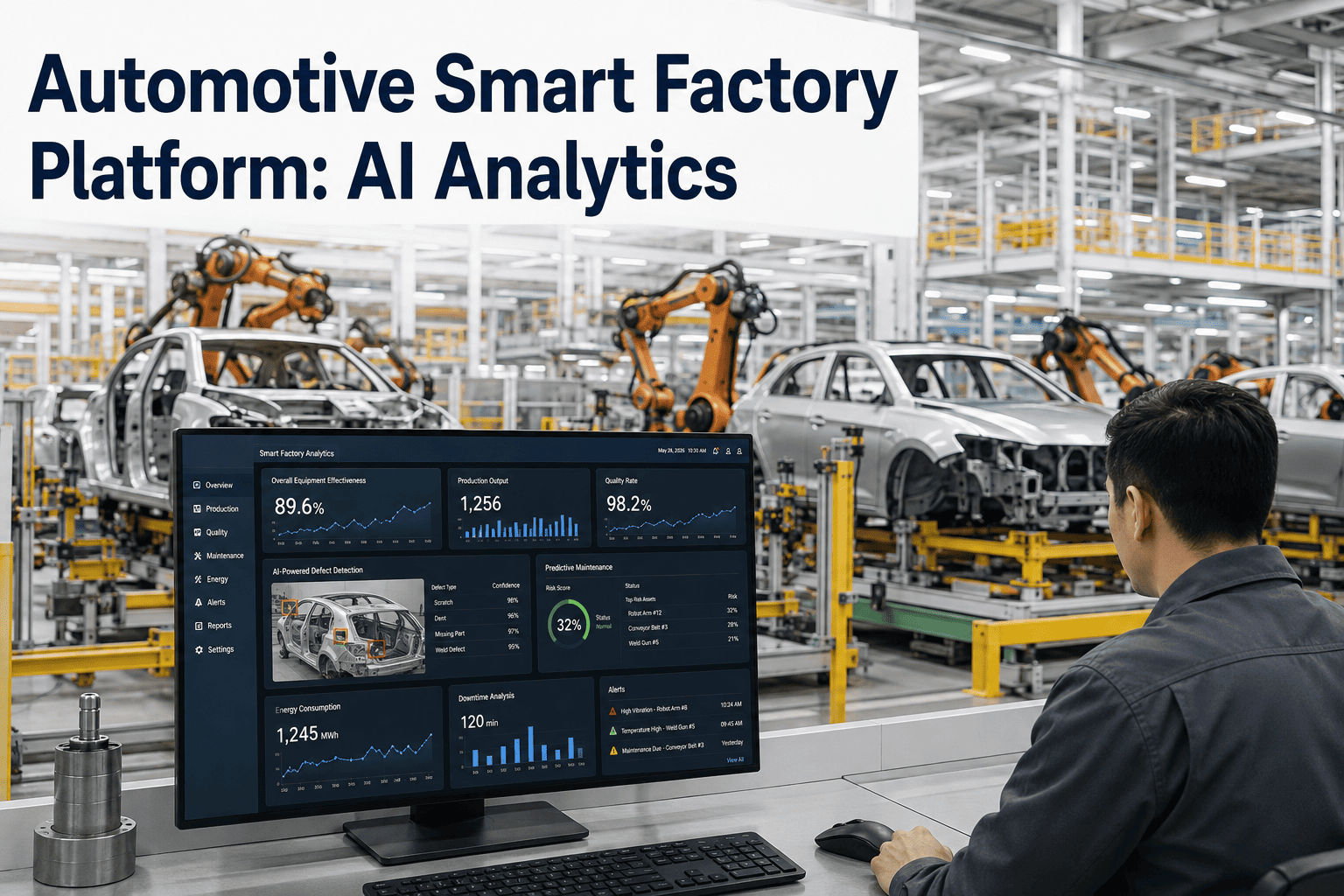
Unify quality, production, maintenance, and supply chain data into one platform, and get AI-powered analytics that go from OEE dashboards to executive decision support.
One Plant, Five Versions of the Truth
Most operations leaders aren't short on data — they're short on a single, trusted version of it. Every added system without a unifying layer adds one more dataset that has to be manually reconciled before a decision can be made.
Quality Systems
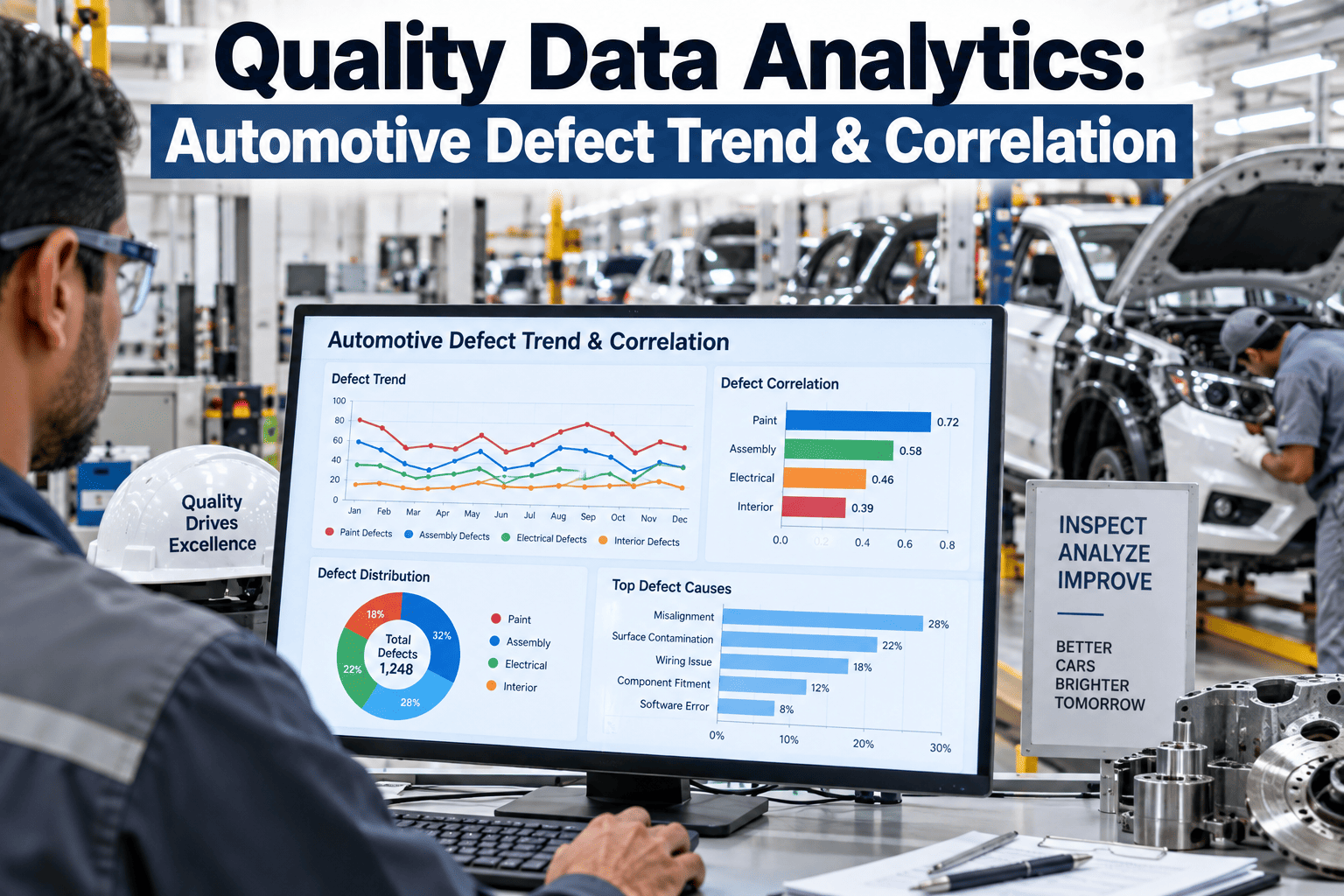
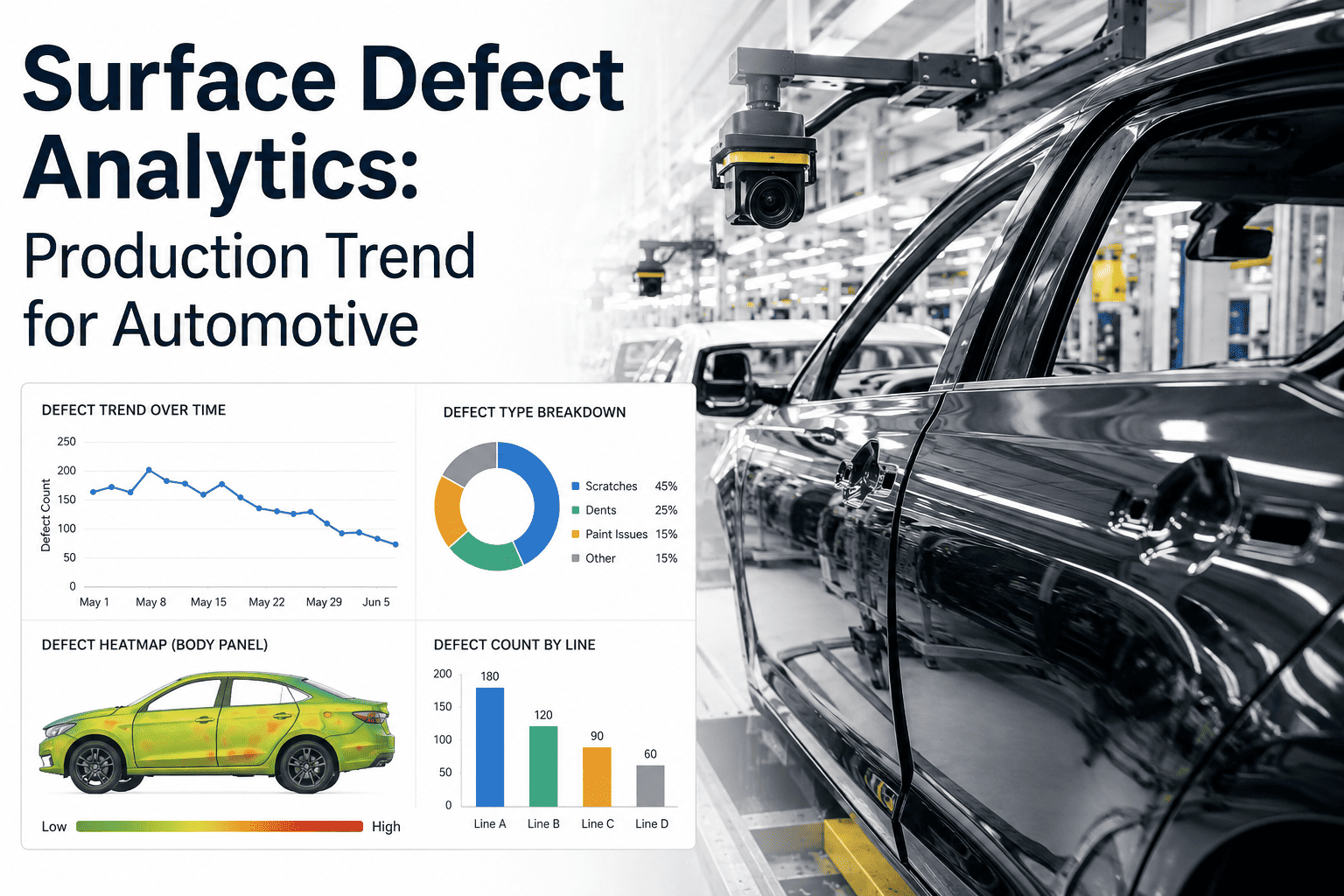
Defect and inspection data lives in its own system, disconnected from the production context that would explain why a defect rate spiked.
Production & MES
OEE and cycle time data is accurate for its own line but rarely rolled up consistently across every site running a different local configuration.
Maintenance & CMMS
Work order history sits apart from the sensor data that could have predicted the failure, making root-cause analysis slower than it needs to be.
ERP & Supply Chain
Inventory and shipment data updates on its own schedule, disconnected from the real-time production rate that actually determines material needs.
From Raw Signals to Executive-Ready KPIs
A well-built manufacturing data lake organizes information into layers of increasing refinement, so raw machine noise on the floor becomes a trustworthy number in a leadership review without anyone reconciling spreadsheets in between.
Bronze Layer
Raw machine, sensor, ERP, and quality data ingested in its native format, preserved as the unaltered source of record.
Silver Layer
Cleaned, validated, and joined data — a production line's sensor readings matched against its actual work orders and quality results.
Gold Layer
Business-ready KPIs like OEE, scrap rate, and supply chain health, structured for direct use in dashboards and executive reporting.
Every team pulling from the same Gold layer means an operations review and a plant floor dashboard finally agree with each other.
What This Actually Unlocks for Operations Leadership
01
Cross-Site OEE Comparison
Compare performance across every facility using one consistent calculation method instead of reconciling different local definitions of the same metric.
02
Predictive Maintenance at Scale
Vibration and temperature trends joined with maintenance history let models flag degrading equipment across every site from a single unified feature set.
03
Demand-Aware Production Scheduling
Combining real-time inventory, shipment signals, and production rate supports rolling schedule adjustments instead of static planning cycles.
04
Executive Decision Support
Leadership reviews pull from the same Gold-layer numbers the floor sees in real time, closing the gap between what's reported and what's actually happening.
Operations Perspective
The value of a manufacturing data lake isn't the storage, it's the fact that every team — data engineers, ML engineers, plant analysts, and executives — ends up working from the same source of truth instead of maintaining separate pipelines that quietly drift apart. A pilot on a single production line typically proves the model in a matter of weeks; full multi-site deployment is the part that takes real planning.
Reflects current guidance on data lakehouse implementation timelines and medallion architecture in manufacturing.
Fragmented Reporting vs. Unified Data Lake Platform
Frequently Asked Questions
Do we need to replace our existing MES, ERP, and CMMS systems to build a data lake?
No, a data lake is designed to ingest data from these systems rather than replace them. Existing MES, ERP, quality, and maintenance systems continue operating as the systems of record on the floor, while the data lake becomes the unified layer where their outputs are joined and analyzed together.
Book a demo to see how existing systems typically connect into the platform.
How long does it realistically take to see value from a project like this?
A focused pilot on a single production line, mapping OT and IT sources and building the initial data layers, typically takes a matter of weeks to prove the model and produce a working set of KPIs. Full-scale deployment across multiple facilities is a longer undertaking, usually planned in phases over several months rather than attempted all at once.
Contact support to scope a realistic timeline for your site count.
What's the difference between a data lake and just adding more BI dashboards?
Dashboards visualize data, but if the underlying data across quality, production, and maintenance systems is still fragmented, every new dashboard just presents another partial view. A data lake addresses the fragmentation itself, so dashboards built on top of it are actually pulling from the same reconciled, joined data rather than five disconnected sources dressed up to look consistent.
Book a demo to see the difference in a working example.
Can this support real-time OEE tracking as well as historical analysis?
Yes, a properly designed platform supports both streaming ingestion for real-time shop-floor visibility and the historical depth needed for trend analysis, forecasting, and executive reporting from the same underlying dataset. This avoids the common trap of building separate real-time and historical systems that eventually disagree with each other.
Contact support to discuss real-time requirements alongside historical reporting needs.
Who typically owns and maintains a manufacturing data lake once it's built?
Ownership usually sits with a combination of IT and operations, since the platform draws on both OT floor data and enterprise IT systems and serves both audiences. The most successful deployments establish clear governance early — who can publish new data, who can access what level of detail — so the platform stays trustworthy as more teams start relying on it.
Book a demo to talk through a governance model that fits your organization.
Give Every Team the Same Number to Work From
Unify quality, production, maintenance, and supply chain data into one platform built for executive decision-making.