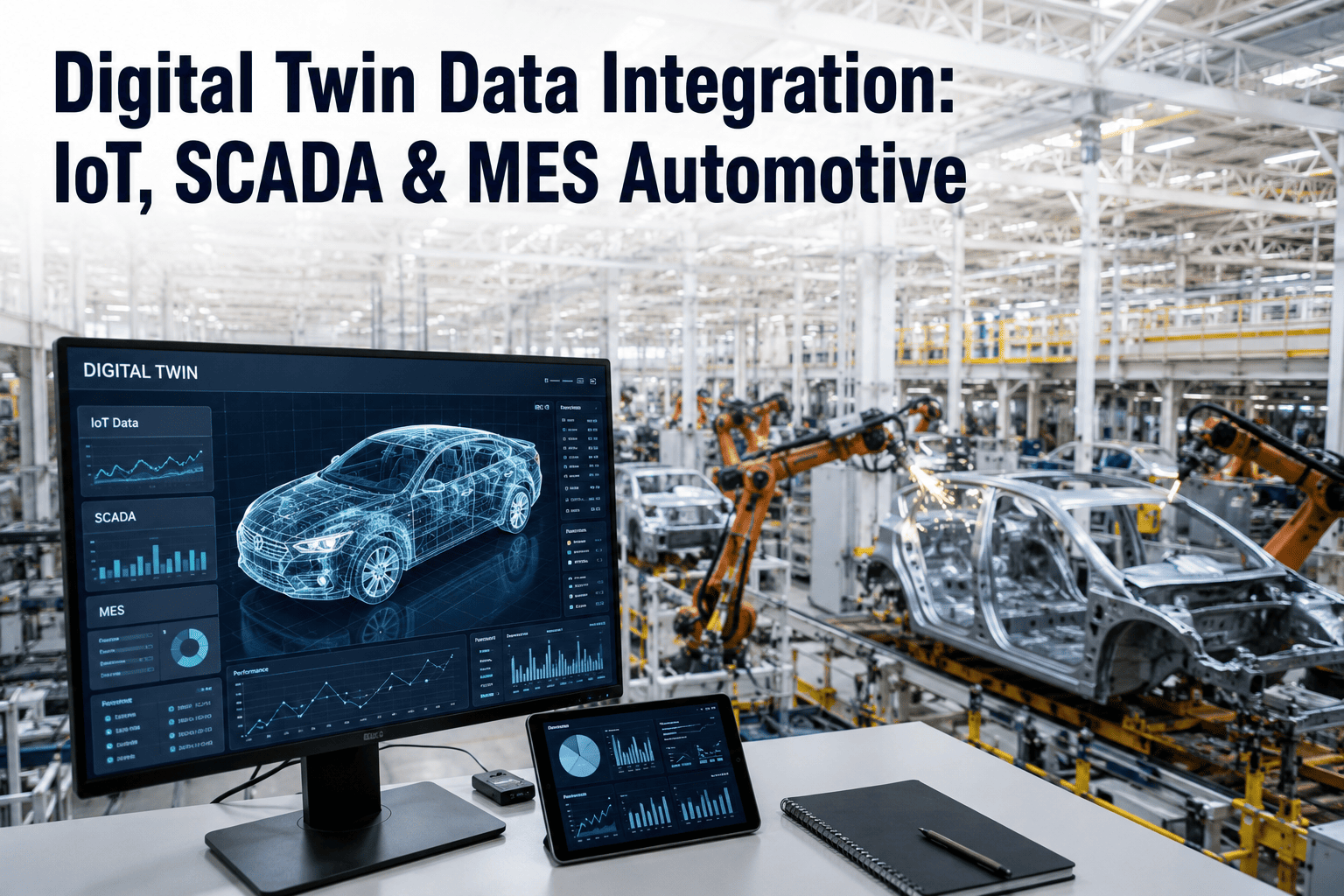
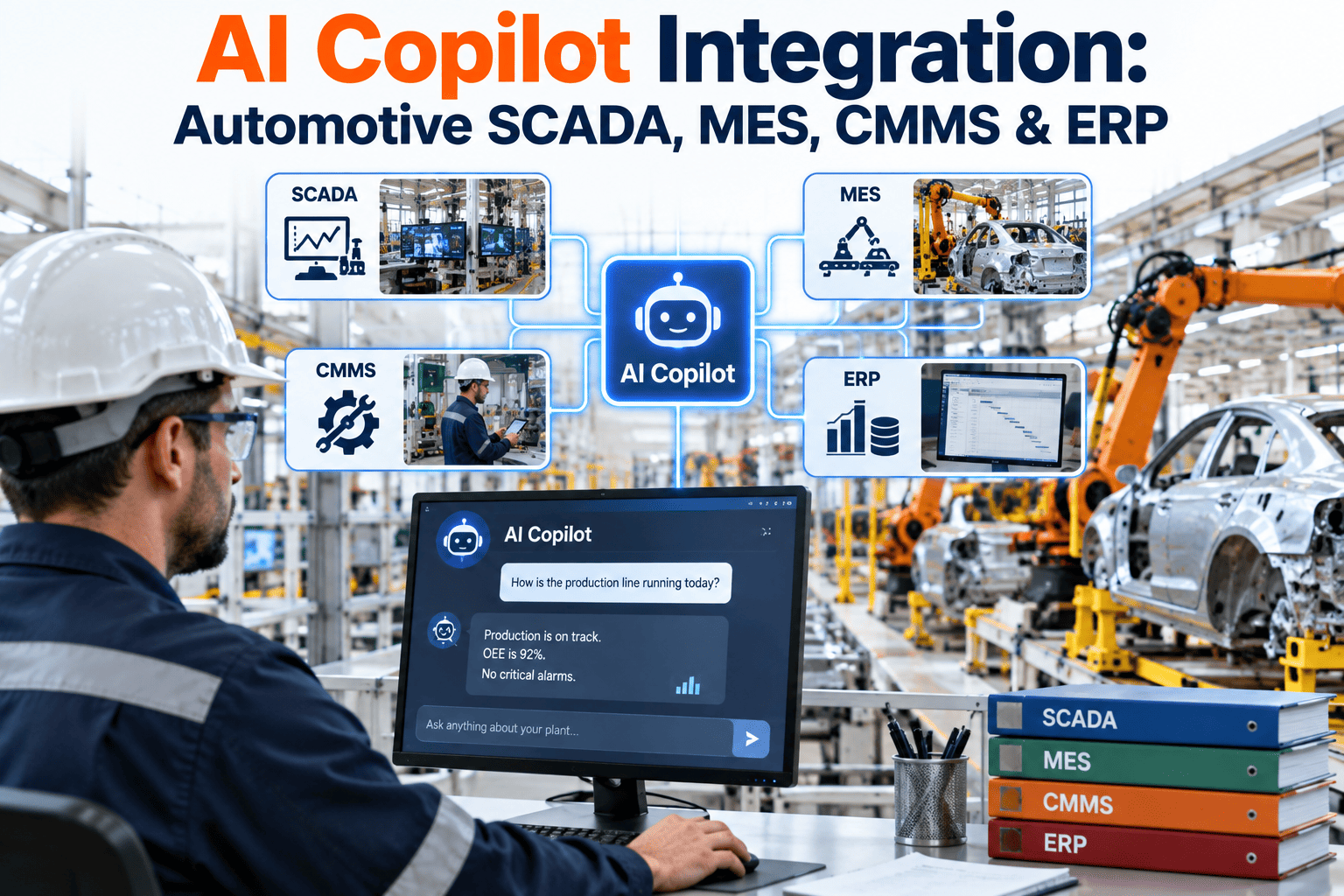
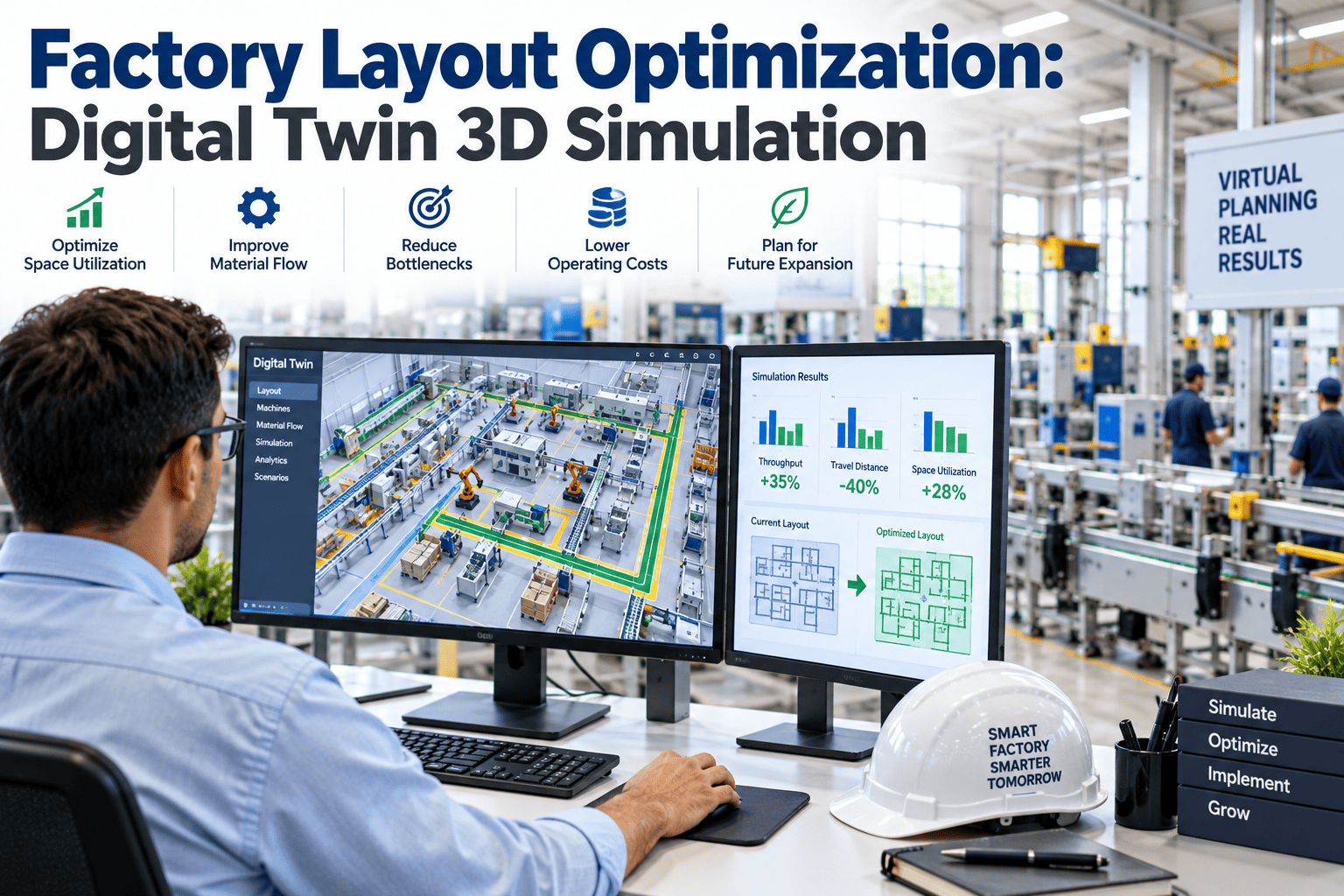
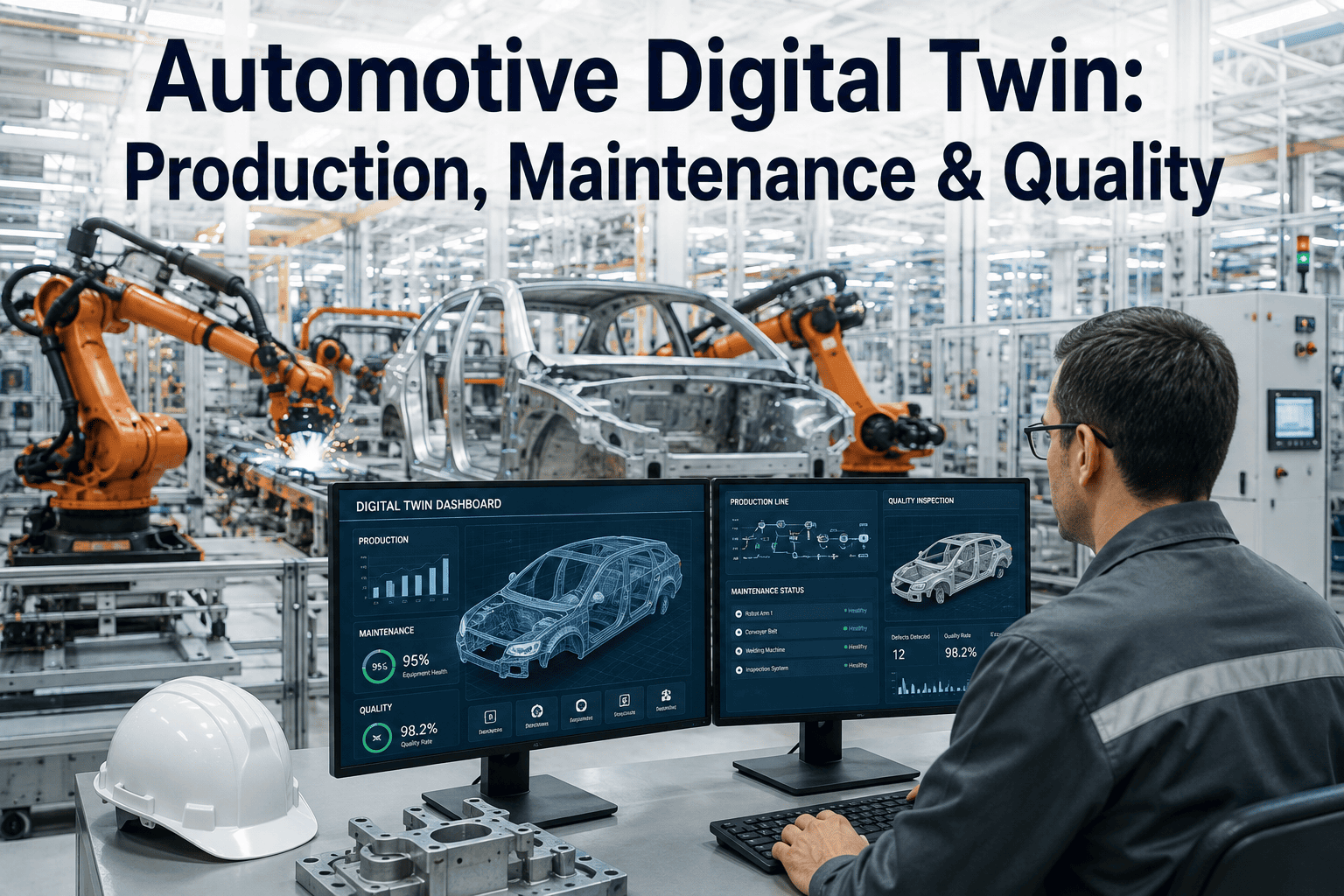
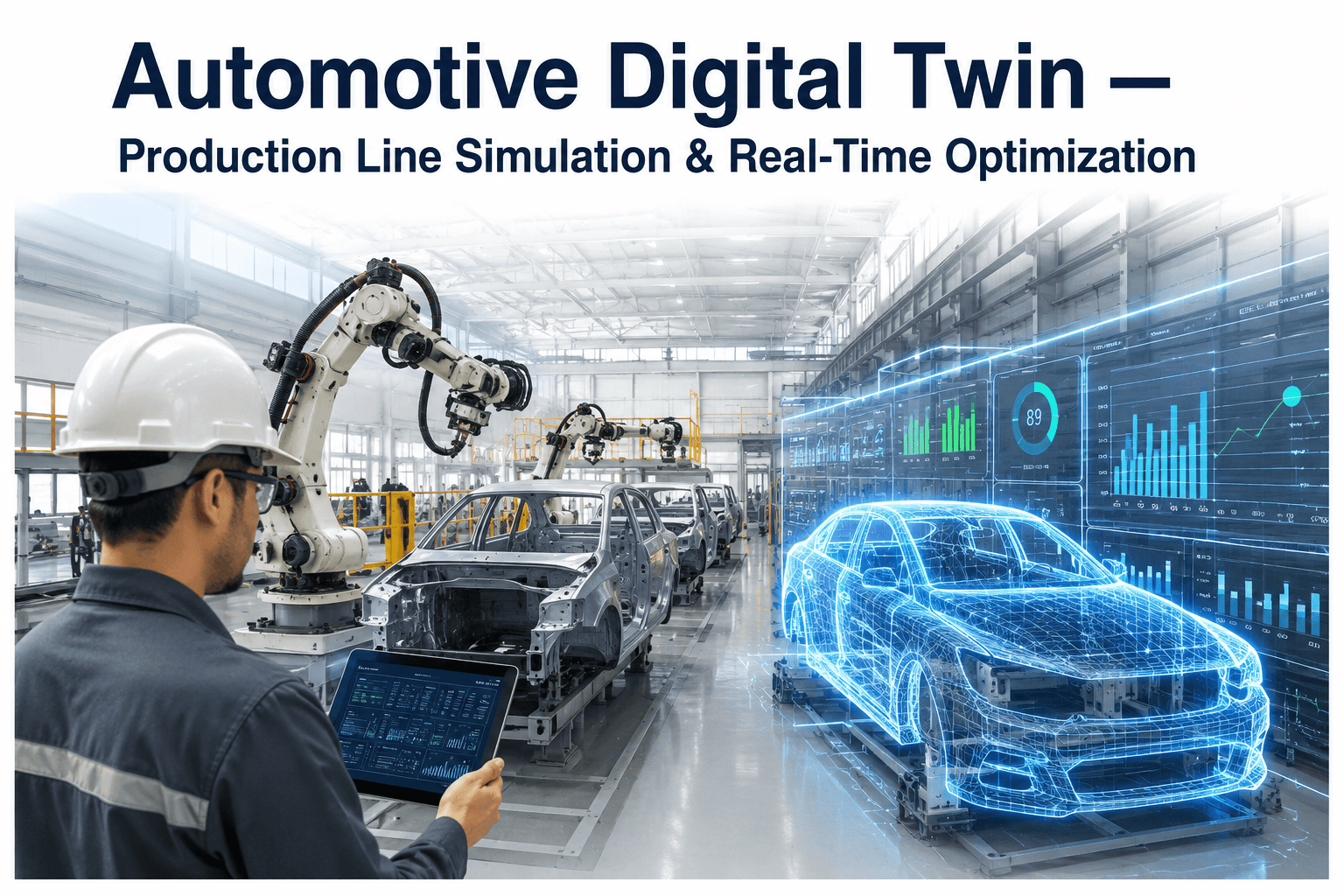
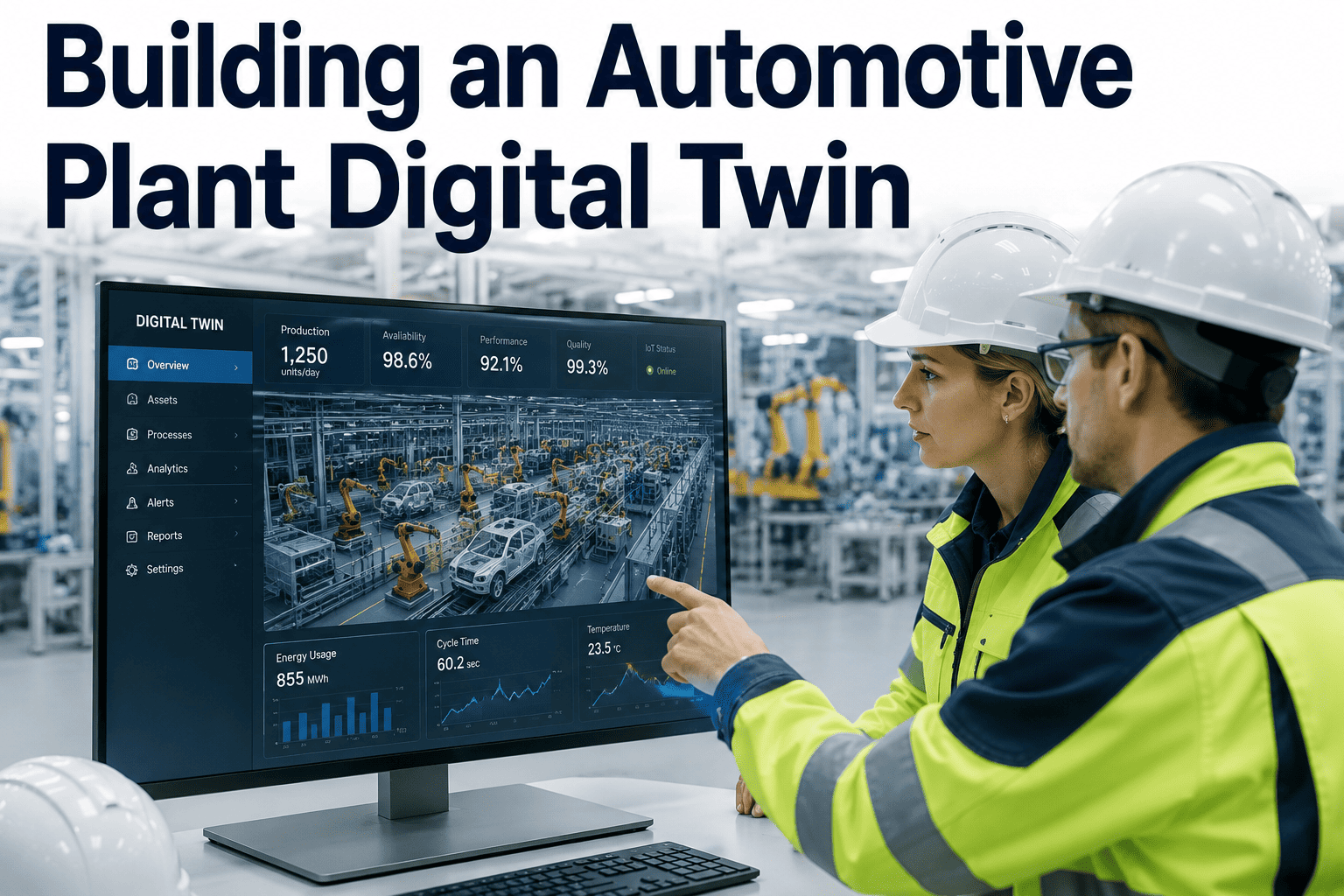
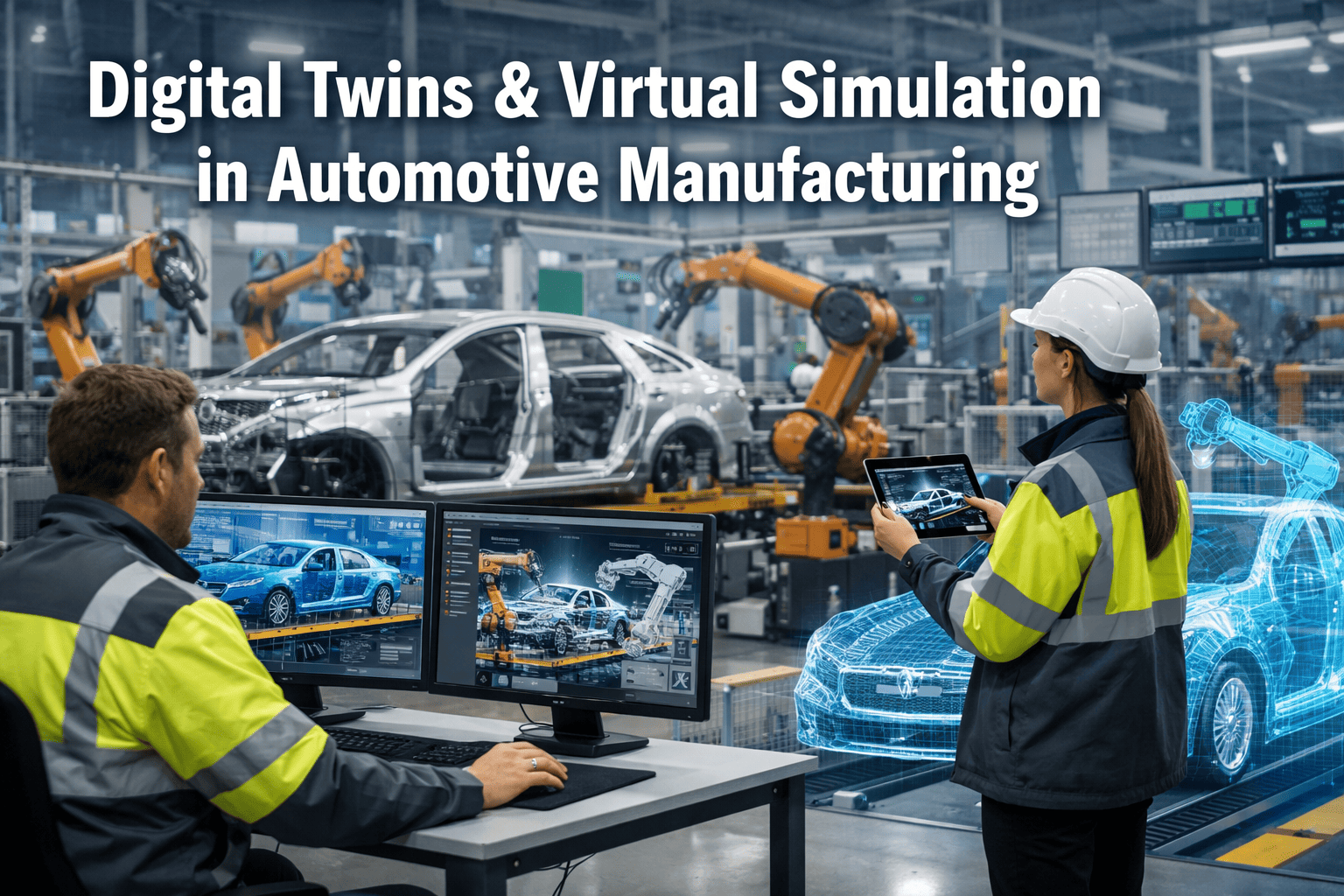
A digital twin of an automotive stamping line is only as accurate as the data feeding it, and that data does not arrive from one place. IoT sensors report vibration and temperature in near real time, SCADA systems hold live equipment states and alarms, and the MES layer knows which production order is running and what the process logic requires. A twin that only connects to one of these three loses the picture the other two would have completed, and a twin that connects to all three without a coherent integration architecture drowns in signals that never resolve into a trustworthy model. iFactory builds the connective layer that turns IoT, SCADA, and MES data into a synchronized, calibrated digital twin your automotive plant can actually rely on. To see this integration architecture reviewed against your own plant systems, book a demo.
DIGITAL TWIN · AUTOMOTIVE · DATA INTEGRATION
Three Data Sources, One Synchronized Twin, Zero Guesswork on the Virtual Factory Floor
iFactory connects IoT sensor streams, SCADA equipment states, and MES production context into a unified data layer that keeps your automotive digital twin calibrated to what is actually happening on the line, not what it was told to expect.
THE THREE SOURCES
What IoT, SCADA, and MES Each Actually Contribute to the Twin
Every automotive digital twin conversation eventually collapses three very different data sources into one word — "data" — as if they were interchangeable. They are not. Each source answers a different question about the physical plant, and a twin that leans on only one or two of them is answering an incomplete question no matter how good its visualization looks.
IoT SENSORS
What is the equipment physically doing right now?
Vibration, temperature, pressure, and position readings streamed continuously from sensors mounted directly on presses, robots, and conveyors, typically updating on a sub-second to few-second cadence.
SCADA
What state is the equipment in, and is anything alarming?
Live equipment states, fault codes, and alarm conditions aggregated from PLCs across the line, giving the twin the operational context IoT sensor values alone cannot provide.
MES
What production order is running, and what should be happening?
Work order data, process specifications, and quality logic that tell the twin what the line is supposed to be producing, so a sensor reading can be judged against the correct target rather than a generic baseline.
A twin built only on IoT data can show that a press is vibrating unusually without ever knowing whether that vibration is expected for the current stamping die in use, because that context lives in MES. A twin built only on MES data knows what should be happening but has no way to confirm what is actually happening at the equipment level. The synchronized combination of all three is what makes a digital twin a decision-support tool instead of an expensive dashboard.
THE LAYERED ARCHITECTURE
How Three Data Sources Become One Coherent Twin
Connecting three systems is not the same as integrating them. A layered architecture is what turns raw signals from IoT, SCADA, and MES into a semantic model the twin can actually reason about, and skipping any layer in this stack is where most automotive digital twin projects lose reliability.
5
Intelligence Layer
Predictive maintenance models, quality correlation analysis, and scenario simulation run against the synchronized model, producing the insights the plant actually acts on.
4
Virtual Modeling Layer
The 3D or logical representation of the line that renders current and predicted states, updated continuously from the semantic model beneath it.
3
Semantic Model Layer
Assets, states, relationships, and operating limits are defined here, giving structure and meaning to raw signals so the twin understands not just that a value changed, but what that change means for the asset it belongs to.
2
Data Acquisition Layer
MQTT and OPC-UA pipelines normalize and time-align signals from IoT sensors, SCADA historians, and MES work order feeds into a common format before anything reaches the model layer above.
1
Physical Layer
The presses, robots, conveyors, and paint booths themselves, along with the PLCs, sensors, and control systems already installed on your automotive line.
Most legacy digital twin failures trace back to a missing or thin layer 2 or layer 3 — organizations connect data sources directly into a visualization tool without building the acquisition and semantic layers in between, producing a twin that displays numbers without understanding what they mean relative to each other. A press vibration reading rendered on a dashboard without the semantic context of which die is currently loaded, what tolerance band applies, or what the historical baseline looks like for that specific configuration is a number, not an insight. Building the middle layers properly is what converts raw telemetry into something an engineer can actually act on with confidence.
See your own IoT, SCADA, and MES data mapped into this architecture
iFactory audits your existing plant systems and shows you exactly where the integration gaps sit before recommending a single sensor purchase.
PROTOCOL CHOICES
MQTT, OPC-UA, and the Protocol Decisions Behind the Data Layer
Underneath the layered architecture, the actual transport protocols carrying data from plant floor to twin matter more than most digital twin conversations give them credit for. Standardization around a small set of protocols is what has made cross-vendor interoperability possible in 2026, but each protocol still has a role it fits better than the others.
| Protocol |
Best Fit |
Update Cadence |
Automotive Use Case |
| OPC-UA |
Structured equipment state and semantic context from PLCs and SCADA |
Sub-second to seconds |
Robot cell status, press state, safety interlocks |
| MQTT |
Lightweight sensor telemetry over constrained networks |
100ms to a few seconds |
Vibration, temperature, and position sensor streams |
| REST/HTTP APIs |
Transactional, lower-frequency system-of-record data |
Minutes to on-demand |
MES work orders, quality specifications, ERP context |
| AMQP |
Reliable message queuing across distributed plant systems |
Near real time |
Cross-line event routing in multi-plant deployments |
The practical implication for an automotive plant is that no single protocol carries the whole integration. A well-designed data layer routes IoT telemetry over MQTT, pulls SCADA equipment state through OPC-UA, and syncs MES work order context through structured APIs, then normalizes all three into a common time-aligned format before the semantic model layer ever sees them. Trying to force one protocol to carry all three data types is a common early-stage mistake that produces either a lightweight pipeline that cannot represent SCADA's structured state complexity, or an overbuilt OPC-UA implementation that adds unnecessary overhead to simple sensor telemetry that MQTT would carry more efficiently.
THE DRIFT PROBLEM
Why a Correctly Built Twin Still Drifts Away From Reality
Even a well-architected digital twin does not stay accurate on its own. Synchronization drift is the single most common reason a digital twin that worked well at go-live becomes progressively less trustworthy over the following months, and it happens quietly enough that plants often do not notice until a prediction is visibly wrong.
01
Sensor Calibration Decay
Physical sensors drift out of calibration over months of operation, feeding the twin readings that no longer match true equipment values even though the data pipeline itself is functioning correctly.
02
Latency Under Network Load
Rising network latency during peak plant activity delays data arrival at the twin, and a twin reasoning against stale data produces predictions that no longer match current equipment state.
03
Unlogged Process Changes
A die change, a tooling swap, or a process parameter adjustment made on the floor without a corresponding MES update leaves the twin's semantic model referencing an outdated production configuration.
04
Edge Device Failures
A failed or intermittently reporting edge gateway creates gaps in the data stream that the twin may silently interpolate across, producing a model state that looks continuous but is not actually grounded in real readings.
None of these four causes is exotic or rare. They are the ordinary wear and tear of running a real plant, which is exactly why drift detection has to be a designed-in capability of the twin rather than something discovered only when a prediction fails visibly enough to trigger an investigation. A twin that silently drifts for months before anyone notices has often already produced several quietly wrong recommendations by the time the drift is caught, which is a more expensive failure mode than the drift itself.
CALIBRATION AS A PROCESS
Keeping the Twin Honest With Continuous Model Calibration
Calibration is not a one-time step performed at commissioning and then forgotten. It is an ongoing comparison between what the twin predicts and what the physical plant actually does, and the gap between those two is the signal that tells you whether the twin still deserves to be trusted.
Step 1
Continuous Comparison
The twin's predicted state is compared against incoming ground-truth sensor and SCADA data on an ongoing basis, not just at scheduled review intervals.
→
Step 2
Drift Threshold Alerting
When the gap between prediction and reality exceeds a defined threshold, the system flags the specific asset or model component responsible rather than a generic accuracy warning.
→
Step 3
Root Cause Isolation
The flagged drift is traced back to one of the known causes — sensor decay, latency, an unlogged process change, or an edge failure — so the fix addresses the actual cause rather than re-tuning the model blindly.
→
Step 4
Targeted Recalibration
The specific sensor, data pipeline, or semantic model reference is corrected, and the comparison loop resumes, closing the cycle rather than requiring a full model rebuild.
This calibration loop is what separates a digital twin platform that stays reliable for years from one that requires an expensive re-implementation project every time it drifts far enough to lose the plant's trust. Budgeting for ongoing data engineering and calibration effort, not just the initial integration build, is standard practice among manufacturers running mature digital twin programs today, and treating that ongoing budget as optional is one of the more common ways an otherwise well-built twin loses credibility within its first year of operation.
AUTOMOTIVE-SPECIFIC CONTEXT
Where This Integration Work Pays Off Fastest on an Automotive Line
Automotive manufacturing has become one of the highest-adoption sectors for digital twin technology, and the integration architecture above is what makes the specific automotive use cases below possible rather than theoretical.
Predictive Tool and Die Maintenance
Vibration and cycle-count data from IoT sensors, cross-referenced against MES tooling records, predicts stamping die wear before a quality escape occurs on the physical line.
Production Scheduling Simulation
A twin synchronized with real SCADA equipment states can simulate alternate shift schedules and changeover sequences against actual current line conditions rather than idealized assumptions.
Virtual Commissioning of New Lines
New robot cells and conveyor configurations are validated against the synchronized twin before physical installation, catching integration conflicts while they are still cheap to fix.
Quality-to-Process Correlation
MES quality data linked back through the semantic model to the specific IoT sensor readings and SCADA states present at the time of production isolates which process variables actually drive defect rates.
TURNKEY DELIVERY
How iFactory Builds This Integration Into a Working Automotive Twin
Everything above describes the architecture. Turning it into a running system on your plant floor is a structured deployment, not a research project, and iFactory delivers it as a defined engagement with clear milestones rather than an open-ended integration effort.
What Gets Built
Data acquisition pipeline normalizing IoT, SCADA, and MES feeds
Semantic model layer mapping your specific assets and process logic
Continuous drift detection and calibration monitoring
Virtual model layer connected to your line's actual configuration
24×7 remote monitoring of data pipeline health and twin accuracy
Deployment Timeline
Weeks 1–4: System audit, data source mapping, network and integration planning
Weeks 5–8: Semantic model build, pipeline deployment, parallel accuracy validation
Weeks 9–12: Go-live, calibration loop activation, operator training
READINESS CHECK
Signals Your Plant Systems Are Ready for This Integration
Not every automotive plant is starting from the same position, and knowing which of these conditions already hold true shapes how much groundwork the integration project needs before the semantic model layer can be built with confidence.
SCADA Exposes Structured State Data
A modern SCADA platform with OPC-UA support connects directly; older platforms without a structured data interface typically need an adapter layer scoped during the initial audit.
MES Work Orders Are Digitally Tracked
If production orders, tooling changes, and process specifications already live in a digital MES system, that context is immediately available to the semantic model rather than requiring manual reconciliation.
Sensor Coverage Matches the Assets You Want Modeled
A twin can only be as detailed as its sensor coverage allows, so an asset with no vibration or temperature instrumentation cannot support the same predictive depth as one that is fully instrumented.
Network Infrastructure Supports the Required Cadence
Plants planning near-real-time equipment monitoring need network capacity to match, since a data layer built for sub-second updates on infrastructure that cannot sustain that load will show latency-driven drift almost immediately.
None of these being absent rules out a digital twin project, they simply shift where the early project effort goes. A plant strong on MES digitization but weak on sensor coverage will spend its first phase on instrumentation, while a plant with strong sensor coverage but a legacy SCADA platform will spend it on adapter development instead. The system audit at the start of any iFactory engagement is specifically designed to identify which of these gaps apply before committing to a project timeline.
FREQUENTLY ASKED QUESTIONS
What Automotive Plants Ask Before Integrating IoT, SCADA, and MES Into a Twin
Do we need to replace our existing SCADA and MES systems to build a digital twin?
No, the integration architecture is designed to connect to your existing SCADA and MES systems rather than replace them, since these systems already collect the operational data the twin needs and already represent significant prior investment. The data acquisition layer is specifically built to work with the protocols your existing systems already speak, whether that is OPC-UA from a modern SCADA platform or a more limited legacy interface, though older or highly proprietary platforms sometimes require additional adapter work to expose the structured data a semantic model needs.
Book a demo to review compatibility with your specific SCADA and MES environment.
How real-time does the data actually need to be for the twin to be useful?
It depends on the application rather than a single universal answer — most manufacturing twins run on a hybrid cadence where geometry updates infrequently since physical layouts change slowly, sensor and equipment state data updates on the order of seconds to a few minutes, and deeper simulation runs on demand when an engineer requests a prediction. Applications like tool wear prediction tolerate a few minutes of latency comfortably, while safety-relevant equipment state monitoring benefits from sub-second updates. Matching cadence to application, rather than defaulting to the fastest possible update rate everywhere, keeps the data pipeline's compute and network cost proportional to the actual value delivered.
Contact our support team to map the right cadence for your specific use cases.
What happens when the twin's predictions stop matching what we see on the floor?
This is synchronization drift, and it is a normal, expected part of operating a digital twin over time rather than a sign the initial build failed. A properly designed calibration loop continuously compares the twin's predictions against ground-truth data, flags the specific asset or model component where the gap exceeds a defined threshold, and traces the root cause to one of the known drift sources — sensor decay, network latency, an unlogged process change, or an edge device failure — so the correction is targeted rather than a full model rebuild. Plants that skip building this feedback loop in from the start are the ones that end up needing an expensive re-implementation once drift becomes visible enough to matter.
Book a demo to see the drift detection and calibration loop in action.
Our plant has a mix of modern and legacy equipment — does that block a digital twin project?
A mixed equipment environment is common on automotive lines rather than an edge case, and it is manageable as long as the data acquisition layer accounts for it explicitly. Modern equipment with native OPC-UA or MQTT support integrates directly, while legacy PLCs and control systems that do not expose structured data typically need an adapter or gateway layer that translates their proprietary interface into the common format the rest of the pipeline expects. The complexity this adds is usually proportional to how much legacy equipment is in the mix, which is exactly why a system audit happens before any integration work begins rather than after.
Contact our support team to scope the adapter work your specific equipment mix would need.
How much of the ongoing budget should we expect to go toward data engineering versus the initial build?
Industry practice among manufacturers running mature digital twin programs commonly allocates roughly ten to twenty percent of the total twin budget toward ongoing data engineering and model maintenance rather than treating the initial integration as a one-time cost. This ongoing allocation covers the ordinary continuous work of calibration monitoring, drift correction, and keeping the semantic model current as production configurations change, all of which are what keep a twin trustworthy years after go-live rather than degrading quietly.
Book a demo to build a realistic ongoing maintenance budget specific to your plant's scale.
START WITH A DATA AUDIT
Get an Integration Architecture Built Around Your Actual Plant Systems
iFactory maps your existing IoT sensors, SCADA platform, and MES environment before recommending anything, then builds the layered data architecture that keeps your automotive digital twin accurate and calibrated over time, not just at go-live.