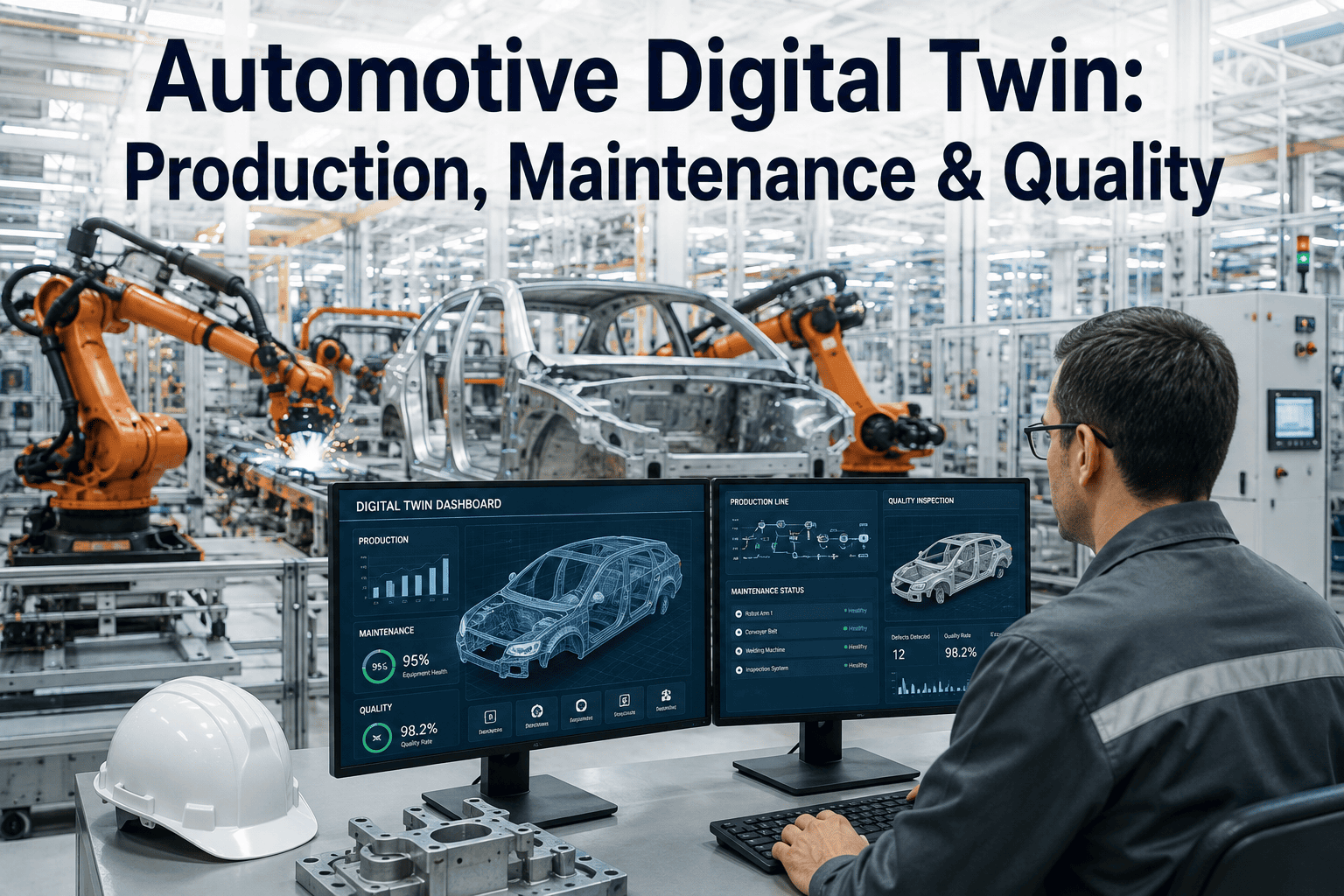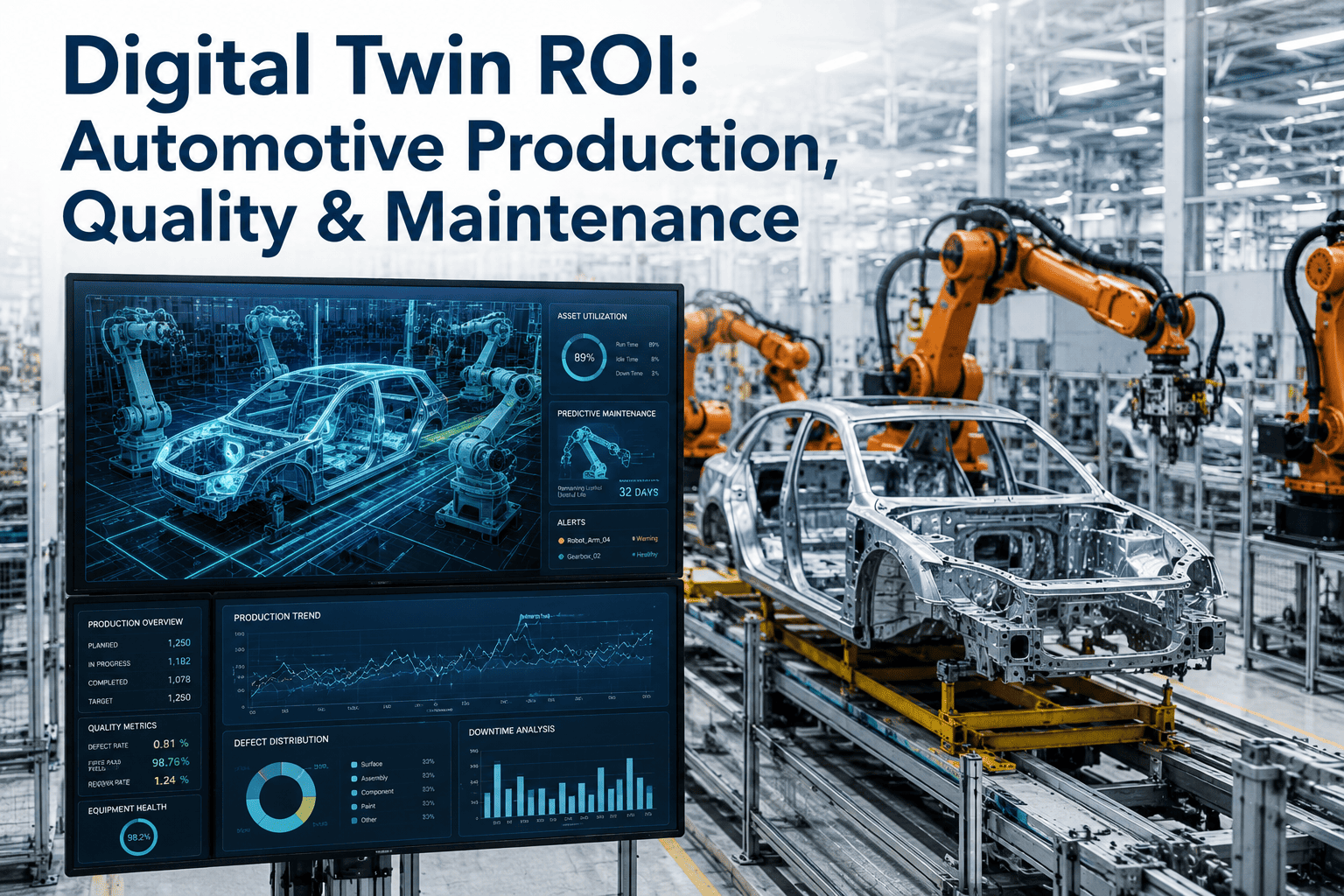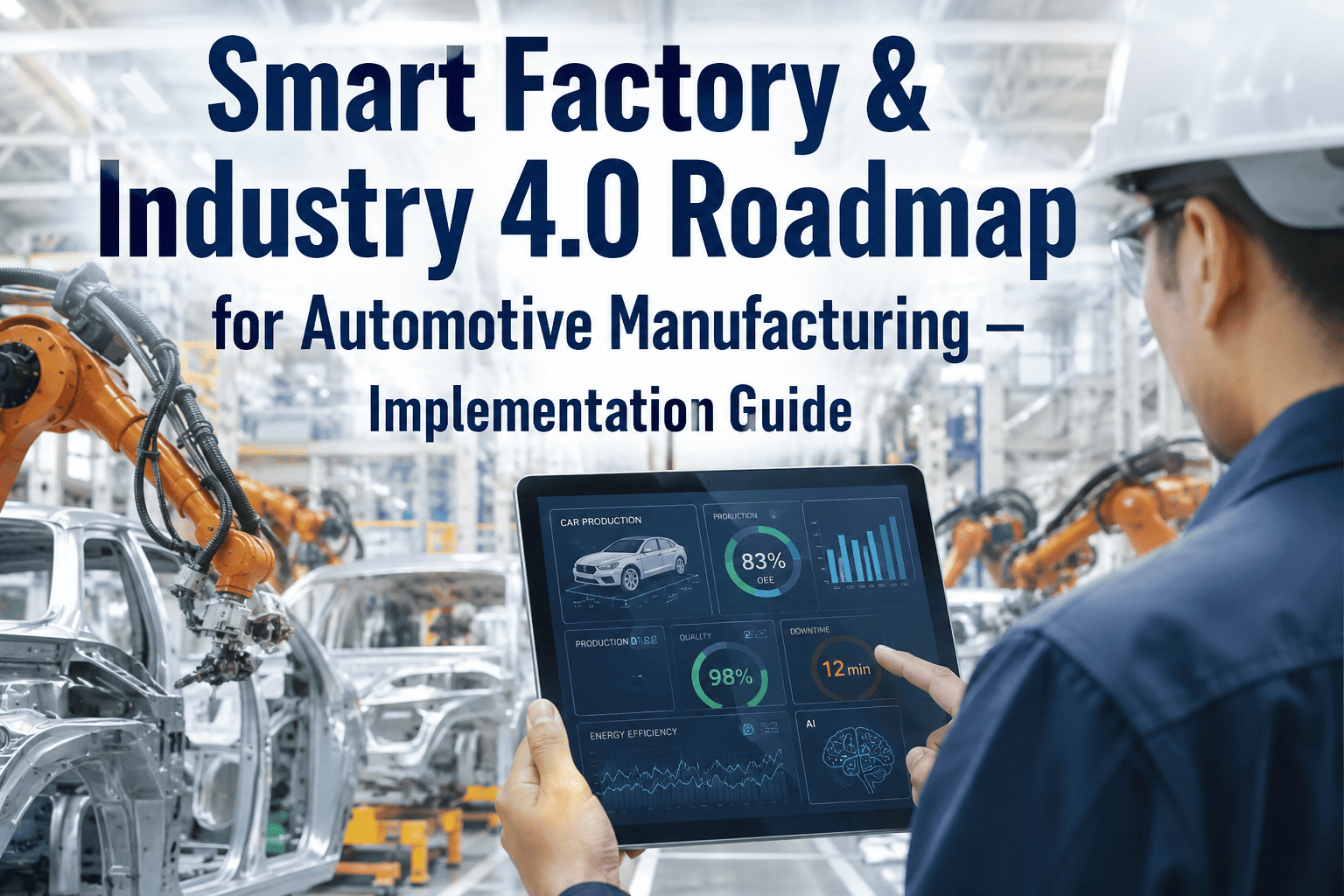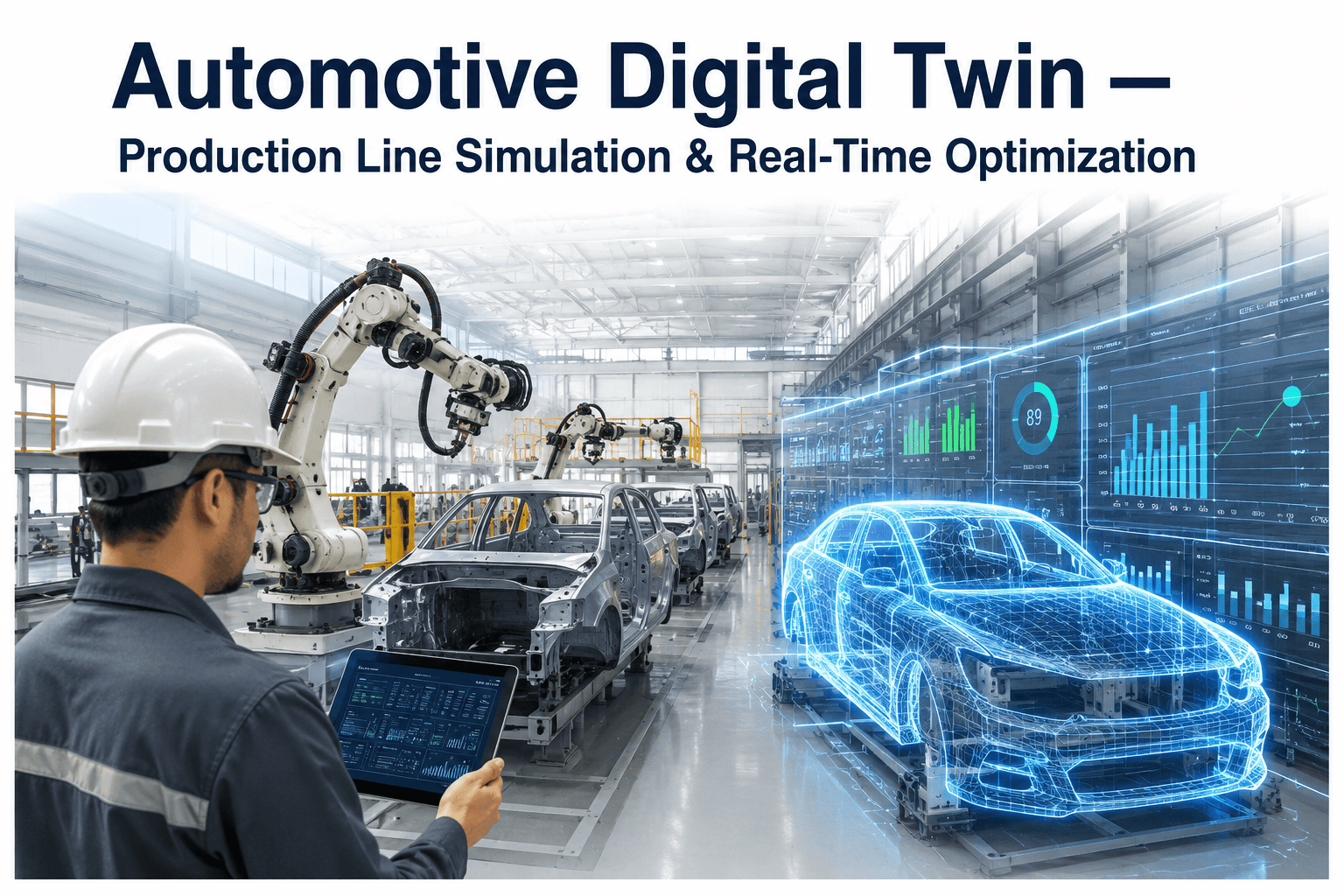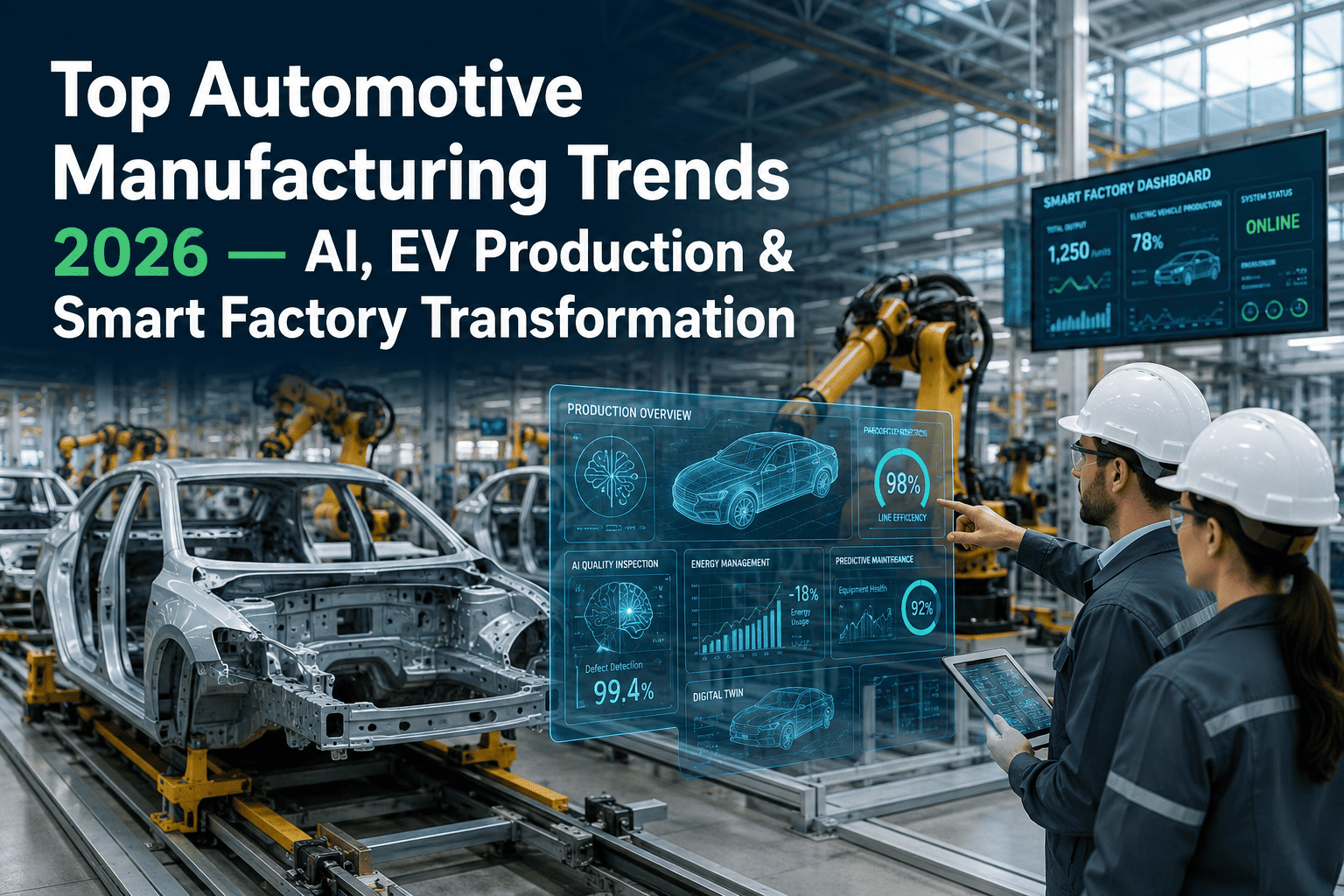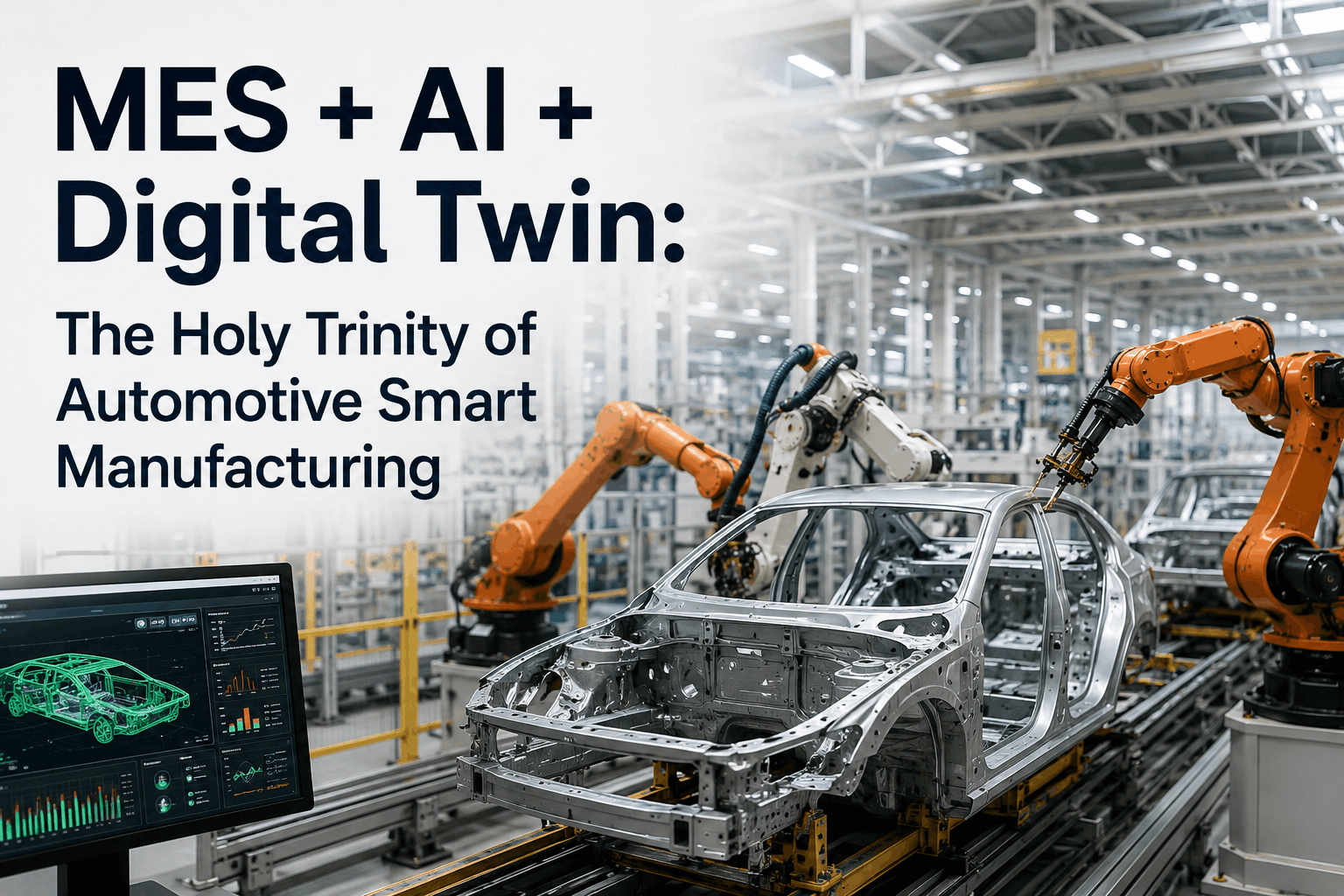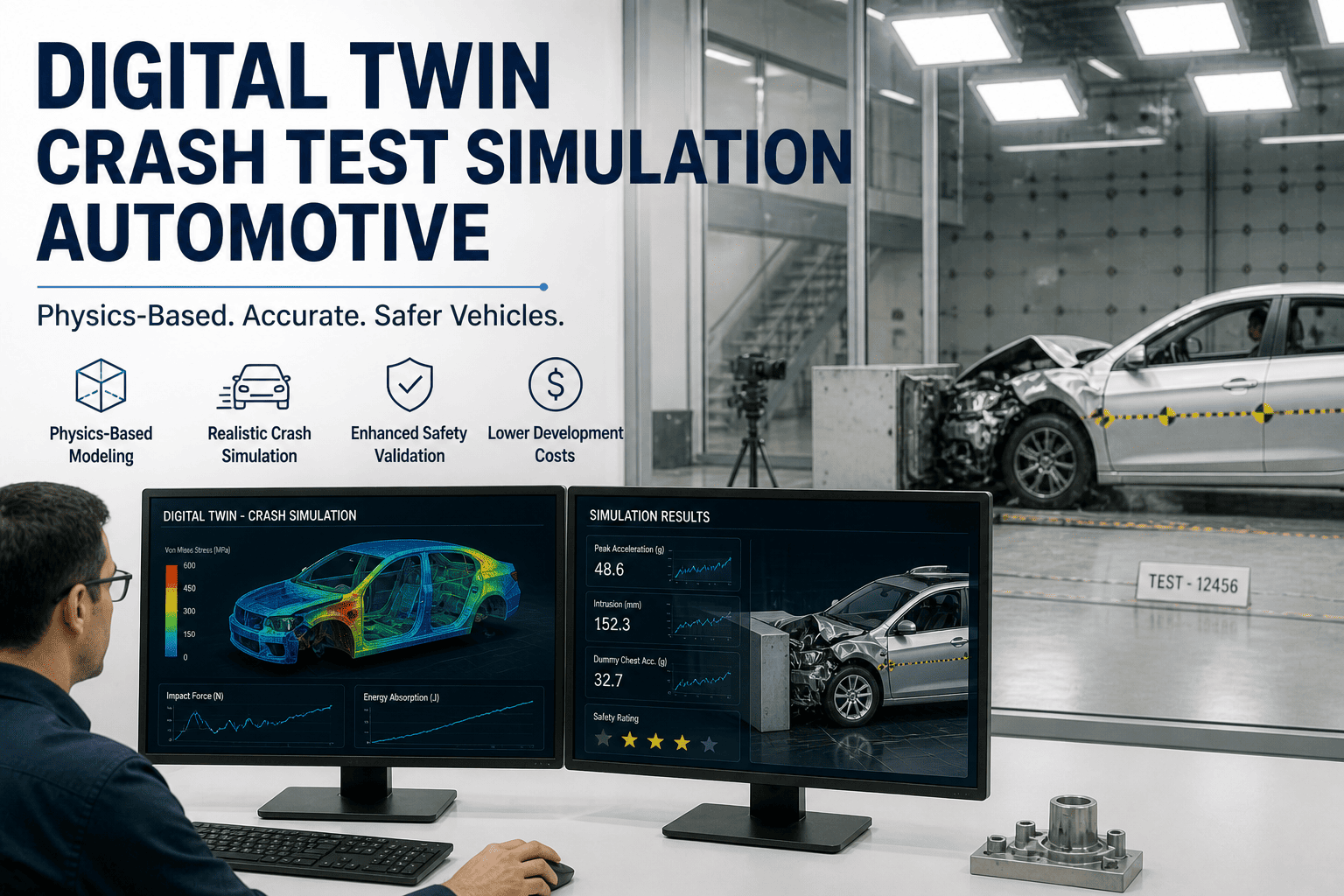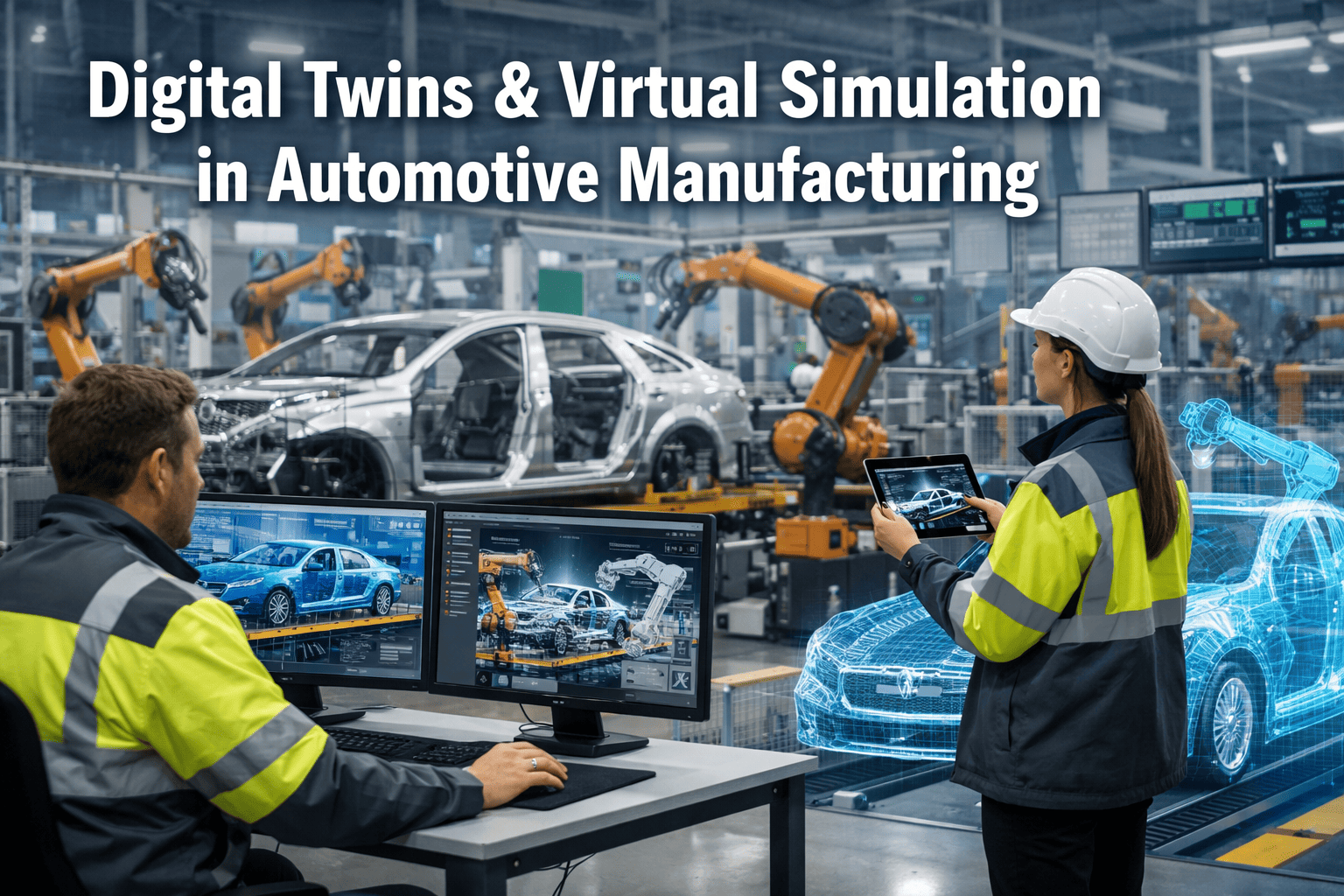
Automotive manufacturing is entering the simulation-first era. In 2026, leading OEMs and Tier 1 suppliers no longer commission production lines, validate process changes, or launch new vehicle programs without first building, testing, and optimizing in the digital world. Digital twins—real-time virtual replicas of physical assets, processes, and entire factories—are delivering 35% faster time-to-production, 40% fewer commissioning errors, and up to $12M in annual savings per plant by eliminating costly physical trial-and-error. From virtual commissioning of robotic welding cells to full-factory simulation of material flow, digital twin technology is reshaping how automotive manufacturers design, validate, and continuously optimize their operations. This guide explores the digital twin ecosystem, virtual simulation capabilities, and implementation strategies that define manufacturing excellence in 2026.
Perfect It Physically.
Real-time virtual replicas of your entire manufacturing operation—from individual robots to full factory floors.
Why Digital Twins Are Redefining Automotive Manufacturing
The automotive industry faces an unprecedented convergence of pressures: accelerating model cycles, mass customization demands, electrification transitions, and relentless cost optimization. Traditional physical prototyping and trial-and-error commissioning can no longer keep pace. Digital twins provide the answer—a parallel digital universe where every change can be simulated, validated, and optimized before a single bolt is turned on the factory floor.
Accelerating Product Cycles
Vehicle programs that once took 48 months now target 24–30 months from concept to SOP. Digital twins compress engineering validation, tooling design, and production ramp-up into parallel workstreams instead of sequential phases.
Mass Customization Complexity
Modern automotive plants produce hundreds of vehicle variants on shared lines. Digital twins simulate every variant's production path, validating that mixed-model scheduling, fixture changes, and robot programs work flawlessly across all configurations.
EV Transition & Retooling
Electrification requires massive production line reconfiguration—battery module assembly, high-voltage testing, new material handling. Digital twins let manufacturers validate entire EV production systems virtually before committing to multi-million-dollar physical retooling.
Anatomy of an Automotive Digital Twin
A manufacturing digital twin is far more than a 3D model. It's a living, data-connected virtual replica that mirrors the behavior, physics, and logic of its physical counterpart in real time. Understanding the layers of a digital twin is essential for planning implementation scope and investment.
3D Geometry & Spatial Model
High-fidelity 3D representations of every physical asset—robots, conveyors, fixtures, tooling, building structure, and material handling equipment. CAD-accurate geometry ensures spatial validation: reach analysis, collision detection, and ergonomic assessment are precise to millimeter tolerances.
Physics & Kinematic Simulation
Accurate physics engines model robot kinematics, material dynamics, gravity, friction, and process forces. Robot controllers run native code (not simplified approximations) so cycle times, motion paths, and singularity behaviors match real-world performance exactly. Process simulations model welding heat distribution, paint atomization, and adhesive flow characteristics.
PLC & Control System Emulation
Virtual PLCs run the actual control logic that will govern the physical line. Sensor signals, actuator commands, safety interlocks, and HMI interfaces all operate in the digital twin exactly as they will on the factory floor—enabling full virtual commissioning before hardware installation.
Real-Time Data Connection & AI Analytics
Live sensor feeds from the physical plant continuously update the digital twin, creating a synchronized mirror of actual operations. AI and machine learning models analyze the combined physical and virtual data streams to predict equipment failures, optimize process parameters, and recommend production schedule adjustments in real time.
Virtual Simulation Use Cases Across the Plant
Digital twin technology transforms every stage of the automotive manufacturing lifecycle—from greenfield plant design to ongoing production optimization. These are the highest-impact use cases driving ROI in 2026.
Virtual Commissioning
Test and debug PLC programs, robot paths, safety systems, and material handling logic in the digital twin before physical installation begins. Manufacturers report 40% fewer commissioning errors and 30% shorter ramp-up periods when lines are virtually commissioned first.
Factory Layout Optimization
Simulate entire factory floor layouts—equipment placement, material flow paths, buffer sizing, and AGV routing—to maximize throughput and minimize wasted space before committing to physical installation. Layout changes that cost millions on a live floor cost nothing in the digital twin.
Robotic Workcell Programming
Offline robot programming (OLP) in the digital twin eliminates production downtime for robot teach-in. Engineers program, simulate, and validate robot paths with collision detection, cycle time analysis, and reach verification—then download validated programs directly to production robots.
Throughput & Bottleneck Analysis
Discrete event simulation models production flow across entire value streams—identifying bottlenecks, testing buffer strategies, and optimizing takt time before changes hit the live floor. Run thousands of production scenarios in minutes to find optimal configurations that would take months to test physically.
Ergonomic & Safety Validation
Human simulation models validate operator ergonomics—reach zones, force requirements, repetitive motion risks, and visibility lines—across all workstation configurations and vehicle variants. Identify and resolve ergonomic risks digitally before operators ever enter the physical station.
Continuous Production Optimization
Once the physical line is running, the digital twin becomes a continuous improvement tool. Real-time synchronization with production data enables what-if analysis on live operations—testing scheduling changes, maintenance windows, and process parameter adjustments without disrupting actual production.
Simulate Before You Build. Optimize Before You Launch.
iFactory's digital twin platform connects 3D simulation, PLC emulation, production analytics, and AI-driven optimization into a unified environment for automotive manufacturing.
The Technology Stack: What Powers an Automotive Digital Twin
Building a manufacturing digital twin requires integrating multiple technology layers. Understanding this stack helps plant leaders evaluate vendor capabilities and plan integration architecture.
IoT Sensors & Edge Computing
Thousands of sensors (vibration, temperature, current, vision) feed real-time data through edge computing nodes that filter, aggregate, and stream high-frequency production data to the digital twin with sub-second latency.
Physics-Based Modeling & Discrete Event Simulation
Multi-physics engines model mechanical kinematics, thermal behavior, fluid dynamics, and electrical systems. Discrete event simulation layers model production flow, scheduling logic, and resource allocation across the entire factory.
PLM, MES, ERP & SCADA Connectivity
Digital twins integrate bidirectionally with PLM systems (product design data), MES (production execution), ERP (planning and scheduling), and SCADA (real-time control). This connectivity ensures the virtual model always reflects the latest product design, production schedule, and operational state.
Machine Learning & Predictive Optimization
AI models trained on combined physical and virtual data predict equipment degradation, quality drift, and throughput optimization opportunities. Reinforcement learning algorithms continuously test process improvements in the digital twin before deploying validated changes to the physical floor.
3D Visualization, AR/VR & Dashboards
Immersive 3D visualization lets engineers walk through virtual factories, inspect robot workcells in VR, and overlay real-time production data on physical equipment using AR headsets. Executive dashboards present KPIs, simulation results, and predictive alerts in real time.
ROI Analysis: The Business Case for Digital Twins
Digital twin investments deliver measurable returns across multiple dimensions. Here's what manufacturers with mature digital twin deployments are reporting in 2026.
Virtual commissioning and parallel engineering workflows compress program launch timelines by eliminating sequential physical validation steps.
PLC logic, robot programs, and safety systems debugged virtually before installation—eliminating weeks of on-floor troubleshooting during ramp-up.
Combined savings from reduced downtime, faster launches, lower scrap rates, optimized throughput, and avoided physical prototyping costs.
Design changes validated in the digital twin before physical implementation—identifying conflicts, process impacts, and tooling requirements virtually.
Human simulation catches workstation design problems before operators experience them—reducing injury claims, absenteeism, and workers' compensation costs.
Typical payback period for comprehensive digital twin deployment covering virtual commissioning, production simulation, and continuous optimization.
Want to model the ROI of digital twin investment for your plant? Request a custom savings analysis from our simulation team.
Implementation Roadmap: Deploying Digital Twins in Your Plant
Digital twin deployment follows a proven maturity path—from basic 3D visualization to fully autonomous, AI-driven optimization. This roadmap helps manufacturers plan their journey based on capability, investment, and business priority.
Asset Digitization & Baseline Model
- 3D scan existing production lines using laser scanning and photogrammetry
- Import equipment CAD models and build spatial digital twin of current state
- Establish data connectivity architecture (OPC-UA, MQTT, sensor mapping)
- Define use case priorities and success metrics for digital twin deployment
Simulation Activation & Virtual Commissioning
- Connect PLC emulators and robot controller simulations to digital twin
- Build discrete event simulation models for production flow and scheduling
- Run virtual commissioning pilot on one production cell or line segment
- Validate simulation accuracy against physical production data
Real-Time Synchronization & Plant-Wide Expansion
- Deploy IoT sensor network and edge computing for real-time data feeds
- Synchronize digital twin with live production data (MES, SCADA, ERP)
- Expand digital twin coverage from pilot cell to full production line or plant
- Implement real-time production dashboards and anomaly detection
AI-Driven Optimization & Autonomous Operations
- Deploy AI/ML models for predictive maintenance, quality prediction, and throughput optimization
- Implement reinforcement learning agents that test improvements in the digital twin autonomously
- Enable closed-loop optimization: AI recommends changes, validates in twin, deploys to floor
- Extend digital twin to multi-plant network for enterprise-wide simulation and benchmarking
Ready to start your digital twin journey? Schedule a roadmap planning session with our simulation engineering team.
Industry 4.0 Integration: How Digital Twins Connect the Smart Factory
Digital twins don't operate in isolation—they serve as the central nervous system of the Industry 4.0 smart factory, connecting and coordinating every other digital manufacturing technology.
Predictive Maintenance
Digital twin monitors real-time equipment health data alongside simulated degradation models to predict failures 2–4 weeks before they occur, enabling planned maintenance during scheduled windows.
AI Vision Quality Inspection
Quality defect data from AI vision systems feeds back into the digital twin, correlating quality issues with process parameters to identify root causes and simulate corrective actions before implementation.
Autonomous Material Handling
AGV and AMR fleets are simulated in the digital twin to optimize routing, traffic management, and fleet sizing. Real-time twin synchronization enables dynamic re-routing based on actual production conditions.
Energy Management & Sustainability
The digital twin models energy consumption across all production processes, simulating the impact of scheduling changes, equipment upgrades, and renewable energy integration on plant-level carbon footprint.
Supply Chain Synchronization
Production scheduling simulations in the digital twin connect to supplier delivery data and material availability, enabling proactive schedule adjustments when supply chain disruptions are detected upstream.
Expert Perspective
"Digital twins have moved from proof-of-concept curiosity to mission-critical infrastructure in automotive manufacturing. The manufacturers who have invested in simulation-first engineering are launching programs 35% faster, with dramatically fewer quality escapes and ramp-up delays. What's changed in 2026 isn't the technology—it's the business case. With vehicle programs compressing, electrification demanding entirely new production systems, and labor markets tightening, the cost of NOT having a digital twin now exceeds the cost of building one. The competitive gap between digital-twin-enabled manufacturers and those still relying on physical trial-and-error is widening every quarter."
Conclusion
Digital twins and virtual simulation have become the defining competitive advantage in automotive manufacturing. In a landscape of compressed timelines, exploding variant complexity, and massive electrification retooling, the ability to build, test, and optimize production systems virtually before committing physical resources is no longer optional—it's the difference between leading and falling behind. With proven ROI of 35% faster launches, 40% fewer commissioning errors, and $12M+ in annual savings per plant, the business case is unambiguous. From virtual commissioning and factory layout optimization to AI-driven continuous improvement and multi-plant digital twin networks, the technology stack is mature and the implementation roadmap is proven. For plant leaders and manufacturing executives, the question isn't whether to invest in digital twins—it's how quickly you can build the simulation-first culture that defines manufacturing excellence in 2026.
Schedule your iFactory demo to see digital twin simulation in action, or connect with our simulation engineers to discuss your virtual manufacturing strategy.
Simulate. Validate. Optimize. Repeat.
Join leading automotive manufacturers using iFactory to build production-grade digital twins, run virtual commissioning, and achieve continuous AI-driven optimization across every line and every plant.