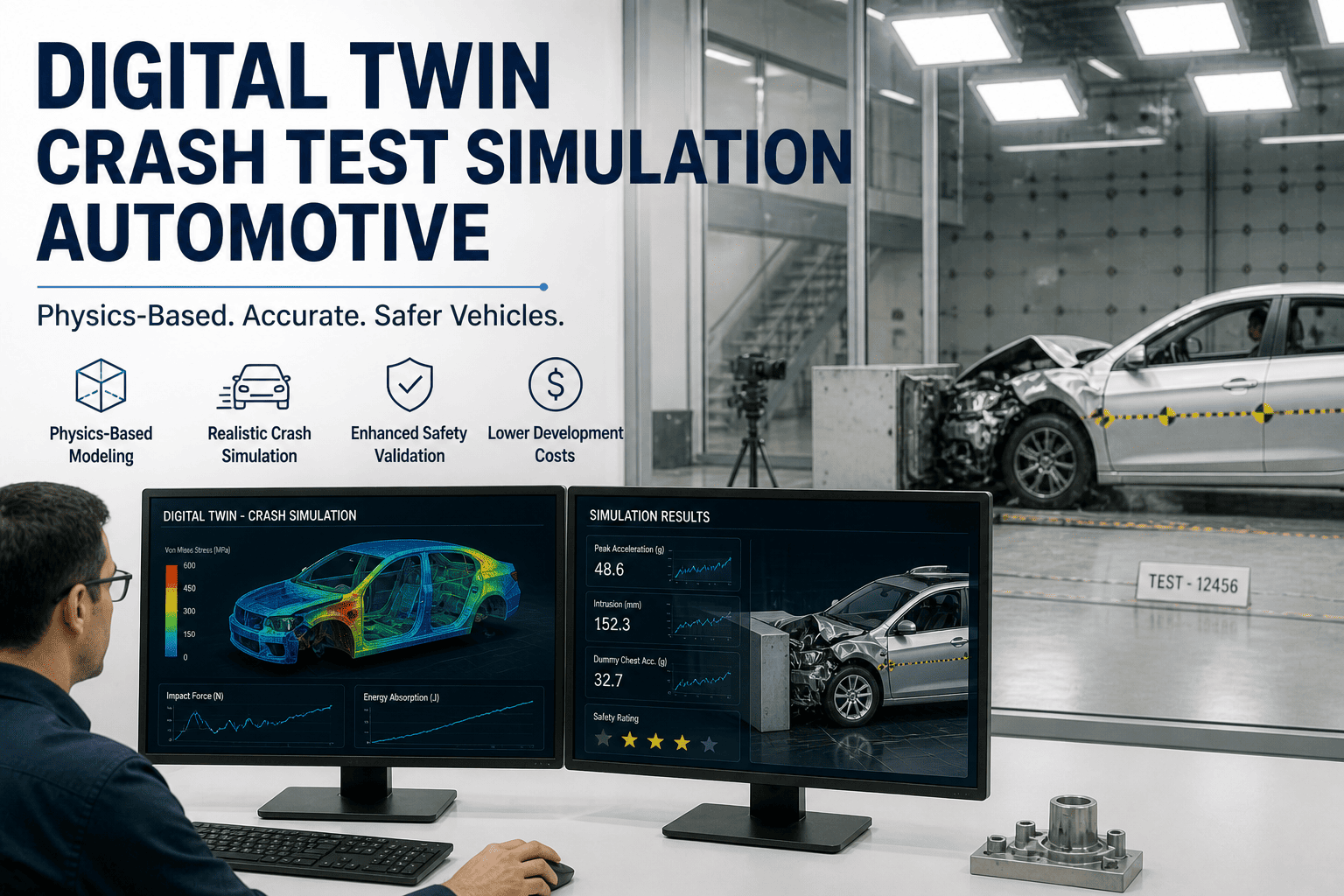
A vehicle enters a crash test barrier at 64 kilometers per hour. In 150 milliseconds, 127 metal stampings crumple in a choreographed sequence. Sensor data streams from 1,200+ measurement points across the frame, door panels, and safety cage. Post-test analysis consumes 4 weeks of engineering time. By then, the next design iteration is already being tooled. Traditional crash testing build physical prototypes, destroy them, analyze the wreckage, iterate based on damage patterns is the speed of manufacturing in the 1990s. Physics-based digital twins compress that cycle from weeks to hours. A crash simulation runs on the same vehicle design 500 times with different materials, frame geometries, and safety component placements. Real optimization happens before the first physical prototype is ever built. Book a demo to see how iFactory's physics-based digital twins accelerate automotive safety validation.
The Cost of Physical Crash Testing in Automotive Development
Modern vehicle development requires validation against 15+ regulatory crash scenarios: frontal impact, side impact, rollover, pedestrian protection, roof crush, and more. Each unique test vehicle costs $600,000 to $1.2M in materials and labor. A mid-size OEM running 30 crash tests across 5 design iterations spends $9M to $18M on physical testing alone. A safety validation engineer analyzing post-test sensor data manually spends 280 hours per crash test identifying failure modes, measuring deformation, and documenting compliance.
Vehicle prototype, fuel system, interior trim, sensors, and labor. Single-use destructive test.
Weeks 1-2: Test scheduling and setup. Weeks 2-3: Physical testing. Weeks 4-6: Post-test disassembly, measurement, and engineering analysis.
Budget and time allow 4-5 design iterations. Potential improvements identified late in development cannot be evaluated or implemented.
Commercial testing labs are booked 6-12 months in advance. OEMs queue competing projects. Schedule pressures force early crash test decisions before design is fully mature.
What Are Physics-Based Digital Twins in Automotive Safety?
A physics-based digital twin for crash testing is a complete virtual vehicle model that simulates real-world crash dynamics using computational mechanics. The model includes every major structural component (frame rails, pillars, roof structure, floor pan), the chassis, suspension hard points, interior trim, and safety systems (airbags, seat belt pre-tensioners, energy-absorbing crush zones). When a crash scenario is defined (64 kph frontal barrier impact, 56 kph side pole impact), the model calculates deformation, acceleration, and force distribution across all vehicle components in real-time.
The physics engine underlying the digital twin solves thousands of nonlinear differential equations every millisecond — material plasticity (how steel yields under load), contact algorithms (when metal panels touch and generate friction), and failure mechanics (when welds rupture or material tears). The output is not a pretty animation. The output is precise engineering data: acceleration at the driver's head (used to calculate head injury criterion), deformation of crush zones (used to verify energy absorption), and final vehicle configuration (compared against regulatory dimensional limits).
Macroscopic vehicle deformation, mesoscale component failure, microscopic material plasticity — all solved simultaneously in the same model.
Real material properties (yield strength, strain-hardening, fracture toughness) loaded from material databases. Different steel grades and aluminum alloys behave differently under crash loads.
Sliding contact between panels, assembly clearances, and friction dissipates energy and affects deformation sequence. Ignored in simplified models, critical in physics-based predictions.
Models predict rupture of spot welds, plastic hinge formation in frame rails, and tearing of thin-wall components — not just deformation, but structural failure.
Crash dynamics unfold at 1-millisecond intervals. Energy absorption, force buildup, and occupant acceleration are resolved continuously — not averaged or smoothed.
Crash dummy motion (head, thorax, pelvis, femur) is calculated using biomechanical models. Injury metrics (HIC, 3ms acceleration, chest compression) are computed automatically.
How Physics-Based Digital Twins Reduce Development Time and Cost
Real-World Impact: Physics-Based Digital Twin Use Cases
Use Case 1: Frontal Impact Optimization for a Mid-Size Sedan
An OEM's crash test team needed to validate a new front-end design that combined reduced weight (for electric vehicle range) with improved occupant protection. Traditional approach: build 3 prototype variants, crash test each, then iterate. Total time: 12 weeks. Total cost: $3.6M (3 crash tests at $1.2M each).
Using a physics-based digital twin, the team ran 150 virtual crash scenarios with variations in: front rail gauge (2.0mm to 2.5mm), bumper beam geometry (4 different cross-sections), crush zone trigger point (3 configurations), and material grade (340MPa to 450MPa steel). The digital twin identified that a 2.2mm gauge with a modified bumper beam geometry reduced weight by 12kg while maintaining head injury criterion below the regulatory limit. Only 1 physical crash test was required for validation (vs 3). Time: 8 weeks. Cost: $1.8M.
Use Case 2: EV Battery Pack Crash Safety Validation
An EV manufacturer's battery pack structure had to survive side impact without rupture (thermal runaway risk). The pack is integral to the floor and side sill structure. A late change to the pack geometry (18650 cell to larger 21700 format) would require retooling the floor tooling — a $2.4M investment. The team ran 240 virtual side-impact simulations with the new battery geometry, different impact angles (0 to 30 degrees), and varying speeds (50 to 72 kph). The digital twin revealed that a specific sill reinforcement pattern (applied to only the lower 200mm of the sill) maintained structural integrity across all test conditions without major geometry change.
Result: Tooling modification was minimal and affordable ($80K). The battery pack geometry remained unchanged. No need for the full $2.4M retooling investment. Development validation accelerated from 16 weeks (physical testing) to 5 weeks (digital twin plus selective physical test).
Use Case 3: Pedestrian Protection Optimization
Euro NCAP pedestrian protection tests require impact to the hood, A-pillar, and windshield at specific energy levels. A new vehicle architecture had a stiffer hood and narrower A-pillar than previous models — both increased pedestrian injury risk. The team used physics-based digital twins to simulate impacts on 180 different configurations: hood stiffness (varying reinforcement patterns), foam thickness (25mm to 50mm), and A-pillar cross-section geometry. The digital twin accurately predicted that a specific hood foam configuration (40mm variable-thickness foam with local stiffening) would reduce pedestrian head injury criterion below Euro NCAP limits while maintaining hood stiffness for hail and dent resistance.
This design was validated with 2 physical tests (vs typical 6-8 tests for pedestrian protection). Euro NCAP testing passed on the first submission. The optimization avoided 2 full design iterations and the associated prototype builds, test scheduling delays, and engineering labor.
Physics-Based vs AI-Surrogate Models: When to Use Which
Two approaches exist for crash simulation: full physics-based models (computationally expensive but highly accurate across design variations) and AI-surrogate models (fast neural networks trained on physics data). The choice depends on development stage and design maturity.
| Characteristic | Physics-Based Digital Twin | AI-Surrogate Model |
|---|---|---|
| Accuracy | High across wide design variation. Solves fundamental equations of motion. | High within trained parameter space. Degrades outside training range. |
| Computation Time | 4-8 hours per crash scenario on HPC cluster | Milliseconds per prediction on standard GPU |
| Design Flexibility | Can handle major geometry changes, new materials, novel architectures | Limited to design space used in training data |
| Best Use Case | Concept phase to detailed design. Design space exploration. Novel safety concepts. | Final validation. Rapid sensitivity analysis. Parameter fine-tuning. |
| Cost (Year 1) | $2M-4M (HPC infrastructure, licensing, expertise) | $500K-1M (AI platform, training data generation) |
| Validation Requirement | Requires physical test correlation (10-15% of nominal design space) | Requires extensive training data and validation test set |
| Regulatory Acceptance | Fully accepted. Can replace physical tests with OEM certification. | Emerging. Most regulators require physical validation of surrogate outputs. |
The optimal approach: Physics-based twins for major design decisions and concept validation. AI-surrogates for rapid parameter optimization and sensitivity studies once the design is mature.
Building a Physics-Based Digital Twin: Key Components
Converting CAD geometry into finite elements (tetrahedral or shell elements). Mesh quality determines solution accuracy. Automated AI meshing reduces 3-4 weeks of manual work to 48 hours.
Physical material data (yield strength, elongation, failure strain) for each steel and aluminum grade. Includes temperature-dependent properties and strain-rate effects (materials behave differently at 64 kph vs 150 kph impact).
Spot welds, adhesive bonds, and mechanical fasteners are modeled with failure criteria. A weld fails at ~400 MPa stress. Failure of 5-10 critical welds changes the entire crash behavior.
Crash dummies are modeled with 60+ rigid bodies, joint constraints, and contact surfaces. Motion is calculated from vehicle acceleration and seatbelt/airbag forces. Injury metrics (HIC, chest compression, femur load) are computed automatically.
Impact velocity, barrier rigidity, and vehicle positioning determine crash boundary conditions. A 15-degree angled barrier impact differs dramatically from straight-on barrier.
Physics model is correlated against 2-3 physical tests. Mesh refinement, material properties, and contact definitions are adjusted until physics model predictions match test data within 5-10%. Then the model is trusted for design optimization.
iFactory's Physics-Based Digital Twin Platform for Automotive Crash Testing
iFactory's digital twin platform integrates CAD geometry, material databases, crash physics engines, and AI-assisted analysis to compress validation timelines.
AI-assisted meshing transforms CAD geometry into validated finite element mesh in 24-48 hours. Automated topology cleanup identifies and fixes mesh issues (intersecting elements, isolated regions) before simulation.
Run 50-200 crash scenarios in parallel across cloud HPC infrastructure. Frontal barrier, side pole, rear impact, rollover, and pedestrian protection tests all run simultaneously — not sequentially.
Physics simulation outputs acceleration time-histories and occupant kinematics. AI post-processing automatically calculates HIC (Head Injury Criterion), 3ms chest acceleration, femur load, and pelvic acceleration. Compliance with Euro NCAP, NHTSA, and other standards verified automatically.
Define material gauge, cross-section geometry, weld pattern, and foam thickness as parameters. Run 200+ variations automatically. Sensitivity analysis identifies which design changes have the highest impact on safety metrics.
Use physics simulation to generate training data for AI-surrogates. Surrogates enable rapid exploration of design space. High-confidence designs validated with physics simulation before physical testing.
Safety engineers, chassis engineers, and crash test managers access the same digital twin data. Crash results, injury metrics, design recommendations, and validation status shared in real-time.
ROI Timeline: Physics-Based Digital Twin Implementation
Regulatory Acceptance and Validation Strategy
Physics-based digital twins are increasingly accepted by regulatory agencies (NHTSA, Euro NCAP, CNCAP) as alternatives to full physical testing, but validation strategy is critical. Most regulators require:
Physical test data on the baseline design. Physics model predictions compared against measured accelerations, deformations, and injury metrics. Target: Less than 10% prediction error.
Physical tests on 2-3 design variations (different materials, gauges, or geometries). Digital twin predictions compared to test results. Confirms model is predictive across design space, not just for baseline.
Technical report submitted to regulatory body showing model assumptions, material properties, mesh quality metrics, and correlation results. Transparency builds regulator confidence.
High-risk configurations identified by digital twin are validated with physical tests before production. Low-risk variations (validated by physics model) can skip physical testing.
Competitor Comparison: Physics-Based Digital Twin Platforms
| Vendor | Physics Engine | AI Integration | CAD Integration | Deployment | Automotive Focus |
|---|---|---|---|---|---|
| iFactory | LS-DYNA + custom solver | AI meshing, metric extraction, surrogate models | Native CATIA, NX, Creo | Cloud HPC + on-premise | Purpose-built for automotive |
| Altair Radioss | Proprietary explicit FEA | Basic (AI post-processing) | Multiple CAD formats | Desktop + cloud | Strong, but general purpose |
| ANSYS LS-DYNA | LS-DYNA (industry standard) | Limited AI | Mechanical interface | On-premise / Desktop | Mature but manual workflow |
| Siemens Simcenter | Multiple (LS-DYNA, PAM, DYNA) | Emerging AI capabilities | NX integration | Desktop + cloud | Enterprise breadth, automotive segment |
| ESI Virtual Performance Solution | PAM-CRASH | Minimal AI | Limited CAD | On-premise | Focused on safety but declining market share |
iFactory's advantage: Pre-built automotive expertise, seamless CAD workflows, AI-accelerated meshing and analysis, and cloud infrastructure designed for batch crash simulations.
Frequently Asked Questions
Getting Started: Physics-Based Digital Twin for Your Safety Validation Program
Accelerate Automotive Safety Validation with Physics-Based Digital Twins
Reduce physical crash testing by 40-50%, accelerate time-to-market by 8-12 weeks, and save $2M-4M per development program. iFactory's physics-based digital twin platform integrates seamlessly with your CAD tools, crash simulation workflows, and regulatory validation process.