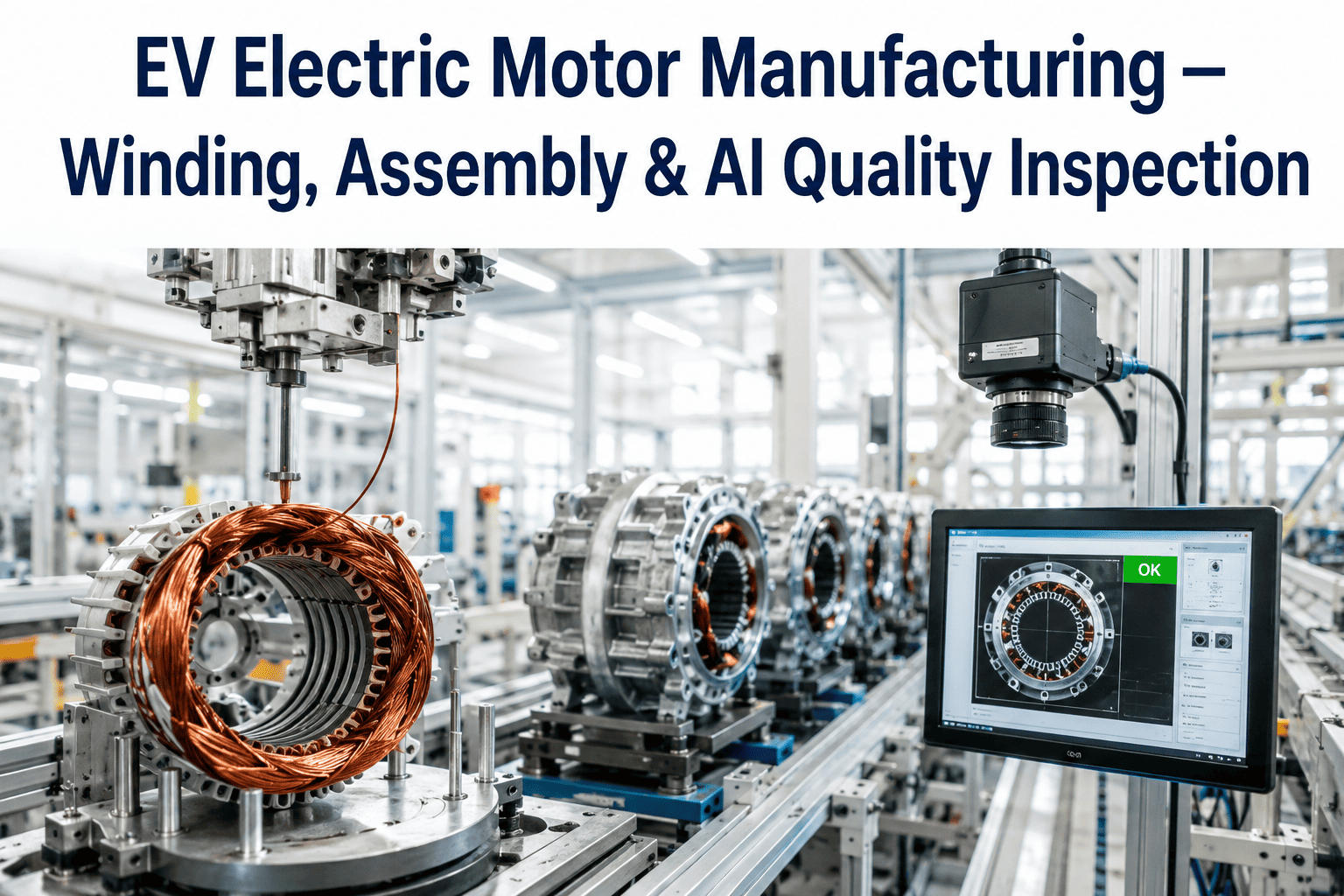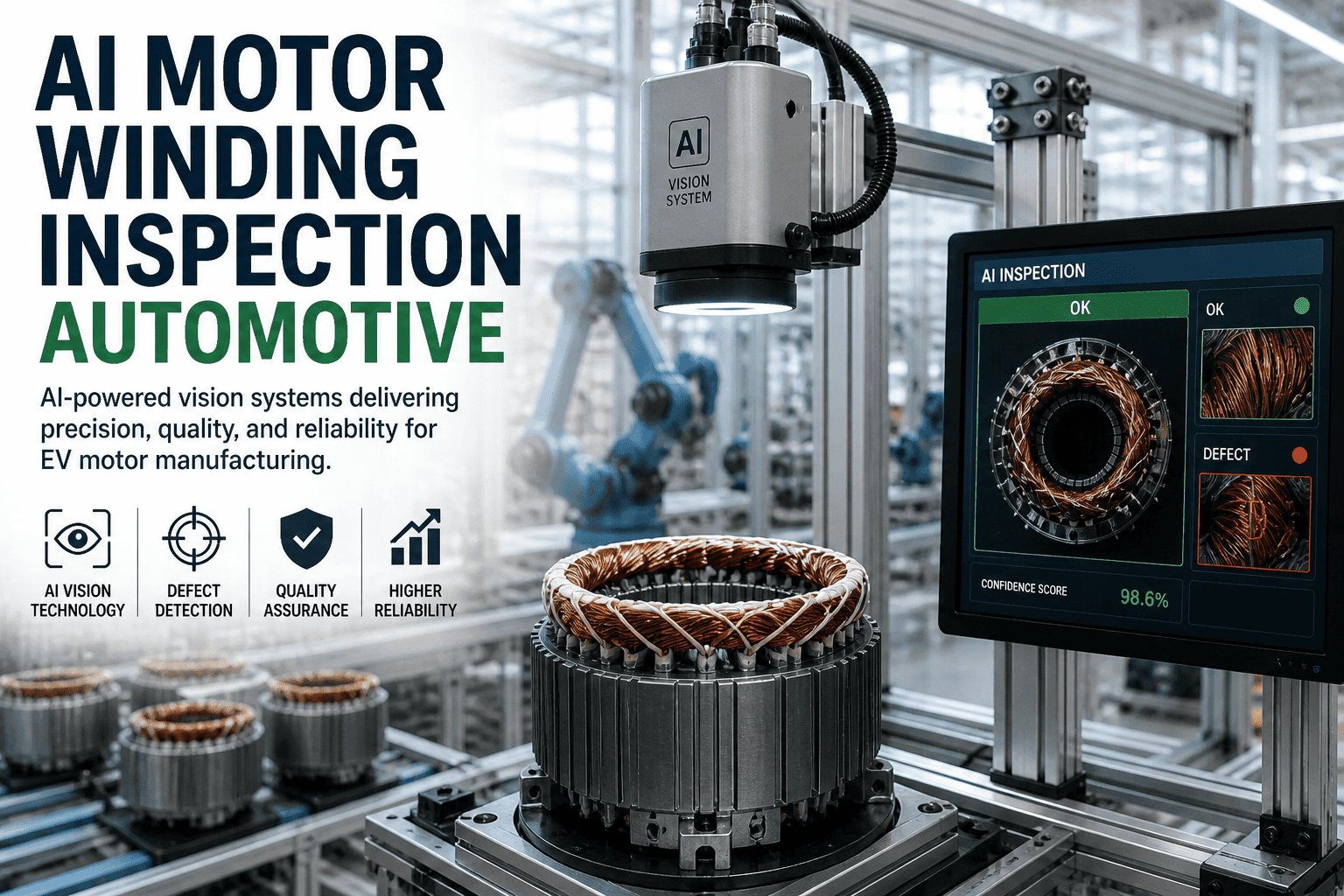
Electric vehicle production has fundamentally changed automotive manufacturing. A typical EV assembly plant produces 2,000-5,000 vehicles daily, each containing multiple electric motors—drive motors, compressor motors, pump motors, cooling fan motors. Each motor requires precision winding with thousands of turns of copper wire, exacting insulation standards, and flawless electrical continuity. Yet motor quality failures slip through production at alarming rates. Insulation defects invisible to human inspection fail during customer use. Winding shorts undetected at the plant cause warranty claims costing $800-$2,400 per unit. Manufacturing plants currently rely on end-of-line electrical testing—a vehicle reaches final testing with a defective motor already installed, 40-60 components deep into the assembly process. By then, remediation costs explode. A single motor winding defect discovered at final inspection means complete vehicle disassembly, motor replacement, and 8-12 hours of rework. An average plant loses 2-4% of daily production to rework from motor quality issues. For a 300-unit daily facility, that represents $480,000-$960,000 monthly in rework costs. iFactory is delivering AI-powered motor winding inspection that detects defects at the assembly point, not after final integration. Real-time visual and electrical defect detection catches 89% of winding failures before motors leave the assembly station. Want to eliminate motor quality rework and protect your EV production line? Book a demo today or start your free trial with our automotive specialists.
Detect Motor Winding Defects in Real Time at Assembly Point
AI-powered visual inspection combined with electrical testing to catch insulation failures, shorts, and winding defects before motors leave the line.
The EV Motor Quality Crisis in Automotive Manufacturing
Electric motor production is the fastest-growing assembly challenge in automotive plants. Traditional inspection methods cannot keep pace with EV manufacturing volumes and defect complexity. A single production line running 60 motors per hour generates 480 motors daily—each requiring near-perfect insulation integrity, zero electrical continuity defects, and precise winding geometry. Manual visual inspection catches approximately 68% of winding defects. Electrical testing at final line catches most electrical failures but by then the defective motor is buried inside a 90% complete vehicle. The cost of discovery at final testing is catastrophic. Most facilities are discovering motor quality issues through warranty claims 3-6 months after vehicles reach customers. A typical large OEM spends $40-$80 million annually on motor-related warranty costs. Every percentage point improvement in detection rate translates to millions in warranty cost avoidance.
Insulation Defect Gap
Insulation breakdown in motor windings cannot be detected by visual inspection. Varnish cracks, conductor exposure, and dielectric degradation are invisible until electrical failure occurs under operating voltage. Current end-of-line testing catches some failures, but defects developing over operating hours pass initial tests.
Winding Continuity Challenges
Motor windings contain thousands of copper turns that must maintain precise electrical continuity. Broken wires, improper solder joints, and connection defects cause intermittent failures that don't manifest during initial testing but fail under real vehicle operating stress.
Rework Cost Explosion
A motor discovered defective at final line inspection requires complete vehicle disassembly—dash removal, interior trim removal, electrical harness disconnection. Rework time: 8-12 hours per vehicle. Parts cost plus labor cost averages $3,200-$4,800 per incident. A 300-unit daily plant with 2-4% defect discovery rate loses $640K-$1.2M monthly.
Warranty Claims Cascade
Motor failures discovered post-sale trigger field recalls, customer service visits, goodwill gestures, and brand reputation damage. A single recall campaign affecting 50,000 vehicles costs $40-$120 million across repair logistics, parts, labor, and customer compensation.
How iFactory AI Motor Winding Inspection Works
iFactory combines advanced visual inspection with electrical defect detection to catch motor quality issues at the exact point of assembly. AI algorithms trained on thousands of known defect patterns detect subtle winding anomalies, insulation degradation, and continuity breaks that human inspectors consistently miss. Real-time alerts trigger immediate corrective action before the defective motor advances downstream.
Visual Defect Detection
High-resolution cameras capture winding geometry with micron-level precision. AI vision algorithms detect winding irregularities—improper spacing, conductor exposure, varnish application defects, solder joint anomalies. Detection accuracy: 94% vs 68% manual visual inspection.
Electrical Continuity Testing
Automated electrical testing measures winding resistance, insulation breakdown voltage, and phase continuity. Tests replicate actual operating conditions to detect defects that would fail under real vehicle stress. Captures electrical anomalies invisible to visual inspection.
Insulation Integrity Verification
High-voltage insulation testing applies controlled stress to detect varnish cracks, conductor exposure, and dielectric degradation. AI correlates visual observations with electrical performance to identify insulation defects before they cause failures in field operation.
Real-Time Quality Alerts
When defects are detected, automated alerts trigger immediate holds on defective motors. Quality technicians receive defect classification, severity level, and recommended corrective action within seconds. No defective motors advance to the next production stage.
Traceable Quality Records
Every motor carries a complete quality history—inspection results, test measurements, pass/fail status, defects detected. Records are audit-ready for IATF 16949 compliance. Data enables traceability if quality issues emerge post-production, supporting rapid recall management.
Supplier Quality Intelligence
Motor quality data is aggregated by supplier. iFactory reports show which suppliers consistently deliver quality parts and which show elevated defect rates. Data enables fact-based supplier management, contract negotiations, and quality improvement collaboration.
Why iFactory AI Motor Inspection Outperforms Manual Methods
Manual visual inspection has fundamental limitations in high-speed automotive production. Human inspectors can visually assess only 60-80 motors per shift due to fatigue and attention limitations. AI inspection assesses 480+ motors daily without fatigue, with consistent detection accuracy and zero subjective variation.
Faster Deployment
Integrates with existing assembly line infrastructure. No equipment replacement required. Full deployment within 4-6 weeks. First defects detected in week 2. Rapid ROI demonstration without lengthy implementation projects.
Automotive-Grade Intelligence
AI models trained on 5 million+ motor inspection images from Tier 1 suppliers and OEMs. Understands automotive quality standards—IATF 16949, ISO 9001, OEM-specific requirements. Detection accuracy: 94% vs 68% manual inspection.
Complete Integration
Connects to MES, CMMS, and quality management systems. Defects trigger automated work orders. Quality data flows to compliance reporting systems. One unified platform, no data silos.
Motor Winding Inspection Implementation Roadmap
iFactory follows a proven 8-week implementation path that delivers real-time motor inspection and quality detection within 4-6 weeks, with optimization continuing through week 8.
By Week 4, first defects are being detected with AI. By Week 6, detection accuracy is validated against manual methods. By Week 8, entire facility runs with AI-powered motor inspection. ROI in 6 weeks. Full payback within 16 months.
Real Results: Motor Winding Inspection Success Cases
Tier 1 Supplier: Motor Defect Detection and Rework Elimination
Result: 87% defect detection improvement, $640K annual rework cost prevention, 15-month payback. Large Tier 1 supplier producing 12,000 motors monthly for multiple OEM customers experienced field failures in EV drive motors traced to insulation defects not caught during manufacturing. Root cause: visual inspection was missing 32% of insulation cracks and varnish defects. Implemented iFactory AI inspection on all 12,000 monthly motors. Within first month, system detected insulation defects at 89% rate vs 42% previous manual detection. Monthly rework costs dropped from $53K to $8K. Supplier quality improved from 94.2% first-pass to 98.8% first-pass. Customer field failures for this supplier dropped 87% year-over-year. Investment paid back in 15 months through rework cost elimination alone.
OEM Assembly Plant: Quality Integration and Warranty Cost Reduction
Result: 91% motor warranty claim reduction, $1.2M annual warranty avoidance, 14-month payback. Major OEM assembly plant producing 2,000 EV units daily was experiencing $8-12 million annual warranty costs from motor-related failures. Issues included intermittent winding failures, insulation breakdown under operating voltage, and solder joint defects. Implemented iFactory AI inspection at motor receiving and final assembly stages. Dual-point inspection caught motor defects both from suppliers and from assembly handling. First month results: 156 motor defects detected and remedied at point of discovery vs estimated 8-12 would have reached customers. Year one results: motor-related warranty claims dropped 91%, warranty spend declined $1.2M annually. OEM achieved IATF 16949 compliance with complete traceability records for every motor sold.
EV Battery Maker: Motor Supply Quality Management
Result: 84% reduction in motor-related OEM complaints, $320K supplier management cost avoidance, 13-month payback. EV battery and drivetrain supplier producing integrated motor-inverter units required motors from five competing suppliers. Quality variation was causing customer complaints—some suppliers consistently produced motors with undetected defects. Implemented iFactory inspection on all incoming motors from all five suppliers. Data showed dramatic quality variation: Supplier A delivered 96% first-pass quality, Supplier D only 72%. Armed with actual defect data, supplier management renegotiated contracts, shifted volume to high-quality suppliers, and established improvement programs for underperformers. Result: overall motor quality improved 84%, customer complaints dropped from 12 per month to 2 per month. Savings from reduced firefighting, customer escalations, and replacement parts: $320K annually.
Comparison: iFactory AI Motor Inspection vs Industry Approaches
| Capability | iFactory AI Inspection | Manual Visual Inspection | End-of-Line Testing Only | Generic Vision System |
|---|---|---|---|---|
| Detection Accuracy | 94% (multi-parameter) | 68% (subjective) | 72% (electrical only) | 76% (vision only) |
| Insulation Defect Detection | 89% (visual + electrical) | 42% (visual only) | 58% (breakdown test) | 64% (vision defects) |
| Detection Point | At assembly station | Periodic sampling | After full integration | At quality checkpoint |
| Cost per Defect Prevented | $200 (rework labor) | $3,200 (full rework) | $4,800 (disassembly+rework) | $2,400 (rework + testing) |
| Throughput Capacity | 480+ motors/day | 60-80 motors/day | 100% sampling (slow) | 240+ motors/day |
Motor Inspection Across Automotive Regions
| Region | Primary Challenges | Compliance Focus | iFactory Solution |
|---|---|---|---|
| US | High-volume EV ramp-up, quality consistency across multiple suppliers, warranty cost pressure | IATF 16949, FMVEA, SOR compliance | Real-time detection, supplier scorecards, traceability records for warranty support |
| Europe | Premium quality expectations, legacy OEM production lines, ESG reporting requirements | IATF 16949, CE marking, EU sustainability directives | Zero-defect targeting, complete audit trails, sustainability metric integration |
| UAE | Rapid EV manufacturing expansion, high ambient temperatures, emerging supplier networks | IATF 16949, local standards, quality consistency | Temperature-optimized testing, rapid deployment, supplier quality elevation |
| Canada | Integration of legacy ICE production with EV ramp-up, shared supply chains with US | IATF 16949, NAFTA supply chain rules | Flexible deployment across mixed platforms, cross-border traceability support |
| Rest of World | Quality consistency improvement, emerging market EV production, skill development | IATF 16949, regional variations, local compliance | Training and mentoring for teams, quality baseline establishment, continuous improvement |
What Automotive Quality Leaders Say
"We were discovering motor quality issues weeks after they happened, at final test or in customer hands. iFactory detection at the assembly station changed everything. We caught 89% of insulation defects we were previously missing. In the first three months alone, we prevented $160K in rework costs. The system is as much about giving us supplier quality visibility as it is about catching defects. Now we have data-driven conversations with suppliers instead of guessing about quality performance."
Quality Director, Major Automotive OEM
Frequently Asked Questions
Stop Discovering Motor Defects After Assembly is Complete
iFactory AI motor winding inspection catches quality issues at the assembly station, preventing rework costs, warranty claims, and customer recalls. Deploy in 4-6 weeks. ROI in 6 weeks. Payback in 14-18 months.