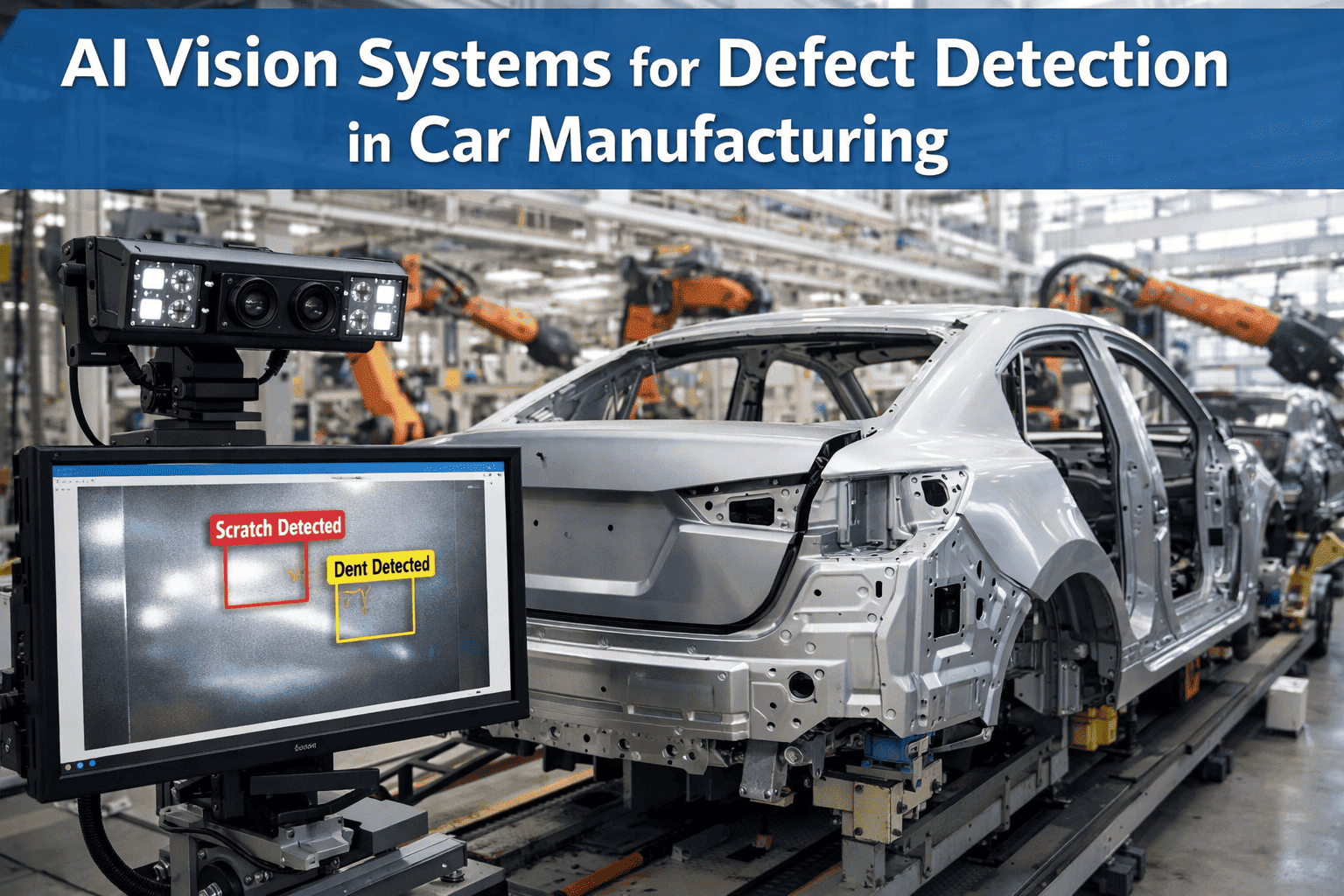
In 2026, human-only visual inspection is no longer sufficient for automotive quality standards. AI vision systems—powered by deep learning, hyperspectral imaging, and real-time edge processing—are detecting surface defects, dimensional deviations, weld anomalies, and assembly errors at speeds and accuracy levels impossible for human inspectors. Manufacturers deploying AI-powered defect detection report 99.5%+ inspection accuracy, 80% fewer customer-facing escapes, and 45% reduction in scrap and rework costs. With OEMs enforcing zero-defect delivery standards and warranty claim data flowing directly into supplier scorecards, AI vision is no longer optional—it's the new quality baseline. This guide explores how automotive manufacturers are deploying AI vision systems to transform defect detection from a bottleneck into a competitive advantage.
Why Automotive Quality Inspection Must Evolve
Traditional visual inspection methods—manual spotlights, random sampling, and end-of-line checks—were designed for a slower, less complex manufacturing era. In 2026, three converging forces are making AI-powered vision systems an operational necessity for every automotive plant.
Zero-Defect OEM Standards
Leading OEMs now enforce zero-defect delivery policies with automated supplier scorecards. A single escaped defect can trigger containment actions, financial chargebacks of $500–$5,000+ per incident, and risk of losing preferred supplier status on future vehicle programs.
Labor & Skill Shortages
Experienced quality inspectors are retiring faster than they can be replaced. Manual inspection relies on subjective judgment that varies by shift, fatigue level, and individual skill—creating inconsistent quality gates that become liability risks at scale.
Increasing Product Complexity
Multi-material bodies, EV battery assemblies, ADAS sensor brackets, and tight-tolerance components create defect types and inspection requirements that exceed human visual capability—demanding spectral, thermal, and 3D inspection modalities only AI systems can deliver.
Struggling with inspection escapes or rising quality costs? Book a consultation with iFactory's AI vision specialists.
How AI Vision Defect Detection Works
AI vision systems combine advanced imaging hardware with deep learning software to inspect every part, every surface, and every assembly point at production speed. Here's the technology stack that makes automotive-grade AI inspection possible.
High-Resolution Area Scan Cameras
50–150 megapixel industrial cameras capture full-surface images of body panels, stampings, and assemblies at sub-millimeter resolution. Multi-angle lighting reveals surface defects invisible under normal illumination.
3D Structured Light & Laser Profilers
Structured light projectors and laser triangulation sensors create precise 3D point clouds of component geometry. Detects dimensional deviations, warping, gap/flush misalignment, and surface waviness down to ±10 microns.
Hyperspectral & Thermal Imaging
Near-infrared and thermal cameras detect subsurface defects, coating thickness variations, adhesive coverage gaps, and material contamination that are completely invisible to standard RGB cameras and human eyes.
Deep Learning CNNs & Transformers
Convolutional neural networks and vision transformers trained on millions of labeled defect images classify anomalies by type, severity, and location. Models continuously improve through active learning from production data streams.
Edge GPU Inference
NVIDIA Jetson and Intel-based edge computing platforms run inference at the point of inspection—delivering defect classification in under 100 milliseconds per part. No cloud latency, no data transfer bottlenecks, no production slowdowns.
Anomaly Detection (Unsupervised)
Self-supervised models learn "normal" appearance from production data and flag any deviation—detecting novel defect types never seen before without requiring pre-labeled training examples for every possible failure mode.
Automated Pass/Fail & Sorting
Inspection results trigger automated reject gates, robotic sorting, rework routing, and hold-for-review queues—removing subjective human decision-making from the disposition process.
MES/QMS Integration & Traceability
Every inspection image, defect classification, and disposition decision is logged with part serial number, timestamp, and operator context—feeding directly into MES, QMS, and warranty traceability systems.
SPC & Trend Analytics
Statistical process control dashboards track defect rates, types, and trends in real-time. AI identifies process drift before it produces defects—enabling upstream corrections that prevent scrap rather than catching it.
Defect Types AI Vision Detects Across the Production Line
AI vision systems aren't limited to a single inspection point. They deploy across every stage of automotive manufacturing—each tuned to detect the specific defect types that matter most at that production step.
Sub-millimeter surface imperfections on formed panels detected through deflectometry and structured light scanning
Material fractures at trim edges and draw radii identified via high-resolution line scan cameras
Part geometry variations beyond tolerance detected by 3D laser profiling against CAD reference models
Material flow anomalies in formed panels identified through surface waviness analysis and thickness mapping
Weld bead irregularities, spatter deposits, and porosity detected by inline laser profiling and thermal imaging
Spot weld count verification and seam weld location validation using structured light 3D scanning
Body panel fit verified against tolerance specifications using multi-sensor 3D gap and flush measurement systems
Structural adhesive width, height, position, and continuity verified using laser triangulation profilers
Surface texture anomalies and paint sags detected by deflectometry systems scanning entire body surfaces in seconds
Particulate contamination trapped in paint layers identified under specialized angled lighting and high-resolution imaging
Spectrophotometric measurement of color coordinates (L*a*b*) and gloss units across all panels for batch consistency
Non-contact measurement of primer, base coat, and clear coat layer thickness using eddy current or ultrasonic sensors
Verification of clip presence, connector seating, label placement, and component orientation using pattern matching
Interior trim panel gaps, bezels, badge positioning, and seal seating verified against design specifications
Torque-to-angle fastener presence and engagement confirmed by vision systems cross-referenced with torque gun data
Thermal imaging identifies coolant, brake fluid, and refrigerant leaks invisible to the naked eye during end-of-line testing
Want to see AI vision detect real defects from your production line? Talk to our AI vision engineers for a defect detection feasibility study.
AI Vision vs. Traditional Inspection: The Performance Gap
The differences between human inspection and AI-powered vision systems aren't marginal—they're transformational. This comparison shows why AI vision is replacing manual inspection as the primary quality gate in automotive manufacturing.
Deploy AI-Powered Defect Detection in Your Plant
iFactory's AI vision module integrates with your existing cameras, PLCs, and MES systems to deliver real-time defect detection, automated disposition, and quality analytics across every production zone.
ROI Breakdown: The Business Case for AI Vision Inspection
AI vision systems pay for themselves faster than almost any other manufacturing technology investment. Here's what the data shows across automotive plants with deployed AI inspection systems in 2026.
Early defect detection at the source station prevents defective parts from advancing through downstream operations—eliminating compounding rework labor, material waste, and production delays.
100% inline inspection with 99.5%+ accuracy virtually eliminates defects reaching OEM customers—reducing chargebacks, warranty claims, containment actions, and supplier scorecard penalties.
Automated inspection replaces repetitive manual checks, enabling quality engineers to focus on root cause analysis, process improvement, and supplier quality management rather than visual sorting.
Sub-second inspection speeds eliminate quality bottlenecks that constrain production lines. Parts flow continuously through vision stations without stopping, reducing cycle time and increasing effective capacity.
Want to calculate the ROI of AI vision for your specific production volumes and defect rates? Get a custom quality savings analysis from our team.
Implementation Roadmap: Deploying AI Vision in Your Plant
Deploying AI vision defect detection follows a proven phased approach—starting with high-value pilot applications and expanding across the full production line as models mature and ROI is validated.
Assessment & Pilot Scoping
- Audit current quality gates, defect data, and inspection bottlenecks
- Identify highest-ROI inspection stations based on scrap, rework, and escape data
- Evaluate existing camera and lighting infrastructure for AI readiness
- Define defect taxonomy, acceptance criteria, and target accuracy thresholds
Model Training & Pilot Deployment
- Collect and label defect image datasets from production (1,000–10,000+ images)
- Train and validate deep learning models against defect taxonomy
- Deploy pilot vision station in shadow mode (parallel with manual inspection)
- Tune detection thresholds to minimize false positives while maximizing catch rate
Production Go-Live & Integration
- Transition pilot station from shadow mode to primary inspection authority
- Integrate with MES, QMS, and automated reject/sorting systems
- Deploy real-time SPC dashboards and defect trend analytics
- Train quality engineers on AI system monitoring and model feedback workflows
Scale & Continuous Learning
- Expand AI vision to additional inspection stations across all production zones
- Deploy cross-station defect correlation for upstream root cause identification
- Implement active learning pipelines for continuous model improvement
- Connect defect analytics to predictive maintenance for process equipment
Ready to pilot AI vision inspection on your production line? Schedule a pilot planning session with our AI vision engineering team.
Expert Perspective
"AI vision inspection is the most impactful quality technology shift since the introduction of coordinate measuring machines. The difference is speed and scale—CMMs sample parts offline, AI vision inspects every single part at line speed. But the real transformation isn't just catching defects faster. It's the data. When every part is inspected and every result is logged, you create a complete digital quality record that feeds SPC, drives root cause analysis, predicts process drift before it creates scrap, and gives your OEM customers complete confidence in your quality system. The plants deploying AI vision today aren't just reducing defects—they're building the quality data infrastructure that becomes their competitive moat."
Conclusion
AI vision systems for defect detection have moved from experimental technology to production-proven necessity in automotive manufacturing. With OEMs demanding zero-defect delivery, quality labor becoming scarce, and vehicle complexity outpacing human inspection capability, AI-powered vision is the only path to achieving 99.5%+ inspection accuracy at production speed and scale. Manufacturers deploying AI vision across stamping, welding, painting, and assembly operations are achieving 45% lower scrap costs, 80% fewer customer escapes, and 60% quality labor savings—with full ROI in 6–10 months. From deep learning CNNs and edge GPU inference to automated disposition and real-time SPC analytics, the technology stack is mature and the implementation roadmap is proven. For quality leaders and plant managers, AI vision isn't a future investment—it's today's competitive requirement.
Schedule your iFactory demo to see AI vision defect detection in action, or connect with our quality engineers to discuss your defect detection challenges.
See Everything. Catch Everything. Prove Everything.
Join leading automotive manufacturers using iFactory's AI vision platform to achieve 99.5%+ defect detection accuracy, eliminate customer escapes, and build complete digital quality traceability.