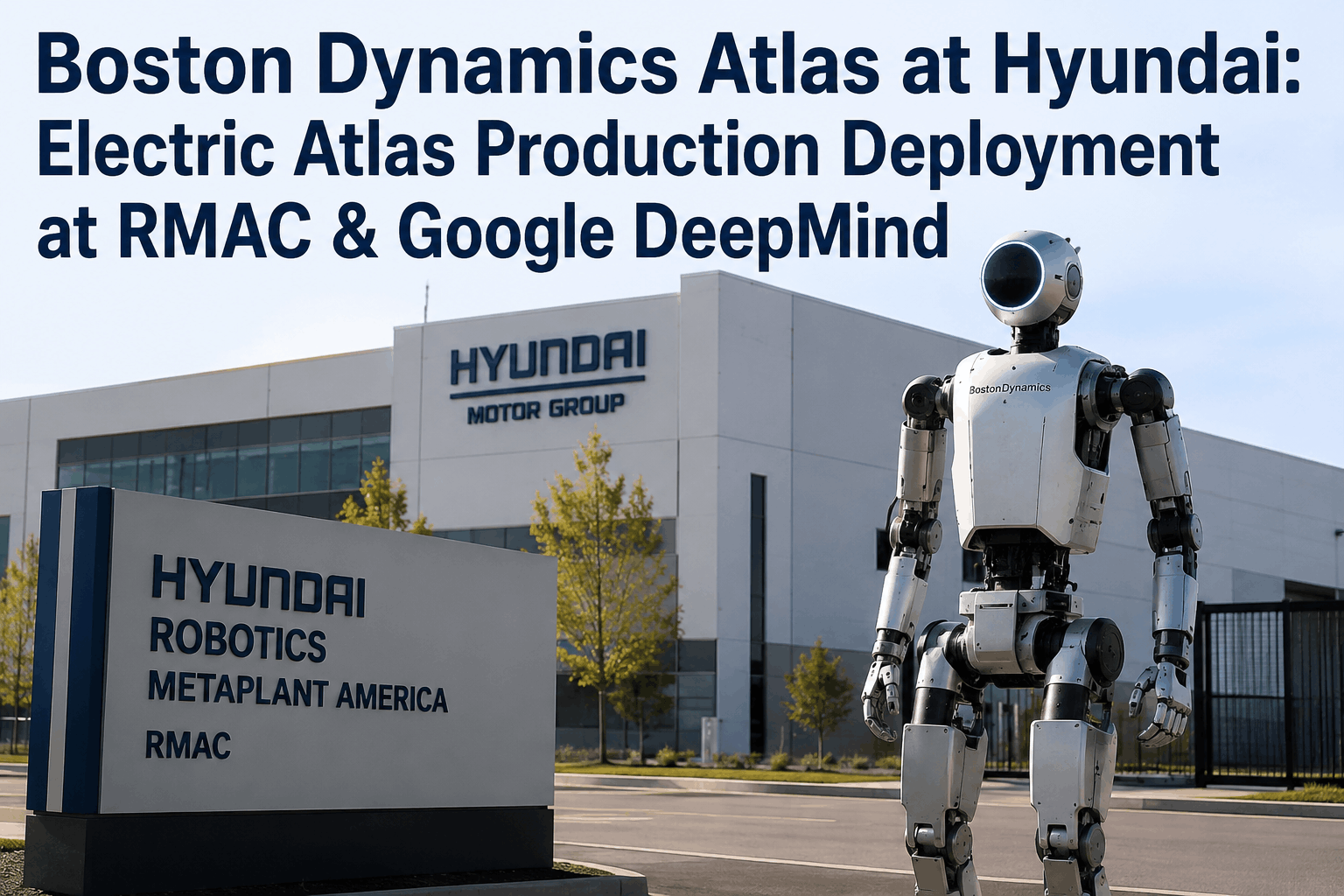
When Hyundai Motor Group acquired Boston Dynamics in 2021 for $1.1 billion, the automotive world assumed the acquisition was about prestige and innovation headlines. Three years later, the logic is obvious: Hyundai now owns the most capable humanoid robot platform in existence and is deploying it at its own Metaplant America (RMAC) facility in Georgia — the most advanced automotive assembly plant currently under construction in the United States. The Electric Atlas is not a research robot borrowed from a startup. It is the industrial evolution of a platform with 15 years of development history, now backed by the manufacturing scale of the world's third-largest automotive group and a Google DeepMind AI partnership that may be the most consequential collaboration in industrial robotics. Book a demo to see how iFactory's on-premise and cloud platforms integrate with Atlas deployments.
Case Study — Boston Dynamics & Hyundai 2026
Electric Atlas at Hyundai RMAC: The Third Major Humanoid Automotive Deployment — and Why It May Be the Most Capable
30,000 units/year production capacity · Google DeepMind Gemini Robotics · Hyundai Metaplant America · $1.1B acquisition · CES 2026 debut — the complete deployment analysis.
30,000
Atlas units/year production capacity at RMAC
$1.1B
Hyundai acquisition price for Boston Dynamics — 2021
15 yrs
Atlas platform development history — deepest in the industry
DeepMind
Google DeepMind Gemini Robotics AI partnership
Why the Hyundai-Boston Dynamics Combination Is Structurally Different
The BMW-Figure and Mercedes-Apollo deployments are partnerships — a robot company and a manufacturer working together under a commercial agreement. The Hyundai-Atlas relationship is different in kind: Hyundai owns Boston Dynamics outright. This means Atlas's R&D roadmap, production capacity, and deployment priorities are directly aligned with Hyundai's manufacturing strategy — not negotiated across a commercial contract. It also means Hyundai's engineering teams have access to Atlas's full technical architecture, not just its external API, enabling integration depth that external customers cannot replicate.
The Metaplant America (RMAC) facility in Bryan County, Georgia — Hyundai's $5.5 billion greenfield EV assembly plant — was designed with robotic flexibility as a core architectural requirement. Unlike legacy plants retrofitting humanoids into existing workstation layouts, RMAC's body shop, battery assembly, and final assembly zones incorporate Atlas-compatible workstation dimensions, interaction zones, and charging infrastructure as standard. iFactory's platform provides both on-premise and cloud-based integration for Atlas deployments at facilities like RMAC and external adopters.
OWN
Full Ownership — Not a Partnership
Hyundai owns Boston Dynamics entirely. Atlas R&D roadmap, pricing, production capacity, and deployment priority are all internal Hyundai decisions — not commercial negotiations with an external company.
15Y
15 Years of Development Depth
Atlas has been in continuous development since 2013. The Electric Atlas (2024) builds on hardware, control software, and failure mode knowledge accumulated over a decade and a half — unmatched by any competitor platform founded after 2015.
NEW
RMAC Built for Atlas
Metaplant America was designed with humanoid robotics as a core assumption. Workstation dimensions, interaction zones, charging infrastructure, and safety layouts incorporate Atlas specifications from the ground up — a structural advantage no retrofit deployment can match.
AI
Google DeepMind Gemini Robotics
The partnership with Google DeepMind gives Atlas access to Gemini Robotics — a family of AI models specifically trained for physical manipulation tasks. This is the most advanced foundation model collaboration in industrial humanoid robotics today.
Electric Atlas: Full Technical Specification
The Electric Atlas (announced April 2024, CES debut January 2026) is a complete redesign from the hydraulic Atlas platform. Every joint is electrically actuated, eliminating the hydraulic pump, fluid system, and associated failure modes that constrained the previous generation. The result is a quieter, faster, more reliable, and more commercially viable platform. See how iFactory integrates with Electric Atlas in a live demo.
Physical
Height1.5 m
Weight89 kg
Max Payload25 kg
DOF28 total — more than any competitor
Actuation100% electric — no hydraulics
Mobility
Walk Speed1.5 m/s (fastest production humanoid)
TerrainUnstructured — stairs, ramps, obstacles
BalanceWhole-body control — industry-leading
RecoverySelf-recovery from stumble/fall
Manipulation
End EffectorsMulti-DOF tool-change system
Grip ForceHigh — automotive part handling
Wrist Range360° rotation — exceeds human
Tool ChangeAutonomous end-effector swap
AI & Computing
AI PlatformGoogle DeepMind Gemini Robotics
VisionMulti-modal — RGB + depth + LiDAR
TrainingImitation + reinforcement learning
Fleet LearningCross-robot knowledge transfer
Deployment Timeline: From Hydraulic to Electric Atlas at RMAC
June 2021
Hyundai Acquires Boston Dynamics for $1.1 Billion
Hyundai Motor Group completes the acquisition of Boston Dynamics from SoftBank, valuing the company at $1.1 billion. The acquisition gives Hyundai ownership of the Atlas humanoid, the Spot quadruped, and the Stretch logistics robot — plus the deepest robotics engineering team in the industry. BD CEO Robert Playter remains in role; Hyundai commits to operational independence while aligning on manufacturing deployment roadmap.
2022–2023
Spot Deployed Across Hyundai and Kia Plants Globally
As a precursor to Atlas deployment, Spot quadruped robots are deployed across Hyundai and Kia manufacturing facilities in Korea, Czech Republic, and the United States for predictive maintenance patrols, safety inspections, and plant monitoring. These deployments generate operational data, refine integration protocols, and build institutional knowledge that Atlas's automotive deployment will require at significantly higher complexity.
April 2024
Electric Atlas Unveiled — Hydraulics Retired
Boston Dynamics retires the hydraulic Atlas and unveils Electric Atlas — a complete ground-up redesign with fully electric actuation, a new 28-DOF joint architecture, tool-change end effectors, and a significantly quieter and more reliable drive system. The announcement is timed with a new commercial deployment agreement with Hyundai for RMAC integration. Electric Atlas achieves 1.5 m/s walking speed — the fastest of any production humanoid robot platform.
2024
Google DeepMind Gemini Robotics Partnership Announced
Boston Dynamics and Google DeepMind announce a collaboration to develop Gemini Robotics — a family of AI foundation models trained for physical manipulation tasks and designed to run on the Atlas hardware platform. The partnership combines DeepMind's leading position in robot learning research with Atlas's mechanical capability. Gemini Robotics models are trained on demonstrations of automotive assembly tasks including part handling, fastener insertion, and connector seating.
January 2026
CES 2026 — Electric Atlas Automotive Deployment Debut
At CES 2026, Boston Dynamics demonstrates Electric Atlas performing automotive manufacturing tasks at Hyundai RMAC — including body panel handling, fastener installation, and under-vehicle assembly access. The CES demonstration is notable for showing Atlas performing tasks in actual RMAC production zone environments, not a staged demonstration cell. Production capacity for Atlas at RMAC is confirmed at 30,000 units per year.
2026–2027
Commercial Atlas Programme + RMAC Full Deployment
Boston Dynamics opens Atlas commercial orders for external manufacturers, with Hyundai RMAC serving as the primary reference deployment. The 30,000-unit annual production capacity positions Atlas for fleet-scale adoption. External customers include Hyundai suppliers, and potentially non-Hyundai OEMs evaluating the platform for body shop and final assembly applications where Atlas's mobility and payload specification exceed alternatives.
What Electric Atlas Does at Hyundai RMAC
Body Shop
Heavy Panel Handling and Weld Fixture Loading
Deployment Active
Atlas's 25kg payload and 1.5 m/s walk speed make it the strongest and fastest humanoid robot in automotive production. In RMAC's body shop, Atlas handles door panels, roof assemblies, and structural sub-components that require a combination of precise positioning and force capability beyond other humanoid platforms. The 360° wrist rotation allows Atlas to position panels at angles that human workers find ergonomically difficult — reducing injury risk in the highest musculoskeletal-load zone in the plant.
Key advantage25kg payload + 1.5m/s speed — highest in class
Task typesDoor panel loading · Roof assembly transfer · Structural sub-assembly fixture loading
EV Battery Assembly
Battery Module Handling and HV System Assembly
Deployment Active
RMAC is an EV-dedicated facility — every vehicle built is an electric Hyundai or Kia. Battery module assembly is the highest-precision, highest-consequence manufacturing task in the plant. Atlas uses Gemini Robotics-powered manipulation to handle battery cells, seat high-voltage connectors, and route thermal management systems with sub-millimetre precision. The tool-change end-effector system allows Atlas to switch between a broad gripper for module handling and a precision tool for connector seating within the same station cycle. Book a demo to see iFactory's EV battery assembly integration.
Key advantageGemini Robotics precision + autonomous tool change
Task typesBattery cell handling · HV connector seating · Thermal pad placement · Pack loading
Final Assembly
Under-Vehicle and Confined-Space Assembly
Expanding
Atlas's mobility advantage over all other humanoid platforms is most visible in final assembly tasks that require non-standard body positions — under-vehicle fastening, overhead connector access, and confined-space installation that human workers perform with high injury risk. Atlas's whole-body control system allows it to adopt these positions without the balance constraints that limit other humanoid platforms, and its self-recovery capability means a stumble in a confined space does not require a maintenance intervention to reset the robot.
Key advantageBest-in-class mobility for confined and non-standard positions
Task typesUnder-vehicle fastening · Overhead connector access · Confined-space trim installation
How iFactory Connects Atlas to Hyundai RMAC Production Systems
Atlas operating without production system integration is a physically capable robot performing tasks in isolation. Atlas integrated with iFactory's platform — receiving live MES work orders, writing quality records per vehicle, triggering CMMS maintenance work orders, and feeding enterprise fleet analytics — is a production asset with measurable, traceable, and continuously improving ROI. iFactory delivers this integration in two deployment models designed for the full range of automotive manufacturing infrastructure requirements.
On-Premise Deployment
For RMAC and Plants With Data Sovereignty Requirements
iFactory edge nodes installed within the plant process all Atlas task data, quality records, and production events locally. No raw production data leaves the facility — critical for Hyundai's IP protection requirements and for external adopters operating under multi-OEM supplier data confidentiality agreements. Full production intelligence continues operating during WAN outages.
Zero cloud dependency for real-time production decisions
Sub-5ms edge inference — matches Atlas cycle times
Full data sovereignty — raw data never leaves the plant
MES, quality system, and CMMS integration on-site
Continues operating during internet connectivity loss
Cloud-Based Analytics
For Multi-Plant Atlas Fleet Management
iFactory's cloud platform aggregates Atlas performance data across all Hyundai and external adopter plants — providing enterprise fleet visibility, cross-plant task success benchmarking, AI model update distribution, and predictive maintenance scheduling at fleet scale. As the Atlas commercial programme expands to Hyundai suppliers and other OEMs, the cloud platform scales with the fleet.
Cross-plant Atlas fleet performance dashboard
Gemini Robotics model updates distributed to edge nodes
Enterprise sustainability and energy reporting
Predictive maintenance analytics across entire fleet
Scales from single RMAC deployment to global Hyundai network
Atlas → iFactory → Hyundai RMAC Production Systems
1
Electric Atlas
Task data · Quality flags · Joint telemetry · Battery status
2
iFactory Edge Node
On-premise · Real-time AI inference · MES context join
3
MES / Quality / CMMS
Work orders · Per-vehicle quality records · Maintenance alerts
4
iFactory Cloud
Fleet analytics · Multi-plant benchmarking · Model distribution
Atlas vs Figure 03 vs Optimus: The Three-Way Comparison
FAQ: Electric Atlas at Hyundai RMAC
Connect Atlas to Your Production Systems — On-Premise, Cloud, or Both
iFactory provides the integration architecture that connects Electric Atlas to your MES, quality systems, and production analytics. Available as on-premise edge deployment for data sovereignty requirements, cloud-based platform for multi-plant fleet management, or a hybrid of both — designed to scale from your first Atlas pilot to full fleet deployment.
On-Premise Edge
Cloud Analytics
MES Integration
Quality Data Routing
Fleet Management