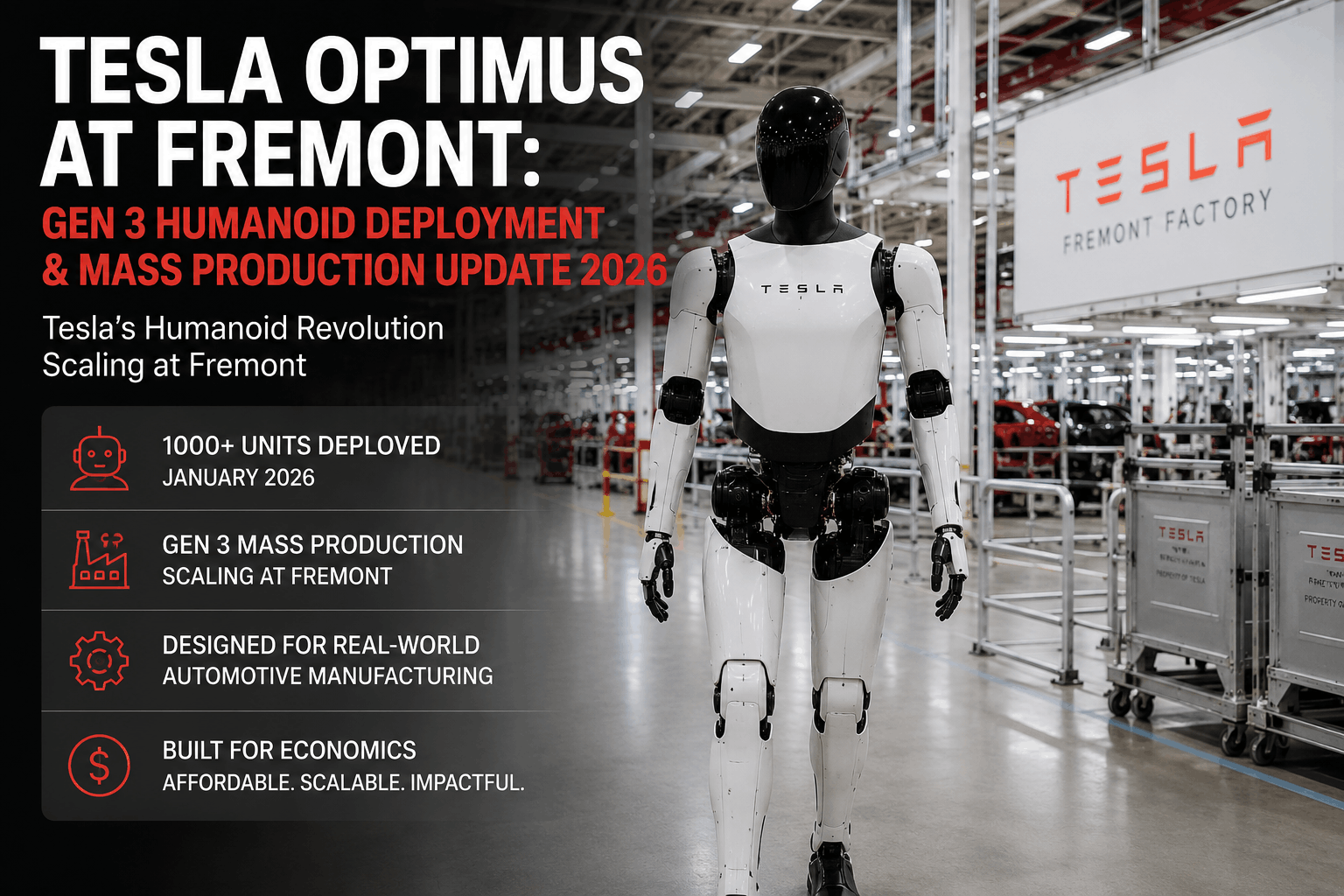
In January 2026, Elon Musk confirmed that over 1,000 Optimus Gen 3 robots were operating on the production floor at Tesla's Fremont, California factory. Not in a demonstration cell. Not in a pilot zone. On the live production line — building the vehicles that Tesla ships to customers. No other company in history has deployed humanoid robots at this volume inside a single manufacturing facility. Tesla's Optimus programme is not just the highest-volume humanoid deployment in existence; it is the proof point that humanoid robots can be manufactured, deployed, and operated at a scale that changes the economics of automotive production permanently. Book a demo to see how iFactory connects Optimus-scale deployments to production intelligence.
Case Study — Tesla Fremont 2026
Tesla Optimus Gen 3 at Fremont: 1,000+ Units, Mass Production, and the Humanoid Economics Breakthrough
January 2026 milestone · 1,000+ units on live production line · Gen 3 specs · FSD computer AI · $20–30K target price · The case study every manufacturer needs to understand.
1,000+
Optimus units on Fremont production floor — January 2026
$20–30K
Target commercial price per unit — lowest in the industry
22-DOF
Tactile hands — same DOF as Apollo, built in-house
Gen 3
Third hardware generation — production-optimised platform
Why Tesla Optimus Is the Highest-Stakes Humanoid Bet in Manufacturing
Every other humanoid programme — Figure at BMW, Apollo at Mercedes, Digit at Ford — is a partnership between a robot company and a manufacturer. Tesla's programme is different in a fundamental way: Tesla is simultaneously the robot manufacturer and the manufacturing customer. Optimus is built in Tesla factories, deployed in Tesla factories, and will eventually be sold to other manufacturers. This vertical integration gives Tesla a structural advantage that no other humanoid company can replicate in the near term: every robot deployed internally generates training data, cost reduction data, and production insights that directly feed the next generation of the product.
The 1,000-unit Fremont milestone is not just a deployment number. It is proof that Tesla's manufacturing supply chain — the same one that produces 500,000+ vehicles per year — can produce humanoid robots at industrial scale. iFactory's platform provides the production integration layer that connects Optimus task data to MES systems, quality management, and enterprise analytics for manufacturers adopting the platform externally.
V
Vertical Integration
Builds AND deploys Optimus internally — no external partnership required
S
Scale Manufacturing
Same supply chain as 500K+ vehicles/yr — humanoid production at automotive volume
D
Data Flywheel
1,000+ robots × every production cycle = unmatched real-world training dataset
P
Price Target
$20–30K commercial target — 5–10× cheaper than nearest competitor
Optimus Gen 3: Full Technical Specification
Gen 3 is not an incremental hardware update. It represents a complete redesign from Gen 2's prototype architecture to a production-optimised platform — lower part count, higher reliability, and a computing backbone built on Tesla's own FSD (Full Self-Driving) computer hardware rather than off-the-shelf components. See how iFactory integrates with FSD-powered Optimus in a live demo.
Physical
Height1.73 m
Weight57 kg
Max Payload20 kg (carry) · 150 kg (lift assist)
Walk Speed1.0 m/s (current) · 2.0 m/s (target)
Degrees of Freedom28 total body DOF
Hands & Dexterity
Hand DOF22-DOF tactile hands
ActuationTendon-driven, in-house design
Force Sensing6-axis F/T per finger
Grip ModesPinch, power, tool, lateral
Finger SpeedTarget: human-equivalent
AI & Computing
ComputeTesla FSD Computer (custom silicon)
VisionTesla Autopilot camera system (adapted)
Training MethodVideo prediction + imitation learning
Fleet Learning1,000+ units contribute to shared model
Language ModelVoice interaction — task instruction receipt
Power & Reliability
BatteryTesla 2.3 kWh — in-house cell
Runtime~8 hours per charge
Charge Time~2 hours (fast charge)
Target Price$20,000–$30,000 commercial
Current Cost~$150K (est. internal 2025)
The Fremont Deployment: From 1 Robot to 1,000+ in 18 Months
September 2023
Optimus Gen 1 — First Internal Deployment
Tesla deploys the first Optimus unit at Fremont for basic parts-sorting tasks. Gen 1 is slow, limited in dexterity, and requires significant teleoperation support — but the internal deployment begins generating the training data that will define Gen 2 and Gen 3.
December 2023
Optimus Gen 2 Released — Major Dexterity Upgrade
Gen 2 introduces 11-DOF hands (up from 6), 30% faster walking speed, and improved balance. Elon Musk publicly demonstrates Optimus Gen 2 handling fragile objects and performing sorting tasks at speed. Internal Fremont deployment scales to dozens of units across battery assembly and parts handling zones.
Q2 2024
Battery Module Assembly — First High-Precision Task
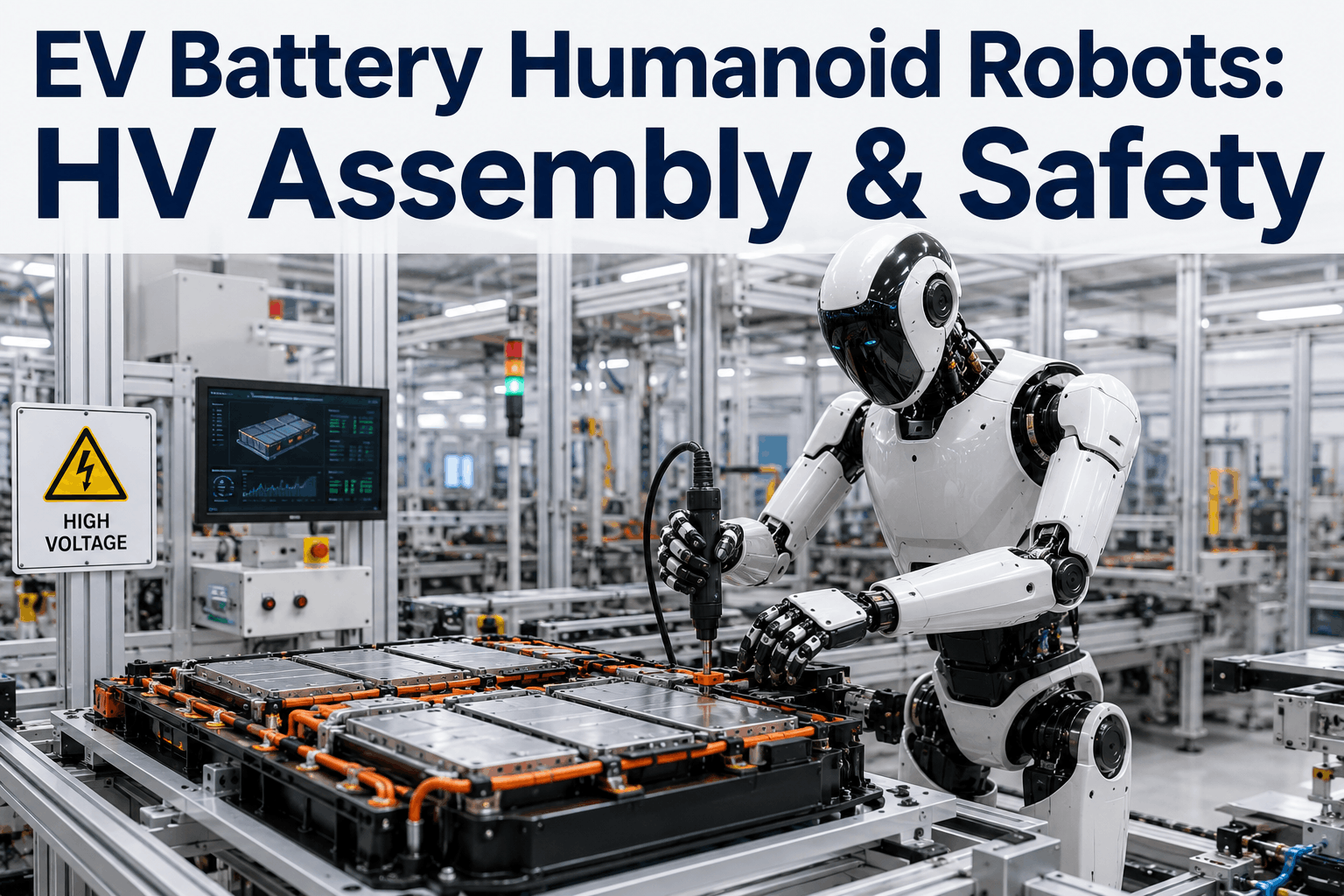
Optimus Gen 2 begins performing battery module assembly tasks at Fremont — handling lithium-ion cells, seating electrical connectors, and placing thermal management components. These tasks require the sub-millimetre precision that was not achievable with Gen 1. Tesla reports that Optimus is performing these tasks entirely unsupervised during this period.
Q3–Q4 2024
Gen 3 Development — FSD Computer Integration
Tesla integrates its custom FSD (Full Self-Driving) AI chip into the Optimus Gen 3 computing architecture. This is the same silicon that powers Tesla's autonomous vehicle fleet — giving Optimus access to vastly more onboard compute than any competitor platform using off-the-shelf chips. The 22-DOF tactile hand system is designed, manufactured, and validated entirely in-house.
January 2026
1,000+ Units — The Volume Milestone No One Else Has Reached
Elon Musk confirms 1,000+ Optimus Gen 3 units are operating at Fremont. The fleet is working across battery assembly, EV pack loading, cable routing, connector seating, and parts handling. The 1,000-unit threshold makes Tesla's deployment larger than the combined total of all other automotive humanoid deployments globally at that date.
2026–2027 Roadmap
External Sales Launch + Gigafactory Expansion
Tesla plans to begin external commercial sales of Optimus in 2026 at the $20–30K target price — a price point that would make humanoid robots accessible to mid-size manufacturers for the first time. Parallel expansion into Gigafactory Texas, Gigafactory Berlin, and Gigafactory Shanghai is planned for 2027.
What Optimus Does at Fremont: Production Zone Breakdown
Primary Zone
Battery Module & Pack Assembly
Task success rateReported >99%
Key tasksCell handling · Connector seating · Thermal pad placement · HV cable routing · Pack loading
Why here firstEV battery assembly requires consistent fine-motor dexterity — a task humans perform with high variability and injury rate
Secondary Zone
Parts Sorting & Kitting
Key tasksPart identification · Bin sorting · Kit assembly for assembly stations · Rack replenishment
AI methodFSD vision + imitation learning from teleoperated demonstrations
Secondary Zone
Final Assembly Assist
Key tasksPanel clip installation · Fastener assist · Wiring harness routing · Trim clip seating
IntegrationMES vehicle build sequence drives task assignment per station
2027 Roadmap
Gigafactory Expansion — Texas, Berlin, Shanghai
TargetMulti-Gigafactory fleet deployment · 10,000+ units across Tesla global network
External salesCommercial availability at $20–30K targeting Tier-1 suppliers and OEM assembly plants
The Optimus Economics Breakthrough: Why $20–30K Changes Everything
The economics of humanoid robotics are currently at an inflection point. At $150K–$250K per unit (the approximate 2025 price range for leading platforms), humanoid robots have an 18–36 month ROI payback at ergonomic-risk stations and a questionable business case for lower-risk tasks. At $20–30K — Tesla's stated commercial target for Optimus — the payback period collapses to 3–6 months for high-repetition tasks. This changes who can deploy humanoid robots, what tasks justify the investment, and how quickly the industry scales. Talk to iFactory about building the integration infrastructure before Optimus reaches your facility.
Current Market
$150K–$250K
Payback period18–36 months
Viable task typesErgonomic-risk, high-repetition only
Accessible toTier-1 OEMs and large Tier-1 suppliers
Deployment modelPilot programmes, limited fleets
Tesla Optimus Target
$20K–$30K
Payback period3–6 months
Viable task typesMost repetitive assembly tasks
Accessible toAll automotive tiers + mid-market mfg
Deployment modelPlant-wide fleet deployment
Tesla's $20–30K target is projected for 2026–2027 commercial availability. Current internal production cost estimated at ~$150K with rapid cost reduction trajectory driven by vertical integration and volume manufacturing.
How iFactory Connects Optimus to Your Production Systems — On-Premise or Cloud
A 1,000-unit Optimus fleet generates enormous production data — task completions, quality flags, battery status, cycle times, error recovery events. Without an integration layer connecting this data to your MES, quality system, and maintenance platform, you have robots producing output but no production intelligence. iFactory provides that integration layer in two deployment models, designed to match the data sovereignty and infrastructure requirements of any automotive plant.
On-Premise Deployment
For Plants With Data Sovereignty or Air-Gap Requirements
iFactory's edge nodes are installed within your plant infrastructure — processing all Optimus task data, quality records, and production events locally. No raw production data leaves your facility. Fully operational during WAN outages. Designed for automotive plants operating under strict IP protection agreements, ITAR requirements, or multi-OEM supplier data confidentiality obligations.
Zero cloud dependency for real-time decisions
Sub-5ms edge inference — matches Optimus cycle times
Continues operating during internet outages
Full data sovereignty — nothing leaves the plant
MES, quality, and CMMS integration on-site
Cloud-Based Analytics
For Multi-Plant Fleet Management and Enterprise Visibility
iFactory's cloud platform aggregates Optimus fleet performance data across all your plants — providing enterprise-level visibility into robot utilisation, task success rates, predictive maintenance schedules, and cross-plant benchmarking. AI model updates and fleet learning improvements are distributed from cloud to all on-premise edge nodes automatically.
Cross-plant Optimus fleet dashboard
AI model updates distributed to all edge nodes
Enterprise energy and sustainability reporting
Predictive maintenance analytics across entire fleet
Scales from single plant to global Gigafactory network
Optimus → iFactory Integration Architecture
1
Optimus Robot
Task data · Quality flags · Battery status · Cycle times
2
iFactory Edge Node
On-premise processing · Real-time AI inference · MES context
3
MES / Quality / CMMS
Work orders · Quality records · Maintenance work orders
4
iFactory Cloud
Fleet analytics · Cross-plant benchmarking · Model updates
Optimus vs Competitors: The 2026 Leaderboard
FAQ: Tesla Optimus Gen 3 at Fremont
Prepare Your Plant for Optimus — On-Premise or Cloud, Both Available from iFactory
iFactory provides the MES integration, quality data routing, and production analytics that connect Optimus to your existing manufacturing systems. Choose on-premise edge deployment for data sovereignty, cloud-based analytics for multi-plant fleet management — or run both together as a hybrid architecture. Build your integration foundation now, before commercial Optimus availability opens in 2027.
On-Premise Edge
Cloud Analytics
MES Integration
Quality Data Routing
Fleet Management