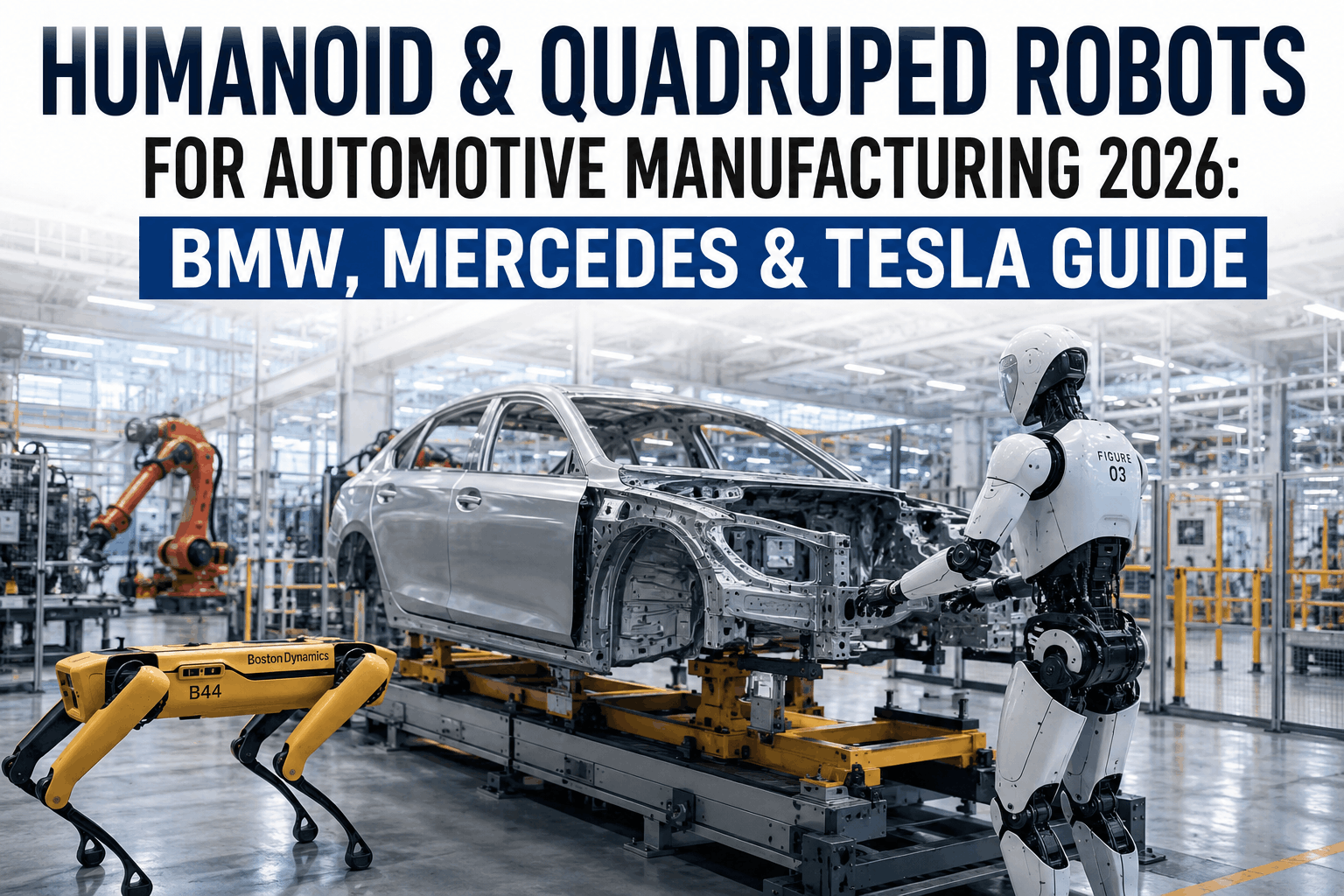
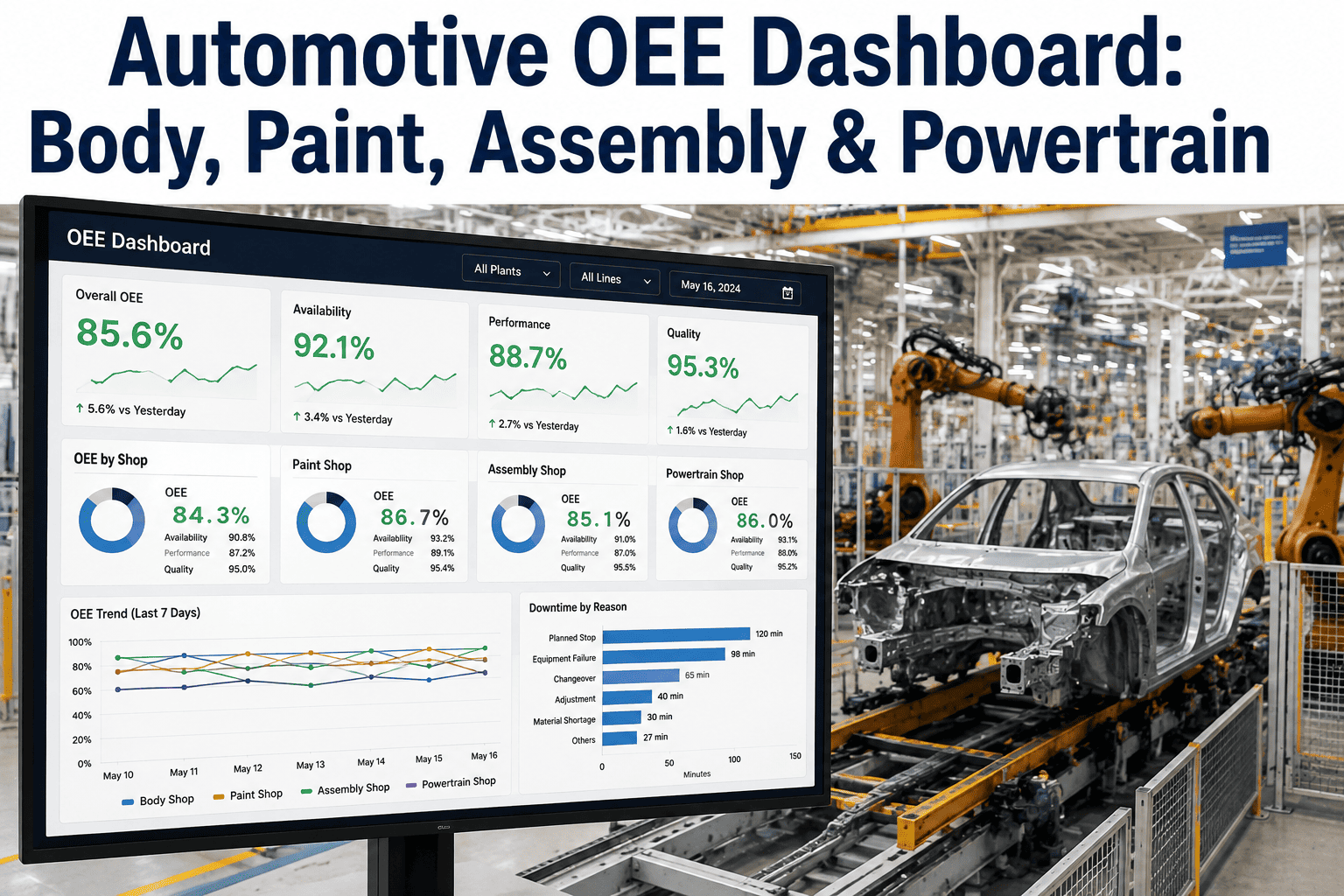
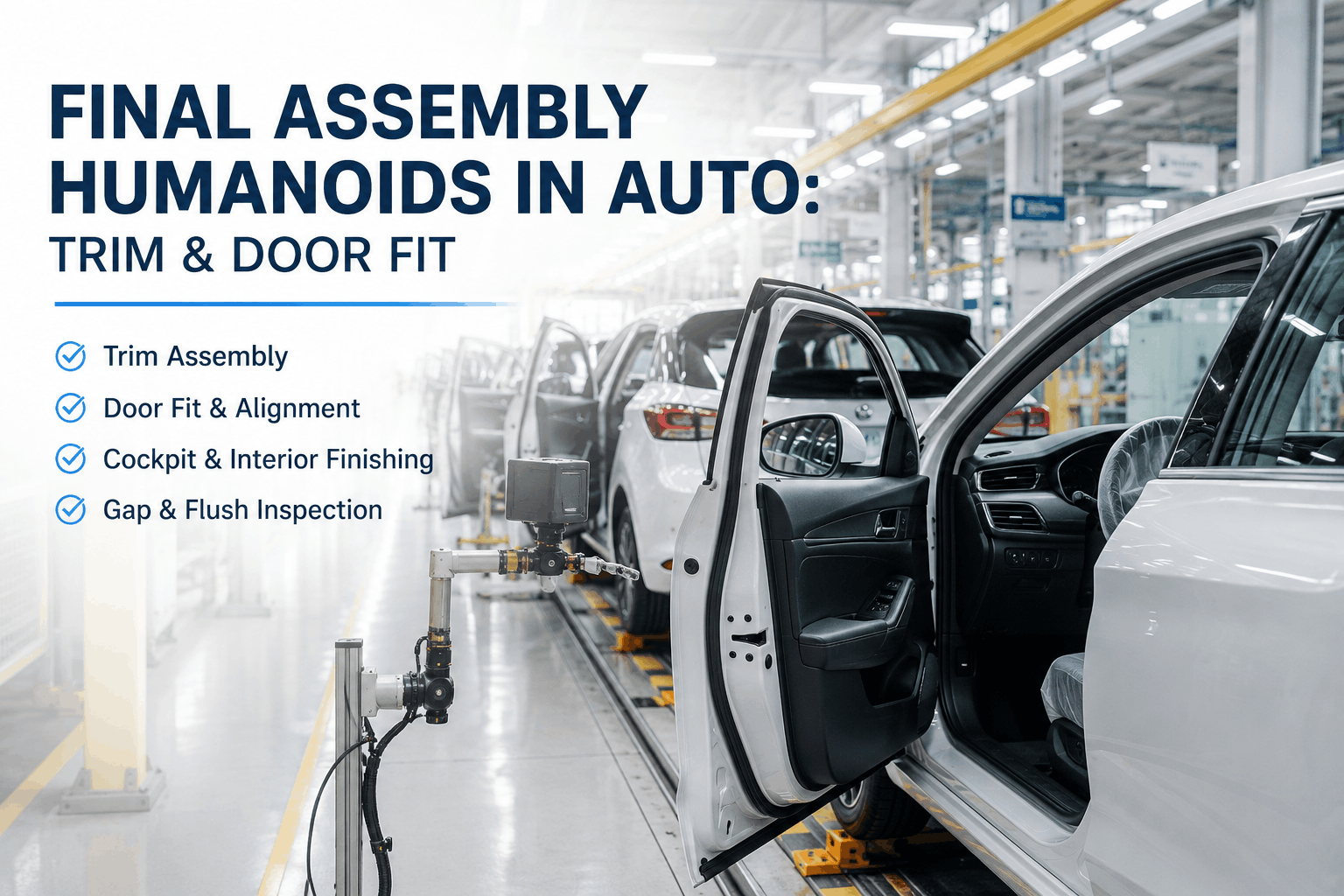
The automotive factory floor is undergoing the most significant labour transformation since Henry Ford's assembly line. In 2026, humanoid robots are not a research project — they are bolting parts at BMW, handling body panels at Mercedes-Benz, and loading battery modules at Tesla. Quadruped robots are conducting autonomous plant inspections at Hyundai. The race to deploy bipedal and four-legged machines in automotive manufacturing is accelerating faster than any technology adoption in the industry's history. This guide covers every major deployment, every production zone, and everything manufacturers need to know about what is real versus what is still roadmap. Book a demo to see how iFactory integrates AI with humanoid robot deployments.
2026 Industry Report
Humanoid & Quadruped Robots in Automotive Manufacturing 2026
Figure 03 at BMW · Apollo at Mercedes · Optimus at Tesla · Atlas at Hyundai — the definitive guide to real deployments, production zones, and what comes next.
50K+
Humanoid robots ordered for automotive plants by 2027
$38B
Projected automotive robotics market by 2030
7 OEMs
Running active humanoid pilot programmes in 2026
Why Automotive Manufacturing Is Ground Zero for Humanoid Robots
Automotive assembly plants are the ideal environment for humanoid robot deployment — not because they are simple, but because they were designed for humans. Workbenches, tool racks, part bins, and assembly fixtures are all sized and positioned for a bipedal operator with two arms and hands. Retraining a humanoid robot to work in a human-designed space is significantly easier than redesigning the space for a fixed-arm industrial robot. This is the central logic driving every OEM into humanoid robotics right now.
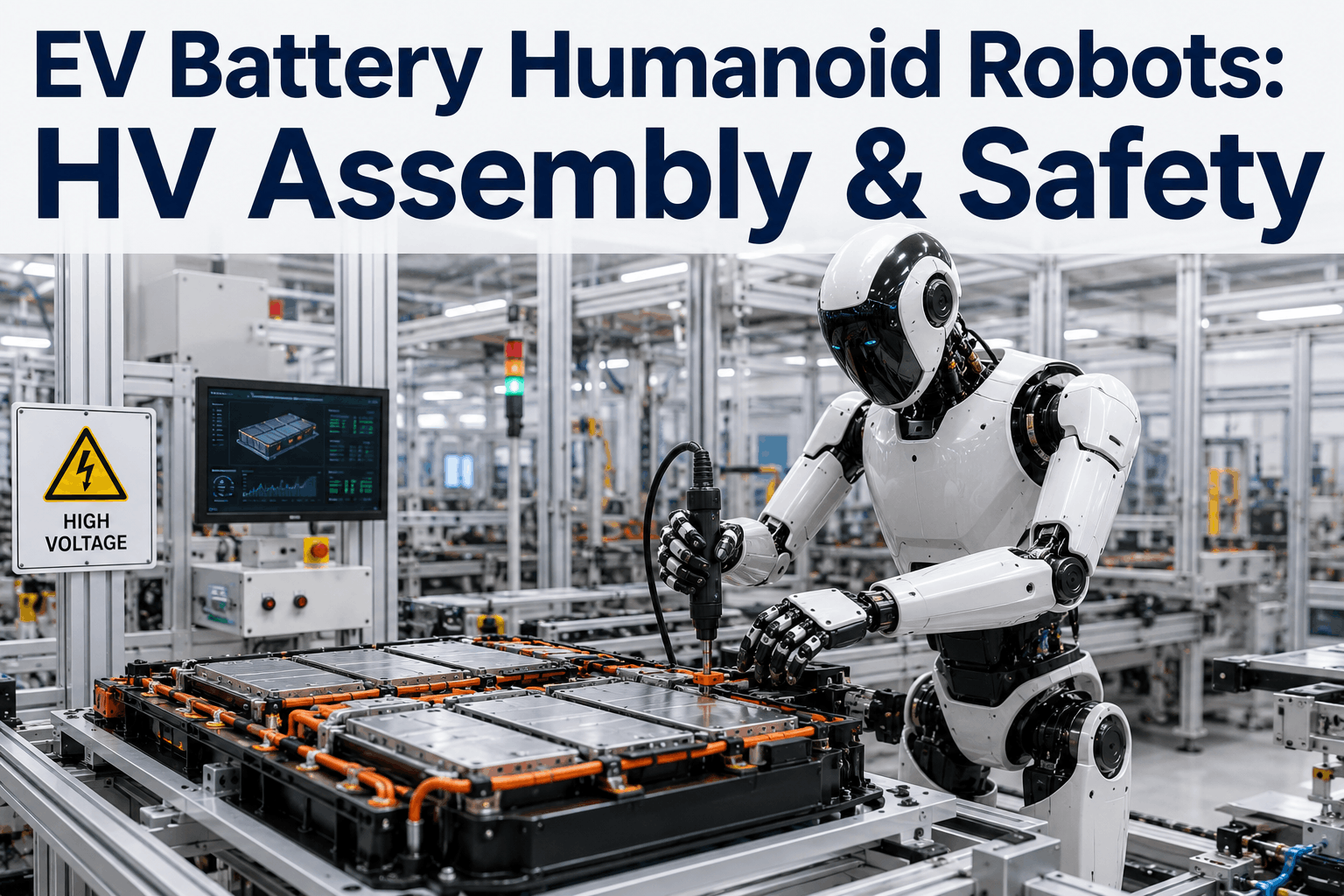
The secondary driver is EV manufacturing complexity. Battery module assembly requires fine motor skills — precise cable routing, connector seating, and thermal pad placement — that current fixed-arm robots handle poorly. Humanoid robots with dexterous hands can perform these tasks with consistency that human assembly cannot match at scale. iFactory's AI platform connects humanoid robot task data to production MES and quality systems in real time.
01
Plants Were Built for Humans
Humanoid robots work in existing infrastructure without retooling. No new fixtures, no line redesign — the robot adapts to the plant, not the other way around.
02
Labour Shortage Is Real
North American and European automotive plants face a structural shortage of assembly workers. Humanoid robots fill specific high-difficulty, high-repetition roles where human recruitment consistently falls short.
03
EV Complexity Demands Precision
Battery module assembly — connector seating, thermal management, high-voltage cable routing — requires consistent dexterity at volumes that human assembly cannot sustain without quality variance.
04
Ergonomic Risk Elimination
Under-vehicle, overhead, and confined-space assembly tasks carry high injury risk and low human appeal. Humanoid robots take these roles, reducing workers' comp exposure and improving retention of human workers in higher-value tasks.
The 2026 Deployment Tracker: Who Is Running What, Where
Robot Profiles: The Machines Transforming Automotive Production
Height1.7m
Payload20kg
Runtime~5 hrs
Hands16-DOF dexterous
Automotive Tasks:
Sheet metal handling
Body panel loading
Part transfer
Quality visual checks
BMW reports Figure 03 completing sheet metal loading tasks with 98.7% success rate in production pilot at Spartanburg plant.
Height1.73m
Payload25kg
Runtime~4 hrs
HandsMulti-grip end effectors
Automotive Tasks:
Final assembly assist
Bin picking
Kitting & logistics
Ergonomic task relief
Mercedes-Benz validated Apollo across multiple European plants in 2025–2026, focusing on logistics and assembly ergonomic relief stations.
Height1.73m
Payload20kg
Runtime~8 hrs
Hands22-DOF tactile
Automotive Tasks:
Battery module assembly
Cable routing
EV pack loading
Connector seating
Tesla operates 1,000+ Optimus units internally at Fremont in 2026, targeting external sale at $20–30K per unit — the lowest-cost humanoid in production.
Height1.5m
Payload25kg
Runtime~1 hr (tethered option)
MobilityFull body — extreme agility
Automotive Tasks:
Stamping press tending
Heavy part transfer
Confined space access
Weld fixturing
Hyundai, as Boston Dynamics owner, has Atlas operating in stamping and body shop environments — the most physically demanding humanoid deployment in automotive to date.
Speed1.6 m/s
Payload14kg
Runtime90 min
Sensors360° LiDAR + thermal
Automotive Tasks:
Autonomous plant inspection
Thermal anomaly detection
Gauge reading
Safety perimeter patrol
Spot is the most widely deployed quadruped in automotive — running predictive maintenance patrols at Hyundai, BMW, Ford, and Volkswagen plants across three continents.
Production Zone Deployment Map: Where Robots Fit in the Plant
Humanoid & Quadruped Robot Deployment by Production Zone — 2026
Press Shop & Stamping
Atlas HD
Spot
Die loading · Heavy blank transfer · Press tending · Dimensional inspection patrol
Body Shop
Figure 03
Atlas HD
Spot
Panel loading · Weld fixture · Sheet metal transfer · Weld quality patrol
Paint Shop
Spot
Booth condition inspection · Thermal monitoring · Surface defect patrol · Environmental compliance
Final Assembly
Apollo
Figure 03
Digit
Fastener installation · Bin picking · Kitting · Ergonomic relief · Under-vehicle access
EV Battery Assembly
Optimus
Apollo
Cell module handling · Cable routing · HV connector seating · Thermal pad placement · Pack loading
Logistics & Kitting
Digit
Neo Beta
Spot
Tote transport · Part kitting · Rack replenishment · Warehouse pick operations · AGV collaboration
Humanoid robot
Quadruped robot
Bar = current industry deployment maturity in that zone
AI Integration: How Smart Factories Connect Humanoid Robots to Production Systems
A humanoid robot operating in isolation is a novelty. A humanoid robot connected to the MES production schedule, the quality management system, and the AI predictive analytics platform is a production asset. The integration layer is where most OEM robotics programmes are currently investing — and where platforms like iFactory deliver the highest value. Book a demo to see iFactory's humanoid robot integration layer.
MES Integration
Robot receives live work orders, vehicle build sequences, and station assignments. Automatically switches tasks as production schedule changes.
Quality System
Robot visual inspection results feed quality records directly. Defects flagged to QMS in real time with location, image, and vehicle ID — no manual entry.
Predictive Maintenance AI
Quadruped inspection patrols upload thermal, vibration, and visual anomaly data to predictive analytics platform. Generates CMMS work orders automatically.
Safety Systems
ISO/TS 15066 collaborative robot safety zones enforced via real-time spatial tracking. Human proximity triggers immediate speed reduction or halt without production stop.
Energy Management
Robot charging schedules optimised against production demand windows and energy tariff rates. Fleet charging coordinated to prevent simultaneous peak demand events.
FAQ: Humanoid & Quadruped Robots in Automotive Manufacturing
Connect Your Humanoid Robot Programme to Production Intelligence
iFactory integrates humanoid and quadruped robot data with MES, quality systems, and predictive analytics — turning isolated robot deployments into connected production assets with measurable ROI.
MES Integration
Robot Quality Data
Predictive Maintenance AI
Human-Robot Safety
Fleet Analytics