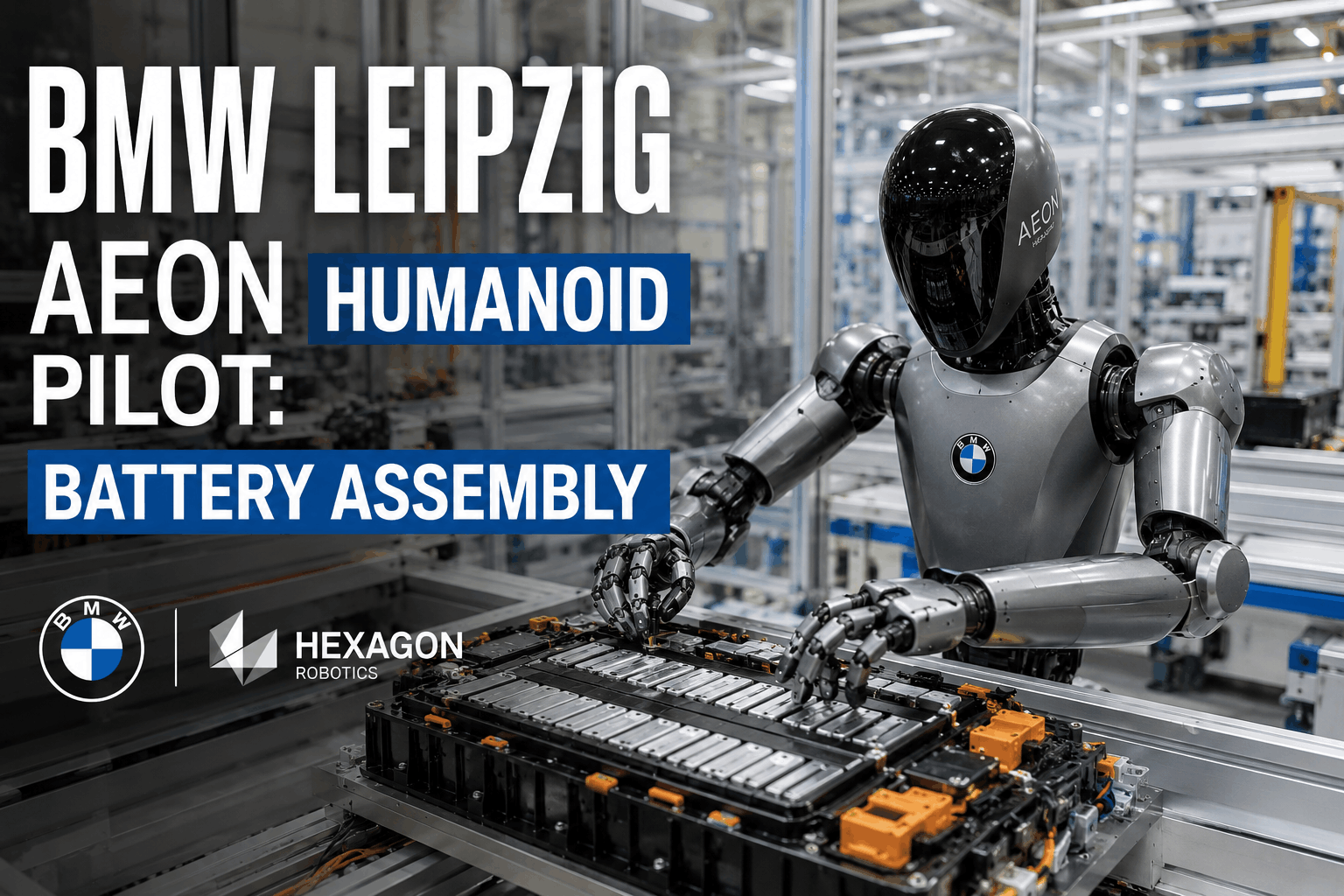
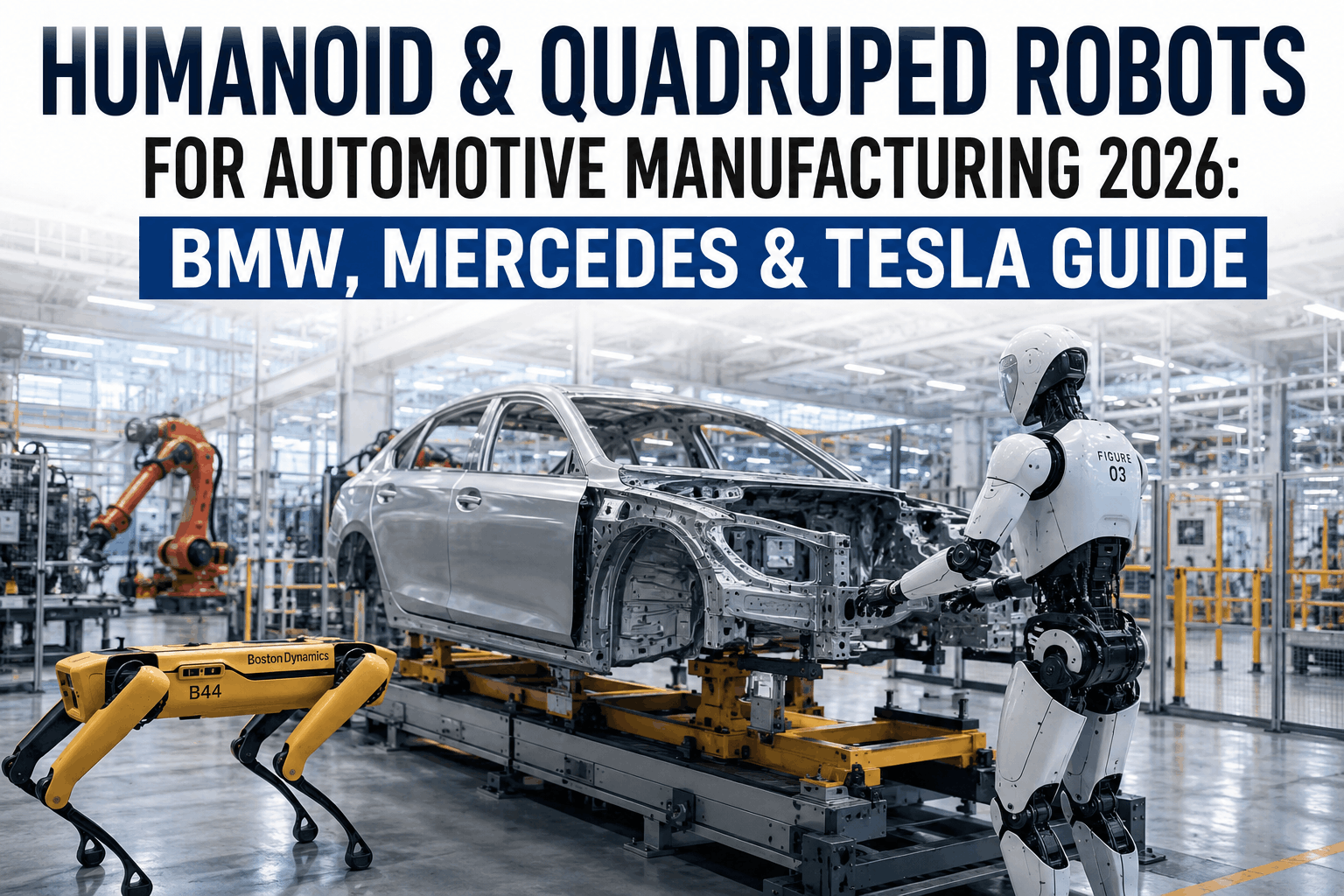
While BMW Spartanburg's Figure 02 deployment captured the world's attention with its 30,000-vehicle milestone, BMW was simultaneously running a technically more complex and less publicised pilot 5,000 miles away: the AEON programme at BMW Leipzig, deploying Hexagon Robotics' AEON humanoid on high-voltage battery assembly — one of the most demanding and most consequence-laden tasks any humanoid robot has ever been assigned in a production environment. This is the case study the industry has not fully read yet. Book a demo to see how iFactory connects AEON-style HV battery humanoid deployments to production intelligence.
Case Study — BMW Leipzig × Hexagon AEON
BMW Leipzig AEON Humanoid Pilot: High-Voltage Battery Assembly, 22-Sensor Physical AI, and BMW's Centre of Competence
BMW's most technically advanced humanoid deployment · HV battery assembly · Hexagon Robotics AEON · 22 onboard sensors · Physical AI Centre of Competence · iFactory on-premise and cloud integration.
AEON
Hexagon Robotics — BMW Leipzig's humanoid platform
22
Onboard sensors for Physical AI perception
HV
High-voltage battery assembly — most demanding humanoid task in automotive
CoC
BMW Centre of Competence for Physical AI — Leipzig
Why BMW Leipzig and Why HV Battery Assembly?
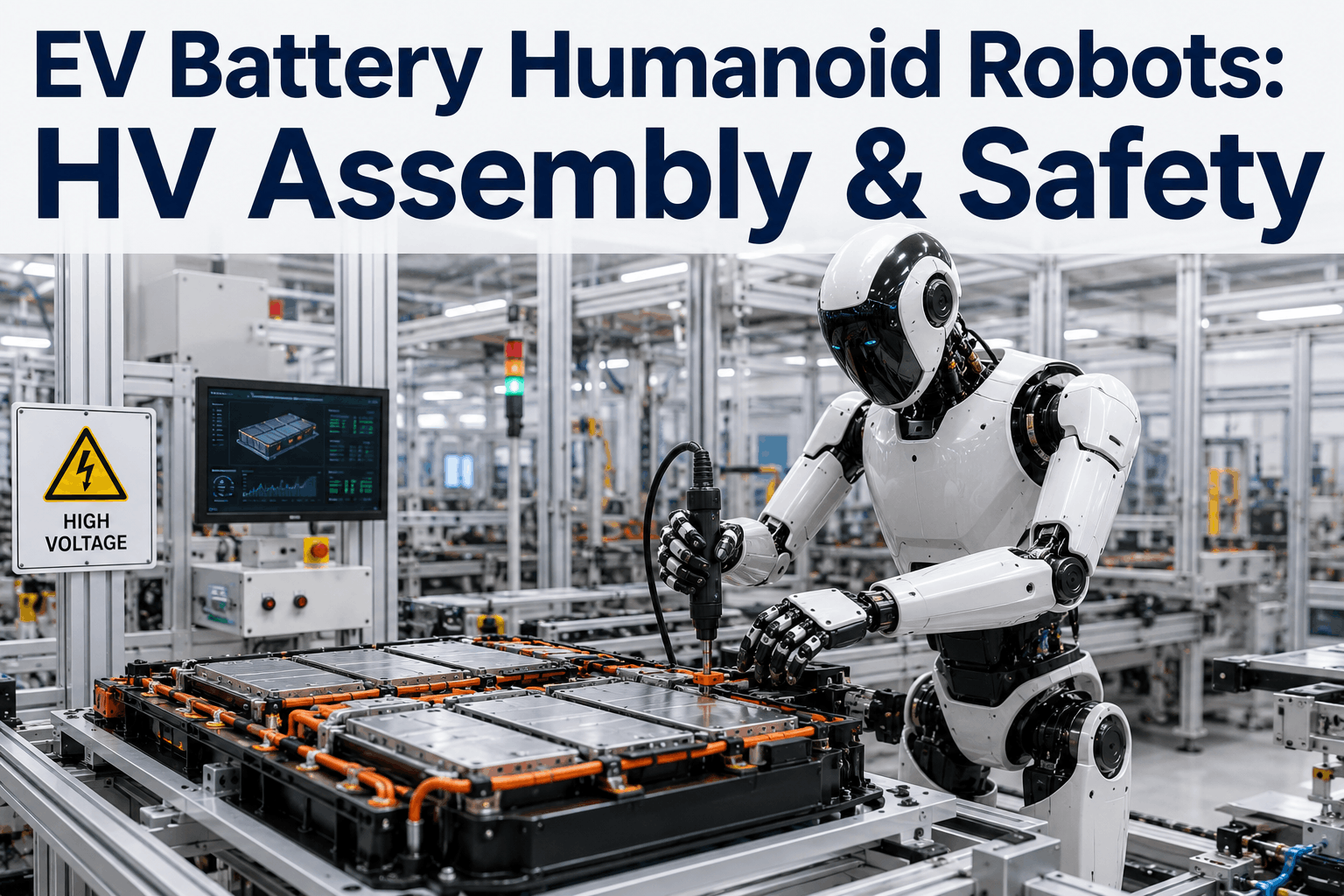
BMW Leipzig is not a conventional automotive assembly plant. It is the production home of the BMW i4, iX1, and 1 Series — a mixed EV and ICE facility that manages the complexity of producing battery electric vehicles alongside conventional models on shared infrastructure. High-voltage battery assembly at Leipzig requires the most precise, most safety-critical manual operations in the plant: seating HV connectors, routing high-current cables, placing thermal management pads, and torquing battery module retention fasteners — all in close proximity to systems capable of delivering lethal voltages.
This task profile makes it simultaneously the hardest and the most valuable humanoid deployment target. If a humanoid robot can perform HV battery assembly reliably and safely, it can perform almost any automotive assembly task. BMW's choice to pilot this at Leipzig — rather than a lower-stakes first task — reflects the strategic logic of the AEON programme: prove the hardest case first, then scale with confidence. Talk to iFactory about HV battery assembly integration architecture.
HV
High-Voltage Battery: The Hardest Task in Automotive Assembly
HV battery assembly combines three demanding requirements simultaneously: sub-millimetre positioning precision for connector seating, strict force control to avoid damaging sensitive cells or insulators, and absolute compliance with HV safety protocols. Human operators require extensive certification; fatigue and variation are the primary quality risks. A humanoid robot that masters this task eliminates all three risks simultaneously.
EV
Leipzig's EV Transformation Makes Automation Urgent
BMW Leipzig is mid-transformation from ICE-majority to EV-majority production. Battery assembly volume is growing every quarter. The ergonomic and quality risks of scaling HV battery assembly with purely human labour are well-documented. The AEON pilot is BMW's response to this scaling challenge — proving robotic capability in advance of the volume that will demand it.
CoC
Centre of Competence: Leipzig as BMW's Physical AI Proving Ground
BMW has designated Leipzig as its Centre of Competence for Physical AI in manufacturing — the internal hub that develops, validates, and standardises humanoid robot deployment methodology across the entire BMW Group manufacturing network. Lessons from Leipzig's AEON pilot will be applied to every future BMW humanoid deployment, including plants in Munich, Dingolfing, Regensburg, and Spartanburg.
AEON: The Hexagon Robotics Platform BMW Chose for HV Battery Assembly
Hexagon Robotics is a Munich-based humanoid robotics company — making BMW's choice of AEON for Leipzig an exercise in geographic and supply chain alignment as much as technical evaluation. AEON's specification, however, is what secured the deployment: 22 onboard sensors, a physical AI architecture that combines proprioception, force sensing, and visual reasoning in real time, and a design philosophy explicitly optimised for industrial precision tasks rather than general logistics. Book a demo to see iFactory's AEON integration in a live demonstration.
Physical
Platform originHexagon Robotics, Munich, Germany
Design philosophyIndustrial precision — not logistics
Onboard sensors22 sensors — perception + proprioception + force
ActuationFully electric — precision servo joints
End effectorsHigh-DOF dexterous hands — tool-compatible
AI Architecture
PerceptionMulti-modal: vision + tactile + proprioception
AI approachPhysical AI — real-time sensorimotor control
Task learningImitation learning from expert demonstrations
Force controlSub-Newton precision — HV connector rated
HV Battery Tasks
HV connector seatingSub-mm positioning + tactile confirmation
Cable routingDeformable object manipulation — active research
Thermal pad placementForce-controlled placement + visual verification
Module fasteningTorque tool integration — programmable spec
Quality verificationVisual + force signature per assembly step
Safety & Compliance
HV safety ratingIEC 60900 insulated — HV environment rated
Cobot standardISO/TS 15066 collaborative operation
Emergency stopHardware + software dual-channel E-stop
Data complianceOn-premise processing — no HV data leaves plant
The 22-Sensor Architecture: How AEON Perceives HV Battery Assembly
The most technically distinctive aspect of AEON is its 22-sensor onboard perception system — a fusion architecture that gives the robot a richer model of its physical state than any previous production humanoid. Understanding what these sensors do, and why they are necessary for HV battery assembly specifically, explains why AEON was selected for Leipzig over platforms with simpler sensor suites.
AEON 22-Sensor Architecture — Function by Category
~8 sensors
Stereo RGB-D cameras — part localisation and depth estimation
High-res wrist cameras — sub-mm connector alignment
Wide-angle head cameras — workspace awareness
Structured light projector — surface geometry scanning
~8 sensors
6-axis F/T sensors at wrist joints — assembly force monitoring
Fingertip tactile arrays — grip confirmation and slip detection
Joint torque sensors — full-body proprioceptive awareness
Contact force sensing — HV connector seating confirmation
~6 sensors
IMU — full-body balance and orientation
LiDAR — workspace mapping and obstacle detection
Joint encoders — high-resolution position feedback
Proximity sensors — safety zone enforcement
Why 22 sensors for HV battery assembly: HV connector seating requires simultaneous sub-mm visual guidance, <2N force limit compliance, and electrical contact confirmation — tasks that require vision, force, and tactile data fused in real time. No single sensor type is sufficient; only multi-modal fusion delivers the reliability that HV safety protocols demand.
BMW's Physical AI Centre of Competence: The Leipzig-to-Global Playbook
BMW's designation of Leipzig as the Centre of Competence for Physical AI in manufacturing is more significant than a naming decision. It means that the methodology, tooling, safety frameworks, and integration architecture developed at Leipzig become the standard that all BMW Group plants adopt when deploying humanoid robots. The AEON pilot at Leipzig is not a one-plant experiment — it is writing the playbook that Munich, Dingolfing, Regensburg, Spartanburg, and BMW's joint venture plants will follow. Book a demo to see iFactory's Centre of Competence-ready integration architecture.
Leipzig Centre of Competence → Global BMW Network
Leipzig
Develop & Validate
AEON task methodology, safety commissioning, MES integration architecture, and KPI framework developed and validated at Leipzig CoC
Doc
Standardise
Deployment standards, integration specifications, and operator training curricula codified into BMW Group manufacturing standards
Scale
Deploy Globally
Standardised playbook applied at Munich, Dingolfing, Regensburg, Spartanburg, and JV plants — each deployment faster and lower-risk than the Leipzig original
iF
iFactory Integration
iFactory's on-premise edge nodes and cloud analytics provide the production integration layer at Leipzig and all subsequent BMW Group deployments
How iFactory Connects AEON to BMW Leipzig's Production Systems
The AEON pilot's operational value depends entirely on whether the robot's actions are connected to production context. A robot that seats HV connectors without writing a quality record per battery pack, without receiving the current work order from MES, without triggering an andon event when it detects an anomaly — is performing physical work with no production intelligence attached. iFactory provides the integration layer that connects AEON to BMW Leipzig's production systems in two deployment models, both essential for a Centre of Competence deployment that must serve as the template for the entire BMW Group.
On-Premise Deployment
For Leipzig's HV Data Sovereignty Requirements
HV battery assembly data — connector seating force profiles, quality verification records, torque specifications — contains sensitive production IP that BMW requires to remain within the plant. iFactory edge nodes at Leipzig process all AEON task data, MES interactions, and quality records locally. No HV battery assembly data leaves the facility. The on-premise model also ensures production intelligence continues operating during any WAN outage — critical for a safety-certified HV assembly process that cannot tolerate connectivity-dependent control systems.
HV assembly data never transmitted externally
Sub-5ms edge inference — faster than AEON cycle time
MES work order and quality record integration on-site
Andon system integration — safety-certified response
Operational independent of internet connectivity
Get On-Premise Quote
Cloud Analytics
For BMW Group Multi-Plant CoC Intelligence
As Leipzig CoC validates the AEON deployment and rolls out the playbook to other BMW Group plants, iFactory's cloud platform provides the enterprise intelligence layer: cross-plant task success benchmarking, AI model update distribution from Leipzig's learnings to all plants, fleet maintenance analytics, and the quality trending data that BMW Group's manufacturing engineering uses to drive continuous improvement across the network.
Leipzig learnings distributed to all BMW Group plants
Cross-plant AEON performance benchmarking
AI model updates from Leipzig CoC to all edge nodes
HV quality trend analytics across the fleet
Enterprise sustainability reporting for BMW Group
Talk to an Expert
FAQ: BMW Leipzig AEON Humanoid Pilot
Deploy the Leipzig Integration Architecture at Your Plant — On-Premise, Cloud, or Both
iFactory provides the production integration layer that connects AEON and other humanoid platforms to your MES, quality systems, and HV safety protocols — on-premise for battery assembly data sovereignty, cloud for BMW Group-scale fleet intelligence. Both models available from the same platform.
On-Premise Edge
Cloud Analytics
HV Battery Integration
MES + Quality Records
CoC-Ready Architecture