Automotive Paint Shop Robotics: Phosphating, E-Coat & Topcoat Robotic Inspection Automation

By Tom Cooke on May 27, 2026

automotive-paint-shop-robot-phosphate-ecoat-topcoat

The automotive paint shop is the most chemically hostile, most energy-intensive, and most quality-sensitive zone in any vehicle assembly plant. Phosphating tanks operate at 50°C with aggressive chemical baths. E-coat (KTL) tanks contain electrophoretic paint solutions that coat every surface of the vehicle body through electrodeposition. Topcoat spray booths maintain solvent concentrations that create explosive atmospheres under ATEX/NEC Zone 1 classifications. Human inspection in these environments means VOC exposure, chemical splash risk, and temperature extremes that OSHA regulations strictly limit. Robots — quadrupeds for inspection, humanoids for targeted tasks, and AI vision for quality — are transforming the paint shop from the most inaccessible zone in the plant to one of the most monitored. Book a demo to see how iFactory's on-premise and cloud platforms enable AI automation for automotive paint shops.

Paint Shop Robotics — Automotive 2026
Paint Shop Automation: Phosphating, E-Coat, Topcoat and the AI Systems Transforming the Highest-VOC Zone in Automotive Manufacturing
Phosphating PdM · E-coat tank inspection · Topcoat quality AI · Paint defect vision · ATEX-rated quadrupeds · BMW, Toyota, Stellantis deployments — the complete technical guide.
ATEX Z1
Explosive atmosphere classification — topcoat spray zones
40–50°C
Phosphating and E-coat tank operating temperature
96%
AI vision defect detection rate vs 73% manual inspection
18%
Energy cost reduction from AI HVAC and booth optimisation

The Paint Shop Process: Five Zones, Five Automation Challenges

The automotive paint shop is not a single process — it is a sequence of five chemically and physically distinct zones, each presenting different automation challenges and requiring different robotic and AI capabilities. Understanding this structure is the foundation for any intelligent paint shop automation programme.

Automotive Paint Shop — Process Flow & Automation Profile
Zone 1
Pre-Treatment & Phosphating
Chemical bath 50°C Acidic / alkaline
Tank degradation, zinc phosphate sludge buildup, temperature uniformity, chemical concentration drift
Quadruped inspection AI process monitoring
Zone 2
E-Coat (KTL / CED)
Electrodeposition High voltage
Electrode degradation, tank bath chemistry balance, current distribution, filter maintenance, rectifier performance
Quadruped + sensors Electrochemistry AI
Zone 3
Primer / Surfacer
Spray application VOC environment
Film build uniformity, atomiser wear, paint supply pressure, booth temperature/humidity, overspray management
Vision QC AI Process AI
Zone 4
Topcoat — Basecoat & Clearcoat
ATEX Zone 1 Spray robots
Colour consistency, atomiser tip wear, fan pattern deviation, orange peel, metallic flake orientation, clearcoat gloss
AI vision inspection Colour matching AI
Zone 5
Oven Curing & Cooling
180–200°C Conveyorised
Temperature uniformity, conveyor drive maintenance, oven seal condition, cooling curve compliance, energy consumption
Thermal quadruped Energy AI

Phosphating and E-Coat: Where Predictive Maintenance Has the Highest ROI

Pre-treatment (phosphating) and E-coat tanks are the highest-value, least-inspected assets in the paint shop. Phosphating tanks run continuously at 50°C in aggressive chemistry — zinc phosphate, iron phosphate, or manganese phosphate depending on application — and tank liner degradation, heating element failure, and chemical concentration drift all cause coating quality failures that manifest on vehicles hours after the root cause occurs. E-coat (cathodic electrodeposition / KTL) tanks are even more consequence-laden: a rectifier failure or electrode degradation event can cause incomplete corrosion protection on an entire production batch — a warranty liability worth millions. Talk to iFactory about phosphating and E-coat predictive maintenance integration.

Phosphating Tank PdM
Monitored Parameters
Bath temperature Chemical concentration Heating element current Pump vibration Tank level Sludge accumulation rate
Detectable Failure Modes
Heating element failure — 48hr advance warning
Chemical concentration drift — continuous alert
Pump bearing wear — 72hr advance warning
Sludge accumulation — schedule-triggered maintenance
Prevented cost per event: $40K–$120K in rework and warranty
E-Coat (KTL) Tank PdM
Monitored Parameters
Rectifier current/voltage Electrode condition Bath conductivity Solids content pH and temperature Ultrafiltration pressure
Detectable Failure Modes
Rectifier degradation — 24hr advance warning
Bath chemistry drift — real-time continuous alert
Electrode fouling — trend-based detection
UF membrane blockage — pressure signature AI
Prevented cost per event: $150K–$500K in batch corrosion failures

Topcoat Quality AI: How Vision Systems Inspect Every Vehicle at Line Speed

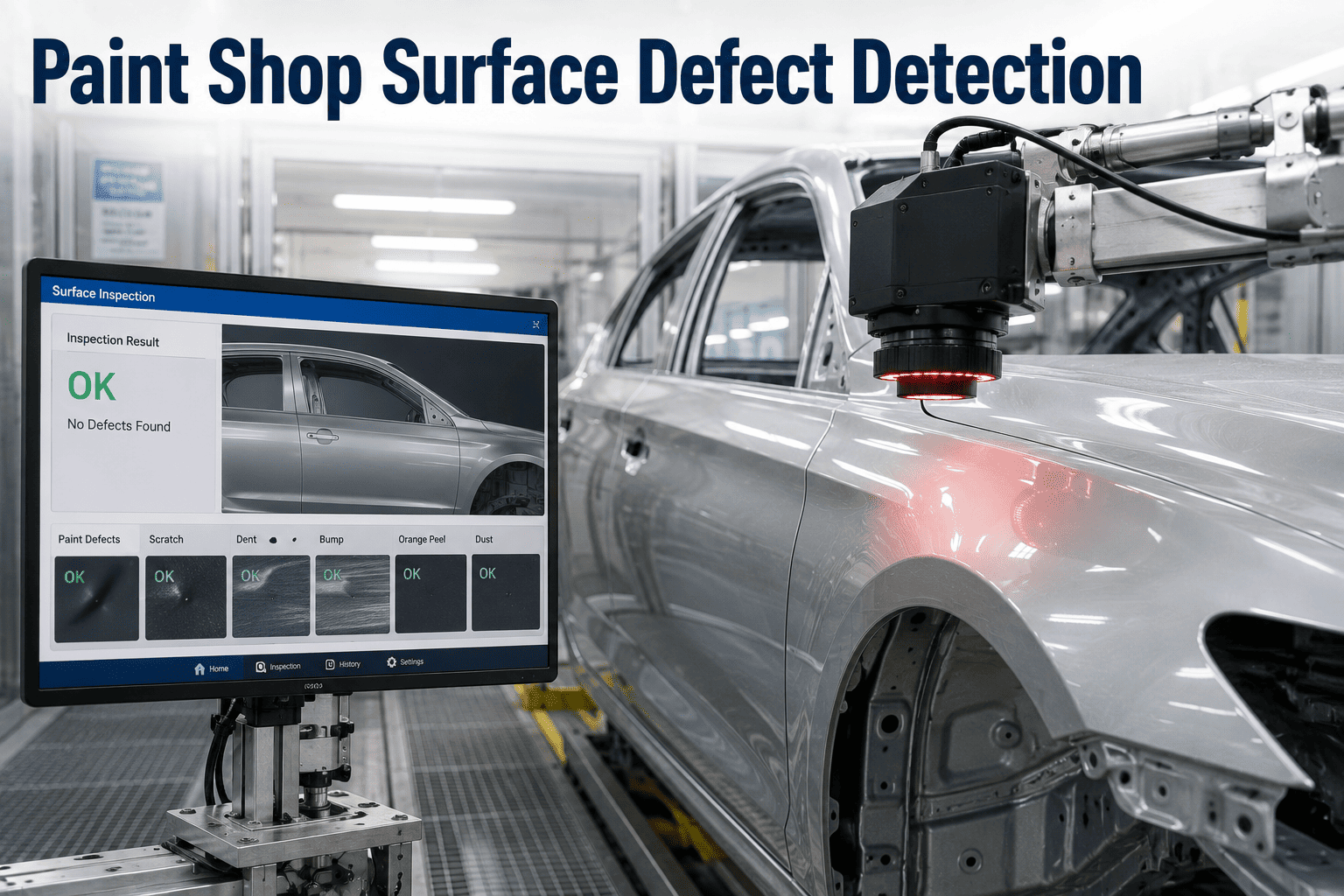
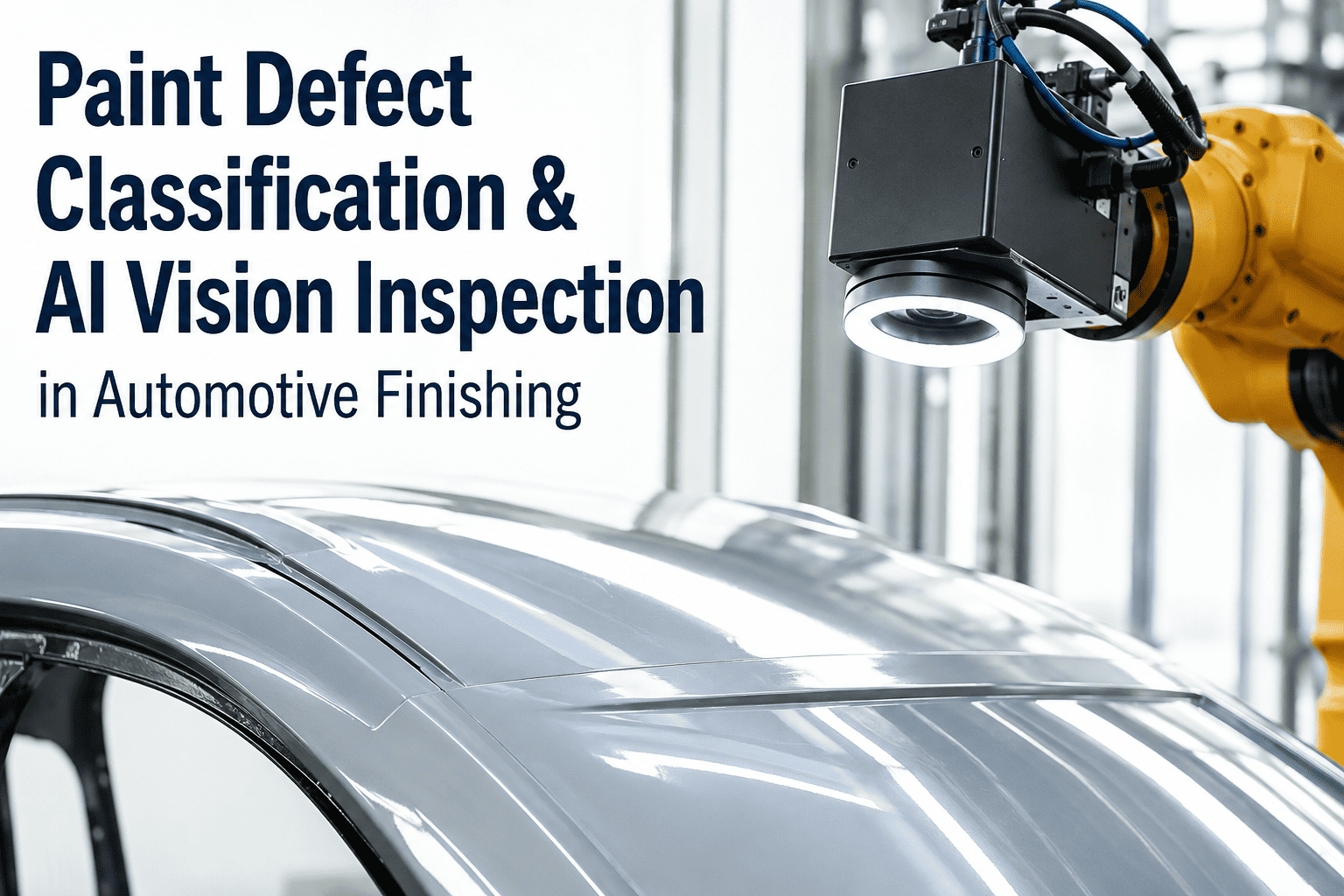
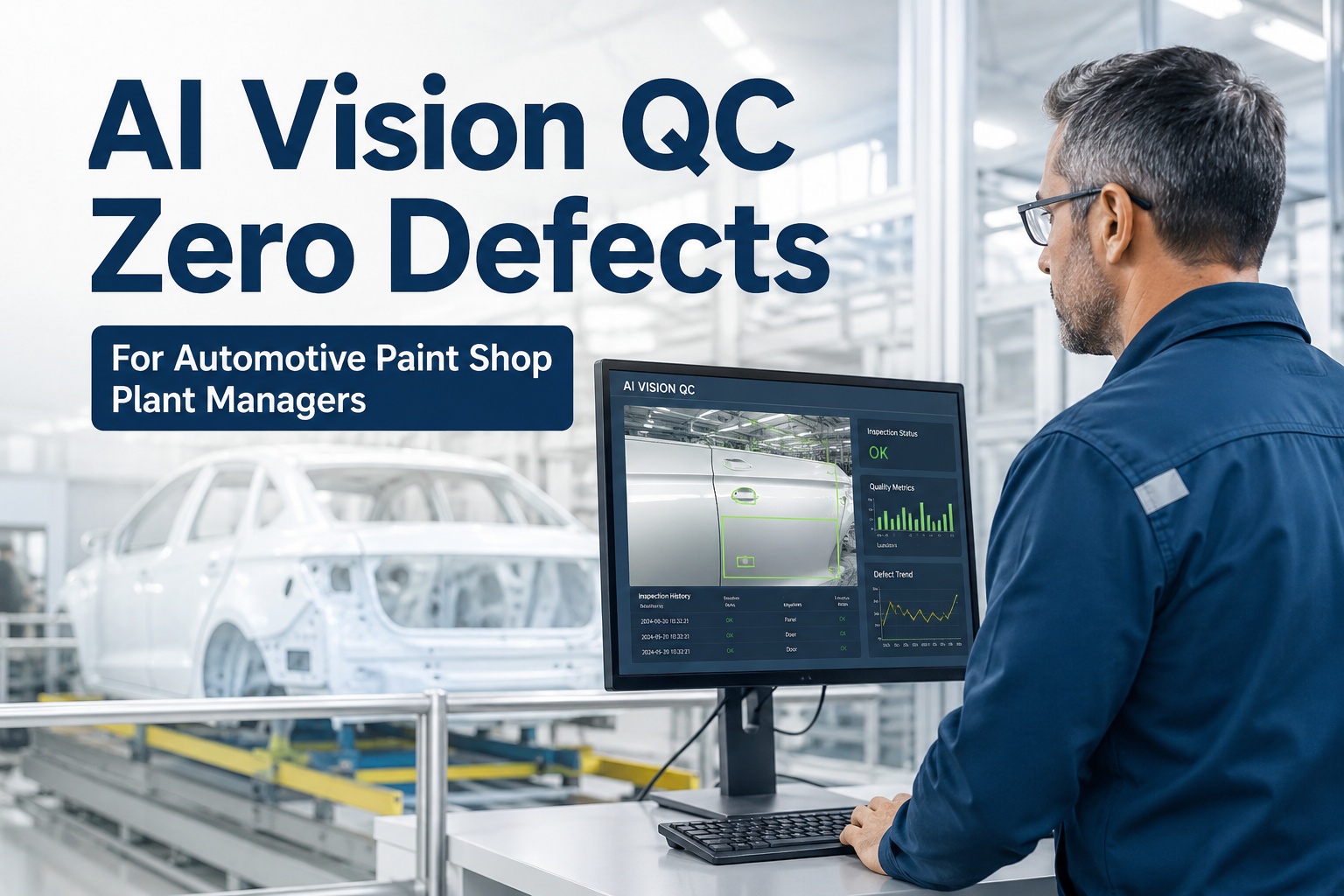
Manual paint quality inspection is sampling-based — a trained inspector examines a percentage of vehicles at a designated inspection station, typically under specific lighting conditions. The inherent problem is coverage: a 60 JPH production line produces one vehicle per minute, and a thorough manual inspection takes 3–5 minutes. AI vision inspection covers 100% of vehicles, in under 2 seconds, with consistent performance across all shifts and no sensitivity to inspector fatigue. Book a demo to see iFactory's topcoat vision inspection integration.

AI Topcoat Vision Inspection System Architecture
1
Multi-Angle Camera Array
8–16 high-resolution cameras capture 360° vehicle body coverage at booth exit. Structured light and specular illumination reveal surface defects invisible to diffuse lighting.

2
iFactory Edge Node
All camera feeds processed simultaneously on NVIDIA AI server within the paint shop — no cloud latency. 8 feeds × 4K resolution analysed in under 2 seconds per vehicle.

3
Defect Classification AI
AI model trained on 50,000+ labelled defect examples classifies: runs, sags, orange peel, contamination, cratering, solvent pop, colour mismatch, and metallic flake anomalies.

4
Quality Record & Routing
Per-vehicle quality record written to MES with defect type, location, severity, and image evidence. Vehicles requiring rework routed automatically — no manual inspection judgement needed.
Defect Types Detected by AI Vision
Runs & Sags Orange Peel Cratering / Fish Eye Contamination / Dirt Solvent Pop Colour Mismatch Metallic Flake Anomaly Clearcoat Gloss Deviation Chip / Stone Damage Weld-Through Primer Miss

ATEX-Rated Quadruped Robots in Spray Booth Environments

Standard quadruped robots cannot enter ATEX Zone 1 environments — topcoat spray booths where solvent concentrations can reach explosive levels during spray cycles. ATEX-rated variants use sealed electronics with intrinsic safety certification, anti-static body coatings, and explosion-proof battery management systems. These platforms enable continuous inspection patrol of spray booth conveyors, atomiser systems, and air handling units without requiring human entry during or after production cycles. See iFactory's ATEX paint shop inspection platform in a demo.

Paint Shop Robot Requirements by Zone Classification
Requirement Pre-treatment / Phosphating E-Coat Tank Hall Primer Spray Booth Topcoat Spray Booth Curing Oven
Classification Non-classified Non-classified ATEX Zone 2 ATEX Zone 1 High temp
Standard Robot IP54 — usable IP54 — usable Not rated Not permitted Not rated
Required Rating IP65 (chemical) IP65 (chemical) ATEX Zone 2 Ex d/e ATEX Zone 1 Ex ia/ib High-temp rated to 220°C
Robot Type Standard quadruped Chemical-rated quadruped ATEX Zone 2 quadruped ATEX Zone 1 intrinsically safe Thermal-rated platform

How iFactory Connects Paint Shop Robots to Production Intelligence

Paint shop AI systems — defect vision, PdM sensors, environmental monitoring, energy management — generate structured data that is only valuable when connected to production context: which vehicle, which colour, which shift, which spray programme. iFactory provides the integration layer in two deployment models, both designed to meet the paint shop's unique data requirements and the OEM's data sovereignty obligations.

On-Premise Deployment
For Paint Shops With Data Sovereignty or Air-Gap Requirements
iFactory edge nodes process all paint shop AI data locally — vision inspection images, defect classification records, PdM sensor streams, and environmental logs — within the plant's own infrastructure. No raw paint quality data, colour matching records, or process parameters leave the facility. Critical for OEMs with multi-supplier paint chemistry IP and for plants supplying multiple competing brands from the same facility.
Defect images and quality records processed locally
Sub-2ms AI inference — faster than booth conveyor speed
Paint chemistry IP never transmitted externally
Operational during WAN outages — zero production impact
MES, quality, and CMMS integration on-site
Get On-Premise Quote
Cloud Analytics
For Multi-Plant Paint Quality Benchmarking
iFactory's cloud platform aggregates paint quality KPIs, defect rate trends, PdM performance, and energy intensity data across all paint shops in your manufacturing network. Cross-plant colour consistency benchmarking, defect pattern analysis, and paint chemistry optimisation insights are available at enterprise level — enabling quality engineering teams to apply learnings from one paint shop to another faster than plant-by-plant manual analysis.
Cross-plant defect rate and quality benchmarking
Paint chemistry optimisation insights across all sites
Energy intensity per vehicle — paint shop Scope 2 reporting
AI model updates distributed to all on-premise nodes
OEM quality portal data feed integration
Talk to an Expert

FAQ: Paint Shop Robotics and AI Automation

Standard quadruped robots cannot enter active ATEX Zone 1 spray booths — the explosive atmosphere created by solvent-based paints requires intrinsically safe (Ex ia/ib) electrical equipment. ATEX-certified quadruped variants are available from Boston Dynamics (Spot ATEX) and Ascento, featuring sealed electronics, anti-static coatings, and explosion-proof battery management. These platforms can conduct inspections during active spray cycles, enabling continuous monitoring of atomiser systems, conveyor drives, and air handling units without requiring a production stop for human entry. For primer booths (ATEX Zone 2), less restrictive Ex d/e certification is acceptable. Book a demo to see ATEX-rated paint shop inspection.
AI colour matching uses multi-angle spectrophotometry and machine vision to measure colour coordinates (L*, a*, b* in CIELab colour space) and compare against the vehicle's specified colour target. Metallic flake orientation — which affects how a colour appears under different lighting angles (gonioapparent effect) — is assessed using multi-directional illumination captures that reveal flake alignment anomalies invisible to single-angle inspection. The AI model flags deviations beyond the tolerance band (typically ΔE* <0.5 for premium colours) before the vehicle leaves the paint shop. This is significantly more consistent than the human eye, which is subject to fatigue, lighting variation, and inter-inspector calibration differences.
E-coat (cathodic electrodeposition / KTL) failure affects corrosion protection — the most safety-critical and warranty-sensitive attribute of a vehicle body. A rectifier failure or bath chemistry excursion that affects even a partial production batch can result in insufficient coating thickness on body cavities, chassis components, and door edges. If this escapes into the field, warranty claims for premature corrosion are typically $800–$2,500 per vehicle over a 12-year warranty period. A batch of 200 vehicles with insufficient E-coat coverage represents $160K–$500K in warranty exposure — far exceeding the cost of the predictive maintenance system that would have caught the rectifier degradation 24 hours in advance. Talk to iFactory about E-coat PdM integration.
iFactory connects paint shop AI data — vision inspection results, E-coat process parameters, oven temperature profiles — to the vehicle's production quality record via MES integration. Each vehicle body is identified by VIN or body serial number, and all paint shop measurements are appended to that vehicle's digital quality record. The record is available to subsequent assembly zones, end-of-line inspection, and the OEM's customer delivery quality documentation system. For multi-plant paint shop operations, iFactory's cloud platform aggregates records across all sites for enterprise quality analysis. Both on-premise and cloud deployment models include full vehicle-level quality record integration.
Paint shop AI investments have two distinct ROI timelines. Vision inspection ROI is fastest — most deployments recover cost within 6–9 months through reduced end-of-line rework, eliminated manual inspection labour, and prevented defect escapes to customers. Predictive maintenance ROI depends on the frequency of the failure mode targeted — for E-coat tanks and phosphating systems, a single prevented batch failure typically covers the entire sensor and software investment. Energy management ROI — from AI HVAC and booth condition optimisation — typically delivers $120K–$210K annual savings on a full paint shop, with payback in 9–14 months. Book a demo to model paint shop AI ROI for your facility.

Deploy Paint Shop AI — On-Premise, Cloud, or Both

iFactory connects paint shop vision inspection, phosphating and E-coat PdM, ATEX booth monitoring, and energy management to your MES and quality systems — available as on-premise edge deployment for data sovereignty or cloud analytics for cross-plant quality benchmarking. Both models available from a single platform.

On-Premise Edge Cloud Analytics Topcoat Vision AI E-Coat PdM ATEX Booth Inspection

Share This Story, Choose Your Platform!