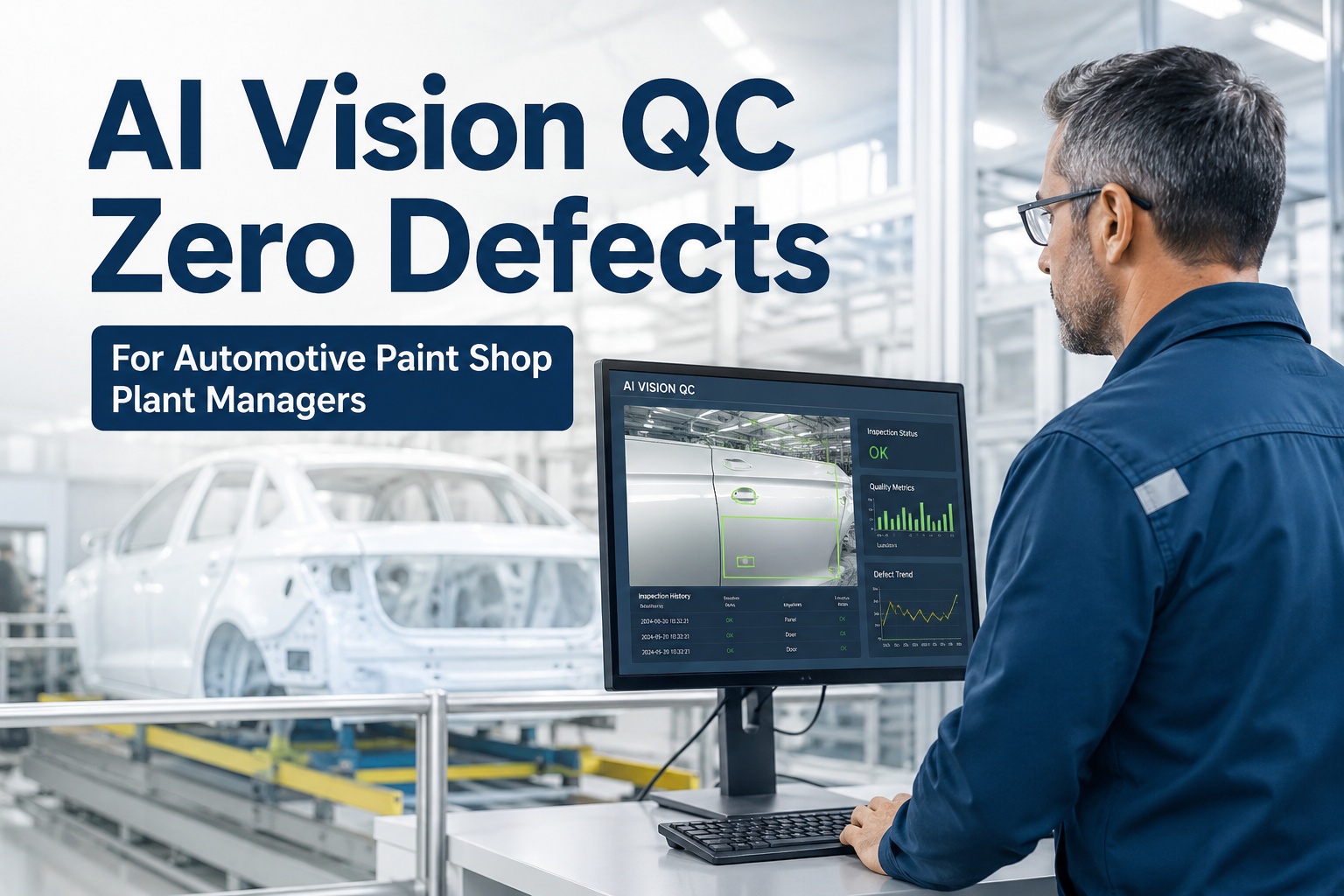
The auto body shop is where humanoid robots have already proven themselves in production — not in a lab, not in a demo, but on the line building actual vehicles. Figure 02 spent ten months at BMW Spartanburg's body shop, working 10-hour shifts inserting sheet metal parts into welding fixtures, supporting the production of over 30,000 BMW X3s, moving 90,000+ components across 1,250 operating hours. The task — picking sheet metal from bins and placing it precisely onto fixtures before industrial welding robots take over — is exactly the kind of repetitive, ergonomically demanding, precision-critical work that defines the body shop challenge. And it is only the start. The next frontier is not just loading fixtures — it is using humanoid robots to inspect the welds they help create, identify BIW surface defects, and generate the structured quality data that connects body shop operations to MES, SAP QM, and ERP. Talk to an iFactory expert about humanoid orchestration for your body shop — book a demo.
Body Shop + Humanoid Robots + AI Quality
30,000 Cars. 90,000 Parts.
One Humanoid. Zero Compromises.
Figure 02 proved humanoid robots work in auto body shop production. Now the question is how to scale the use case — from sheet metal loading to spot weld inspection, BIW defect detection, and full MES-ERP integration through iFactory.
30,000+
BMW X3 vehicles supported in production at Spartanburg (2025)
90,000+
Sheet metal components moved across 1,250 operating hours
10 months
Continuous body shop deployment on 10-hour production shifts
The BMW Spartanburg Proof Point: What Actually Happened
In September 2024, BMW became the first automotive OEM to deploy a humanoid robot in production. The location: Body Shop at Plant Spartanburg, South Carolina. The robot: Figure 02. The task: picking sheet metal parts from logistics containers and placing them precisely onto welding fixtures — after which six-axis industrial robots welded and fed the parts into the main chassis line. Figure AI defined three production-grade KPIs to measure the deployment.
30,000+
BMW X3 vehicles supported in production
90,000+
Sheet metal components moved
1,250 hrs
Total operating hours on production shifts
10 months
Deployment duration — 10-hr shifts, Mon–Fri
KPI 1: Cycle Time
Requirement: 84 sec total / 37 sec load time
Total time to complete one cycle including loading phase after weld-fixture door opens — the production-grade throughput target
KPI 2: Placement Accuracy
Percentage of cycles all 3 sheet metal parts correctly loaded
Precision of part placement directly determines weld quality — off-position parts produce defective welds downstream
KPI 3: Uptime & Reliability
Stable shift operation — no unplanned line stoppages
Figure's own data confirmed the shift from lab learning to stable production operation, compressing the second use case deployment from 12 months to 30 days
The Body Shop Challenge: Why This Is Where Humanoids Fit
The auto body shop concentrates three problems that humanoid robots are uniquely positioned to solve simultaneously. No other automation technology addresses all three in one platform.
Sheet metal loading, part placement into fixtures, and overhead assembly positions in the body shop are among the highest musculoskeletal injury rates in the plant. Workers repeatedly lift 5–15kg panels, reach into confined fixture spaces, and hold parts in position under time pressure. Humanoid robots perform these motions without fatigue, injury risk, or shift-to-shift variance.
Spot weld quality depends directly on panel positioning accuracy at the fixture. A part placed 0.5mm off-centre produces an undersize nugget. A panel with misaligned edge contact fails the weld entirely. Human placement varies with shift time and fatigue — the 500th placement of the shift is measurably less accurate than the 50th. Humanoid robots maintain positional accuracy across the full shift.
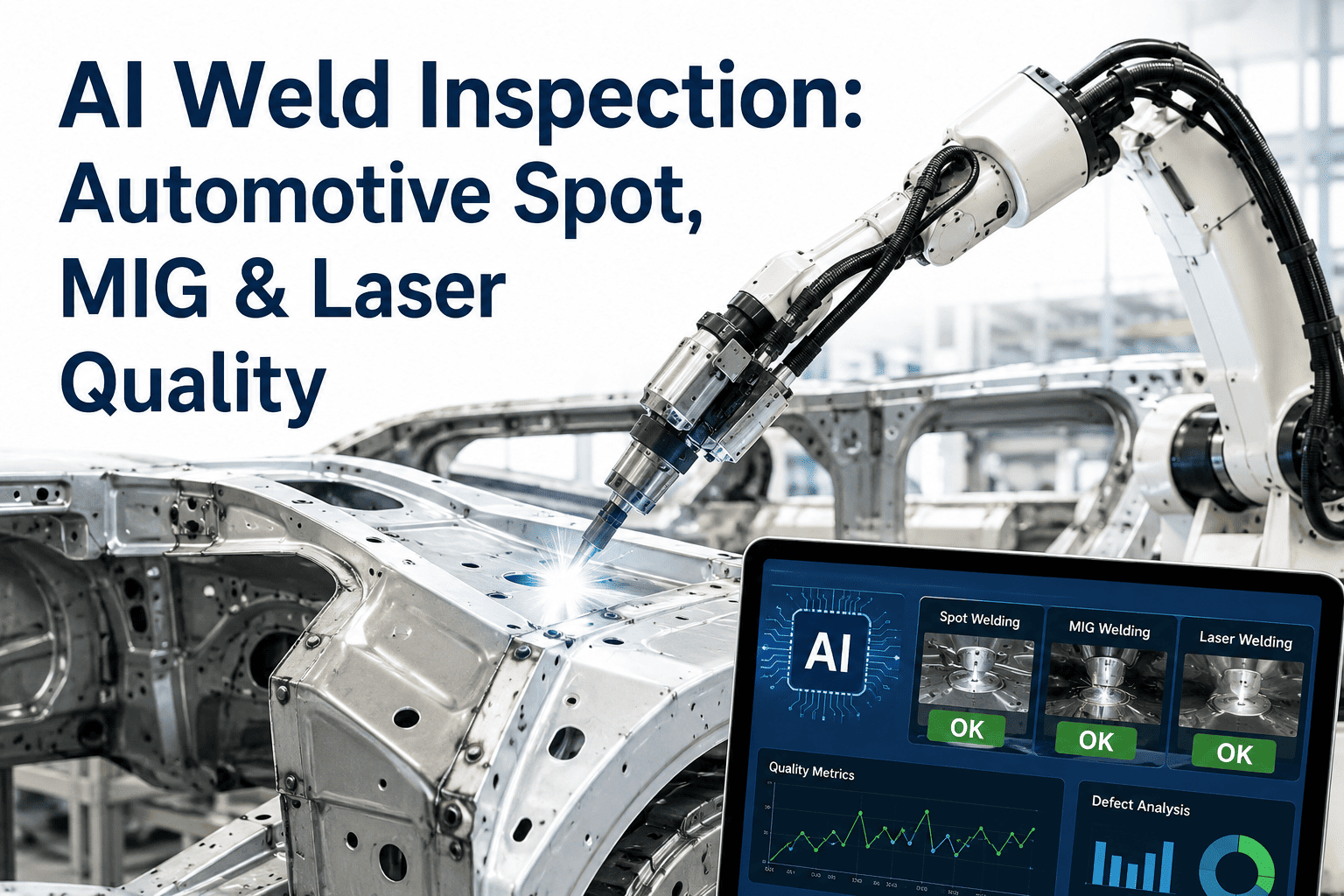
BIW (body-in-white) has 3,000–6,000 spot welds per vehicle body. Manual inspection samples 2–5%. Conventional vision systems cover fixed camera angles and miss complex geometries. Humanoid robots with modular scanner attachments can navigate around the full BIW, scan every accessible weld, and generate structured quality records — coverage no fixed system can match.
5 Body Shop Use Cases for Humanoid Robots
Sheet Metal Part Loading into Welding Fixtures
The proven BMW use case. Humanoid robot picks sheet metal panels from logistics containers and places them onto welding fixtures to positional tolerances of ±1–2mm. Six-axis welding robots then execute the weld. The humanoid provides the dexterous, variable-reach capability that fixed automation cannot — reaching into different container configurations without tooling changes.
Proven — BMW Spartanburg (30,000 vehicles)
Spot Weld Quality Inspection — Post-Weld
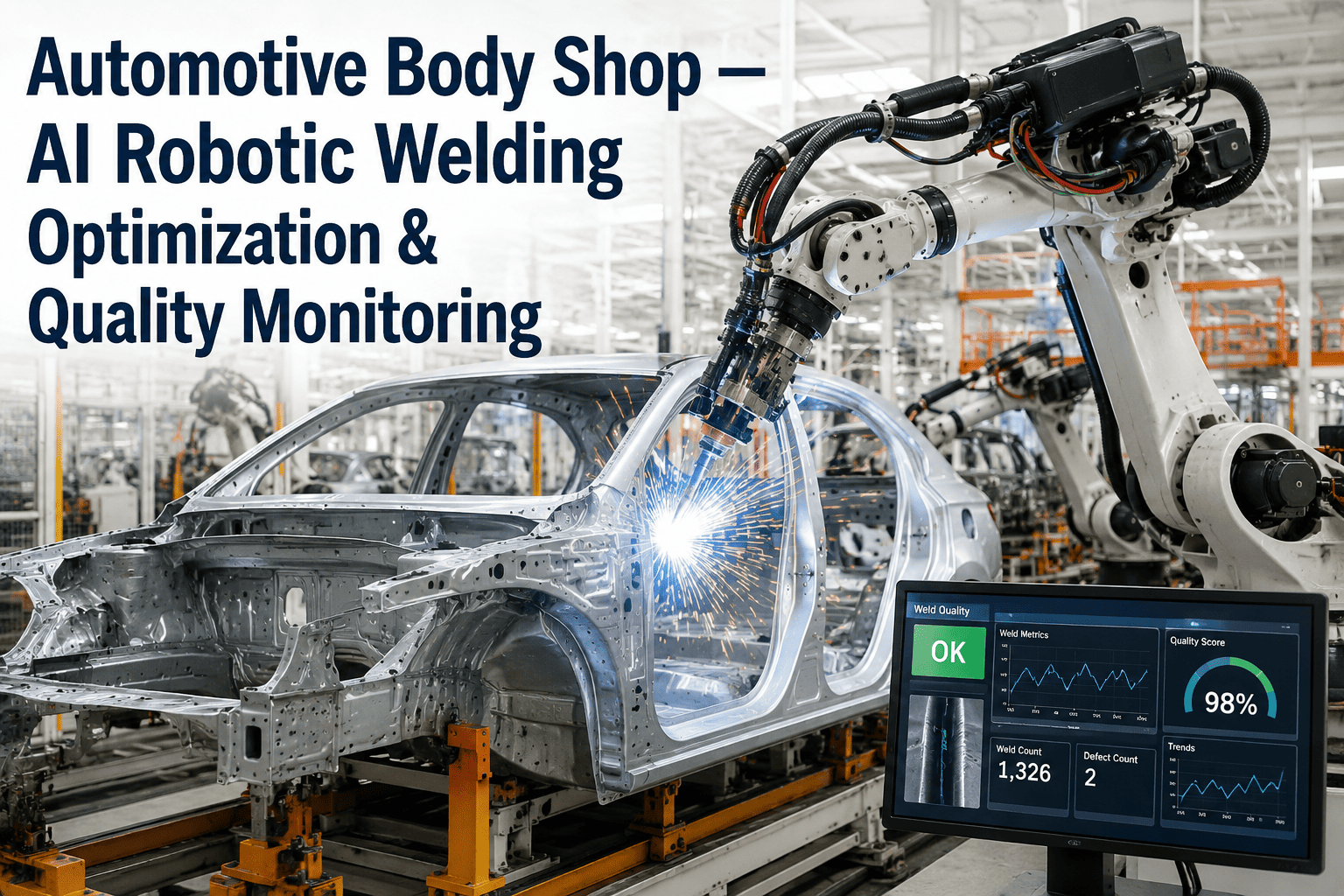
After the welding station completes its cycle, the humanoid robot docks a phased-array ultrasonic or eddy current scanner end effector and traverses the weld zone. Each spot weld is probed for nugget diameter, penetration depth, and cold-weld signatures. Results are structured — weld ID, location coordinates, measurement value, pass/fail — and routed to SAP QM via iFactory in under 30 seconds per inspection cycle.
Active Pilots — multiple OEM body shops 2026
BIW Sheet Metal Surface Defect Detection
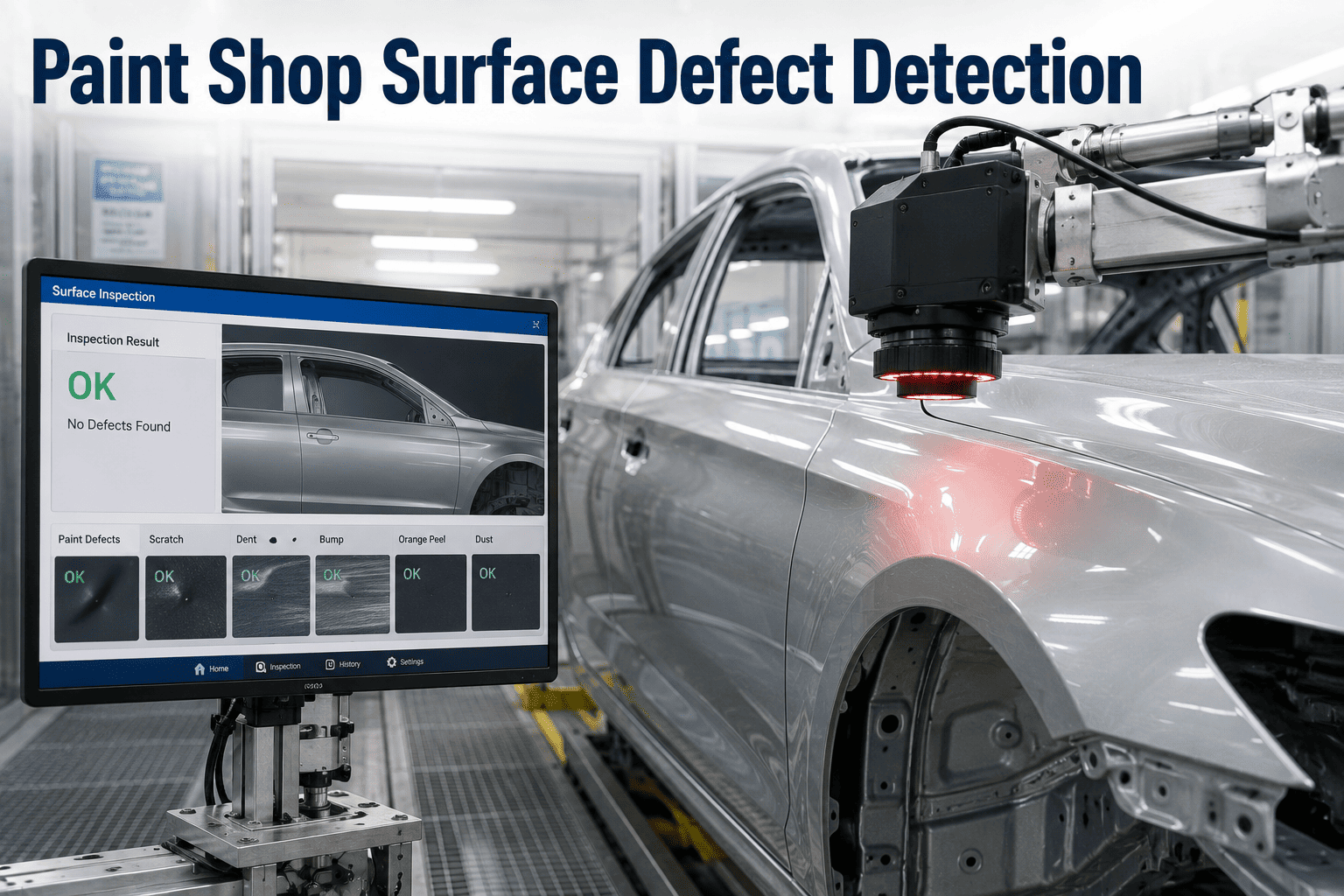
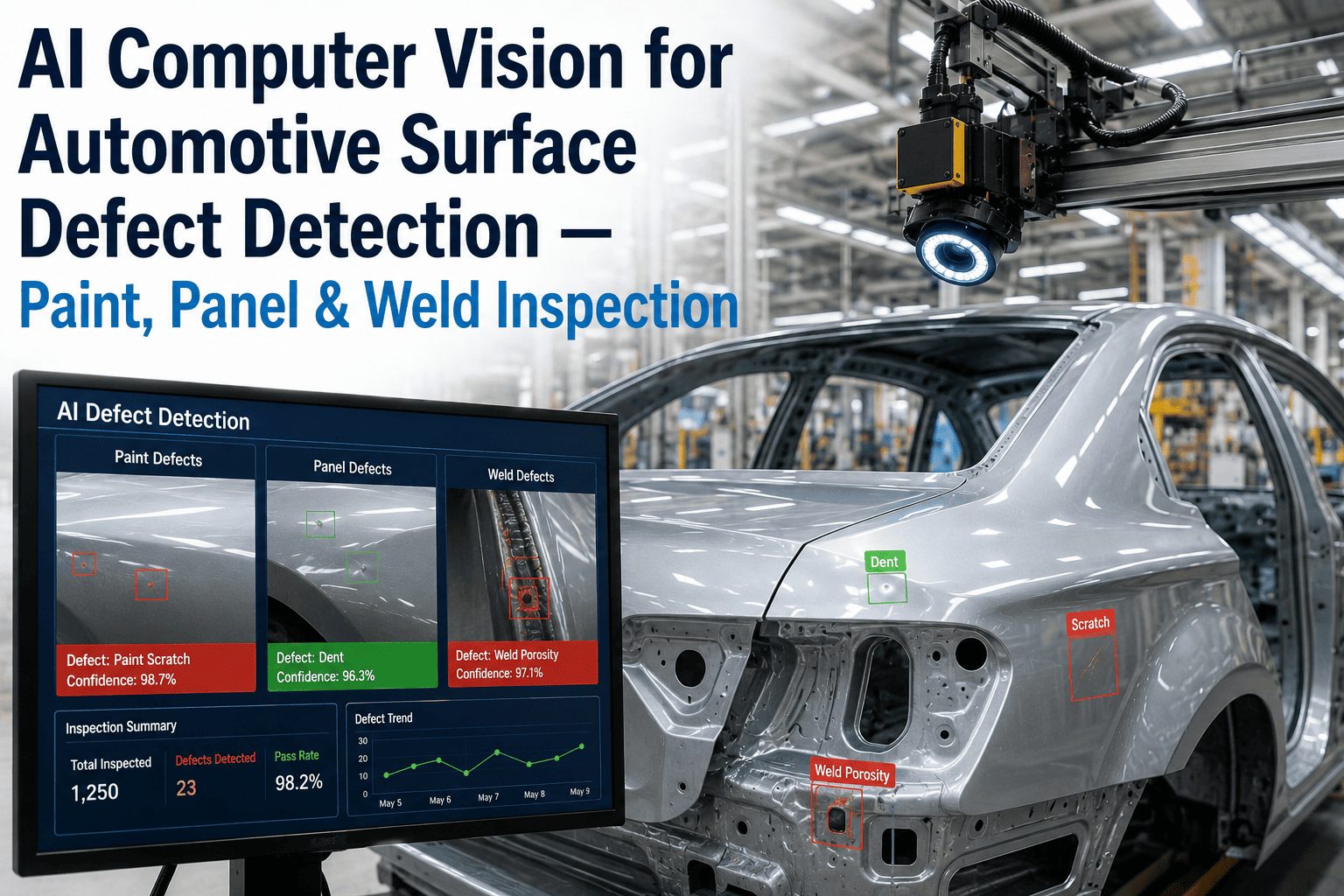
AEON's modular high-resolution scanner attachment enables the humanoid to scan BIW exterior surfaces for micro-dents, scratches, panel gap deviations, and edge geometry variations that precede paint defects. The humanoid navigates the full BIW geometry, reaching areas fixed camera arrays cannot cover, generating a per-panel surface map linked to the production order.
Live — AEON at BMW Leipzig (door panel inspection)
Fixture Gauging & Dimensional Verification
Welding fixture wear causes progressive positional drift that degrades weld quality over thousands of cycles. Humanoid robots can perform in-line fixture gauging using CMM-grade probe attachments between production cycles — detecting fixture drift before it affects weld quality. The maintenance signal routes automatically to CMMS through iFactory, triggering fixture recalibration before a quality defect occurs.
Emerging — enabled by modular end effector design
Adhesive & Sealant Application Verification
Structural adhesives and seam sealers applied between body panels in modern BIW structures are critical to vehicle stiffness and NVH performance. Humanoid robots with thermal and vision sensor packages verify bead continuity, width, and position — catching missed application or voids before panels are welded closed. Once welded, these defects are undetectable and uncorrectable without destructive disassembly.
Emerging — builds on existing adhesive robot integration
Spot Weld Quality: What AI Actually Detects
Spot Weld Defect Types — Humanoid AI Detection Capability
Cold Weld
95% detection — ultrasonic nugget signature
Structural failure under crash load
Undersized Nugget
92% detection — diameter measurement vs. spec
Progressive joint fatigue failure
Expulsion / Splash
98% detection — visual + acoustic signature
Surface damage + reduced joint strength
Sheet Separation
90% detection — gap measurement probe
Corrosion ingress + structural weakness
Off-Position Weld
97% detection — coordinate vs. nominal map
Assembly interference downstream
Missed Weld
99% detection — absence detection in weld map
Critical structural failure in crash
Detection rates based on AI vision + ultrasonic sensor fusion. A typical BIW has 3,000–6,000 spot welds. Manual inspection samples 2–5%. Humanoid AI inspection covers 100% of accessible welds per cycle.
iFactory Data Integration: On-Premise & Cloud
A humanoid robot in the body shop without production system integration is a sophisticated fixture loader with no quality record, no traceability, and no feedback loop into the systems that run the plant. iFactory connects every humanoid action — sheet metal placement confirmation, weld inspection result, surface scan finding, fixture gauge reading — to MES, SAP QM, CMMS, and ERP automatically. Ask our team about integrating your body shop humanoids with your existing MES and SAP environment.
Sheet Metal Placement
Position confirmed + production order ref
MES + SAP PP
Production confirmation — per-part traceability
Spot Weld Inspection
Nugget diameter, depth, defect classification
SAP QM + CAQ
Per-weld quality record — IATF compliant
BIW Surface Scan
Defect type, location, severity score
SAP QM + MES
Go/hold decision before paint entry
Fixture Gauge Reading
Positional drift vs. nominal tolerance
CMMS
Predictive maintenance work order auto-created
Robot Anomaly / Fault
Fault code, location, safe-state confirmation
CMMS + MES
Immediate alert — no manual incident logging
On-Premise Deployment
All body shop humanoid data — weld inspection records, surface scan results, placement logs — processed and stored inside your plant network. No external dependency. Meets OEM data sovereignty requirements. Edge inference for sub-20ms quality decision latency. Ideal for OEM plants and Tier 1 suppliers with strict IT governance.
Discuss On-Premise
Cloud-Based Deployment
Enterprise fleet management across multiple body shops and plants. Cross-plant weld quality benchmarking, defect trend analysis, and robot performance dashboards accessible from operations centres. Continuous AI model improvement from fleet-wide inspection data. Ideal for global OEMs running humanoid fleets across multiple facilities.
Discuss Cloud Setup
Body Shop Humanoid KPIs: What Changes After Deployment
100%
Weld coverage — humanoid AI inspection vs. 2–5% manual sampling
30,000
Vehicles supported by a single Figure 02 in 10 months at BMW
30 days
Figure AI's 2nd body shop use case deployed vs. 12 months for 1st
<30 sec
Time from inspection to SAP QM quality record via iFactory routing
The financial case is direct: a single BIW quality escape that reaches paint costs $800–$3,000 in rework at the paint shop. The same defect reaching final assembly costs $5,000–$15,000. Escaping to the field triggers warranty claims averaging $500K–$5M for systemic weld defects. Book a demo to model the ROI for humanoid-based weld inspection in your body shop.
FAQ: Humanoid Robots in the Auto Body Shop
Has any humanoid robot actually operated in an automotive body shop in production?
Yes — with verified production data. Figure 02 operated in the body shop at BMW Group Plant Spartanburg from September 2024 for ten months, supporting the production of over 30,000 BMW X3 vehicles, moving 90,000+ sheet metal components across 1,250 operating hours on 10-hour daily shifts. The task was sheet metal part picking and fixture loading ahead of spot welding by industrial robots. Figure AI published the three production KPIs they measured against: cycle time (84 seconds total requirement), placement accuracy, and uptime reliability. This is the only publicly verified body shop humanoid deployment with full production metrics as of mid-2026.
What is the accuracy of humanoid AI spot weld inspection versus manual inspection?
AI vision and ultrasonic sensor fusion achieves 90–99% detection accuracy for the primary spot weld defect types — cold welds, undersized nuggets, expulsion, sheet separation, off-position welds, and missed welds — depending on the defect type and sensor configuration. Manual inspection of spot welds is inherently limited: a typical BIW has 3,000–6,000 spot welds, and manual teams inspect 2–5% by sampling. The critical advantage of humanoid AI inspection is not just higher per-weld detection accuracy — it is 100% coverage replacing 2–5% coverage.
How does the humanoid robot reach all spot welds on a BIW structure?
Humanoid robots use modular end effector systems — swapping between gripper, scanner, and probe attachments depending on the task. For BIW inspection, AEON's design allows it to dock high-resolution scanning tools and navigate dynamically around the vehicle body structure. Areas not accessible to fixed camera arrays — inner sill channels, A-pillar joins, underside flange welds — can be reached by a humanoid with the correct probe attachment. The inspection path is programmed in simulation and validated before physical deployment.
How does iFactory connect body shop humanoid data to SAP and MES?
iFactory provides a platform-agnostic orchestration layer that captures humanoid robot data streams and routes each data type to the appropriate production system using standard protocols (OData for SAP, REST/OPC-UA for MES and CMMS). SAP QM receives weld inspection records linked to the production order within 30 seconds of inspection completion. MES receives placement confirmations for production tracking. CMMS receives maintenance alerts from fixture gauge drift detections — automatically creating work orders without manual intervention.
Contact our integration team for a technical scoping session.
What is the deployment timeline for a humanoid robot body shop pilot?
Based on BMW's Spartanburg experience, the first use case took approximately 12 months from initial deployment to stable production operation. Figure AI's own data shows the second use case took 30 days. For new body shop deployments today using proven platforms like Figure 03 or AEON, the realistic timeline is 3–6 months for a first use case, with subsequent use cases deployable in 4–8 weeks. iFactory's MES and SAP integration adds 1–2 weeks to the deployment timeline — configured in parallel with robot commissioning.
Body Shop + AI + iFactory
From Fixture Loading to Full BIW Traceability.
One Orchestration Layer.
iFactory connects humanoid robots in your body shop to MES, SAP QM, CMMS, and ERP — on-premise or cloud — turning every sheet metal placement and weld inspection into a structured production record from day one.
Figure AI + AEON Integration
Spot Weld QC Routing
On-Premise & Cloud
SAP QM + MES Data Flow
BIW 100% Coverage