The automotive factory floor is changing faster than at any point since the introduction of industrial robots in the 1960s. This time, the robots walk on two legs. In 2026, humanoid robots are not a concept — they are bolting parts at BMW, loading batteries at Tesla, kitting materials at Ford, and patrolling assembly lines at Hyundai. The question manufacturers are asking has shifted from "will this happen?" to "how do we integrate it, and how quickly?" This guide answers that question with current deployment data, technical requirements, and the integration architecture that turns isolated robot pilots into connected production intelligence. Book a demo to see how iFactory connects humanoid robots to your production systems.
2026 Industry Guide
Humanoid Robots in Automotive Manufacturing 2026: The Complete Guide
Every major OEM deployment · BMW Figure 02 & 03 · Tesla Optimus · Ford Digit · Hyundai Atlas · Apollo Mercedes · iFactory integration architecture — on-premise and cloud. Everything you need to know.
Tesla Optimus units on live production line — January 2026
7 OEMs
Running active humanoid programmes in 2026
$38B
Projected automotive robotics market by 2030
12 wks
iFactory deployment: assessment to live AI alerts
What Is a Humanoid Robot — and Why Automotive Manufacturing First?
A humanoid robot is a bipedal, two-armed machine designed to operate in environments built for humans — using tools designed for human hands, at workstations designed for human bodies, in factories designed for human scale. Unlike fixed-arm industrial robots that require custom fixtures, purpose-built cells, and major production line modification, a humanoid robot walks to the workstation and does the job.
Automotive manufacturing is the world's first proving ground for humanoid robots because it combines three conditions that make humanoid deployment economically viable: high production volume (making per-unit ROI calculations compelling), extreme ergonomic risk (creating immediate safety justification), and existing infrastructure designed for humans (eliminating the need to retrofit the environment). iFactory's platform connects these deployments to production intelligence — on-premise, cloud, or both.
01
Plants Were Built for Human Scale
Workbenches, tool racks, fixtures, and aisles are all sized for a 1.7m bipedal operator. Humanoid robots adapt to the plant — not the other way around. No line redesign required.
02
Ergonomic Risk Is the Entry Point
Under-vehicle assembly, overhead fastening, heavy panel loading — these are the tasks with the highest injury rates and lowest staffing appeal. Humanoid robots eliminate muri (overburden) without displacing higher-value human work.
03
EV Complexity Demands Precision
Battery module assembly requires consistent dexterity at volumes human assembly cannot sustain without quality variance. Humanoid robots with 22-DOF tactile hands perform cell handling, HV connector seating, and cable routing with >99% accuracy.
04
Labour Shortage Is Structural
North American and European automotive plants face a structural shortage of assembly workers for ergonomically demanding roles. Humanoid robots fill these positions permanently — without shift premiums, turnover cost, or WC exposure.
2026 Deployment Leaderboard: Every Major Automotive Humanoid Programme
#
OEM
Robot Platform
Scale
Primary Zone
Status
1
Tesla
Optimus Gen 3
1,000+ units
Battery assembly · EV pack
Live
2
BMW
Figure 02 → Figure 03
30,000+ vehicles
Body shop · Sheet metal
Live
3
Hyundai
Atlas HD + Spot
Full deployment
Stamping · Inspection · Logistics
Live
4
Mercedes-Benz
Apollo (Apptronik)
Multi-plant pilot
Final assembly · Logistics
Live
5
Ford
Digit (Agility Robotics)
Active pilot fleet
Kitting · Material handling
Pilot
6
Toyota
T-HR3 · Partner Robot
Georgetown + SATX
Assembly ergonomics
Pilot
7
Stellantis
NEO Beta · Multi-platform
5+ plants evaluation
Body shop · Assembly
Evaluating
The BMW Spartanburg Story: World's First Documented Humanoid Production Case
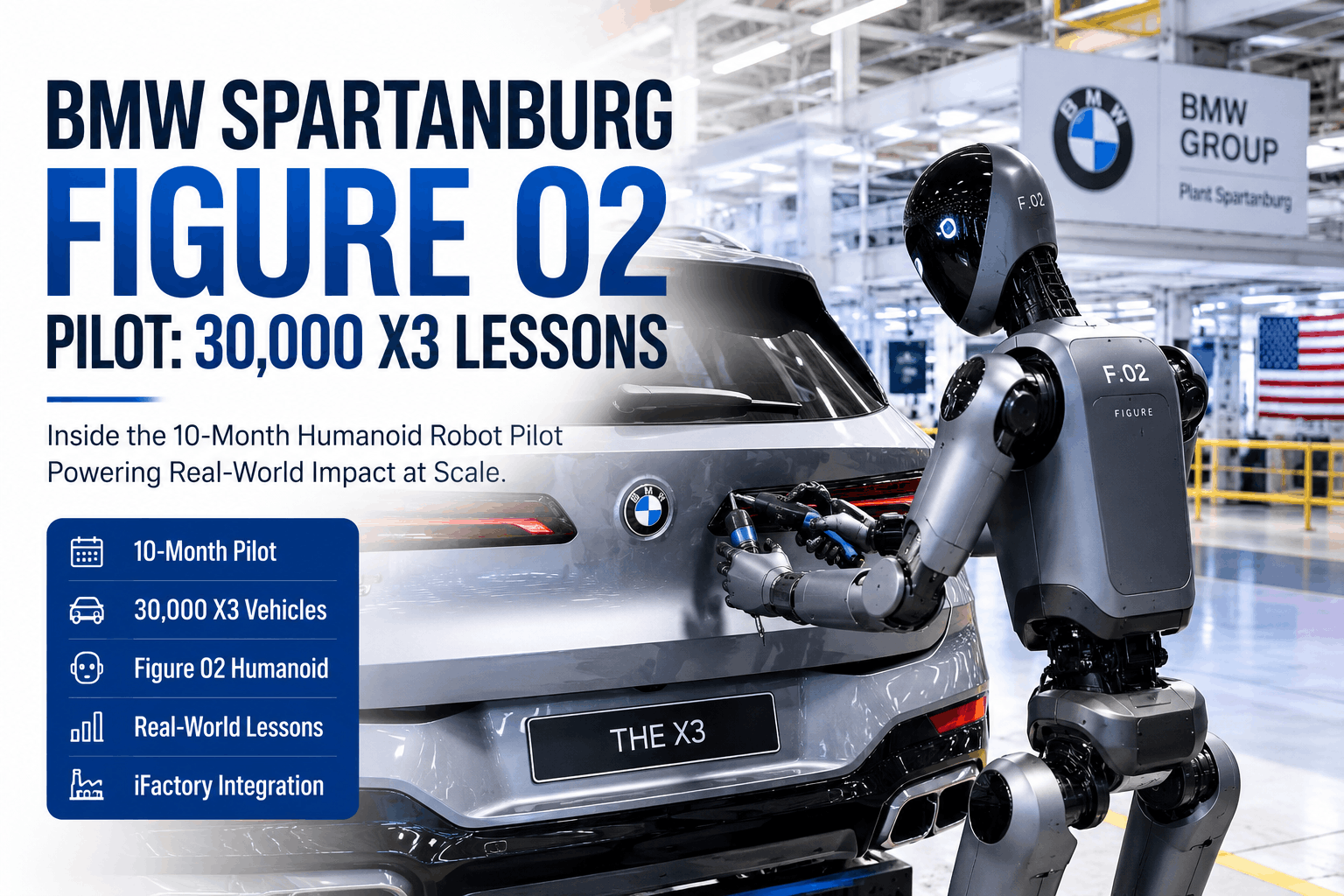
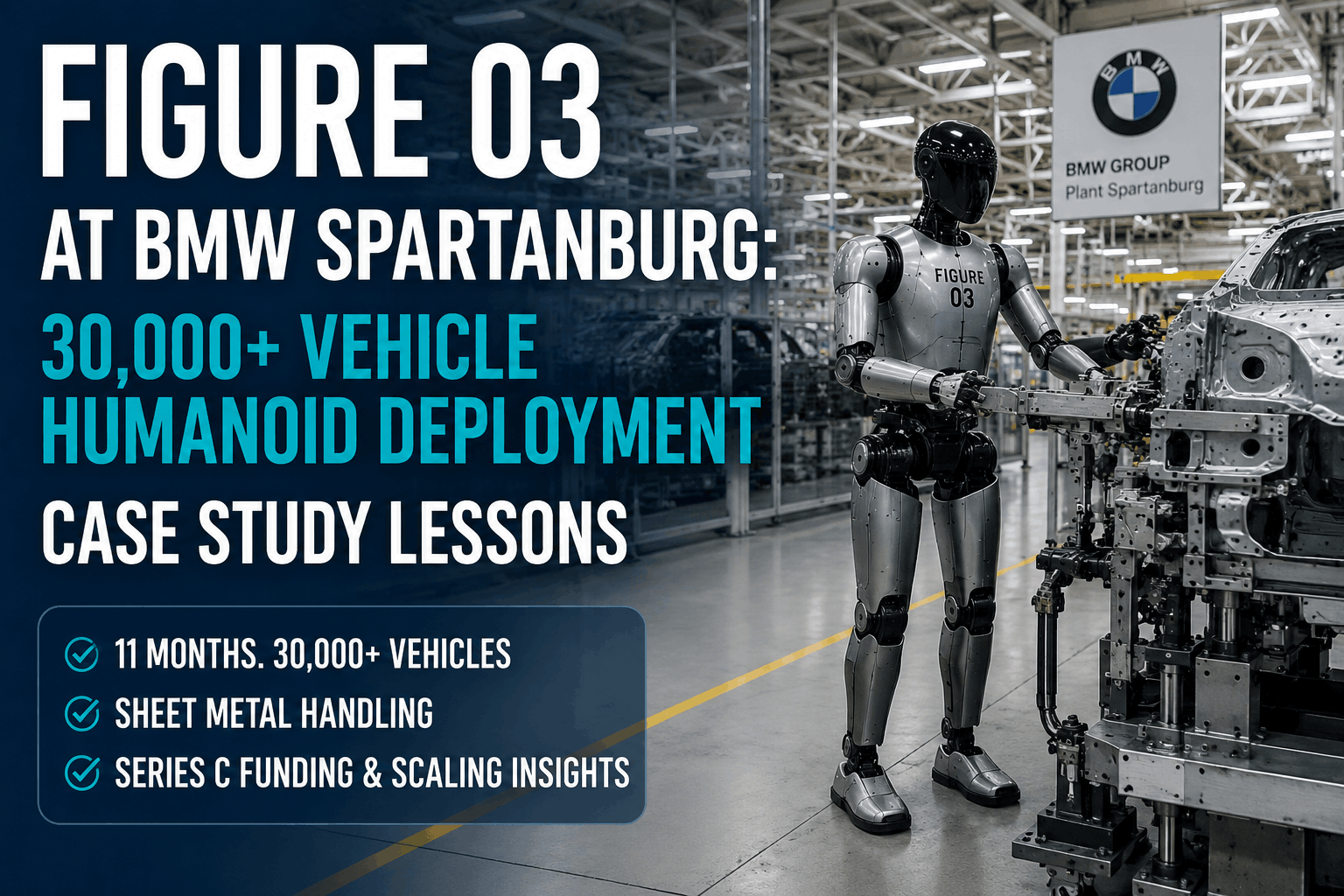
The BMW Spartanburg deployment of Figure 02 (later Figure 03) remains the most documented and most analysed humanoid manufacturing deployment in history. In 11 months from contract signing to live production, humanoid robots contributed to the assembly of over 30,000 vehicles — establishing the benchmark that every OEM now measures their own programme against.
Nov 2023
Commercial agreement signed — BMW Manufacturing & Figure AI
Mar 2024
Figure AI raises $675M Series C at $2.6B valuation — BMW deployment as proof of commercial viability
Q2 2024
Figure 02 goes live on BMW body shop production line — first humanoid on live automotive production
30,000+ vehicles assembled with humanoid assistance — 11 months from contract to milestone
Physical AI: The Technology Layer Making Humanoid Robots Production-Ready
The leap from research humanoid to production humanoid is not mechanical — it is computational. "Physical AI" — AI models that understand and act in the physical world in real time — is what separates the robots in today's production deployments from the research platforms of five years ago. Three technology breakthroughs converged in 2023–2024 to make production deployment viable. Book a demo to see Physical AI integrated with automotive production systems.
VLA
Vision-Language-Action Models
Models like Google DeepMind's Gemini Robotics and OpenAI's RT-X translate visual observation directly into physical action — enabling robots to perform tasks they have never specifically been trained on by generalising from millions of real-world manipulation examples.
Example: Apollo (Mercedes) generalises battery connector seating across 40+ connector variants without individual training
FSD
Custom AI Silicon
Tesla's FSD computer, integrated into Optimus Gen 3, delivers more AI inference per watt than off-the-shelf chips — enabling complex visual processing and physical control in a battery-powered mobile robot that runs for 8 hours per charge.
Example: Optimus identifies and handles 200+ battery component variants in real-time at Fremont
FL
Fleet Learning
Every task completed by every robot in a fleet generates training data shared across all units. A fleet of 1,000 Optimus units learns 1,000× faster than a single robot — creating a compounding improvement rate that accelerates with scale.
Example: Tesla's 1,000-unit Fremont fleet generates model improvements that benefit all future Optimus deployments externally
22D
Dexterous Hands
22-DOF tactile hands (Apollo, Optimus Gen 3) with 6-axis force sensing on each finger enable manipulation precision that matches or exceeds human hand capability for structured assembly tasks — the critical prerequisite for EV battery and precision assembly deployment.
Example: Apollo at Mercedes performs HV connector seating with 99%+ accuracy across 8-hour shifts
The Integration Gap: Why Most Humanoid Pilots Stall
The most common reason humanoid robot pilots fail to scale is not robot capability — it is integration. A robot that cannot receive live work orders from MES, write quality records per vehicle, trigger andon signals when it detects a problem, or route maintenance alerts to CMMS is generating physical output but no production intelligence. The robot is an island. iFactory closes this gap with the integration layer that every production deployment requires — available as on-premise edge deployment or cloud-connected analytics, or both.
The Humanoid Integration Gap — What iFactory Bridges
Robot Layer
Task executionSensor dataVision resultsBattery status
iFactory Integration Layer
On-Premise Edge Node
+
Cloud Analytics
Production Systems
MES work ordersQuality recordsAndon systemCMMS alerts
iFactory: On-Premise and Cloud Deployment — Both Available
iFactory provides the production integration layer that connects humanoid robots to your MES, quality systems, andon boards, and CMMS — in two deployment models designed for different manufacturing infrastructure and data governance requirements. Both models deliver the same AI capability. The difference is where data lives.
On-Premise Edge
Data Stays in Your Plant
iFactory edge nodes installed within your plant infrastructure process all humanoid robot task data, quality records, and production events locally. No raw production data leaves the facility. Real-time decisions in under 5ms without cloud dependency. Operational during WAN outages.
iFactory's cloud platform aggregates humanoid fleet performance data across all your plants — cross-plant benchmarking, AI model update distribution, predictive maintenance fleet analytics, and enterprise sustainability reporting. Scales from one plant to your global network.
Humanoid Robot ROI by Task Category — 2026 Estimates
Ergonomic relief (overhead / under-vehicle)
12–18 mo
EV battery module assembly
14–20 mo
Material kitting and logistics
16–24 mo
Body shop panel handling
18–28 mo
Precision fastener installation
24–36 mo
ROI payback assumes current-generation humanoid pricing ($100K–$250K) with Tesla Optimus target ($20–30K) compressing all timelines to 3–6 months by 2027.
FAQ: Humanoid Robots in Automotive Manufacturing 2026
Humanoid robots are production-ready in 2026 for: ergonomic-risk assembly tasks (overhead, under-vehicle, confined-space), material kitting and logistics, body shop panel handling, EV battery module assembly, and quality inspection assistance. They are not yet production-ready for: high-speed stamping press tending (cycle times too fast), paint shop spray booth environments (ATEX explosive atmosphere certification still maturing), and complex multi-variant trim and fit operations requiring real-time quality judgement across 20+ configurations. The boundary is advancing rapidly — tasks in the "not ready" category today are likely to be production-viable by 2027–2028 as Physical AI models mature. Book a demo to assess your plant's humanoid readiness.
iFactory connects to MES platforms via standard REST API or OPC-UA without requiring any MES modification, customisation, or downtime. The iFactory edge node reads production context (work orders, vehicle build sequence, station assignments) from the MES on a read-only basis in the first phase — the MES sees no new inbound requests during this period. Write-back (quality records, task completions, andon events) is added in the second phase through the same API connection, using the MES's existing event and record structures. iFactory supports SAP ME, SAP MII, Delmia Apriso, Siemens Opcenter, Rockwell Plex, and custom MES platforms. Both on-premise and cloud deployment models include full MES integration. Contact iFactory to confirm compatibility with your MES.
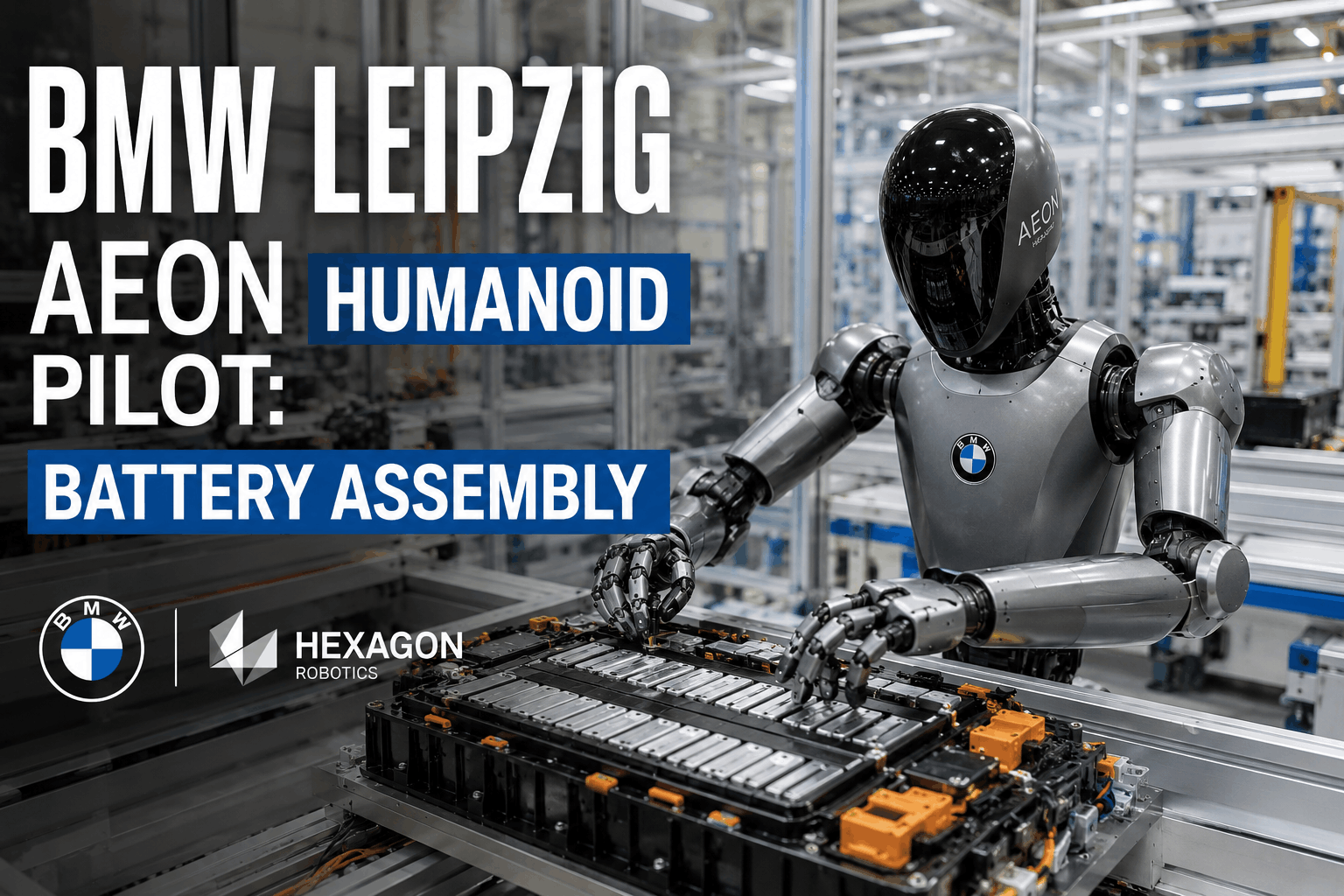
BMW's AEON (Autonomous Execution of Operations in New manufacturing) programme is BMW's internal framework for deploying autonomous robots — including humanoids — across its global manufacturing network. The Leipzig plant AEON pilot follows the Spartanburg Figure 02/03 deployment as the second major humanoid deployment site within BMW's programme. AEON standardises the task evaluation methodology, safety commissioning process, and MES integration architecture across BMW plants — meaning each new deployment benefits from prior learnings rather than starting fresh. iFactory's integration architecture is designed to be compatible with AEON's MES integration requirements at BMW Manufacturing facilities.
Yes — most manufacturers run both simultaneously as a hybrid architecture, and iFactory is designed for this from day one. The on-premise edge node handles all real-time production decisions — MES work order receipt, quality record writing, andon signal generation, CMMS work order creation — with sub-5ms latency and no internet dependency. The cloud platform receives aggregated, anonymised performance data from all on-premise nodes — enabling cross-plant benchmarking, AI model update distribution, fleet maintenance scheduling, and enterprise sustainability reporting. The split is simple: anything that needs to happen in milliseconds at the machine runs on-premise; anything that benefits from multi-plant or historical analysis runs in cloud. Raw production data stays on-premise; derived insights go to cloud.
iFactory's standard humanoid integration deployment takes 8–12 weeks from site assessment to live production operation. The timeline covers: site assessment and network architecture review (weeks 1–2), edge node installation and MES connectivity (weeks 3–5), AI model configuration and alert calibration (weeks 6–8), operator training and go-live preparation (weeks 9–11), and production go-live with 30-day hypercare (week 12). For manufacturers with existing iFactory deployments on other systems (predictive maintenance, quality inspection), humanoid integration typically completes in 4–6 weeks because the edge infrastructure and MES connections are already in place. Book a scoping call to model your deployment timeline.
Connect Your Humanoid Robot Programme to Production Intelligence
iFactory provides the integration layer that connects humanoid robots to your MES, quality systems, andon boards, and CMMS — on-premise for data sovereignty, cloud for enterprise fleet management, or both. From BMW Spartanburg to your plant floor.