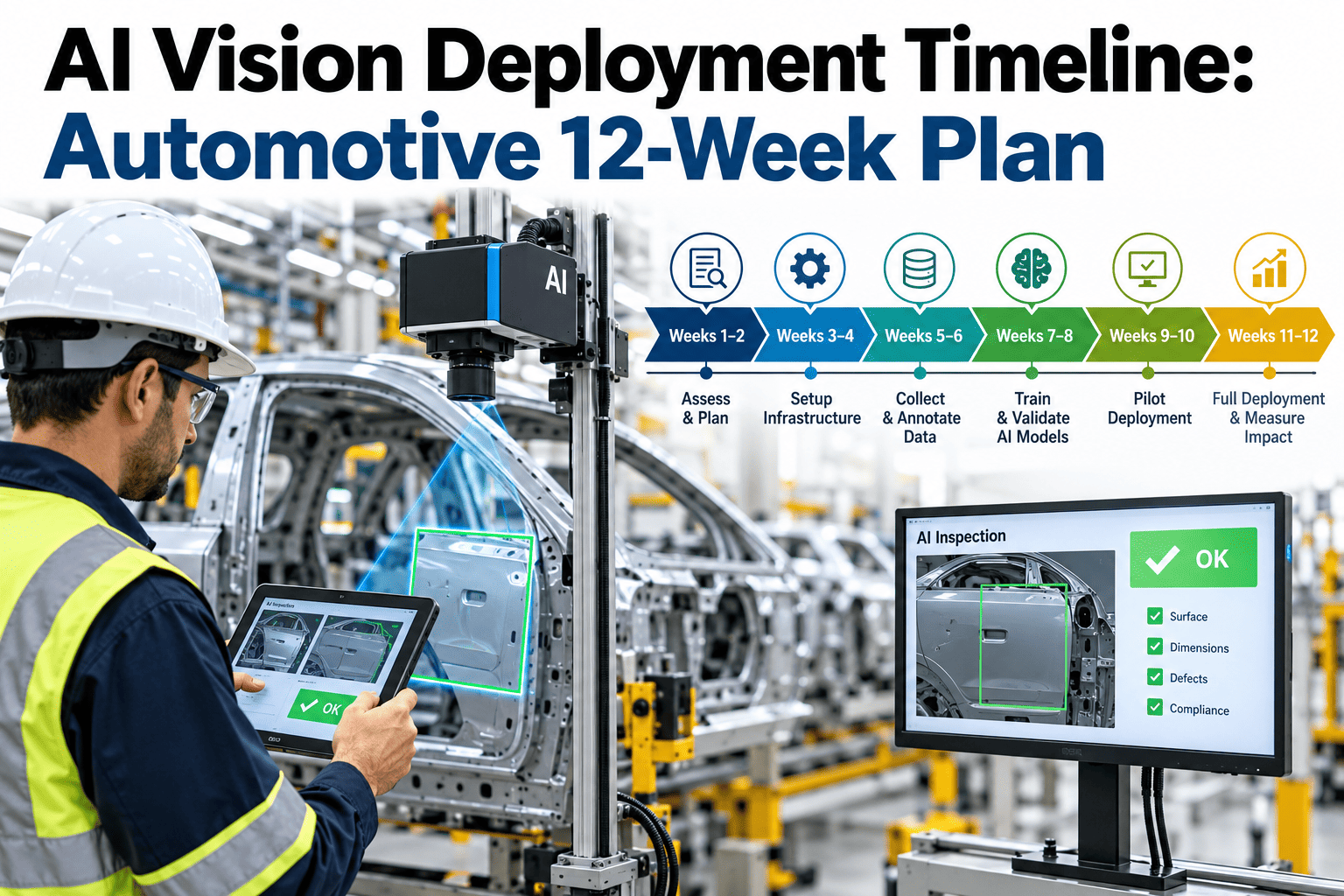
BMW took eleven months to get Figure 02 from first deployment to stable production at Spartanburg. Their second use case at the same plant took thirty days. AEON's Leipzig pilot ran a structured three-phase programme: theoretical evaluation → laboratory testing → first floor deployment in December 2025 → broader test in April 2026 → full pilot summer 2026. The learning curve in humanoid deployment is steep and compresses fast — but only for manufacturers who structure their pilots correctly from week one. A poorly structured pilot wastes six months discovering problems that BMW already documented. A well-structured twelve-week pilot gives you a production-validated use case, a measured ROI case, and a scaling roadmap built on data rather than speculation. This is the roadmap. Talk to an iFactory expert about structuring your humanoid pilot — book a demo.
12-Week Humanoid Pilot Roadmap · Automotive Plants
BMW Took 11 Months.
Your Second Use Case Can Take 30 Days.
The structured 12-week pilot roadmap for automotive manufacturers deploying humanoid robots — based on BMW's Spartanburg and Leipzig methodology, with iFactory MES and ERP integration milestones built in from week one.
Before You Start: The BMW Lesson Every Manufacturer Needs to Hear
BMW's Spartanburg deployment was the world's first production humanoid deployment in an automotive plant. It took twelve months because they were building the playbook. Every problem they solved — safety case development, OEM approval processes, task training methodology, MES integration — they solved without a reference. The result is a documented proof of concept that produced 30,000 vehicles and moved 90,000 components in 1,250 operating hours. But the more important output is what BMW learned about how to deploy the second time: thirty days, same quality standard. Your pilot does not need to take twelve months. It needs to avoid the twelve months of mistakes that made BMW's first deployment take that long.
30,000
BMW X3 vehicles supported by a single Figure 02 in 10 months at Spartanburg
12 months
Time to first stable production use case — without a reference playbook
30 days
Time for Figure AI's second BMW use case — same plant, different task, with the playbook
3 phases
BMW Leipzig structure: lab testing → test deployment → full pilot — the model for every manufacturer
Phase 0 (Pre-Pilot): Workstation Selection — The Decision That Determines Everything
The single biggest mistake in humanoid pilots is choosing the wrong use case. A use case that is too complex — fine assembly with tight tolerances, high-speed cycle requirements, or complex safety interactions — consumes the entire pilot proving the task is hard, not proving the robot works. The right first use case has five characteristics.
The 5 Criteria for a Humanoid-Ready Pilot Use Case
1
Structured Task with Clear Success Criteria
A task that can be described as: pick [object A] from [location B] and place it at [position C] to [tolerance D]. Figure 02's BMW task — sheet metal from bin to welding fixture — is the archetype. No ambiguity about what success looks like.
High Priority
2
Cycle Time > 60 Seconds
Current humanoid platforms operate best at 60–120 second cycle tasks. Tasks requiring sub-30-second cycles compete with existing automation that does it better. The first use case should value dexterity and adaptability over raw speed.
Required
3
Ergonomic or Safety Risk Removal
Use cases that remove a measurable human health risk — heavy lifting, HV exposure, repetitive awkward posture — have the strongest business case and the clearest regulatory and HR support. BMW specifically cited "relieving employees" as the primary driver.
Highest ROI Signal
4
Consequence of Error Is Recoverable
The first use case should tolerate errors gracefully. A misplaced part in a fixture that can be manually corrected is acceptable during training. A safety-critical fastener torque with no recovery option is not the first use case — it is use case 5 or 6.
Screen Carefully
5
Physical AI Zone Already Exists or Can Be Created
BMW chose the body shop at Spartanburg deliberately — it already had high automation density, robot-safe zones, and a workforce familiar with integrating new technology. Your first deployment zone should not require a full facility redesign to achieve cobot-safe operation.
Plan in Advance
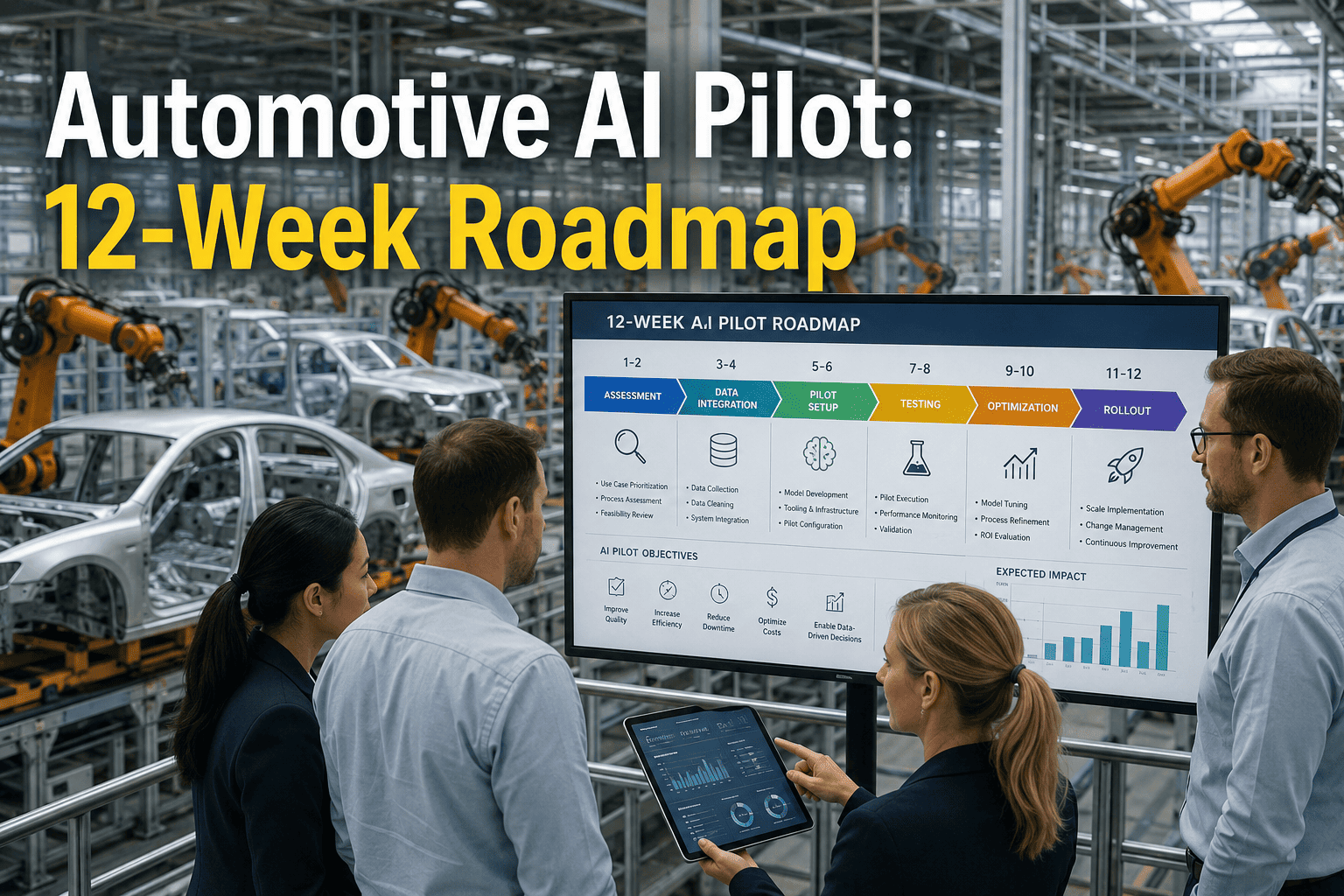
The 12-Week Pilot Roadmap
Workstation Safety Risk Assessment
Document all HV exposures, moving equipment interactions, and human-robot overlap zones at the target workstation. Define collaborative operation boundaries — speed limits, force limits, stop zones — aligned with ISO 10218 and ISO/TS 15066.
OEM / Plant Safety Authority Approval Process
BMW established a "Center of Competence for Physical AI in Production" to own this approval path. For your plant, identify the safety authority (usually Health, Safety & Environment + Engineering sign-off), the approval documentation required, and the timeline. Starting this in week 1 is not optional — this process gates deployment and is the most common cause of pilot delays.
iFactory Integration Pre-Configuration
Connect iFactory to MES, SAP PP, and CMMS via standard connectors. First OEE and production order context flowing within 48 hours. Robot task completion events will route to these systems from week 8 onward — the integration must be ready before the robot arrives on the floor.
KPI Baseline Establishment
Measure the current human performance on the target task: cycle time, placement accuracy, error rate, injury incidents, and shift coverage cost. This baseline is what you measure the robot against — without it, you cannot claim ROI at week 12.
Milestone: Safety case approved · KPIs baselined · iFactory integration live
Simulation Environment Build (NVIDIA Isaac Sim)
Build the digital replica of the target workstation in simulation. AEON's methodology requires all locomotion and manipulation tasks to be validated in Isaac Sim before physical deployment. Figure AI uses OpenAI-trained imitation learning. Both approaches require the simulation environment to be complete before robot training begins. AEON achieved locomotion mastery in simulation in 2–3 weeks — your physical deployment benefits from this pre-validated motion library.
Imitation Learning Demonstrations
AEON's system requires as few as 20 demonstrations to achieve autonomous task execution for a new operation. Figure's Helix 02 uses a similar few-shot learning approach. Demonstrations are performed by robot specialists in the physical workstation — typically completed in 1–2 days once the sim environment is validated.
Sim-to-Real Validation
The robot performs the trained task in an off-line physical mock-up of the workstation — not yet in production — under controlled conditions. Pass criteria: cycle time within specification, placement accuracy within tolerance, zero unsafe motion events over 100 consecutive cycles.
Milestone: Task autonomous in simulation · 100-cycle physical validation passed
Supervised Production Operation — First 500 Cycles
Robot operates on the production floor under continuous human supervision. A qualified operator and robot specialist are present at all times. The robot performs real production tasks on real parts — not simulated loads. Every cycle is logged: task completion, cycle time, placement result, any safety event. This mirrors BMW Leipzig's "initial test deployment" phase exactly.
iFactory Real-Time KPI Measurement
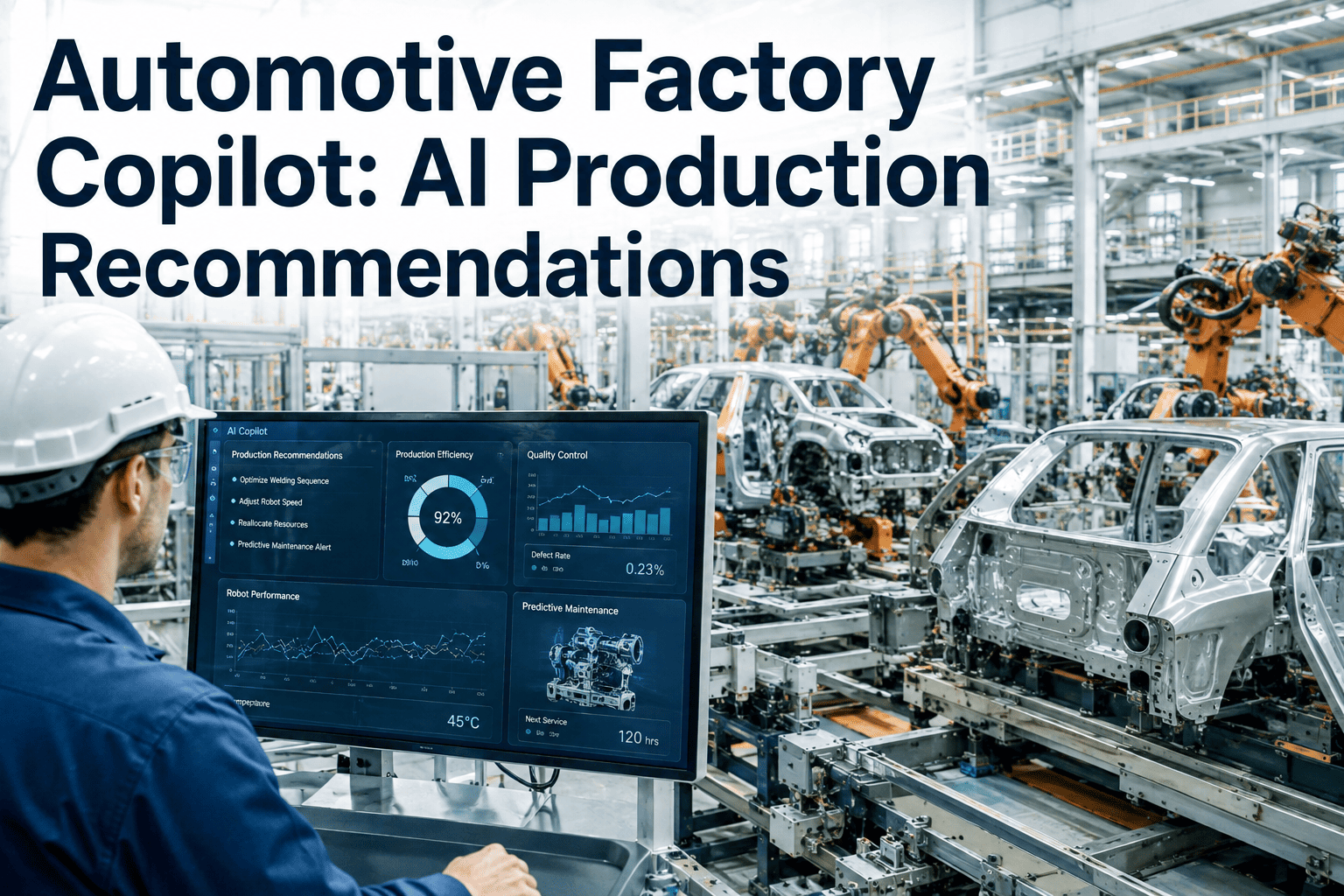
iFactory captures every robot task completion event — cycle time, placement confirmation, production order reference — and routes it to MES and SAP PP automatically. The pilot KPI dashboard (cycle time vs. baseline, placement accuracy rate, availability %) is live and updating per cycle. No manual data collection required.
Edge Case Discovery and Model Refinement
The first 500 cycles always surface edge cases — unusual part orientations, bin configurations outside the training set, material variations. Each edge case is logged, a corrective demonstration is added, and the model is updated. The learning rate in this phase is steep — most teams see 80% of edge cases in the first 200 cycles.
CMMS Integration — Robot Maintenance Workflow
iFactory routes robot telemetry to CMMS — battery state, joint health signals, actuator temperature. Maintenance alerts create work orders automatically, with robot ID, fault description, and recommended action. The same CMMS workflow used for conventional production equipment applies to the humanoid from day one of floor operation.
Milestone: 500 supervised production cycles complete · KPIs tracked live · CMMS integrated
Reduced Supervision — Shift Operation
Supervision level reduces from continuous to periodic — operator check-ins every 30 minutes, then every hour. The robot operates across full shifts with standard plant safety systems (safety laser scanners, area monitoring) rather than dedicated human supervision. This is the transition from "test deployment" to "pilot phase" in BMW's framework.
KPI Measurement Against Baseline
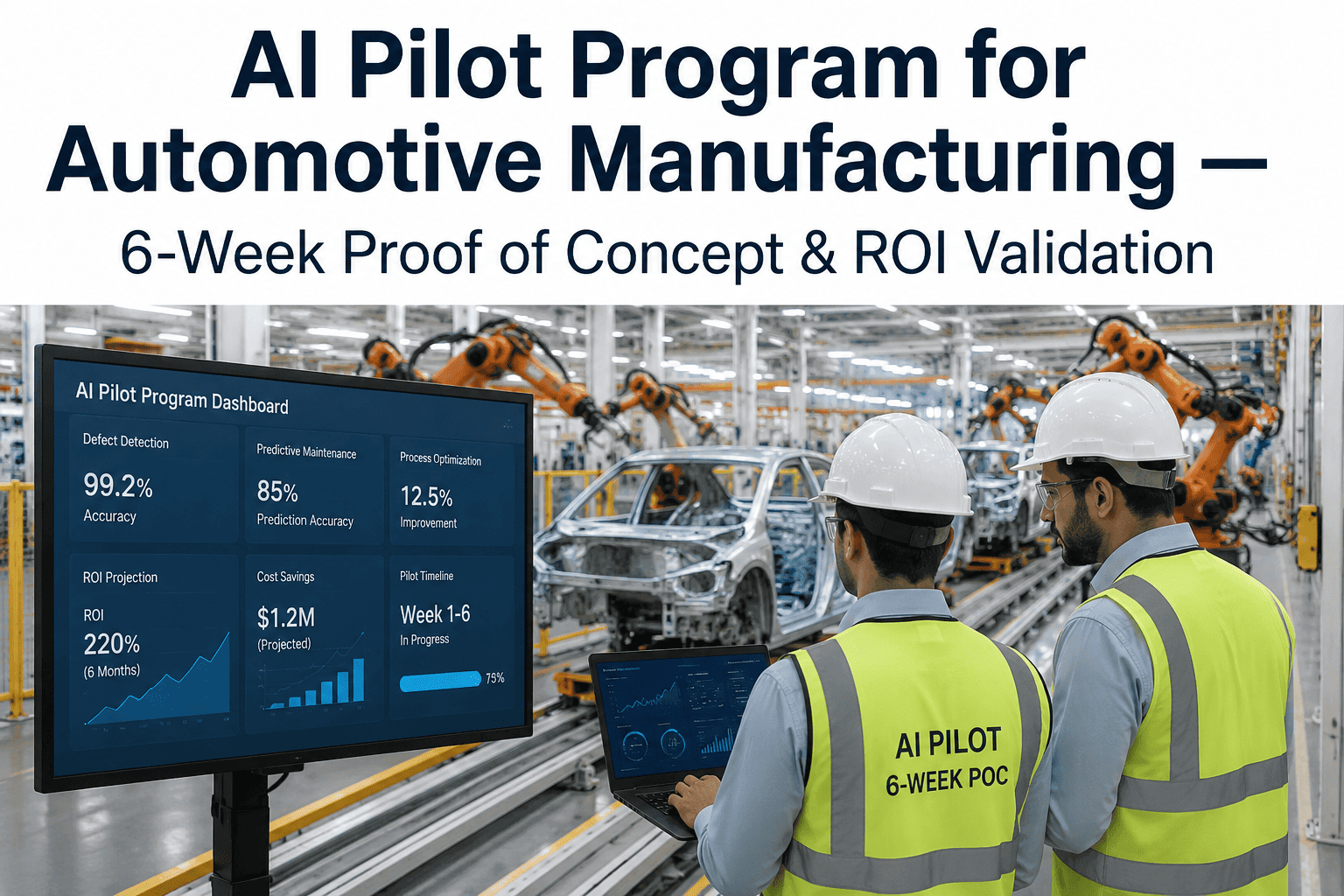
At week 12, iFactory generates the pilot performance report: cycle time achieved vs. baseline, placement accuracy achieved vs. KPI requirement, availability % across the pilot period, safety incidents, and total cycles completed. This is the document that goes to plant management and the executive sponsor for the scale decision.
Second Use Case Identification
With the first use case validated, the team applies the five-criteria selection framework to identify the second. BMW's experience: use case 2 deployed in 30 days vs. 12 months for use case 1. The simulation environment, safety approval process, and iFactory integration are all already in place. The only new work is the task-specific demonstration and model training.
ROI Documentation and Fleet Scaling Plan
iFactory generates the full ROI report from production data: labor hours displaced, ergonomic risk incidents avoided, quality consistency improvement, OEE delta attributable to the humanoid contribution. The scaling plan projects: unit economics at 5, 10, and 20 robots; iFactory on-premise or cloud infrastructure for fleet management; and the 18–24 month use case expansion roadmap.
Milestone: Production pilot KPIs reported · ROI documented · Scale plan ready
Pilot KPIs: What to Measure and How iFactory Tracks Them
The 5 Pilot KPIs — Source, Target, and iFactory Integration
Cycle Time
Within ±5% of human baseline
PLC stroke counter + iFactory timer
SAP PP + MES
Placement Accuracy
95%+ cycles all parts correctly loaded
Vision system + robot end effector
SAP QM + MES
Robot Availability
85%+ uptime during production hours
iFactory telemetry + CMMS
OEE Dashboard + CMMS
Safety Incidents
Zero unplanned human-robot contacts
Safety laser scanner + iFactory log
HSE System + CMMS
Task Completion Rate
90%+ cycles completed without human intervention
Robot controller + iFactory event log
MES + SAP PP
All KPIs tracked automatically by iFactory — no manual data collection. Pilot performance report generated from production data, not engineer estimates.
iFactory: On-Premise & Cloud for Humanoid Fleet Management
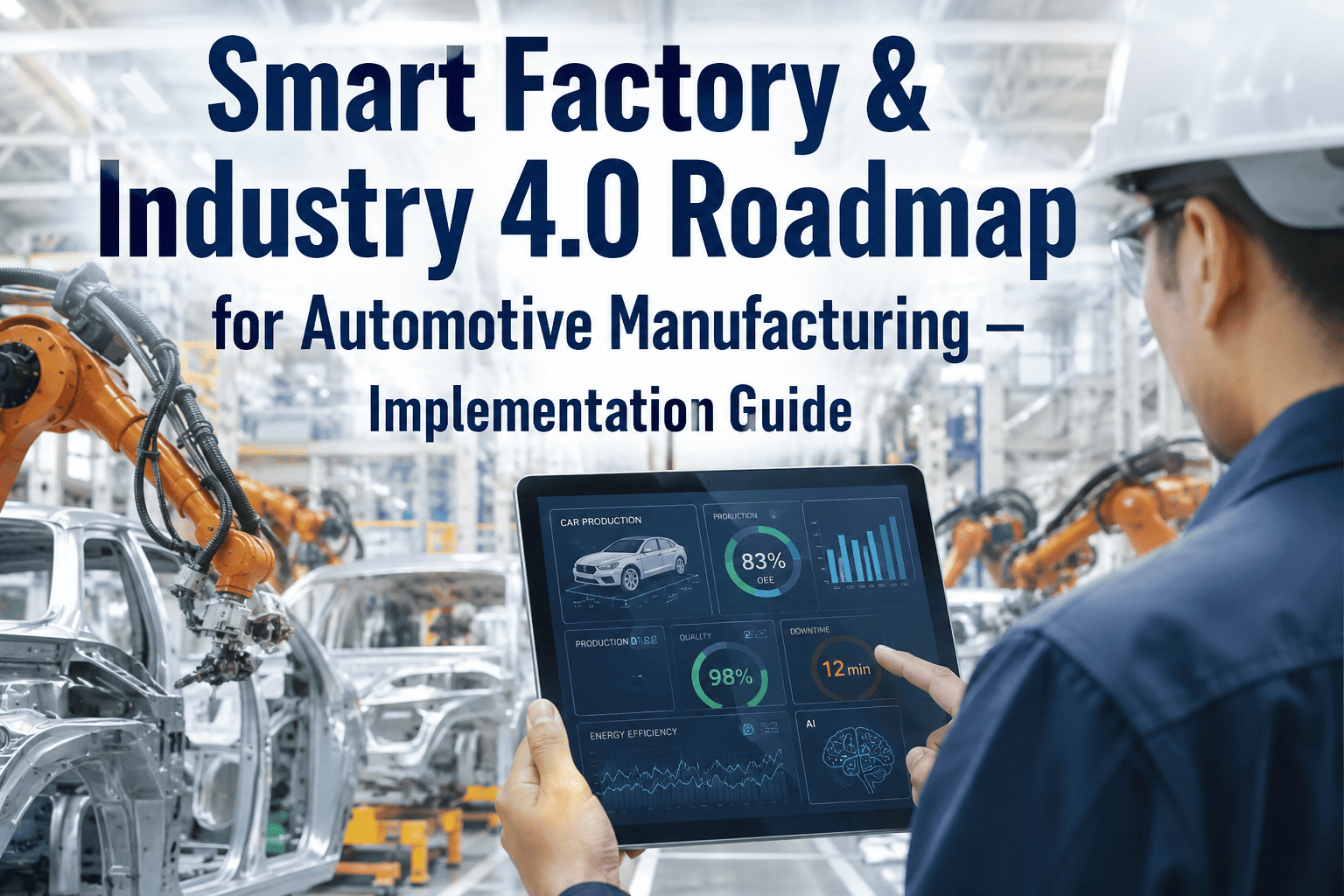
A humanoid pilot generates high-frequency data — task events, telemetry, safety logs, quality observations — that needs to be processed, stored, and routed to production systems in real time. iFactory provides both deployment models to match your plant's data governance requirements. Ask our team which deployment architecture fits your humanoid pilot infrastructure.
On-Premise
Single-Plant Pilot
All robot data processed and stored inside plant network
Sub-20ms event routing — real-time cycle tracking per robot action
No external connectivity dependency for production operation
Meets OEM data sovereignty and OT isolation requirements
NVIDIA edge appliance or existing plant server — operational in 48 hours
Discuss On-Premise Pilot
Cloud
Multi-Plant Fleet Scaling
Centralised fleet management across multiple humanoid deployment sites
Cross-plant KPI benchmarking — which tasks perform best on which platforms
AI model improvement from fleet-wide task data across all facilities
Executive and operations team dashboards accessible from any location
Ideal for scaling from single pilot to 10+ unit production deployments
Discuss Cloud Fleet Setup
The Economics: What the Pilot Needs to Prove for the Scale Decision
Humanoid Pilot Economics — Current and Projected
Robot-as-a-Service (RaaS)
$25/hr
Figure 03's commercial contract at BMW Spartanburg — structured at approximately $25 per robot-operating-hour on a RaaS basis
Outright Unit Price (2025)
$90–100K
Western factory humanoid unit price per Bank of America 2026 analysis; Chinese-manufactured units closer to $35,000
Price Trend
-40%
Manufacturing costs dropped 40% between 2023 and 2024 (Goldman Sachs via Deloitte). Bank of America projects below $17,000 by 2030
ROI Timeline
18–24 mo
Industry analyst estimate at current pricing; compresses to under 14 months as unit costs fall toward $30,000
FAQ: 12-Week Humanoid Pilot for Automotive Plants
Why 12 weeks — is that enough time to validate a humanoid robot pilot?
Twelve weeks is enough to answer the questions that matter for a scale decision: Can this robot perform this task at this workstation to the required cycle time and accuracy? What edge cases exist, and are they manageable? What is the robot availability rate under real production conditions? What is the integration footprint with MES, SAP, and CMMS? Twelve weeks does not deliver a fully production-scaled programme — it delivers a validated proof of concept with real KPI data and a credible ROI case for the investment committee. BMW's Leipzig model confirms this: initial test deployment → validation → full pilot is the correct sequencing. The 12-week roadmap delivers the first two phases plus the beginning of the third.
How much does a 12-week humanoid pilot cost to run?
The primary costs are: platform access (Figure 03 RaaS at ~$25/hour, 2,400 production hours across 12 weeks = approximately $60,000 in robot operating cost on RaaS; or $90,000–$100,000 for an outright unit), robot specialist support during training and supervised operation (typically 3–4 specialists for weeks 4–9, then reducing), facility modifications for collaborative robot zone compliance, and iFactory integration setup (connector configuration, 5–10 business days). Total pilot budget for a well-structured 12-week programme at a single workstation typically ranges from $150,000–$300,000 depending on platform choice, support model, and facility readiness. This compares to the ROI case: if the use case displaces one operator shift at fully-loaded cost of $80,000–$120,000 annually per FTE, payback on the pilot cost is under six months at scale.
What is the role of iFactory in a humanoid pilot — is it required?
iFactory is not a prerequisite for deploying a humanoid robot — but it is the difference between a robot that performs a task and a robot that creates business value. Without production system integration, every task completion is an unrecorded event. The KPI data that justifies scaling exists only in the robot vendor's dashboard, not in your MES or SAP. The quality observation the robot makes stays in its local memory, not in SAP QM. The maintenance alert from joint wear telemetry never reaches your CMMS. iFactory provides the integration layer that connects humanoid robot data to the production systems that run your plant — making the robot a measurable production asset rather than a technology demonstration. On-premise deployment ensures this integration operates inside your OT network without external dependencies.
Which humanoid platform should we choose for a 12-week automotive pilot?
For a 12-week pilot in 2026, the commercially available options with automotive deployment track records are: Figure 03 (proven BMW Spartanburg deployment, RaaS model available, best-in-class fine manipulation for body shop and fixture loading tasks), AEON by Hexagon Robotics (BMW Leipzig deployment, strongest automotive quality inspection capability via modular scanner attachments, 34 DOF), Apptronik Apollo (Mercedes-Benz deployment, highest payload at 25kg, suited to intralogistics and heavy part delivery), and Unitree H1/H1-2 (available today at $99,900–$128,900 outright, open SDK, fastest integration path via iFactory, suited for logistics and inspection pilots). For a first pilot, the task type determines the platform: fine assembly → Figure; inspection or scanning → AEON; intralogistics → Apollo or Unitree.
What are the most common reasons automotive humanoid pilots fail or stall?
The five most common failure modes in automotive humanoid pilots: (1) Wrong use case — chosen for novelty rather than task-robot fit, resulting in a pilot that proves the task is hard rather than the robot works; (2) Safety approval delays — OEM safety authority approval not started until week 6, delaying floor deployment by 4–6 weeks; (3) No production system integration — KPI data exists only in robot vendor tools, making ROI claims unverifiable for the investment committee; (4) Over-supervised operation — the robot never operates at reduced supervision level, so the pilot never answers the question of whether it can run at production conditions; (5) No second use case identified — the pilot ends with one validated use case and no expansion path, allowing momentum to dissipate between the pilot report and the scale decision. iFactory addresses failure modes 3 and 5 directly; the 12-week roadmap structure addresses 1, 2, and 4.
How does the humanoid pilot scale into a production fleet programme?
The scale-up path follows BMW's documented model: single-use-case pilot → multi-use-case deployment → fleet expansion. With iFactory's integration layer in place, adding a second humanoid unit at the same workstation takes 2–3 days of configuration. Adding a second use case at a different workstation follows the same 12-week roadmap — but with the safety approval, simulation environment, and iFactory connectors already established, the net new work is weeks 4–7 only. Fleet management at scale (10+ units across multiple plants) uses iFactory's cloud deployment for centralised KPI tracking, AI model management, and cross-plant benchmarking.
Book a demo to see iFactory's fleet management dashboard for multi-unit humanoid deployments.
12-Week Humanoid Pilot + iFactory
Start Your Pilot Right.
Scale with Data, Not Hope.
iFactory provides the integration layer, KPI tracking, and production system connectivity that turns a 12-week humanoid pilot into a documented ROI case and a credible scaling plan — on-premise or cloud.
BMW-Methodology Roadmap
iFactory MES Integration
On-Premise & Cloud
Automated KPI Tracking
Scale-Ready from Week 1