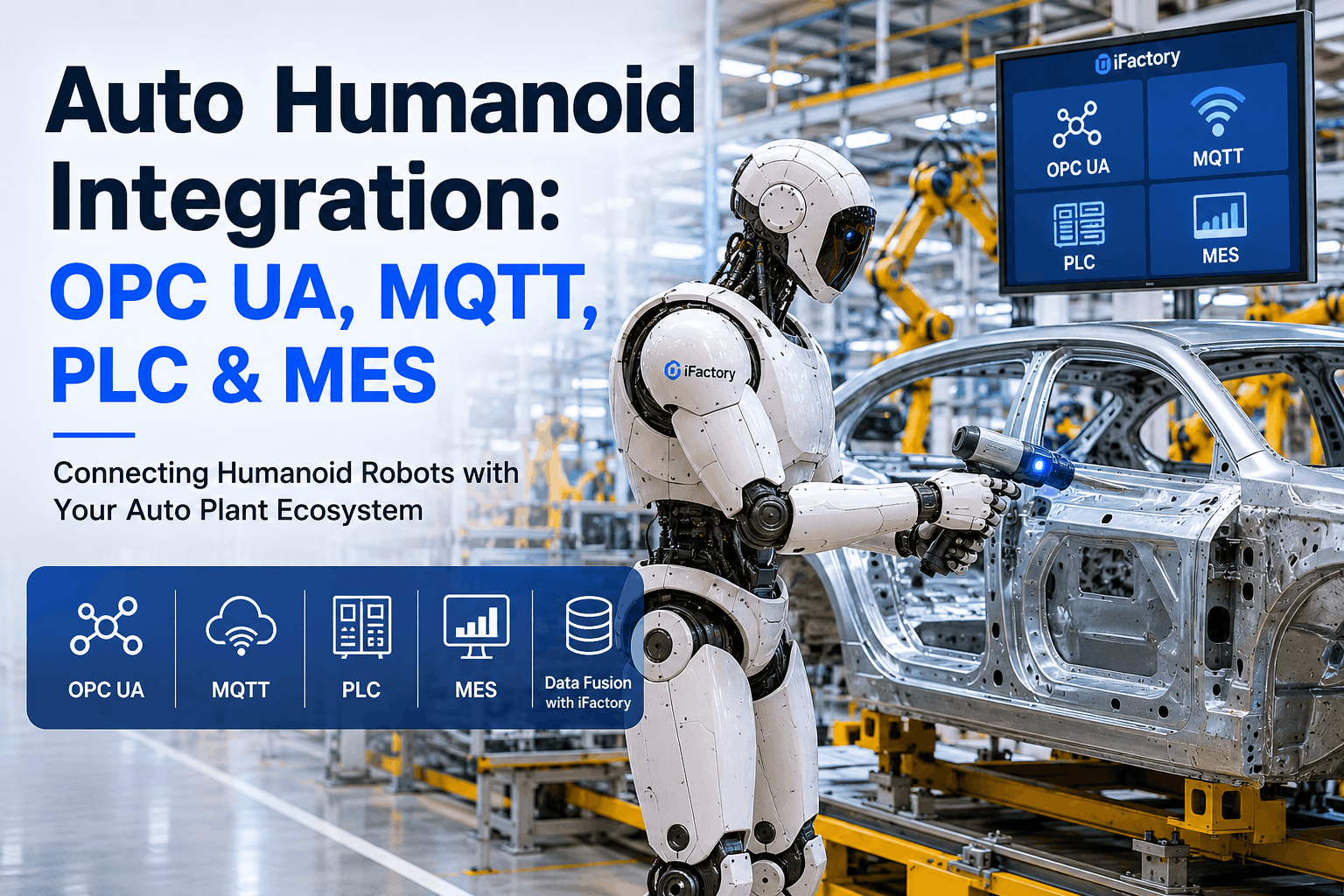
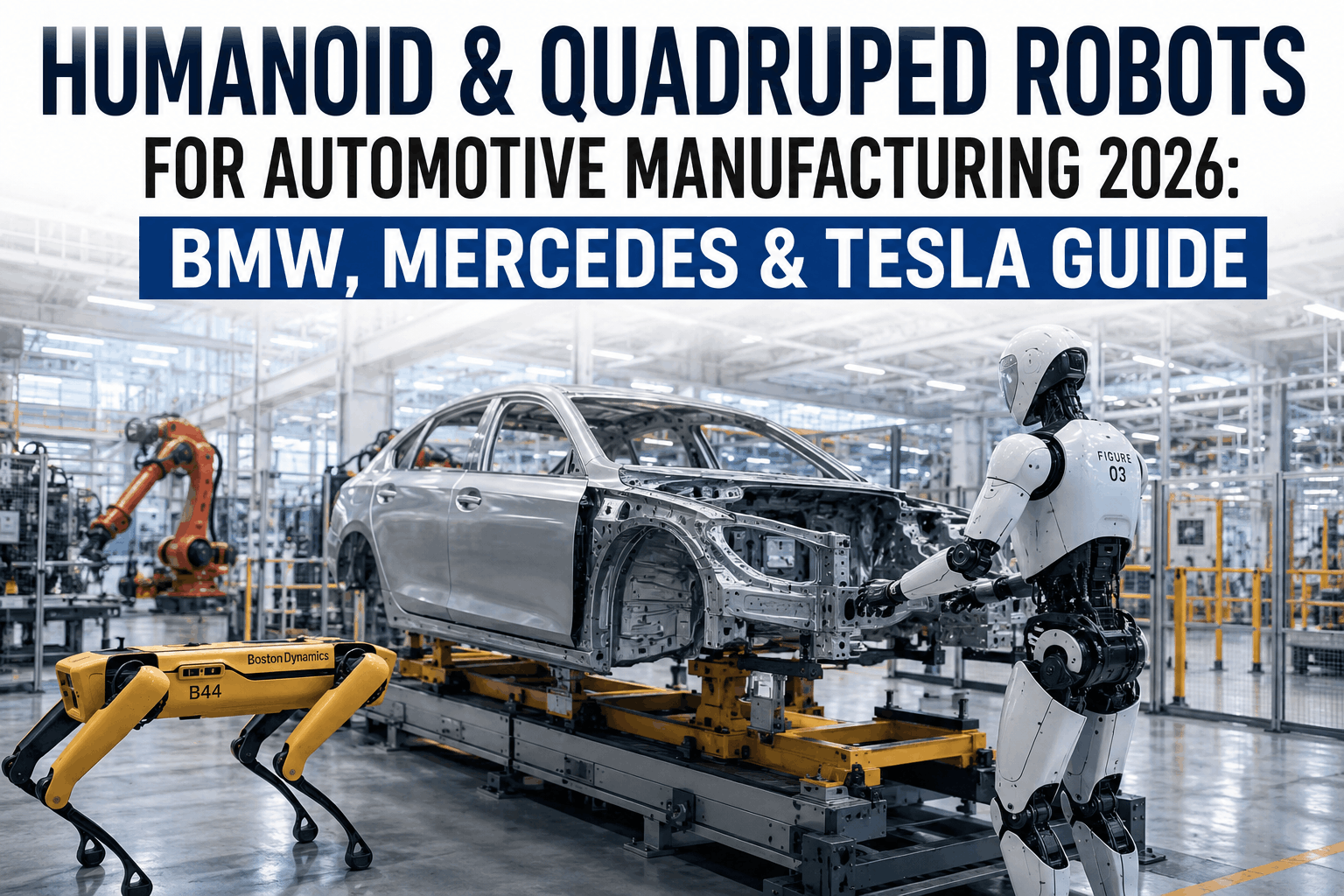
Automotive manufacturing is one of the most physically demanding industries on earth. Workers install dashboards lying on their backs. They lift 15kg components into overhead positions hundreds of times per shift. They work next to 400V battery packs wearing cumbersome PPE. They perform the same wrist rotation 4,000 times a day. The result: transportation equipment manufacturing sees 3.2 recordable injuries per 100 full-time workers, and the prevalence of musculoskeletal disorders among vehicle assembly workers reaches 53% — more than half the workforce. Humanoid robots are not entering the automotive plant to replace workers. They are entering to absorb the tasks that are hurting them. BMW explicitly stated this: the goal is to "relieve employees and further improve working conditions" — particularly in repetitive or physically taxing roles. iFactory provides the EHS workflow integration that turns humanoid robot operation into a measurable safety improvement programme. Talk to an iFactory expert about humanoid-driven EHS improvement for your plant — book a demo.
Automotive EHS + Humanoid Robots
Stop Designing Around the Injury.
Deploy the Robot That Prevents It.
Humanoid robots absorb the ergonomic, hazardous, and repetitive tasks that cause 53% of automotive assembly workers to develop MSDs. iFactory logs every near-miss, every task substitution, and every safety event automatically — on-premise or cloud.
The Human Cost of Automotive Manufacturing — By the Numbers
The EHS Problem Humanoid Robots Are Built to Solve
53%
Automotive assembly workers with musculoskeletal disorders — BMC Public Health, 2025
400K
MSD injuries per year in US manufacturing — one-third of all workers' comp costs
$29K
Average cumulative trauma claim cost per incident (OSHA 2025 data)
$60–80B
Total annual cost of MSDs in US manufacturing — direct + 5× indirect costs
18.5M
Days of lost work caused by MSDs in 2024 — OSHA data
42%
Decrease in ergonomic injuries within 8 months with AI ergonomic monitoring programmes
The 5 Highest-Risk Task Categories in Automotive Plants
Not every automotive task is equal in ergonomic risk. The five categories below account for the majority of MSD claims, lost-time incidents, and near-miss events in assembly plants — and they are the exact categories where humanoid robot dexterity, payload capacity, and task tolerance make a direct substitution viable today.
Overhead Final Assembly (cockpit, headliner installation)
Dashboard insertion, wiring harness routing above door level
Shoulder / neck MSDs · Awkward sustained posture
200–400 per shift
High — 30–60 sec cycle, positional tolerance achievable
Heavy Component Intralogistics (seat sets, module kitting)
Carrying seat sets 15–25kg, kitting component totes to line
Lower back strain · Cumulative load injury
80–200 lifts per shift
High — Apollo (25kg payload) and Unitree H1 (30kg) purpose-matched
High-Voltage Battery Handling (EV assembly)
Cell module insertion, HV connector seating, busbar assembly
Arc-flash exposure · PPE burden · HV shock risk
Continuous during HV assembly shift
High — AEON deployed at BMW Leipzig for this exact task
Repetitive Fine Assembly (torque, clip engagement)
Fastener torque sequences, trim clip insertion, connector seating
Wrist / hand repetitive strain · Carpal tunnel risk
600–2,000+ per shift
Moderate — Figure 03 fine manipulation validated at BMW Spartanburg
Hazardous Environment Inspection (paint booth, chemical zones)
Paint shop VOC exposure inspection, chemical storage area checks
Chemical exposure · Respiratory risk · Confined space
Multiple per shift (inspection tours)
High — robot enters, human stays outside
How Humanoid Robots Remove the Human from the Hazard
The EHS case for humanoid robots is not about replacing workers broadly — it is about surgically removing humans from the specific tasks and environments that are injuring them. Book a demo to see how iFactory maps your plant's ergonomic risk register to humanoid deployment candidates. Each deployment below addresses a specific injury mechanism documented in automotive EHS literature.
Human Risk Profile
Sustained overhead posture 60–90 seconds per cycle
Neck flexion beyond 20° — documented RULA high risk
Shoulder abduction above 90° for wiring routing
Leading body region for automotive MSD claims globally
Humanoid Solution
Humanoid robots equipped with torque tools perform cockpit insertion and fastener sequences in the overhead zone — the exact posture that injures humans. The robot's arm range and force control match the spatial requirements. The human operator transitions to a supervisory role: loading components, inspecting results, managing exceptions. iFactory logs each task substitution as an ergonomic exposure reduction event — feeding the EHS system with documented data rather than annual survey estimates.
Verified: Cockpit installation is among the highest-injury tasks in final assembly — humanoids eliminate operator overhead exposure · iFactory EHS log · 2026
Human Risk Profile
15–25kg seat set carries — 80–200 lifts per shift
NIOSH Lifting Equation: recommended limit exceeded on full load
Cumulative L5-S1 disc compression — leading back injury source
Evening shift fatigue multiplies injury risk by 1.4×
Humanoid Solution
Apollo (Apptronik, 25kg payload) was deployed at Mercedes-Benz specifically for heavy intralogistics — lifting and carrying component sets that exceed safe human manual handling limits under repetitive conditions. The robot operates continuously across shifts without fatigue multiplication. Every lift event is logged by iFactory with weight, distance, and frequency data — enabling EHS teams to report ergonomic exposure reduction in quantified terms for workers' compensation programme management.
Verified: Apollo at Mercedes-Benz Berlin — heavy intralogistics, physically demanding repetitive tasks · February 2026
Human Risk Profile
400–800V live circuit exposure during connector seating
Arc-flash PPE (gloves, face shield, FR clothing) limits dexterity
Heat stress from PPE layer at production pace
Psychological load of working in continuous proximity to lethal voltage
Humanoid Solution
AEON at BMW Leipzig handles HV battery assembly — the human leaves the arc-flash zone entirely. The humanoid's HV-rated insulated end effectors, proximity voltage sensing, and emergency stop under 100ms provide the safety case. iFactory logs every HV component interaction as a human exposure elimination event — replacing the manual arc-flash exposure log with continuous, automated documentation. Safety audit preparation for OSHA 29 CFR 1910.333 becomes a data extract, not a paper reconstruction.
Verified: AEON at BMW Leipzig — HV battery assembly, December 2025 deployment · First humanoid in European automotive production
Human Risk Profile
Paint shop VOC concentration requires full respiratory PPE
Chemical storage inspection in confined or poorly-ventilated zones
High-temperature areas adjacent to curing ovens
Inspection frequency limited by PPE compliance cost and time
Humanoid Solution
Humanoid robots with modular sensor attachments — gas detectors, thermal cameras, acoustic sensors — perform inspection tours in hazardous zones without human entry. Inspection frequency increases from weekly (PPE-limited) to continuous or shift-level. iFactory routes all inspection findings to the EHS system and CMMS automatically — near-miss detection events (abnormal gas readings, temperature anomalies, structural observations) are logged immediately rather than at the next scheduled human inspection tour.
Human exposure to hazardous zones: eliminated · Inspection frequency: continuous vs. weekly · Near-miss logging: automatic
iFactory EHS Workflow Integration: Near-Miss Logging & Safety Data Flow
A humanoid robot that removes ergonomic and hazardous exposures but generates no structured safety data is a missed opportunity. Ask our team how iFactory's EHS integration connects humanoid safety data to your existing safety management systems. iFactory's EHS workflow integration converts every humanoid operation into a continuous stream of safety intelligence — automatically, without adding reporting burden to operators or supervisors.
iFactory EHS Data Flow — Humanoid to Safety Systems
Task Substitution Event
↓
Task type, duration, ergonomic risk score, body region protected, shift timestamp
EHS System
Quantified ergonomic exposure reduction — replaces annual survey estimate
Near-Miss Detection
↓
Sensor anomaly type, location coordinates, severity classification, timestamp
EHS + CMMS
Near-miss logged automatically — no human reporting required or missed
HV Exposure Elimination
↓
Arc-flash zone entry log, HV component interactions, PPE substitution record
EHS + OSHA Log
OSHA 300 log support — documented human exposure elimination
Safety Anomaly / Stop
↓
Stop reason, zone, force/speed at stop, recovery action taken
CMMS + EHS
Incident reconstruction data — replaces manual safety event log
Ergonomic Environment Scan
↓
Posture risk scores, load measurements, repetition counts per station
EHS Risk Register
Continuous ergonomic risk data — replaces annual manual assessment
Hazardous Zone Inspection
↓
Gas readings, thermal anomalies, structural observations, inspection timestamp
EHS + Facilities
Continuous monitoring — not weekly PPE-limited inspection tour
EHS KPIs: What Changes After Humanoid Deployment
1.2
Reduction in work-related injuries per 100 FTEs per standard deviation increase in robot exposure (academic study)
42%
Decrease in ergonomic injuries within 8 months with AI ergonomic monitoring deployment
$29K
Average MSD claim cost prevented per injury avoided — direct cost only (5× more in indirect)
10:1
Maximum benefit-to-cost ratio for ergonomic interventions — OSHA data; direct ergonomic ROI range 2:1 to 10:1
iFactory Deployment: On-Premise & Cloud for EHS Data
EHS data — near-miss logs, injury records, hazardous exposure documentation — is some of the most legally sensitive data in an automotive plant. iFactory provides both deployment models so your EHS safety data is stored and processed according to your legal and governance requirements. Book a demo to discuss iFactory's EHS data architecture for your plant.
On-Premise
Plant-Level EHS Data Sovereignty
All safety event logs, near-miss records, and exposure data stored inside plant network
No external transmission of legally sensitive incident documentation
Real-time safety event routing — sub-20ms for emergency stop signal processing
Meets OSHA recordkeeping requirements with tamper-evident on-premise log
Supports legal hold requirements — all records available for regulatory inspection
Discuss On-Premise EHS Setup
Cloud
Enterprise EHS Analytics
Cross-plant ergonomic exposure benchmarking and injury trend analysis
HSE leadership dashboards accessible from corporate safety centres
AI model improvement from fleet-wide safety data across all facilities
ESG reporting: quantified worker safety improvement data for sustainability reports
Ideal for global OEMs managing EHS programmes across multiple plants
Discuss Cloud EHS Setup
FAQ: Humanoid Robots for Automotive EHS and Ergonomics
Do humanoid robots actually reduce worker injuries — or is this theoretical?
The injury reduction evidence is real. An academic study analysing industrial robot adoption across manufacturing found that one standard deviation increase in robot exposure reduces work-related injury rates by 1.2 injuries per 100 full-time workers — a statistically significant, documented reduction. Companies using AI ergonomic monitoring programmes achieve a 42% decrease in ergonomic injuries within 8 months. BMW explicitly deployed humanoid robots at Leipzig "to relieve employees" from repetitive and physically taxing tasks — not as a technology demonstration but as an occupational health intervention. The mechanism is direct: when a robot performs the task that causes the injury, the injury does not occur.
How does iFactory log near-miss events from humanoid robot operation?
iFactory captures near-miss signals from multiple humanoid sensor streams simultaneously: safety laser scanner activations (human enters robot operating zone), force overload detections (unexpected contact), voltage proximity alerts (HV boundary approach), gas sensor threshold exceedances (hazardous environment inspection), and thermal anomaly detections. Each event is classified by severity (near-miss, safety stop, hazard condition), timestamped, location-tagged, and routed to the EHS management system and CMMS automatically. The near-miss record includes the sensor data that triggered it — enabling root cause analysis without manual incident reconstruction. This replaces the near-miss under-reporting problem that plagues manual safety systems: humanoid-detected near-misses are logged regardless of whether a human operator was present to report them.
What safety standards apply to humanoid robots operating alongside humans in automotive plants?
The primary applicable standards are: ISO 10218-1/-2 (industrial robot safety — safety requirements for design and integration), ISO/TS 15066 (collaborative robot operation — speed, force, and power limits for human-robot shared workspaces), ANSI/A3 R15.06-2025 (updated American National Standard for industrial robot safety, released in 2025), and IEC 61508 (functional safety for safety-related electrical/electronic/programmable systems — targeted by AEON's safety architecture). For HV battery environments, IEC 60479 (effects of current on humans) and NFPA 70E (arc-flash) apply to the humanoid end effector and operating zone design. iFactory's safety data logging is designed to support compliance documentation for all these standards, with timestamped records of every safety event and operational parameter.
How do you measure the ergonomic exposure reduction from humanoid deployment for EHS reporting?
iFactory quantifies ergonomic exposure reduction through four metrics: task substitution count (number of high-risk task cycles performed by the robot rather than a human, logged per shift), load displacement (total weight handled by the robot in kg, eliminating equivalent human lifting exposure), overhead posture time eliminated (minutes of high-RULA-score posture per shift removed from human operators), and HV zone entry elimination (number of arc-flash zone entries replaced by robot operation). These metrics are reported automatically by iFactory's EHS workflow module and can be formatted for OSHA ergonomics programme documentation, workers' compensation management reports, and ESG sustainability reporting. The data replaces annual survey-based ergonomic risk assessments with continuous, production-data-derived measurement.
What is the ROI of humanoid robots as an EHS investment specifically?
The EHS-specific ROI case has three components. Direct injury cost avoidance: average MSD claim costs $29,000 direct + $61,000 indirect (5× multiplier) = $90,000 total cost per prevented injury. At 42% injury reduction across an affected workforce, the prevented-injury cost savings can pay for a humanoid deployment within months for high-MSD operations. Workers' compensation premium reduction: documented injury rate improvements drive measurable premium reductions in the following programme year. Labour stability: MSDs cause turnover, restricted duty periods, and productivity loss beyond the direct claim — reducing MSD incidence improves production consistency. The ergonomic ROI benefit-to-cost ratio ranges from 2:1 to 10:1 per OSHA data — with the highest returns in tasks where injury frequency and severity are both high, which describes the five categories identified in this article.
Book a demo to model the EHS ROI for humanoid deployment in your plant's highest-risk tasks.
How do workers and unions typically respond to humanoid robots deployed for safety reasons?
BMW's stated framing — "humanoid robots are explicitly positioned as a complement to existing automation, not a replacement for workers" — reflects the approach that has achieved worker and union acceptance in automotive deployments. When humanoid robots are deployed specifically for the tasks that workers themselves identify as physically harmful or hazardous, acceptance is markedly higher than general automation deployments. iFactory's EHS logging reinforces this framing: the data demonstrates that robot deployment correlates with injury rate reduction rather than headcount reduction. The recommended approach is to involve worker safety representatives in task selection, use iFactory's ergonomic risk data to show which specific tasks exceed safe human exposure limits, and frame deployment as an occupational health intervention rather than a productivity measure.
EHS + Humanoid + iFactory
Every Ergonomic Task the Robot Takes.
Every Safety Event iFactory Logs.
iFactory connects humanoid robot operation to your EHS systems — logging near-misses, task substitutions, and hazardous exposure eliminations automatically. On-premise for data sovereignty. Cloud for enterprise EHS analytics.
Near-Miss Auto-Logging
Ergonomic Exposure Reduction
On-Premise & Cloud
OSHA 300 Log Support
ESG Safety Reporting