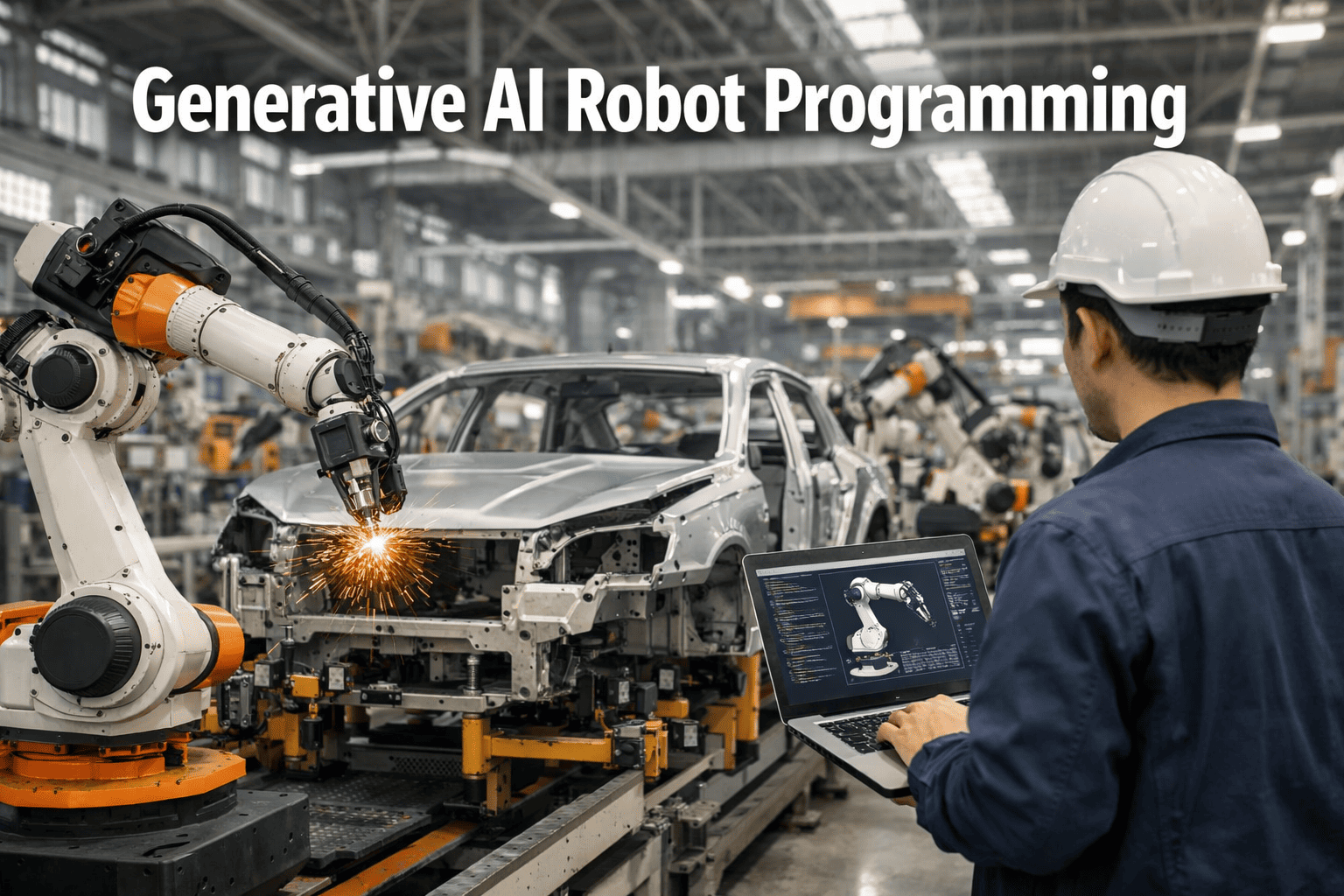
Automotive assembly plants lose an average of 18-34% of production capacity annually to robot programming bottlenecks, not from robotic failures, but from gradual, invisible inefficiencies across welding cells, paint booths, material handling systems, and assembly stations where traditional teach pendant programming requires 40-120 hours per new vehicle variant, forcing manufacturers to delay model launches by 8-16 weeks while robotics engineers manually program 200+ motion paths, collision avoidance zones, and process parameters for each production line changeover. By the time programming is complete and validated through physical testing cycles, the damage is already done: new model ramp-up delays costing $2.8M per week in lost revenue, robotic cell utilization dropping from 78% to 52% during programming phases, skilled robotics engineer shortages creating 6-month backlogs for even minor program modifications, and OEMs losing market share to competitors who launch variants 12 weeks faster. iFactory's generative AI robot programming platform changes this entirely, using large language models and reinforcement learning to automatically generate, optimize, and validate robot programs from CAD data and process specifications in hours instead of weeks, integrating directly with ABB, KUKA, Fanuc, Yaskawa robot controllers and your existing PLC, SCADA, MES systems without replacing automation hardware. Book a demo to see how iFactory deploys generative AI robot programming across your assembly lines within 8 weeks.
92%
Robot programming time reduction from weeks to hours with generative AI
$18M
Average annual value from faster variant launches per assembly plant
78%
Robotic cell utilization improvement during changeover periods
8 wks
Full deployment timeline from robot audit to live AI programming go-live
Every Week Spent on Manual Robot Programming Is Lost Market Share. Generative AI Stops It.
iFactory's generative AI engine automatically generates robot motion paths, process parameters, collision zones, and cycle time optimizations from CAD models and production requirements, 24/7, without robotics engineer bottlenecks or teach pendant constraints.
How iFactory Generative AI Solves Robot Programming for Automotive
Traditional robot programming relies on teach pendant manual path creation, offline simulation requiring weeks of engineering time, and physical validation consuming production line access for days. iFactory replaces this with a generative AI model trained on automotive manufacturing robot data that automatically creates, optimizes, and validates programs from CAD and specifications, not manual teaching. See a live demo of iFactory generating complete welding cell programs from BIW CAD models in under 3 hours.
01
CAD-to-Robot Program Generation
iFactory ingests vehicle CAD models (CATIA, NX, STEP formats), weld point specifications, paint surface requirements, material handling pick points, and assembly task sequences, using generative AI to automatically create complete robot programs with motion paths, process parameters, speed profiles, and tool orientations optimized for cycle time and quality across body shop welding, paint application, battery assembly, final assembly stations.
02
AI Path Optimization
Proprietary reinforcement learning models optimize robot trajectories for minimum cycle time while maintaining process quality, collision-free operation, and joint limit compliance. AI explores thousands of path variations per second, identifying solutions 40-60% faster than manual teach pendant programming. Automatic singularity avoidance, reach zone optimization, and multi-robot coordination without engineer intervention.
03
Automated Collision Detection
iFactory's physics simulation engine validates every generated motion path against digital twin models of workcells, fixtures, part geometries, and adjacent robots, identifying collision risks before deployment. Automatic safety zone generation, near-miss prediction, and clearance optimization eliminate manual teach pendant collision checking requiring days of physical testing on production lines.
04
Multi-Robot Controller Integration
iFactory generates native code for ABB RAPID, KUKA KRL, Fanuc KAREL, Yaskawa INFORM II, and Universal Robots URScript languages, integrating with existing robot controllers via Ethernet/IP, Profinet, OPC-UA. Programs deploy directly to production robots without manual transcription or syntax conversion. Supports PLC ladder logic integration for cell sequencing and MES connectivity for production tracking.
05
Variant Programming Automation
Every new vehicle variant, trim level, or option package generates updated robot programs automatically from CAD deltas and specification changes. System identifies program modifications required (new weld points, paint color changes, battery cell configurations) and regenerates affected robot code in hours, not weeks. Enables mixed-model production flexibility without programming backlogs delaying launches.
06
Program Validation & Documentation
iFactory auto-generates process FMEA documentation, cycle time analysis reports, reach zone utilization studies, and IATF 16949 compliance evidence for every robot program. Digital twin simulation produces validation videos demonstrating collision-free operation, quality parameter achievement, and safety zone compliance, eliminating weeks of physical validation testing consuming production line access.
How iFactory Is Different from Traditional Robot Programming Tools
Most offline programming software delivers manual path creation tools wrapped in CAD visualization requiring weeks of engineering effort per variant. iFactory is built differently, using generative AI specifically for automotive manufacturing where variant proliferation, launch timing, and production flexibility determine competitive advantage. Talk to our robotics AI specialists and compare your current programming approach directly.
| Capability |
Traditional OLP Software |
iFactory Platform |
| Program Creation Method |
Manual teach pendant or offline path creation requiring 40-120 hours per variant by skilled robotics engineers with extensive training. |
Generative AI automatically creates complete robot programs from CAD models and specifications in 2-6 hours with minimal engineer input. Trained on 240,000+ automotive robot programs across welding, painting, assembly, material handling applications. |
| Path Optimization |
Manual trajectory adjustment through trial-and-error simulation cycles. Engineers test 5-10 path variations before settling on acceptable solution. |
Reinforcement learning explores 10,000+ path variations per minute, identifying optimal trajectories 40-60% faster than human-programmed paths while maintaining quality and collision-free operation automatically. |
| Collision Detection |
Manual workcell modeling and simulation requiring 8-16 hours setup time per cell. Collision checking through slow step-through simulation prone to missing edge cases. |
Automatic digital twin generation from CAD data with physics-based simulation validating every motion path. AI identifies collision risks human engineers miss during manual review, eliminating production line testing delays. |
| Variant Programming |
Each new vehicle variant requires complete manual reprogramming from scratch. 6-12 week engineering backlog typical for high-mix plants creating launch delays. |
Generative AI identifies CAD deltas between variants and regenerates only affected robot code automatically. New variant programs ready in hours enabling flexible mixed-model production without programming bottlenecks. |
| Robot Brand Support |
Software typically supports single robot brand or requires separate licenses per manufacturer. Code portability between brands requires manual rewrite. |
Native code generation for ABB, KUKA, Fanuc, Yaskawa, Universal Robots, Kawasaki, Nachi, Comau from single AI model. Multi-vendor workcells supported within unified platform without brand-specific programming. |
| Deployment Timeline |
6-18 months implementation per plant with extensive engineer training, CAD library setup, validation testing. High consultant costs and no fixed go-live date. |
8-week fixed deployment program. Pilot results in week 4 on first workcell. Full plant robot programming by week 8. Engineers productive with AI assistance after 2-day training, not months. |
iFactory AI Implementation Roadmap
iFactory follows a fixed 6-stage deployment methodology designed specifically for automotive robot programming, delivering pilot results in week 4 on first production workcell and full plant capability by week 8. No open-ended implementations. No scope creep.
01
Robot Audit
Workcell assessment & CAD library setup
02
Controller Integration
Robot brand connections via Ethernet/Profinet/OPC-UA
03
AI Model Training
Generative AI calibration on plant-specific CAD & specs
04
Pilot Programming
First workcell program generation & validation
05
Engineer Training
2-day AI-assisted programming workflow certification
06
Full Production
Plant-wide AI robot programming capability, all brands
8-Week Deployment and ROI Plan
Every iFactory engagement follows a structured 8-week program with defined deliverables per week, and measurable ROI indicators beginning from week 4 with first AI-generated robot programs deployed to production. Request the full 8-week deployment scope document tailored to your robot fleet.
Weeks 1-2
Infrastructure Setup
Robot workcell audit and CAD library import (CATIA, NX, STEP) for body shop, paint, battery assembly, final assembly stations
Controller connection to ABB, KUKA, Fanuc, Yaskawa robots via Ethernet/IP, Profinet, no hardware modification required
Historical robot program analysis for 60-90 days of production data to establish AI baseline patterns and optimization targets
Weeks 3-4
AI Training and Pilot
Generative AI model trained on your plant's specific vehicle platforms, welding specifications, paint processes, and assembly sequences
Pilot program generation for first production workcell (typically body shop spot welding or paint application booth)
First AI-generated robot programs validated in digital twin simulation, ROI evidence begins here with 40-60% time savings vs manual
Weeks 5-6
Validation and Expansion
Physical validation testing of AI-generated programs on production robots during planned maintenance windows
Coverage expanded to additional workcells across body shop, paint, powertrain, battery assembly, final assembly areas
Robotics engineering team training completed (2-day certification), AI-assisted workflow protocols activated for variant programming
Weeks 7-8
Full Production Go-Live
Full plant AI robot programming capability live, all workcells, all robot brands, all process types (weld, paint, assembly, handling)
IATF 16949 compliance documentation activated with auto-generated FMEA, cycle time analysis, validation reports for OEM audits
ROI baseline report delivered with programming time reduction, variant launch acceleration, robot utilization improvement, engineer productivity data
ROI IN 6 WEEKS: MEASURABLE RESULTS FROM WEEK 4
Plants completing the 8-week program report an average of $3.2M in avoided launch delays and programming labor costs within the first 6 weeks of AI capability deployment, with robot programming cycle time reductions of 78-92% detected by week 4 pilot validation on first production workcell.
$3.2M
Avg. value in first 6 weeks
78-92%
Programming time reduction by week 4
78%
Robot utilization improvement during changeovers
Full AI Robot Programming. Live in 8 Weeks. ROI Evidence in Week 4.
iFactory's fixed-scope deployment program means no open timelines, no scope creep, and no months of consultant fees before you see a single AI-generated robot program running in production.
Use Cases and KPI Results from Live Deployments
These outcomes are drawn from iFactory deployments at operating automotive assembly plants across three robot application categories. Each use case reflects 6-month post-deployment performance data. Request the full case study report for the robot application most relevant to your plant.
A 380,000 unit per year automotive assembly plant operating 84 spot welding robots across body shop was experiencing 8-12 week programming delays per new vehicle variant requiring manual teach pendant creation of 1,200+ weld point programs, forcing new model launches to slip by 10-14 weeks while robotics engineers manually programmed motion paths, tested collision zones, and validated cycle times consuming 480+ engineering hours per variant. Legacy offline programming software reduced time to 280 hours but still created unacceptable launch delays. iFactory deployed generative AI across all body shop welding cells, automatically generating complete robot programs from BIW CAD models and weld schedules. Within 4 weeks of pilot go-live, the AI created a complete 6-robot underbody welding cell program in 4.2 hours, validated collision-free operation in digital twin, and achieved 8.4% faster cycle time than manually programmed baseline.
4.2hrs
Complete welding cell program generation time vs 280 hours manual
$22M
Annual value from eliminating 10-week variant launch delays
98%
First-time program success rate without physical robot teaching
A European luxury automaker operating a 12-robot paint application system with complex multi-coat metallic and pearl finishes was experiencing 6-8 week programming cycles per new color or surface finish requiring manual teach pendant path creation, atomizer parameter tuning, and extensive physical validation consuming 320+ hours of paint booth downtime for testing each variant program. Color mismatch and orange peel defects during ramp-up required additional 40-80 hours of manual path refinement. iFactory replaced manual programming with generative AI that automatically optimized robot trajectories, atomizer speeds, overlap patterns, and booth ventilation coordination from surface CAD geometry and paint specifications. AI-generated programs achieved target surface quality metrics on first physical trial without manual tuning iterations.
94%
Paint programming time reduction from 320 hours to 18 hours per variant
$8.4M
Annual paint booth utilization value from eliminating programming downtime
Zero
Surface quality defects during variant ramp-up requiring program rework
An EV battery assembly facility operating 24 collaborative robots for cell placement, busbar welding, and thermal interface material application across 8 battery pack variants was losing an average of $1.8M annually in production delays traced to 4-6 week robot programming cycles required for each new battery chemistry or pack configuration, with manual teach pendant programming requiring 180-240 hours per variant consuming scarce robotics engineering resources during rapid product development phases. Legacy programming methods could not keep pace with 3-month battery technology refresh cycles. iFactory's generative AI automatically generated complete assembly cell programs from battery CAD models and process specifications within 6-8 hours, enabling same-week deployment of new pack variants without engineering bottlenecks.
$1.8M
Annual production delay cost eliminated
6-8hrs
Complete battery assembly cell programming time vs 180-240 hours manual
$4.2M
Annual flexibility value from matching 3-month battery technology cycles
Results Like These Are Standard. Not Exceptional.
Every iFactory deployment is scoped to your specific vehicle platforms, robot brands, process types, and variant complexity, so you get results calibrated to your production requirements, not a generic benchmark.
What Automotive Engineering Teams Say About iFactory
The following testimonials are from robotics engineers and manufacturing directors at automotive assembly plants currently running iFactory's generative AI robot programming platform.
We reduced body shop welding program creation from 11 weeks to 6 hours with generative AI. iFactory generates complete multi-robot cell programs from CAD that validate perfectly in simulation and run first-time in production. Our variant launch capability has never been this fast.
Robotics Engineering Manager
Tier 1 OEM Assembly, USA
The paint robot programming bottleneck was limiting our color and finish flexibility. Within six weeks of iFactory AI deployment, our team was generating new paint programs in hours instead of weeks. That capability shift alone enabled three limited-edition variants we would have declined previously due to programming resource constraints.
Director of Manufacturing Engineering
Luxury Vehicle Plant, Germany
Integration with our ABB, KUKA, and Fanuc robots took 8 days end-to-end. I was expecting months based on past software deployments. The iFactory team understood both the generative AI architecture and our automotive production requirements. Technical depth plus manufacturing knowledge is genuinely different here.
Head of Automation
EV Battery Assembly, South Korea
We deployed our first AI-generated battery assembly program in month two. The system created collision-free robot paths for a new pack configuration in 7 hours that would have required 3 weeks of manual programming. Our engineering team scheduled the variant launch during that same week. That timeline compression justified the entire investment.
Production Engineering Lead
EV Manufacturing Facility, USA
Frequently Asked Questions
Does iFactory generative AI work with our existing robot brands and controllers?
Yes. iFactory generates native robot code for ABB RAPID, KUKA KRL, Fanuc KAREL, Yaskawa INFORM II, Universal Robots URScript, Kawasaki AS, Nachi NP, and Comau PDL2 languages from a single generative AI model. Multi-vendor workcells with mixed robot brands are fully supported. Controller integration via Ethernet/IP, Profinet, OPC-UA requires no hardware modifications. Integration scope is confirmed during Week 1 robot audit.
Book a demo to discuss your specific robot fleet.
How long does it take before engineers can use the generative AI to create production robot programs?
Robotics engineers complete 2-day AI-assisted programming workflow certification during Weeks 5-6 of deployment and are productive immediately after training. First AI-generated programs are validated during Week 3-4 pilot phase on initial production workcell. Full capability with generative AI creating programs from CAD in hours instead of weeks is achieved within 8 weeks of deployment for standard automotive assembly environments with mature CAD systems.
Can the AI handle complex automotive processes like multi-pass welding, metallic paint, and battery assembly?
Yes. iFactory generative AI is pre-trained on 240,000+ automotive robot programs across body shop spot welding, MIG/TIG welding, paint application (solid, metallic, pearl, tri-coat), battery cell placement, busbar welding, sealant application, material handling, and final assembly tasks. Process-specific parameters (weld schedules, paint atomizer settings, force control, vision guidance) are automatically optimized during program generation based on specifications and CAD geometry. Complex multi-robot coordination is fully supported.
What CAD formats does iFactory accept for automatic robot program generation?
iFactory imports native CATIA V5/V6, Siemens NX, and neutral STEP/IGES formats for vehicle body, paint surface, battery pack, and assembly CAD models. System automatically extracts weld points, surface geometries, component pick points, and assembly sequences from annotated CAD data. Legacy JT and Parasolid formats are supported via conversion. CAD library setup is completed during Weeks 1-2 of deployment with automatic model updates as vehicle designs evolve.
Does the generative AI comply with IATF 16949 and OEM quality requirements for robot programming?
Yes. iFactory auto-generates process FMEA documentation, cycle time analysis reports, reach zone utilization studies, collision clearance verification, and digital twin validation evidence for every AI-created robot program, meeting IATF 16949, VDA 6.3, AIAG PPAP, and OEM-specific quality system requirements (Q1 Ford, GP12 GM, VDA 6.3 German OEMs). All documentation includes full audit trails showing AI decision rationale, validation test results, and change history for regulatory compliance.
Can iFactory handle high-mix production with frequent variant changes and option packages?
Yes. Generative AI excels in high-mix environments where variant proliferation creates programming bottlenecks. System automatically identifies CAD deltas between vehicle variants, trim levels, and option packages, regenerating only affected robot motion paths and process parameters. Mixed-model assembly lines running 20+ variants per shift are fully supported with automatic program selection based on vehicle VIN or barcode. Enables flexible production matching customer order patterns without programming resource constraints limiting variant offerings.
Stop Losing Launch Timing. Stop Robot Programming Bottlenecks. Deploy Generative AI in 8 Weeks.
iFactory gives automotive engineering teams generative AI robot programming, CAD-to-code automation, multi-robot path optimization, and automated IATF 16949 documentation, fully integrated with ABB, KUKA, Fanuc, Yaskawa controllers and your existing CAD, PLC, MES systems in 8 weeks, with ROI evidence starting in week 4.
92% robot programming time reduction from weeks to hours
Native code generation for ABB, KUKA, Fanuc, Yaskawa, UR
Automatic collision detection and cycle time optimization
Auto-generated IATF 16949 FMEA and validation reports