Robotics in automotive assembly has evolved far beyond welding cages and repetitive pick-and-place. In 2026, collaborative robots (cobots) are working shoulder-to-shoulder with human operators, while AI-powered industrial robots are achieving levels of precision, flexibility, and autonomy that were unthinkable five years ago. Manufacturers deploying next-generation robotics and cobots report 40% higher throughput, 60% fewer ergonomic injuries, and the ability to handle mixed-model production without retooling. This guide explores how leading automotive plants are integrating robotics and cobots across their assembly lines—and the real-world benefits and challenges shaping adoption.
Industrial Robots vs. Cobots: Understanding the Spectrum
Modern automotive assembly doesn't choose between traditional robots and cobots—it deploys both strategically. Understanding where each excels is critical to designing assembly lines that maximize speed, flexibility, and worker safety.
Industrial Robots
Collaborative Robots (Cobots)
Not sure which robotic approach fits your assembly line? Book a consultation with iFactory's automation specialists.
6 Key Benefits of Robotics & Cobots in Automotive Assembly
The integration of advanced robotics and cobots delivers compounding advantages across throughput, quality, safety, and workforce capability. Here are the six benefits driving the fastest adoption.
40% Higher Assembly Output
Robots and cobots operate at consistent speeds across every shift without fatigue-driven slowdowns. Combined with AI-optimized cycle timing, automated stations routinely outperform manual equivalents by 30–50% while maintaining tighter quality tolerances.
60% Fewer Ergonomic Injuries
Cobots take over the repetitive, awkward-posture, and heavy-lift tasks that cause musculoskeletal disorders—the most common workplace injury in automotive assembly. Force-limited joints and smart sensors ensure safe side-by-side operation with no safety caging required.
99.7% First-Pass Quality Rate
Vision-guided robots with AI inspection achieve near-perfect repeatability, detecting defects at the point of assembly rather than downstream. Inline quality data feeds root-cause analysis loops that close quality gaps in hours instead of weeks.
Mixed-Model Without Retooling
AI-powered cobots adapt to different vehicle models on the same line using vision recognition and force-sensing—eliminating the hours of retooling and reprogramming that traditional automation required for every model changeover.
Upskilled Human-Robot Teams
Cobots elevate the role of assembly workers from manual labor to robot supervision, programming, and exception handling. Workers become automation operators, gaining higher-value skills while cobots handle the physically demanding or monotonous tasks.
12–18 Month Payback Period
Cobot cells typically achieve full ROI in 12–18 months thanks to lower capital cost than traditional robots, fast deployment (days vs. months), and immediate labor-augmentation savings. Industrial robots in high-volume welding or painting lines pay back even faster.
Want to quantify the benefits for your specific assembly operations? Talk to our automation team for a line-by-line robotics assessment.
5 Assembly Line Applications Driving the Highest Impact
Robotics and cobots are deployed across every stage of automotive assembly. These five application areas deliver the fastest returns and most transformative operational improvements.
Body-in-White Welding & Joining
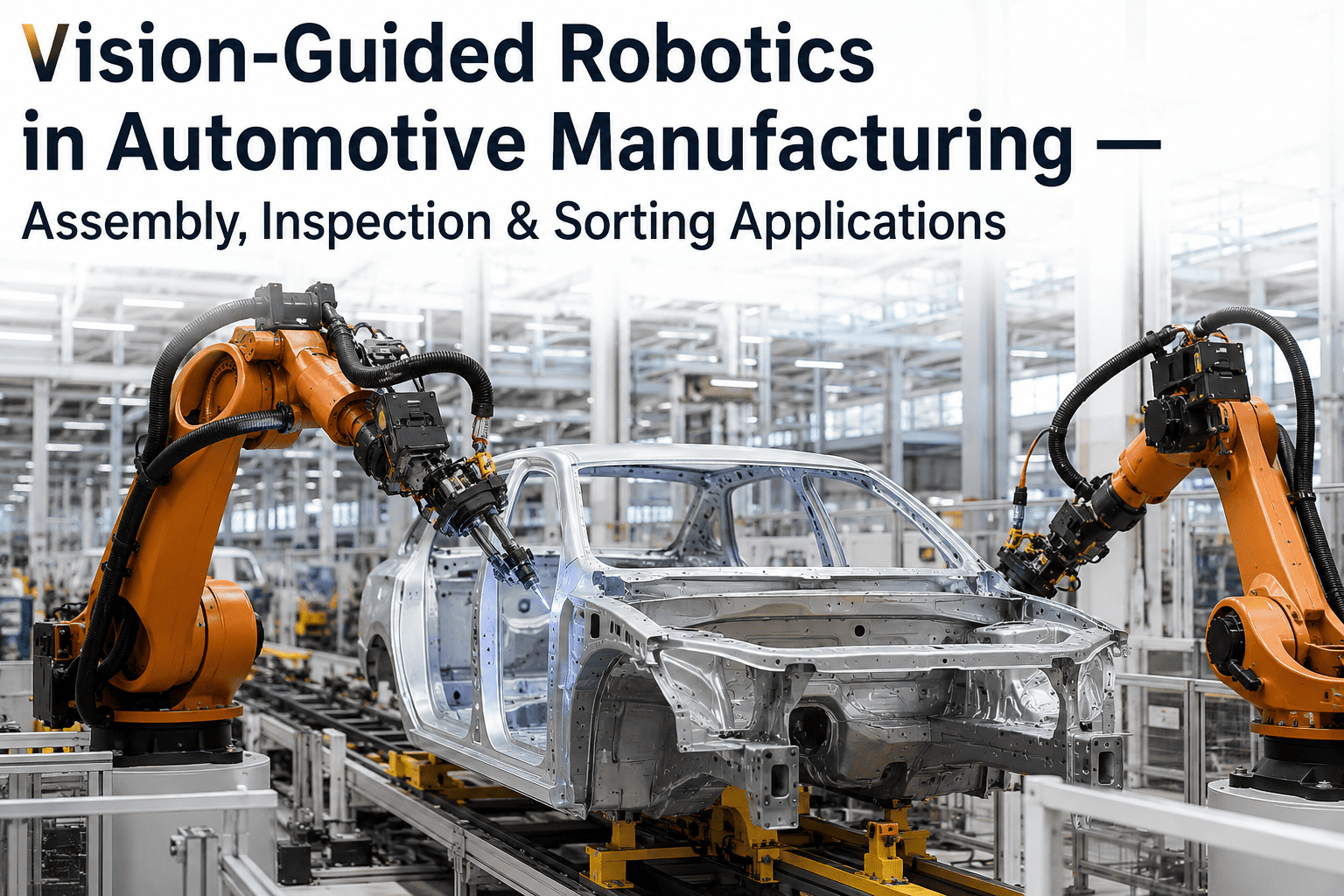
High-speed industrial robots perform thousands of spot welds, laser welds, and adhesive applications per body with sub-millimeter precision. AI-powered weld quality monitoring verifies every joint in real-time, eliminating downstream rework and ensuring structural integrity across every vehicle.
Collaborative Final Assembly
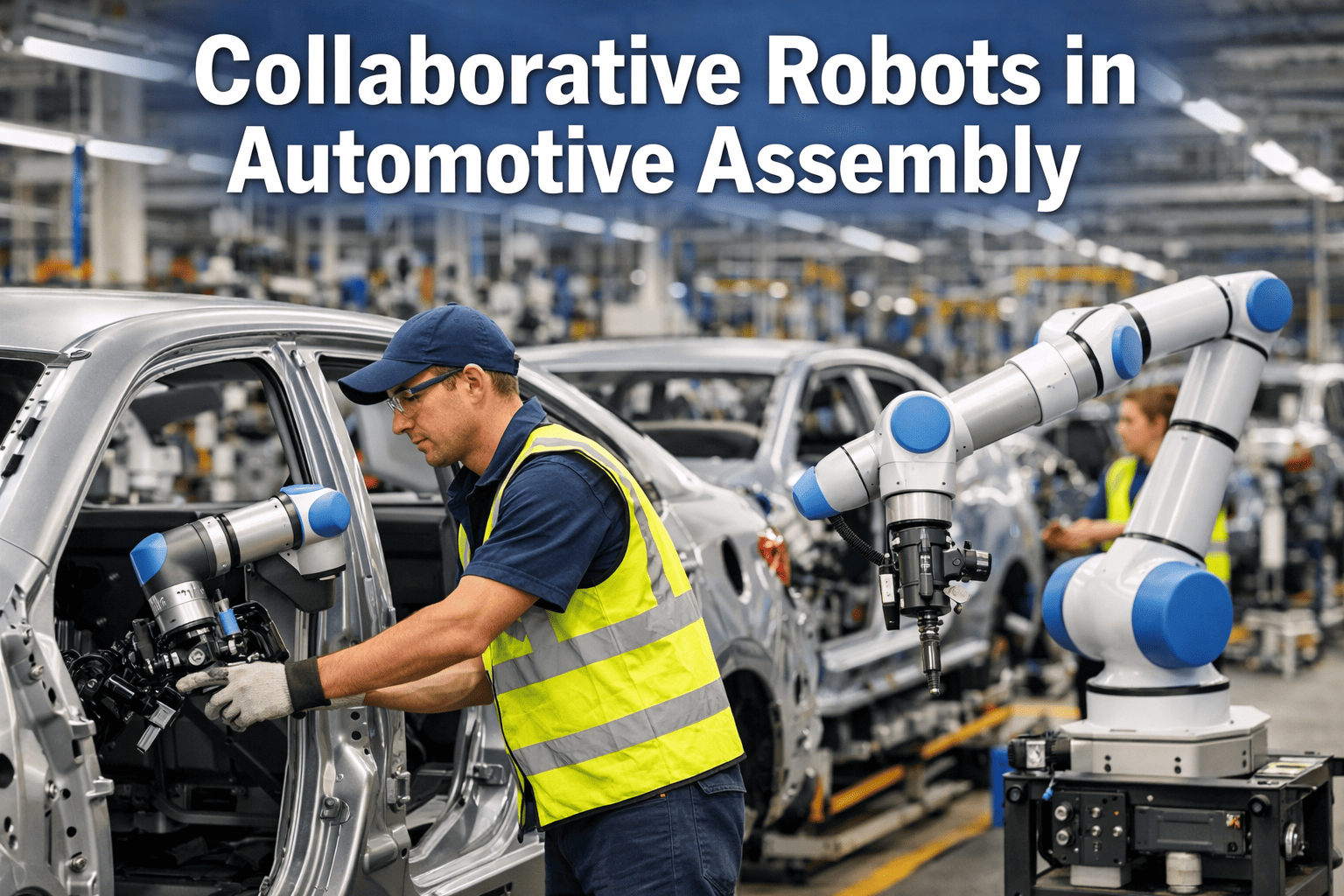
Cobots assist human operators in trim, chassis, and final assembly—handling heavy components (dashboards, seats, doors), driving fasteners to precise torque specs, and performing repetitive sub-assemblies. Force-sensing allows cobots to adapt grip pressure in real-time, preventing component damage on sensitive parts.
AI-Powered Visual Inspection
Vision-equipped robots and cobots inspect painted surfaces, assembled components, and fitment gaps using deep-learning algorithms that detect defects invisible to the human eye. Inline inspection catches quality issues at the station of origin, reducing scrap and preventing defective assemblies from moving downstream.
Automated Material Handling & Logistics
AMRs (Autonomous Mobile Robots) and robotic arms work together to deliver parts from warehouse to line-side in exact sequence and timing. AGV/AMR fleets navigate dynamically around people and obstacles, while cobot arms pick and present parts for operators—eliminating walk time and line-side clutter.
Robotic Paint & Surface Treatment
Multi-axis paint robots apply primer, basecoat, and clearcoat with atomized precision that minimizes overspray and VOC emissions. AI adjusts spray patterns dynamically based on body geometry, ambient humidity, and paint viscosity—delivering Class A finishes with 30% less paint consumption than conventional methods.
Monitor Every Robot & Cobot in Real-Time
iFactory's robotics integration platform connects your industrial robots, cobots, and AMRs into a unified dashboard—with predictive maintenance alerts, cycle time analytics, and automated work orders when performance drifts.
Types of Robots Deployed in Automotive Assembly
Different robot types serve different assembly needs. A well-designed line uses a strategic mix to maximize throughput, flexibility, and safety across all stations.
6-Axis Articulated Robots
Most DeployedThe workhorse of automotive manufacturing. Six degrees of freedom enable complex welding, painting, and material handling across body shop, paint shop, and powertrain lines.
Collaborative Cobots
Fastest GrowingForce-limited robots designed for direct human interaction. Ideal for final assembly assist, screw driving, gluing, inspection, and any task where human judgment and robot consistency combine.
AMRs & AGVs
LogisticsAutonomous Mobile Robots navigate plant floors dynamically using LIDAR and vision, delivering parts line-side in sequence. AGVs follow fixed paths for heavy transport between zones.
SCARA & Delta Robots
High SpeedUltra-fast pick-and-place robots for small component assembly, connector insertion, and packaging. Delta robots achieve 150+ picks per minute for high-speed sorting and kitting operations.
Real Challenges of Robotics Adoption in Automotive Plants
For all the transformative benefits, deploying robotics and cobots at scale introduces genuine engineering, operational, and organizational challenges. Successful plants address these head-on rather than discovering them mid-deployment.
High Upfront Capital Investment
A single industrial robot cell (robot + tooling + integration + safety) costs $150K–$500K+. Full body-shop automation for a new model can exceed $50M. Cobots are cheaper per unit ($25K–$80K), but scaling to hundreds of stations requires significant capital planning, ROI modeling, and phased deployment strategies.
Workforce Skills Gap & Change Resistance
Assembly workers may fear job displacement, while maintenance teams often lack robotics programming and troubleshooting skills. Without proactive training and communication, cobot deployments can stall due to operator resistance, incorrect usage, or maintenance backlogs when robots go down.
Integration Complexity with Legacy Systems
Most automotive plants aren't greenfield—they have decades of existing conveyors, PLCs, SCADA systems, and tooling that weren't designed for modern robotics. Integrating new cobots and robots with legacy infrastructure requires custom middleware, protocol translation, and extensive commissioning time.
Safety Certification & Compliance
Deploying cobots alongside human workers requires rigorous risk assessments per ISO 10218 and ISO/TS 15066, force/pressure limit validation, and ongoing compliance documentation. Every cobot cell needs a documented safety case—and any change to layout, speed, or tooling triggers re-assessment.
Maintenance & Uptime Management
More robots mean more potential failure points. A single robot going down on a synchronized line can halt the entire production flow. Predictive maintenance, spare parts inventory, and fast-response repair capabilities become critical infrastructure—not optional add-ons.
Facing robotics adoption challenges? Schedule a strategy session with our automation integration team to build a risk-mitigated deployment plan.
ROI Breakdown: Robotics & Cobot Investment Returns
Robotics investments are among the highest-returning capital expenditures in automotive manufacturing. Here's what the data shows across plants deploying mixed robot-cobot assembly strategies in 2026.
Robotic stations operate at consistent cycle times with zero fatigue, breaks, or shift changeover delays. AI-optimized scheduling ensures every robot operates at peak utilization across all shifts.
Cobots eliminate the repetitive overhead reaching, heavy lifting, and awkward-posture tasks that cause 65% of automotive assembly injuries. Workers shift to supervisory and exception-handling roles.
Vision-guided robots catch defects at the point of origin. Inline inspection data feeds continuous improvement loops that reduce scrap, rework, and warranty claims simultaneously.
Robotics doesn't eliminate labor—it restructures it. Fewer operators per line with higher skill levels and productivity. One technician supervising 4–6 cobot cells replaces 8–12 manual operators performing repetitive tasks.
Robotics Deployment Roadmap for Automotive Assembly
Successful robotics integration follows a structured, phased approach that proves value before scaling. This roadmap minimizes production risk while building organizational capability at every stage.
Assessment & Station Selection
- Audit all assembly stations for automation potential and ergonomic risk
- Rank stations by ROI, injury frequency, and quality impact
- Select 2–3 pilot stations for initial cobot or robot deployment
- Define safety requirements and integration architecture
Pilot Deployment & Validation
- Install and commission pilot robot/cobot cells
- Train operators on cobot interaction, teaching, and exception handling
- Validate cycle times, quality, and safety against baseline metrics
- Connect robot telemetry to iFactory for real-time health monitoring
Line-Wide Scaling
- Expand robotics to all high-ROI stations identified in Phase 1
- Deploy AMR fleet for automated parts delivery to line-side
- Integrate robot data with OEE dashboards and quality systems
- Establish predictive maintenance baselines for all robotic assets
Plant-Wide Optimization & AI Integration
- Activate AI-powered cycle optimization across all robotic stations
- Enable mixed-model flexibility through vision-guided adaptive programming
- Build digital twin of robotic line for simulation and continuous improvement
- Expand robotics strategy to additional plants across manufacturing network
Ready to plan your robotics deployment? Schedule a roadmap session with our automation integration team.
Expert Perspective
"The most significant shift in automotive robotics isn't the robots themselves—it's the disappearance of the boundary between human and robot workspaces. Cobots have made the safety cage obsolete for an expanding range of assembly tasks, and the plants seeing the greatest returns are the ones treating robots as team members, not replacements. The winners in 2027 won't be the plants with the most robots—they'll be the plants with the best human-robot collaboration models, supported by real-time data platforms that keep every asset performing at its peak."
Conclusion
Robotics and cobots are fundamentally reshaping how automotive assembly lines operate—delivering 40% higher throughput, 60% fewer ergonomic injuries, and mixed-model flexibility that was impossible with traditional automation. From body-in-white welding and collaborative final assembly to AI-powered visual inspection and autonomous material handling, the applications are proven and the ROI is compelling. But success requires more than buying robots: it demands careful station selection, workforce upskilling, legacy system integration, and real-time monitoring that keeps every asset running at peak performance. The plants building this foundation today—combining the right robots with the right data platform—are creating assembly operations that are faster, safer, more flexible, and ready for whatever the next vehicle platform demands.
Schedule your iFactory demo to see robotic fleet monitoring in action, or connect with our automation specialists to discuss your assembly line robotics strategy.
Monitor Every Robot. Optimize Every Cycle.
Join leading automotive manufacturers using iFactory to unify robot health data, automate maintenance workflows, and achieve real-time visibility across every robotic and cobot asset.