Automotive factory automation has a connectivity problem that Wi-Fi cannot solve and public 5G was never designed to address. Thousands of AGVs, robots, vision systems, torque tools, and IoT sensors moving simultaneously across a production floor require connectivity that is deterministic, low-latency, and completely under the plant's control. A single dropped packet at the wrong moment can mean a robot collision, a mis-torqued fastener, or a quality escape that costs more to fix than the network would have cost to build. Private 5G is the infrastructure answer — and when combined with AI, it becomes the nervous system of the intelligent automotive factory. Mercedes-Benz deployed it at Factory 56 in Sindelfingen. BMW built their Debrecen facility around it. Ford activated it at the historic Rouge complex. The private 5G + AI era in automotive manufacturing has definitively arrived. Book a demo to see how iFactory's AI platform runs on private 5G infrastructure in automotive plants.
IoT & Industry 4.0
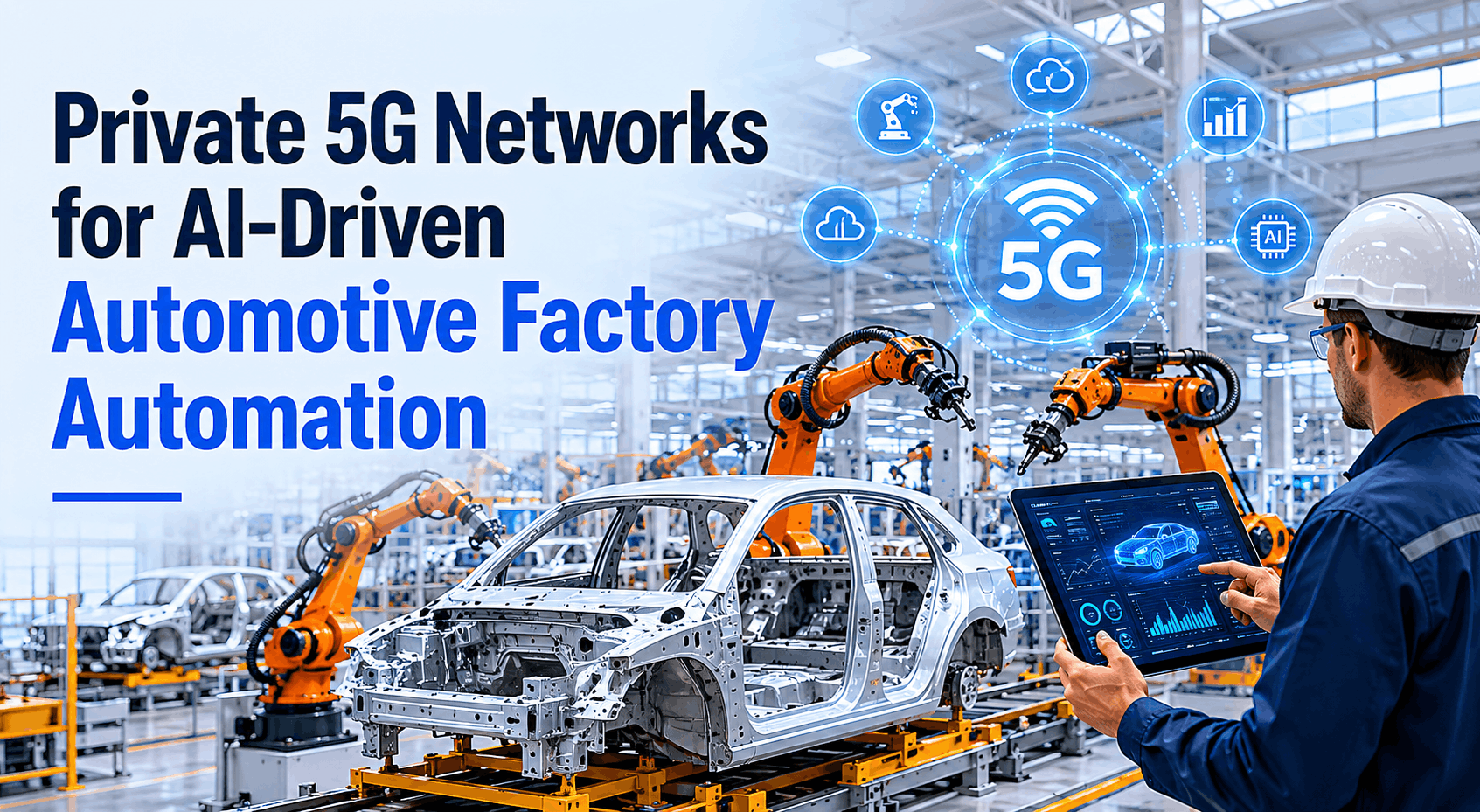
Private 5G Networks for AI-Driven Automotive Factory Automation
Deterministic connectivity for robots, AGVs, and AI inference — purpose-built for the automotive shop floor where latency is measured in milliseconds and failure is measured in millions.
<10ms
ultra-reliable low-latency 5G — vs. 50–100ms for standard Wi-Fi in production environments
99.999%
availability target for private 5G URLLC — required for safety-critical robot coordination
BMW · Ford · Mercedes
confirmed private 5G production deployments — automotive leads all industries in private 5G adoption
Why Public Wi-Fi and Public 5G Cannot Meet Automotive Factory Demands
The problem with connectivity in an automotive plant is not bandwidth — it is determinism. Wi-Fi and public 5G can move large amounts of data, but they cannot guarantee that data will arrive within a precise time window every single time. In an environment where a welding robot needs a collision-avoidance signal in under 5 milliseconds, "usually fast enough" is not an acceptable specification.
Latency
50–100ms (variable)
20–50ms (variable)
<10ms (deterministic)
Reliability
99.9% — drops under load
99.9% — shared spectrum
99.999% URLLC
Mobility Support
Handoff gaps for AGVs
Better but unpredictable
Seamless across plant floor
Data Security
Shared infrastructure risk
Data leaves plant boundary
Fully isolated — plant-owned
Interference Risk
High — metallic plant bodies
Moderate
Managed — licensed spectrum
AI Inference Latency
Cloud round-trip 50–200ms
Cloud round-trip 20–100ms
Edge inference <5ms
Who Is Already Deployed: Automotive Private 5G in Production
Mercedes-Benz — Factory 56, Sindelfingen
Telefónica + Ericsson
The world's most advanced passenger car production facility uses private 5G for precise component and vehicle tracking during production, coordination of automated guided vehicles and robotic systems, and predictive maintenance across the entire line. Zero-latency communication between robotics, human operators, and supply chain logistics platforms — impossible on public infrastructure.
AGV coordinationComponent trackingPredictive maintenanceRobot safety systems
BMW — Debrecen Plant, Hungary
Private 5G + AI Integration
BMW's newest factory was designed with private 5G as a foundational infrastructure layer — not retrofitted. AI-driven production synchronisation, real-time OEE monitoring, and robot coordination all run over the dedicated network. The Debrecen factory demonstrates 5G as the foundation of industrial intelligence, not just a communication standard.
Foundation-layer designAI synchronisationReal-time OEE
Ford — Rouge Complex, Michigan
AT&T 5G Industrial IoT
Ford's historic Rouge complex implemented 5G-enabled industrial IoT that provides production line workers with real-time visibility of operations — immediate access to equipment data and inventory status across hundreds of machines and sensors. Reduced latency enables fast decision-making and automation at a scale impossible with previous connectivity.
Production visibilityEquipment monitoringWorker enablement
The Private 5G + AI Architecture for Automotive Plants
Private 5G's value in automotive manufacturing is not the network alone — it is the combination of the network's deterministic connectivity with AI inference running at the edge, eliminating the cloud round-trip that introduces latency and data sovereignty risk. Talk to an iFactory expert about deploying AI on your plant's 5G infrastructure.
CONNECTED ENDPOINTS — Everything on the 5G Network
Mobile Automation
AGVs & AMRs
Mobile robots
Humanoid robots
Tow trains
Fixed Machines
CNC machining centres
Welding robots
Press lines
Assembly stations
Quality & Vision
AI vision cameras
Gap-flush scanners
Torque tools
CMM systems
Worker & Safety
Worker wearables
Safety zone sensors
AR/MR headsets
Mobile operator devices
PRIVATE 5G NETWORK
Sub-10ms latency
99.999% reliability
Licensed spectrum
Plant-isolated
URLLC + eMBB slicing
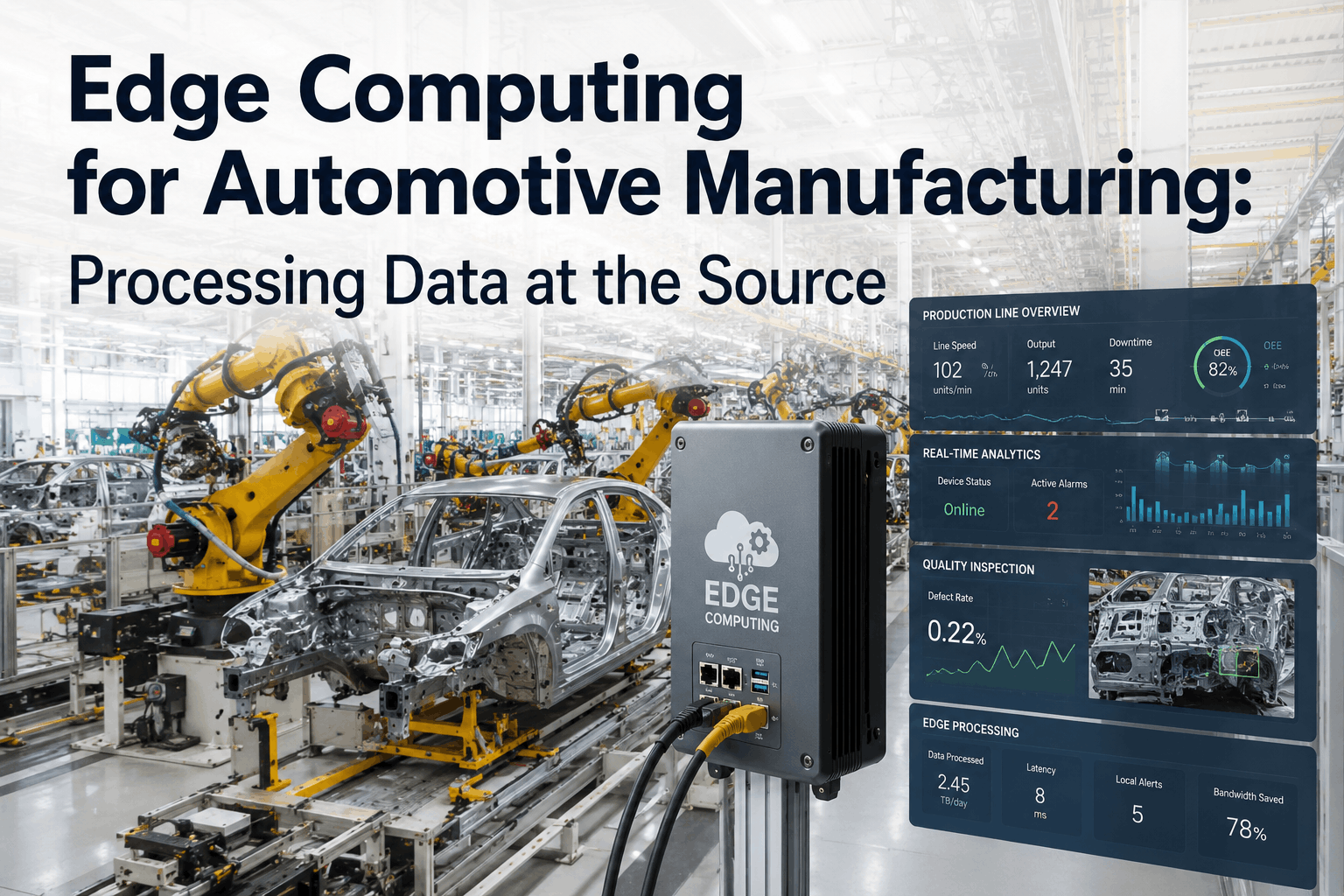
Edge AI (On-Premise)
AI inference runs locally — predictive maintenance, OEE, quality inspection, robot scheduling — under 5ms latency. Production data never leaves the plant.
iFactory On-Premise
or
Cloud AI (Managed)
5G data streams to secure cloud AI — multi-plant visibility, central model training, rapid deployment. Latency >10ms acceptable for non-time-critical analytics.
iFactory Cloud
ENTERPRISE INTEGRATION — MES · SAP · CMMS · Digital Twin
Five AI Use Cases Private 5G Unlocks in Automotive
01
Wireless AGV & AMR Fleet Coordination
Sub-5ms collision avoidance
Automotive plants running 100+ AGVs simultaneously cannot afford the connectivity gaps that occur when vehicles hand off between Wi-Fi access points. Private 5G provides seamless, deterministic connectivity across the entire floor. AI fleet management optimises routing in real time — rerouting vehicles around assembly stoppages, material shortfalls, and human worker zones without operator intervention. A dropped packet on a 5G safety signal stops a vehicle. On Wi-Fi, it can cause a collision.
Result: Zero-gap connectivity across full plant floor at any vehicle density
02
Real-Time AI Quality Inspection at Line Speed
Wireless vision systems · Zero-cable deployment
Traditional AI vision inspection requires cable runs to every camera — expensive, inflexible, and incompatible with reconfigurable production lines. Private 5G enables wireless AI vision cameras to be deployed, repositioned, and scaled without cabling. Images stream from high-resolution cameras to edge AI nodes over 5G in milliseconds — AI classification results are returned before the part reaches the next station. Gap-and-flush scanning, solder inspection, component presence verification, and surface defect detection all become wireless, flexible, and instantly relocatable.
Result: Wireless vision deployment in hours — no cable infrastructure, zero production disruption
03
Wireless Smart Torque Tools with AI Validation
Real-time torque traceability · Error-proof assembly
Torque-critical fastener applications — engine mounts, suspension components, brake callipers — require every torque result to be recorded against the vehicle serial number in the MES. Wired torque tools constrain operator movement and create cable management hazards. Private 5G-connected smart torque tools transmit results in real time to the AI quality system and MES — with AI validating torque sequence, angle, and value against the vehicle-specific requirement before the operator moves to the next fastener. Any deviation triggers an immediate alert, not an end-of-line discovery.
Result: 100% wireless torque traceability — freedom of movement, zero cable hazard
04
Predictive Maintenance on Mobile & Fixed Assets
Continuous sensor streaming · AI failure prediction
Private 5G enables continuous streaming from hundreds of vibration, temperature, and current sensors simultaneously — bandwidth that Wi-Fi cannot reliably sustain at the data rates required for AI maintenance models. Edge AI analyses these streams in real time, detecting the deviation signatures that precede bearing failure, servo degradation, and hydraulic pressure loss — typically 12–48 hours before breakdown. On mobile assets like AGVs and humanoid robots, 5G ensures sensor data streams continuously regardless of position in the plant.
Result: Continuous sensor streaming from all assets — no Wi-Fi dead zones, no handoff gaps
05
AR-Assisted Operator Guidance & Remote Expert Access
Augmented reality · Live expert streams
AR headsets worn by assembly operators and maintenance technicians require constant, low-latency video streaming to render overlay instructions accurately on moving components. Private 5G's bandwidth and <10ms latency makes AR-assisted assembly — where step-by-step instructions are overlaid on the actual part — operationally viable at production scale. The same infrastructure enables remote expert access, where a specialist in another country sees a live 4K video feed from a technician's headset and provides real-time guidance on a complex maintenance procedure.
Result: AR-assisted assembly and remote expert support — viable at production scale for the first time
Ready to map these use cases to your plant's specific automation roadmap? Book a demo and iFactory's team will model the deployment for your infrastructure.
iFactory: On-Premise or Cloud — Both Run on Private 5G
On-Premise Deployment
For OEMs with data sovereignty & ultra-low latency requirements
AI inference edge server co-located with your private 5G core
Production data never leaves your plant boundary
Sub-5ms AI response for safety-critical robot and AGV applications
Supports IATF 16949, OT cybersecurity, and air-gap requirements
Works with any 5G vendor — Ericsson, Nokia, Huawei, AWS Private 5G
Discuss On-Premise Setup
Cloud Deployment
For Tier 1/2 suppliers and multi-plant visibility
5G data streams securely to iFactory's cloud AI platform
Multi-plant OEE, quality, and maintenance dashboards in one view
Rapid onboarding — no on-premise server investment required
Central AI model training across your full plant network
Hyperscaler options — AWS Private 5G, Azure Edge Zones compatible
Discuss Cloud Setup
KPI Impact: Private 5G + AI vs. Legacy Connectivity
Network Latency (Machine to AI)
Vision Inspection Deployment Time (New Station)
Wired camera infrastructure
AGV Fleet Network Reliability
Wi-Fi with handoffs
99.9% — handoff gaps cause stops
OEE Gain from Connectivity-Enabled AI
Legacy connectivity — partial AI
Private 5G + full AI platform
Sources: Mercedes-Benz Factory 56 Deployment (2025) · BMW Debrecen Factory Intelligence Report · Ford Rouge AT&T 5G Case Study · iFactory Plant Connectivity Data 2026
FAQ: Private 5G + AI in Automotive Manufacturing
iFactory Features for Private 5G-Connected Automotive Plants
01
5G-Native Data Ingestion
Connects to all 5G-enabled endpoints — AGVs, wireless torque tools, mobile vision cameras, wearables, and sensor nodes — via 5G transport and standard industrial protocols.
02
Edge AI Inference (<5ms)
On-premise AI server co-located with 5G MEC node — predictive maintenance, quality inspection, robot scheduling, and OEE calculation all run locally without cloud latency.
03
AGV & Robot Fleet AI
AI fleet coordination running over 5G — real-time path optimisation, collision avoidance, task assignment, and robot health monitoring across all mobile assets simultaneously.
04
Wireless Quality Intelligence
5G-connected AI vision cameras and scanning heads — deployable anywhere, repositionable without cable infrastructure, delivering quality inspection results in under 100ms.
05
Real-Time OEE & MES Integration
5G machine state data feeds AI-driven OEE calculation and MES production records in real time — eliminating manual data entry and connecting shop floor performance to enterprise systems.
06
Digital Twin Live Feed
5G sensor streams continuously update the plant digital twin — every robot position, every machine state, every quality result — keeping the virtual model synchronised with the physical plant in real time.
On-Premise & Cloud Available
Connect Your Private 5G to iFactory AI
iFactory's AI platform runs natively on private 5G infrastructure — on-premise edge deployment for sub-5ms latency, or cloud for multi-plant visibility. See it demonstrated on automotive use cases.
5G-Native AI
Edge Inference <5ms
AGV Fleet AI
Wireless Vision
On-Premise Deployment
Cloud Deployment