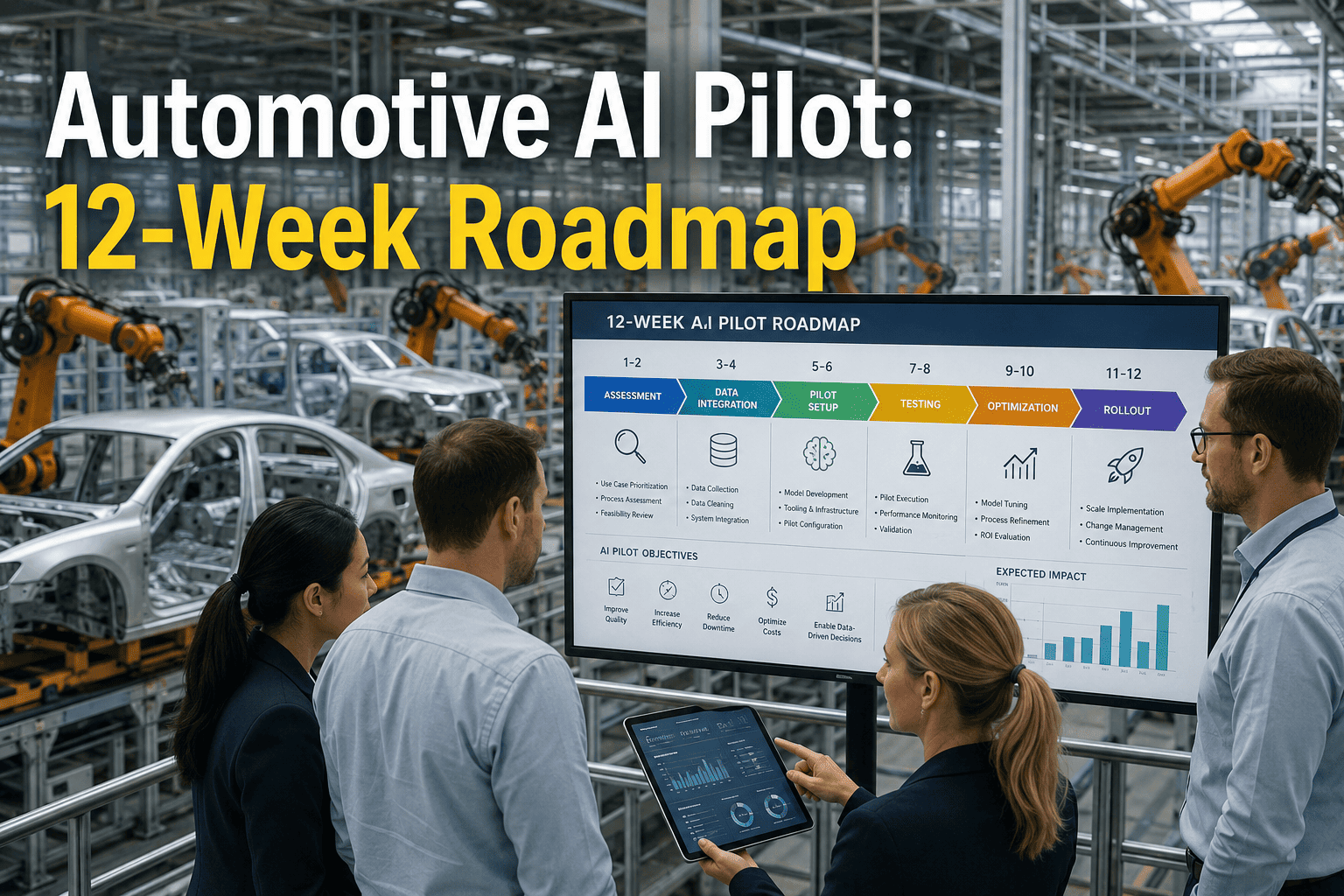
Launching an AI pilot in automotive manufacturing is a high-stakes endeavor where the line between proof-of-concept success and full-scale failure is razor thin. Plant managers and project leads often find themselves trapped in the demo zone—impressive dashboards that never translate to shop-floor impact. This 12-week roadmap is engineered to break that cycle, delivering measurable KPIs that compel executive funding for enterprise-wide rollout. From defining scope with precision to de-risking integration with legacy MES systems, each phase is grounded in real-world automotive deployments. Whether you are targeting predictive maintenance for robotic weld lines or quality anomaly detection in paint shops, this framework ensures your pilot becomes a scalable success story. Book a Demo to align your pilot strategy with industry 4.0 best practices.
Ready to Launch Your Automotive AI Pilot?
Accelerate your 12-week roadmap with expert guidance. Start your proof-of-concept today.
Why Automotive AI Pilots Fail and How to Succeed
According to industry reports, over 70% of AI pilots in automotive never reach production. Common pitfalls include unclear success criteria, scope creep, and lack of integration with existing IT/OT systems. This roadmap addresses each failure point head-on. By focusing on a 12-week sprint with defined gates, you build momentum and evidence for scaling. The key is to treat the pilot not as a technology test but as a business case validation. Every week must deliver a tangible outcome—whether it is a data quality report, a model accuracy threshold, or a workflow integration demo. This approach ensures that by week 12, you have a compelling narrative for CFOs and plant directors alike.
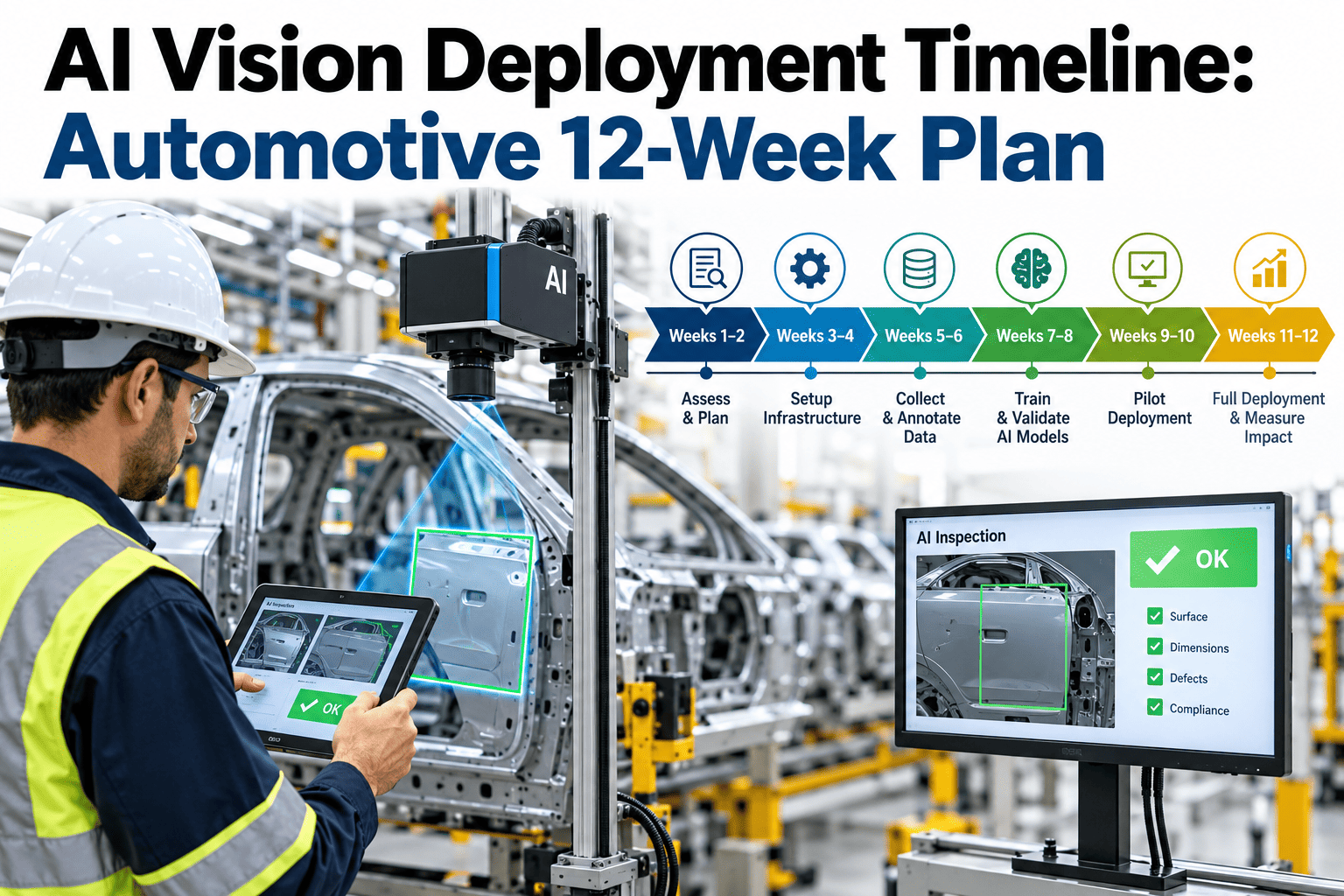
12-Week Pilot Timeline: From Scope to Scale
Scope & Data Audit
Define pilot boundaries, select a high-impact use case (e.g., predictive maintenance for welding robots), and audit available sensor data. Identify data quality gaps and establish baseline KPIs.
Model Development & Training
Build initial AI models using historical data. Focus on accuracy, false positive rates, and explainability. Iterate with domain experts to refine feature engineering.
Integration & Edge Deployment
Deploy models on edge devices or within existing MES architecture. Ensure real-time data ingestion and low-latency inference. Validate integration with PLCs and SCADA.
User Acceptance Testing
Engage plant floor operators and maintenance teams. Gather feedback on UI/UX, alerting thresholds, and workflow integration. Fine-tune model based on real-world conditions.
Performance Benchmarking
Run controlled A/B tests comparing AI-driven decisions vs. traditional methods. Measure metrics like downtime reduction, maintenance cost savings, and quality yield improvement.
Scale Case & Executive Presentation
Compile results into a business case with ROI projections. Present to leadership with clear recommendations for full-scale deployment across lines and plants.
Deep Dive: De-risking Integration with Legacy Systems
One of the biggest hurdles in automotive AI pilots is connecting to legacy MES and SCADA systems. Many plants run on proprietary protocols or outdated databases. The solution is to use a middleware layer that abstracts data ingestion and provides a unified API for AI models. This approach decouples the pilot from core production systems, reducing risk and enabling faster iteration. For example, a Tier 1 supplier used this strategy to integrate predictive maintenance with Siemens MES, achieving 95% data availability within two weeks. The key is to start with a read-only data flow and gradually introduce write-back commands only after validation. This phased integration ensures that the pilot does not disrupt ongoing production schedules.
Transform Your Pilot into a Production Reality
Our experts help you navigate integration challenges and build a scalable AI roadmap. Let's discuss your use case.
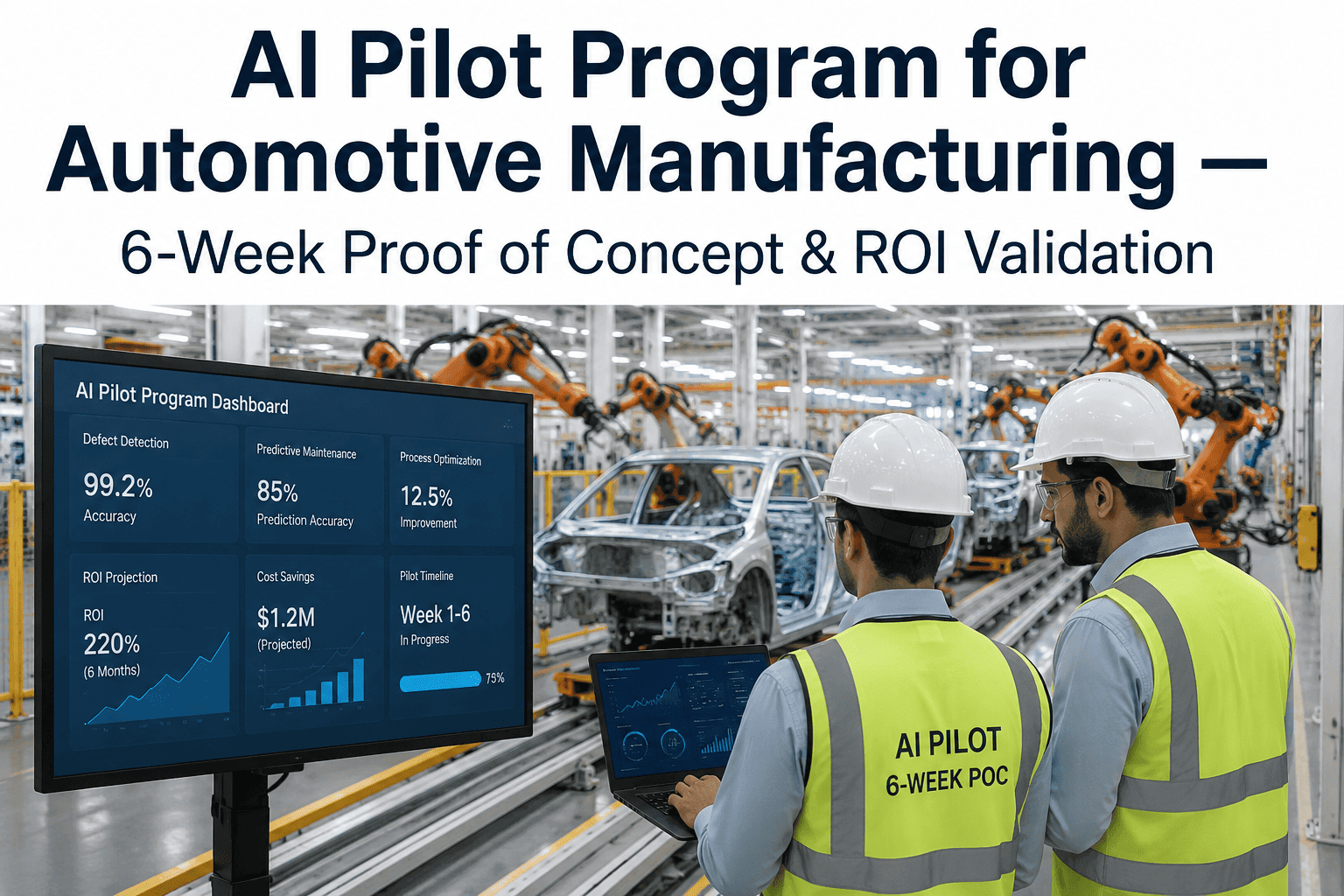
Pilot Success Criteria: What to Measure
Model Accuracy
Target at least 90% precision and recall for predictive maintenance alerts. Track false positive rates to avoid alert fatigue.
Integration Latency
Ensure end-to-end data-to-insight latency under 500ms for real-time use cases. Measure API response times and data throughput.
User Adoption
Monitor daily active users among operators and maintenance teams. Aim for >80% engagement within the first month.
Business Impact
Quantify reduction in unplanned downtime (target >20%), maintenance cost savings, and quality yield improvement.
Comparison: Structured Pilot vs. Ad-Hoc Pilot
| Criteria | Structured 12-Week Pilot | Ad-Hoc Pilot |
|---|---|---|
| Success Rate to Scale | 85% | 30% |
| Average Duration | 12 weeks | 6-9 months |
| Executive Buy-In | High (quantified ROI) | Low (vague promises) |
| Integration Risk | Managed (phased) | High (big bang) |
| Cost Overrun | Minimal (fixed scope) | Frequent (scope creep) |
12-Week Pilot Checklist: Daily Actions
Define pilot scope and select a high-impact use case
Conduct data audit and establish baseline KPIs
Build and train initial AI models with historical data
Deploy models on edge devices or middleware
Conduct user acceptance testing with plant floor teams
Run A/B tests and benchmark performance
Compile results into a business case with ROI
Present to leadership for scale approval
Frequently Asked Questions
What is the ideal scope for an automotive AI pilot?
The ideal scope focuses on a single, high-impact use case with clear ROI potential, such as predictive maintenance for a specific robotic weld line or quality anomaly detection in a paint booth. The scope should be narrow enough to deliver results within 12 weeks but broad enough to demonstrate value. For example, limiting the pilot to a single production line with 10-20 assets ensures manageable data volume and integration complexity. This focused approach allows the team to iterate quickly and build a compelling case for scaling. Book a Demo to define your pilot scope with our experts.
How do you ensure data quality for AI models in automotive plants?
Data quality is ensured through a multi-step audit process that includes sensor calibration verification, timestamp alignment across systems, and handling missing values. For automotive plants, common issues include inconsistent sampling rates from PLCs and noisy vibration data from aging equipment. The solution is to implement a data validation pipeline that flags anomalies and imputes missing values using domain-specific heuristics. Additionally, involving plant floor technicians in the audit helps identify data collection gaps that might not be obvious from a purely technical perspective. Get Support for data quality best practices.
What are the key KPIs to track during an AI pilot?
Key KPIs include model accuracy metrics (precision, recall, F1-score), integration latency (data-to-insight time), user adoption rate (daily active users), and business impact metrics (downtime reduction, maintenance cost savings, quality yield improvement). Additionally, track the number of false positives and false negatives to optimize alerting thresholds. For automotive pilots, it is also important to measure the time saved by operators in diagnosing issues. These KPIs should be tracked weekly and presented in a dashboard for executive visibility. Book a Demo to see how we track pilot KPIs.
How do you handle integration with legacy MES systems?
Integration with legacy MES systems is handled through a middleware layer that abstracts data ingestion and provides a unified API. This middleware supports common automotive protocols like OPC-UA, Modbus, and proprietary Siemens or Rockwell interfaces. The integration is done in phases: first, read-only data flow for model training, then gradual introduction of write-back commands for alerts and recommendations. This phased approach minimizes risk and allows for rollback if issues arise. Get Support for integration architecture guidance.
What is the typical budget for a 12-week automotive AI pilot?
The budget for a 12-week automotive AI pilot typically ranges from $50,000 to $150,000, depending on the use case complexity, number of assets, and integration requirements. This includes costs for data engineering, model development, edge hardware (if needed), and project management. A well-scoped pilot can deliver a clear ROI that justifies the investment. For example, a predictive maintenance pilot on a single production line can save $200,000 annually in reduced downtime and maintenance costs. Book a Demo to get a customized budget estimate for your pilot.
Scale Your AI Pilot with Confidence
Our proven 12-week framework de-risks your AI investment and delivers measurable results. Let's build your success story together.