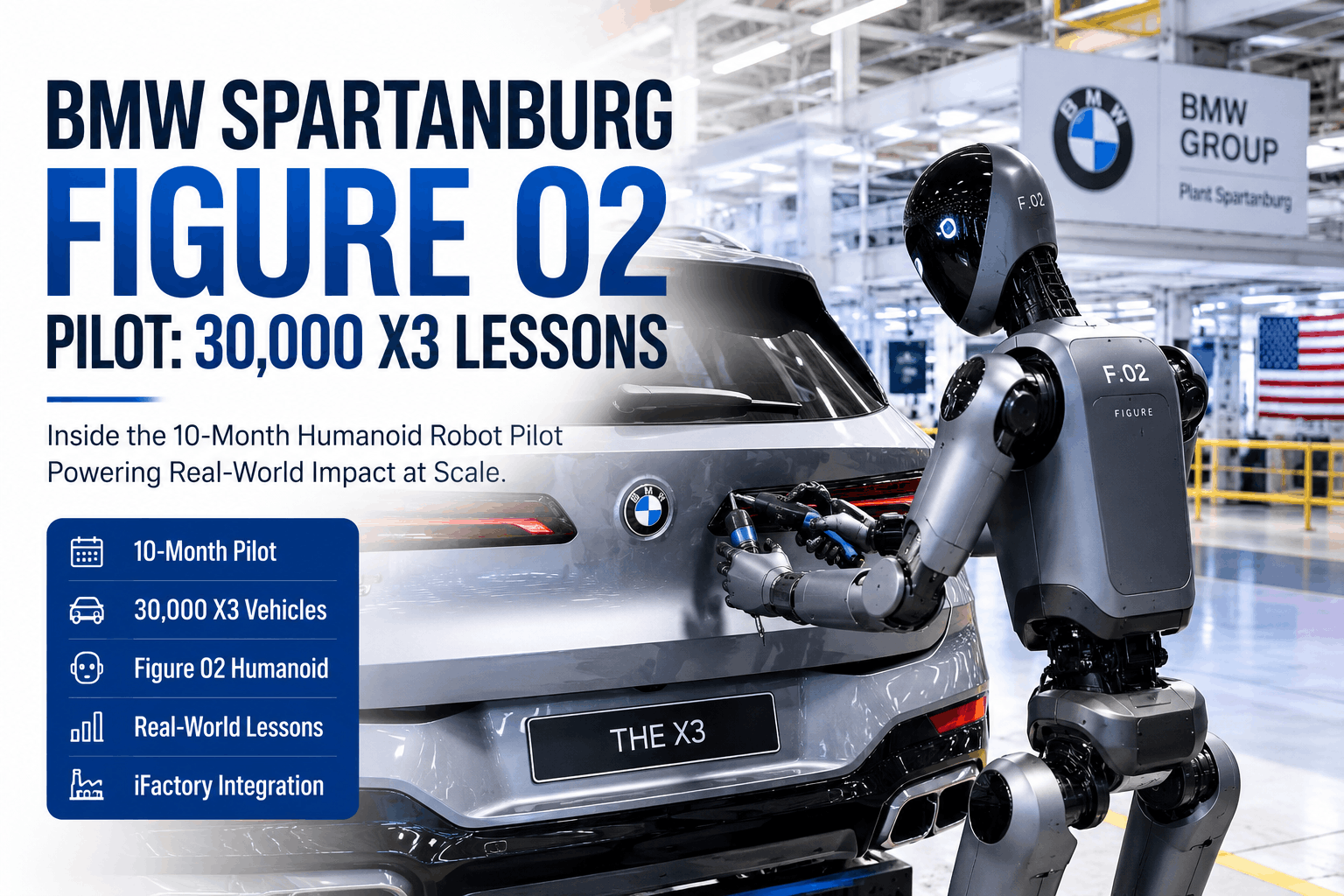
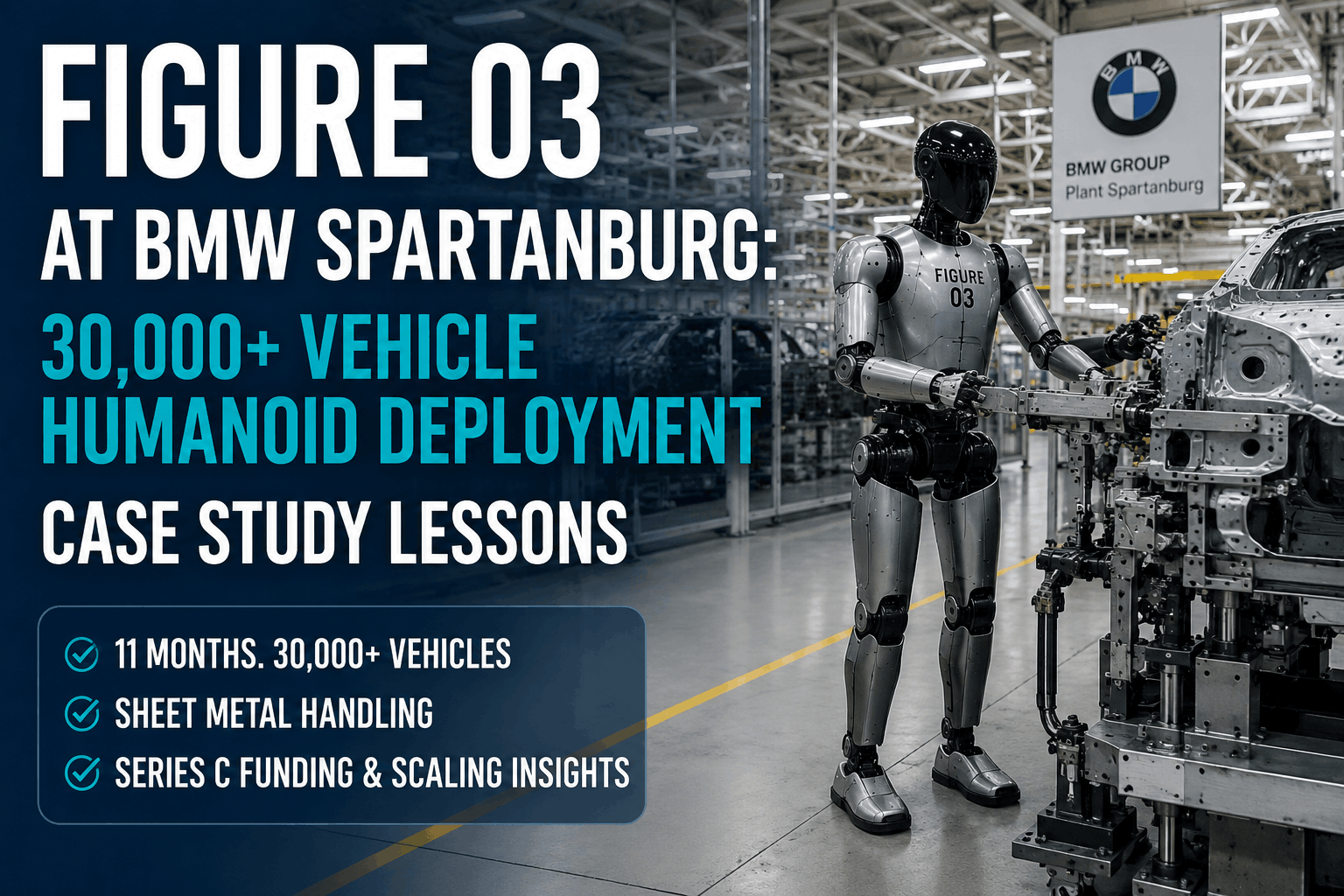
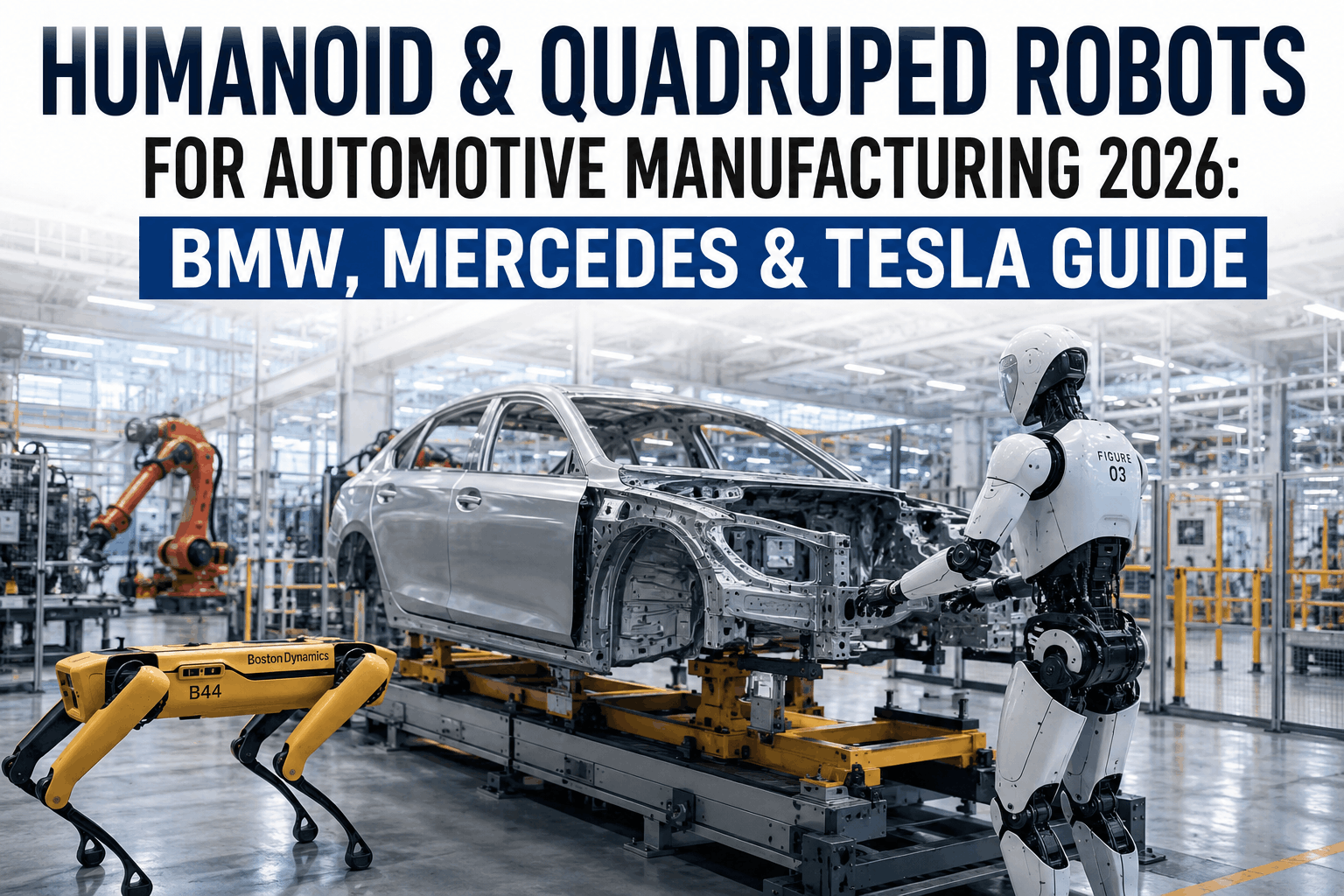
The BMW Spartanburg Figure 02 pilot is not a press release story. It is the most rigorously documented humanoid manufacturing deployment in history — 10 months of live production, 30,000 vehicles assembled with humanoid assistance, and a body of operational lessons that every automotive manufacturer planning a humanoid programme needs to study before writing a single procurement specification. This briefing covers what actually happened at Spartanburg: the KPIs, the failure modes, the integration decisions, and the integration architecture that turned a robot into a production asset rather than a showpiece. Book a demo to see how iFactory replicates the Spartanburg integration playbook for your plant.
Case Study — BMW Spartanburg × Figure AI
BMW Spartanburg Figure 02 Pilot: 30,000 X3 Lessons That Will Define Automotive Humanoid Deployment Through 2028
10 months · 30,000+ vehicles · 98.7% task success · Sheet metal body shop · MES-integrated · Figure 03 transition mid-deployment — the complete operational briefing.
30,000+
Vehicles assembled with humanoid assistance
10 mo
Contract signing to production milestone
98.7%
Sheet metal task success rate (Figure 03)
$2.6B
Figure AI valuation unlocked by deployment proof
The Context: Why Spartanburg Was the Right Plant for This Pilot
BMW Manufacturing Co. at Spartanburg, South Carolina is not a peripheral facility selected for low-risk experimentation. It is BMW's largest manufacturing plant globally — producing over 400,000 vehicles per year across six models (X3, X4, X5, X6, X7, XM) on a single production campus. The decision to deploy humanoid robots here was a deliberate signal: if this technology can work at Spartanburg, it can work anywhere in BMW's network.
The specific zone selected — sheet metal handling in the body shop — was equally strategic. Sheet metal panel loading is ergonomically punishing (heavy, repetitive, precise positioning required), difficult to staff consistently, and structurally repeatable enough for first-generation humanoid capability. It was the right task, at the right plant, for the right reasons. Talk to iFactory about body shop humanoid integration for your facility.
Plant
BMW Manufacturing Co., Spartanburg, SC — BMW's largest global facility
Annual Volume
400,000+ vehicles/year across 6 models
Pilot Zone
Body shop — sheet metal panel handling and loading
Robot Platform
Figure 02 (initial) → Figure 03 (production scale)
Programme Duration
November 2023 (contract) → October 2024 (30K milestone)
Vehicles Produced
X3 · X4 · X5 · X6 · X7 · XM — all models, body shop is shared
Month-by-Month: What Actually Happened in 10 Months
November 2023
Agreement Signed — Zero Robots at Spartanburg
BMW Manufacturing and Figure AI sign a commercial agreement — the first of its kind between a Tier-1 OEM and a general-purpose humanoid robotics company for live production deployment. No robots are at Spartanburg yet. The clock starts.
Milestone: Contract signed — 0 robots deployed
December 2023 – January 2024
Task Scoping and Safety Commissioning
Figure 02 robots undergo task-specific training for sheet metal panel loading at BMW's actual body shop workstations — not a simulation environment. Safety zones are commissioned per ISO/TS 15066 collaborative robot standards. MES integration is designed: work order receipt, vehicle build sequence, station assignment.
Milestone: Task programme validated on physical workstation
February – March 2024
MES Integration and $675M Series C
iFactory-style production integration connects Figure 02 to BMW's MES — robots receive live work orders and build sequences, quality check results write back to quality records per vehicle. In March 2024, Figure AI closes a $675M Series C at a $2.6B valuation — with the BMW deployment in commissioning as the primary proof of commercial viability cited in the raise. Investors: Microsoft, OpenAI, Nvidia, Amazon, Intel Capital, Jeff Bezos.
Milestone: MES live integration · $675M raised at $2.6B valuation
Q2 2024
Live Production Begins — First Humanoid on Active Automotive Line
Figure 02 robots go live on BMW Spartanburg's body shop production line — handling sheet metal panels at production cadence on an active schedule producing real vehicles. This is not a demonstration cell or a shadow operation. The robot is on the line, on the clock, with production accountability. This is the moment that defines the before/after in automotive humanoid history.
Milestone: First humanoid on live automotive production line globally
Q3 2024
Figure 03 Transition — Mid-Deployment Hardware Upgrade
Figure AI releases Figure 03 — 16-DOF hands (up from 12), 20kg payload (up from 16kg), improved neural network, 25% faster walking speed. BMW begins transitioning the Spartanburg deployment from Figure 02 to Figure 03 mid-programme. This is a significant operational decision: upgrading hardware on a live production deployment is complex, but Figure 03's improved success rate justifies the transition risk. Task success rate improves from ~94% to 98.7%.
Milestone: Figure 03 replaces 02 — success rate improves to 98.7%
October 2024
30,000 Vehicles — The Milestone That Changes Everything
BMW and Figure AI announce that humanoid robots have contributed to the assembly of 30,000+ vehicles at Spartanburg. No other humanoid deployment had reached this figure. The milestone validates not just task capability but operational durability: robots maintained performance across model changeovers, variant sequencing, shift transitions, and production ramp events over 10 months of continuous operation.
Milestone: 30,000+ vehicles · 10 months · Industry benchmark set
KPI Scorecard: What the Pilot Actually Measured
Task Performance
98.7%
Sheet metal task success rate (Figure 03)
~94%
Initial Figure 02 success rate
60–90s
Task cycle time at production cadence
Scale & Durability
30,000+
Vehicles with humanoid contribution
10 mo
Continuous production operation
6 models
Vehicle platforms handled in shared body shop
Programme Speed
11 wks
Contract to first live production tasks
4 wks
Figure 02 → Figure 03 transition on live deployment
1 task
Initial scope — narrow and measurable
The 8 Operational Lessons BMW Spartanburg Taught the Industry
01
Narrow Task Scope Is the Deployment Strategy, Not the Limitation
Figure 02 was deployed on one task — sheet metal loading. Every other automotive team that heard "one task" in 2023 thought it sounded underwhelming. By 2024, 30,000 vehicles later, they understood: a single well-scoped task at production scale proves more than a dozen poorly scoped tasks in a demonstration cell.
Book a demo to define your pilot task scope with iFactory's methodology.
02
MES Integration Is Not Optional — It Is the Deployment
A humanoid robot operating without live work order data, vehicle build sequence, and quality record write-back is not a production asset — it is a sophisticated forklift. The MES integration layer is where the production value lives. BMW's integration of Figure 02 with its MES was treated as a core deployment requirement from day one, not an afterthought.
03
98.7% Is Not 100% — Plan for the 1.3%
At production cadence (one cycle per 60–90 seconds), 98.7% success means approximately one failure every 77 cycles. BMW's deployment included explicit human intervention protocols for these events — defined escalation, defined recovery, defined cycle restart. Planning for failure mode management is as important as optimising for success rate.
Contact iFactory to design failure mode protocols for your deployment.
04
Mid-Deployment Hardware Transition Is Operationally Viable
Transitioning from Figure 02 to Figure 03 on a live production deployment seemed risky. BMW did it anyway — and the improvement in success rate justified it. The lesson: humanoid deployment contracts should build in hardware upgrade provisions from the start, because the robot you deploy today will not be the robot you want in 12 months.
05
Volume Milestones Trump Demo Videos — Always
The 30,000-vehicle milestone meant more than any demo video. It proved operational durability across model changeovers, variant sequencing, shift transitions, and real production pressure. The automotive industry is right to demand operational volume milestones rather than accepting laboratory demonstrations as proof of commercial viability.
06
The Deployment Creates Data That the Robot Company Owns
Every Figure 02 and 03 cycle at Spartanburg generated training data that improved Figure AI's models — and that advantage compounds as BMW's deployment scales. Automotive manufacturers considering humanoid partnerships should think carefully about data ownership and exclusivity terms in deployment agreements.
Book a demo to discuss data governance in humanoid integration architecture.
07
Ergonomic Tasks at the Highest-Volume Plant — Not the Lowest-Risk Plant
BMW chose Spartanburg — its highest-volume global plant — for the pilot, not a smaller facility where mistakes would have lower consequence. This decision sent a clear signal to Figure AI about the seriousness of the programme, and it produced data at scale that a low-volume pilot could not have generated in the same timeframe.
08
The Integration Layer Is the Competitive Moat
BMW's deep MES integration — work order receipt, quality record per vehicle, andon integration, maintenance data routing — means the data generated at Spartanburg is production data, not robot data. This integration depth is what makes Spartanburg's 30,000-vehicle milestone so valuable as a benchmark.
iFactory provides this integration layer as both on-premise edge deployment and cloud analytics — the same architecture BMW required at Spartanburg.
The iFactory Integration Playbook: Replicating Spartanburg at Your Plant
The technical architecture that made the Spartanburg deployment operationally successful — MES live integration, quality record per vehicle, andon signal routing, maintenance alert generation — is exactly what iFactory delivers as a standard programme. Both on-premise edge deployment and cloud-connected analytics are available, designed to meet the data sovereignty and infrastructure requirements of any automotive manufacturing environment.
On-Premise Deployment
For Plants Requiring Data Sovereignty
iFactory edge nodes installed within the plant process all humanoid robot task data locally. Quality records, work order data, and production events stay on-site. Sub-5ms inference for real-time production decisions. No cloud dependency — production intelligence continues even during WAN outages. Designed for OEMs with multi-supplier IP agreements and data governance requirements like BMW's.
MES live work order integration on-site
Quality record per vehicle — written locally
Andon system integration — sub-millisecond
CMMS maintenance alert generation on-site
Zero raw data leaves the plant
Get On-Premise Quote
Cloud Analytics
For Multi-Plant Fleet Management
iFactory's cloud platform aggregates humanoid fleet performance data across all your plants — cross-plant task success benchmarking, AI model update distribution, fleet maintenance scheduling, and enterprise analytics. For OEMs expanding their humanoid programme from Spartanburg-style pilots to multi-plant fleets, the cloud layer provides the visibility needed to manage scale.
Cross-plant humanoid performance dashboard
AI model updates distributed to all edge nodes
Fleet maintenance analytics and scheduling
Quality trend analysis across all plants
Enterprise sustainability reporting
Talk to an Expert
FAQ: BMW Spartanburg Figure 02 Pilot
Replicate the Spartanburg Integration Architecture at Your Plant
iFactory delivers the MES integration, quality record routing, andon connectivity, and fleet analytics that made BMW Spartanburg's Figure 02 pilot the industry benchmark — on-premise for data sovereignty, cloud for multi-plant fleet management, or both.
On-Premise Edge
Cloud Analytics
MES Integration
Andon + CMMS
8–12 Week Deployment