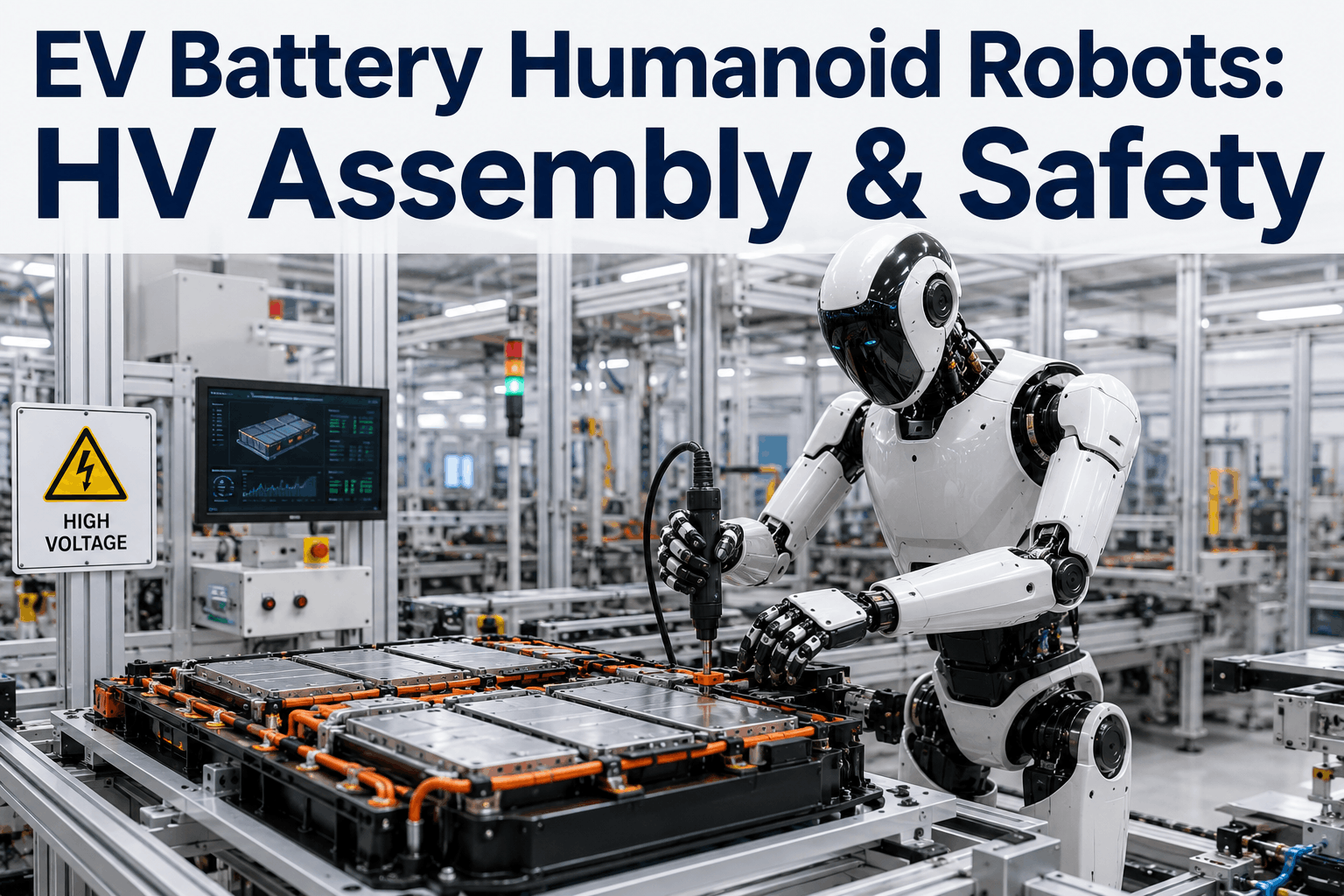
High-voltage EV battery assembly is one of the most hazardous tasks in automotive manufacturing. Workers wear cumbersome protective gear to handle cells operating at 400–800V. Every handling error creates a safety risk. Every repeated motion creates an ergonomic one. Every quality deviation in cell or module assembly can become a thermal runaway event months later in the field. This is exactly why humanoid robots are entering EV battery manufacturing first — before any other production area. AEON is already assembling high-voltage batteries at BMW Leipzig. The question for every gigafactory and automotive battery plant leader is no longer whether humanoid robots belong in HV assembly — it is how to deploy them safely, integrate them intelligently, and extract the quality data they generate. Talk to an iFactory expert about humanoid integration for your EV battery plant — book a demo.
EV Battery + Humanoid Robots + Safety
The Hardest Job in the Gigafactory
Just Got a Robotic Colleague.
Humanoid robots are entering EV high-voltage battery assembly — handling hazardous tasks, delivering consistent quality, and generating structured data that feeds directly into your MES and ERP. iFactory orchestrates the intelligence layer.
Why EV Battery Assembly Is the First Use Case for Humanoid Robots
Of all the tasks in an automotive plant, high-voltage battery assembly concentrates the most safety, ergonomic, and quality risk into the smallest physical space. Workers handling cell modules at 400–800V must wear arc-flash PPE that restricts dexterity. Repetitive cell insertion, connector seating, and module stacking create musculoskeletal risk over long shifts. And the quality consequences of assembly errors — a connector seated 0.3mm off-centre, a torque value 5% below spec on a busbar connection — may not manifest for 12–24 months, when a vehicle arrives at a warranty claim or an accident investigation.
01
Safety Hazard Removal
Workers in HV battery areas wear arc-flash PPE limiting dexterity and comfort. Humanoid robots handle 400–800V components without exposure risk — removing the human from the hazard zone entirely for the most dangerous assembly steps.
02
Ergonomic Relief
Cell module stacking, busbar connector seating, and thermal pad placement require sustained awkward postures and repetitive fine-motor movements across 8–12 hour shifts. These are exactly the tasks regulators are mandating be addressed — and that humanoid robots can perform without fatigue drift.
03
Consistent Quality
Humanoid robots perform the same torque, seating depth, and connector orientation on the 1,000th repetition as on the first. Human performance varies with shift time, fatigue, and workload. For safety-critical battery connections, consistent is safer than average.
04
Structured Data Generation
Every humanoid robot action generates data — torque applied, position achieved, time taken, anomaly detected. Connected to iFactory's orchestration layer, this data flows directly to MES quality records and SAP QM, creating per-cell traceability that human assembly cannot match.
05
Labour Flexibility
Gigafactory ramp schedules are notoriously compressed. Humanoid robots can be redeployed across tasks — battery assembly one week, module inspection the next — without retraining cycles. Workforce shortages and skills gaps in specialised HV assembly no longer gate production scale.
06
Proven at OEM Scale
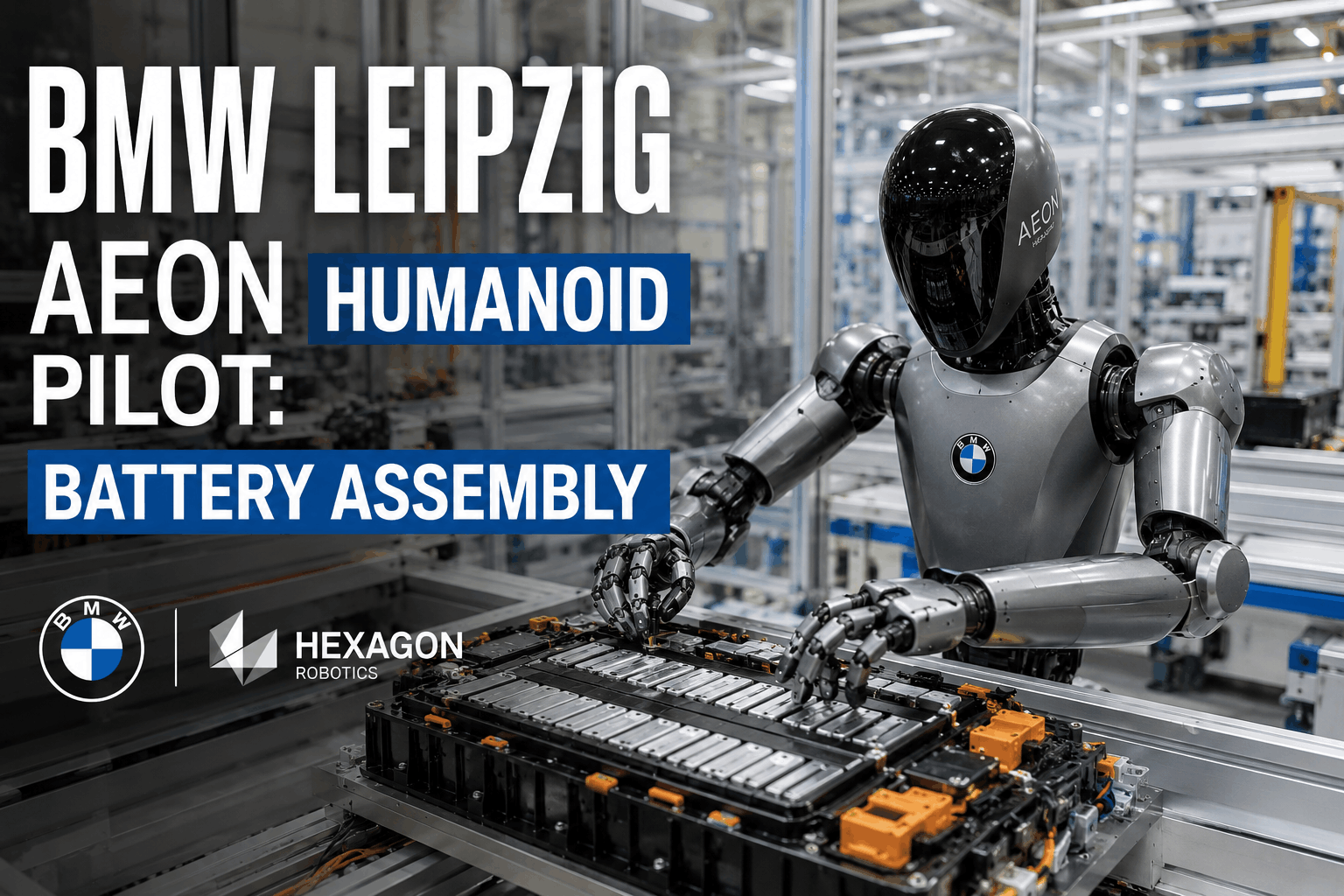
AEON (Hexagon Robotics) is already deployed at BMW Leipzig specifically for HV battery assembly — Europe's first humanoid robot in automotive production, live since December 2025. This is not a pilot for a future use case. It is a production deployment for this use case, now.
AEON at BMW Leipzig: The Blueprint for HV Battery Humanoid Deployment
On 27 February 2026, BMW Group became the first company to deploy humanoid robots in production in Germany. The platform: AEON, by Hexagon Robotics — unveiled June 2025 and built explicitly for industrial production, not consumer demonstration. The deployment focus: high-voltage battery assembly and component manufacturing at BMW Leipzig, where employees previously wore cumbersome protective gear for repetitive, safety-critical tasks.
Hardware Specs
Degrees of Freedom34 DOF
Sensors22 integrated sensors
Payload15 kg
MobilityWheeled casters — multi-station
BatteriesHot-swappable — 24/7 operation
End EffectorsModular — grippers, scanners, hands
AI & Technology Stack
Foundation ModelNVIDIA GR00T N1.5
SimulationNVIDIA Isaac Sim + Isaac Lab
Onboard ComputeNVIDIA Jetson Orin
AI PartnersNVIDIA, Microsoft Azure, Maxon
Training Speed20 demos = autonomous operation
Sim-to-RealLocomotion mastered in 2–3 weeks
H2 2025 Theoretical assessment + lab testing by BMW Centre of Competence for Physical AI
Dec 2025 First test deployment at BMW Leipzig — HV battery assembly begins
Apr 2026 Broader factory floor integration — two AEON units across two use cases
Summer 2026 Full-scale permanent pilot — both units targeting production by year-end
6 Specific HV Battery Assembly Tasks Humanoid Robots Handle Today
1
Cell Module Insertion & Stacking
Picking individual lithium-ion cells or prismatic modules from trays and placing them into pack housings to precise positional tolerances. Humanoid hands provide the dexterity required; robot consistency eliminates the placement drift that accumulates across shifts as human operators fatigue.
Human Hazard Removed
High repetition + HV exposure
2
Busbar & HV Connector Seating
Connecting busbars and high-voltage connectors between cell groups requires precise alignment and controlled force — 400–800V live after connection. Humanoid robots perform the seating sequence to defined torque and depth specifications, with each connection logged automatically.
Human Hazard Removed
400–800V shock risk + PPE burden
3
Thermal Interface Material Application
Applying thermal pads or paste between cells and cooling plates requires uniform coverage without voids — a critical factor in thermal runaway risk. Humanoid robots apply material to precise volume and distribution specifications, verifiable through integrated thermal imaging at each station.
Quality Impact
Void elimination reduces TR risk
4
Pack Cover Assembly & Sealing
Placing and securing battery pack covers requires consistent torque across dozens of fasteners and verification of gasket seating for IP67/IP68 ingress protection ratings. Humanoid robots complete torque sequences to specification and can perform integrated leak-test pre-checks before the pack moves to the next station.
Quality Impact
IP rating compliance per pack
5
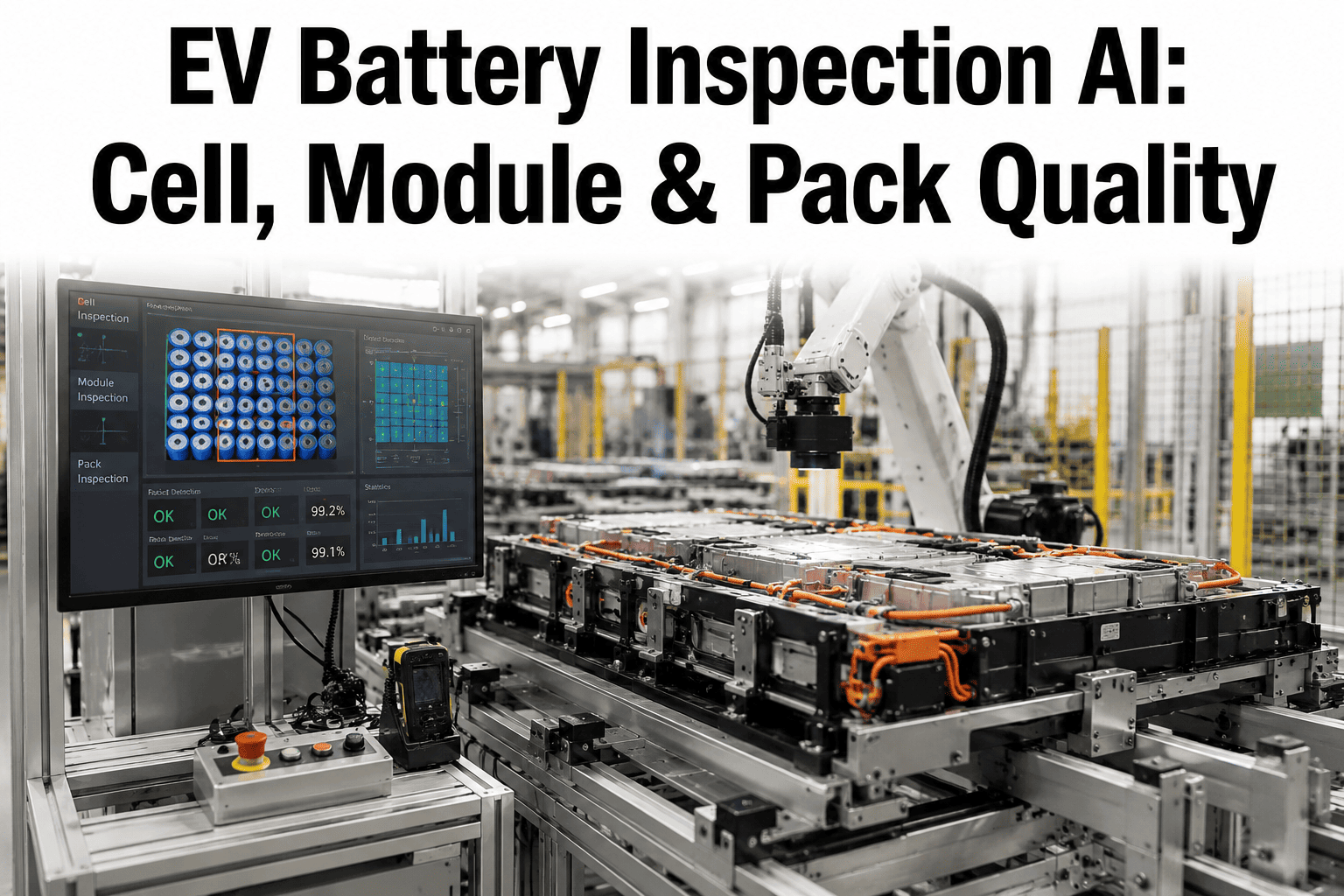
Inline Visual & Dimensional Inspection
AEON's modular scanner attachment enables it to perform dimensional scans and visual inspection of assembled modules and packs between assembly steps — generating structured quality records linked to the production order automatically, without a separate inspection station.
Data Generated
Per-pack inspection record to MES
6
Component Delivery & Kitting to Line
Transporting cell trays, module frames, and cooling components from intralogistics storage to the assembly station — the exact task Apollo performs at Mercedes-Benz. Humanoid robots handle 15–25kg component sets continuously across shifts, removing the ergonomic exposure that causes the majority of musculoskeletal injuries in battery plants.
Human Hazard Removed
MSI risk + heavy repetitive lifting
Safety Architecture: How Humanoid Robots Work Safely in HV Environments
Deploying a robot capable of 30+ degrees of freedom in a live high-voltage assembly environment requires a layered safety architecture. This is not optional — it is the foundation that determines whether a humanoid pilot stays a pilot or becomes a production programme. Book a demo to see how iFactory safety integration works with humanoid platforms in HV environments.
Layered Safety Architecture for HV Battery Humanoid Deployment
Physical Layer
Collaborative robot zones with speed/force limiting
HV-rated insulated end effectors and tool interfaces
Emergency stop with <100ms response time
Physical barriers defining human-robot overlap zones
Sensor & Perception Layer
22 integrated sensors on AEON — continuous environment awareness
LiDAR + depth cameras for real-time obstacle detection
Voltage proximity sensing — detects live HV components
Tactile feedback on hand/gripper for force overload detection
AI Safety Layer
NVIDIA GR00T foundation model with safety-constrained policy
Functional safety compliance targeting IEC 61508 / ISO 10218
Sim-to-real validation — all tasks pre-validated in NVIDIA Isaac Sim
Anomaly detection triggers safe-state halt if deviation detected
Data & Traceability Layer
Every action logged with timestamp, position, force, result
iFactory routes safety events to CMMS for immediate response
Per-pack assembly records in SAP QM — IATF 16949 compliant
On-premise or cloud deployment — no safety data leaves plant network
The iFactory Intelligence Layer: On-Premise & Cloud
A humanoid robot in HV battery assembly without production system integration is a sophisticated piece of hardware generating no business value beyond the task it performs. iFactory transforms humanoid robots from task executors into production intelligence assets — connecting every action to the quality, maintenance, and planning systems that run your plant. Ask our team which deployment model fits your plant's data requirements.
iFactory Humanoid Orchestration — What Gets Connected
Humanoid Robot
↓
Assembly completion event, torque values, position data, inspection result
SAP QM + MES
Per-cell traceability — zero manual entry
HV Connector Seating
↓
Torque achieved vs. spec, depth confirmation, sequence log
SAP QM + CAQ
SPC-ready data for HV connection quality monitoring
Safety Anomaly Event
↓
Fault type, location, timestamp, safe-state trigger log
CMMS + MES
Immediate maintenance alert — no manual incident reporting
Inline Scan Inspection
↓
Dimensional result, surface defect, IP seal verification
SAP QM + ERP
Pack-level quality record — linked to production order
On-Premise Deployment
All robot action data, quality records, and safety events processed and stored inside your plant network. No external connectivity required. Meets OEM data sovereignty and functional safety requirements. Edge AI inference — sub-20ms latency for real-time control loops.
Discuss On-Premise Setup
Cloud-Based Deployment
Fleet performance analytics across multiple battery plants. Cross-site quality benchmarking, robot utilisation dashboards, and AI model improvement from fleet-wide data. Battery passport data records accessible for compliance reporting from any location.
Discuss Cloud Setup
Market Context: Humanoid Robots in EV Battery Manufacturing by 2030
$4–5B
Global humanoid robot market size in 2026, growing at 38–50% CAGR
$77B
Projected global humanoid robot market by 2030 — automotive leads adoption
13,000
Humanoid robots shipped globally in 2025 — 2026 is the "year of mass delivery"
34 DOF
AEON's degrees of freedom — purpose-built for multifunctional factory tasks
FAQ: Humanoid Robots in EV High-Voltage Battery Assembly
Which humanoid robot is currently deployed in EV battery assembly?
As of mid-2026, the most verified HV battery assembly deployment is AEON by Hexagon Robotics at BMW Group Plant Leipzig — Europe's first humanoid robot in automotive production, live since December 2025 and entering full pilot phase in summer 2026. AEON features 34 degrees of freedom, 22 integrated sensors, a 15kg payload, modular end effectors, and hot-swappable batteries for continuous operation. The deployment focuses specifically on high-voltage battery assembly and component manufacturing, with two AEON units targeting simultaneous production across two use cases by end-2026.
How do humanoid robots handle the safety requirements of high-voltage battery environments?
Humanoid robots in HV battery environments require a four-layer safety architecture: physical isolation (HV-rated insulated end effectors, collaborative zones with speed/force limiting, emergency stop under 100ms); sensor awareness (22+ sensors for continuous environment monitoring, voltage proximity detection, tactile overload sensing); AI safety (foundation model safety-constrained policies, IEC 61508/ISO 10218 compliance targeting, pre-validated in simulation before physical deployment); and data traceability (every action logged, safety events routed to CMMS immediately through iFactory's orchestration layer). The key advantage of humanoid robots over human workers in this context is that the robot can be designed to never make the safety errors — wrong tool contact with live HV, PPE compliance failure, fatigue-related position drift — that humans make under production pressure.
What quality data do humanoid robots generate during EV battery assembly?
Every humanoid assembly action generates structured data: torque applied vs. specification on every fastener, connector seating depth and force profile, thermal imaging data for thermal interface material coverage, dimensional scan results for module and pack geometry, and visual inspection results from integrated scanner attachments. Connected to iFactory's orchestration layer, this data is automatically linked to the production order, cell lot, and assembly station — creating per-pack traceability that satisfies IATF 16949 requirements and feeds directly into SAP QM without manual data entry. This is data quality that human assembly physically cannot generate at the same granularity or consistency.
What is iFactory's role in humanoid robot deployment at a battery plant?
iFactory provides the orchestration and integration layer that connects humanoid robot data streams to the production systems that drive business decisions. Without integration, a humanoid robot's quality observations and assembly logs stay trapped in the robot's own system — useful for robot management, useless for MES traceability, SAP quality records, or battery passport compliance. iFactory routes every robot event — assembly completions, quality results, safety anomalies, maintenance signals — to MES, SAP QM, CMMS, and ERP automatically, in real time, using the same connector framework used for conventional machine integration. iFactory is available in both on-premise (for plants with data sovereignty requirements) and cloud-based deployment (for enterprise fleet management across multiple battery plants).
How long does it take to train a humanoid robot for a new battery assembly task?
AEON's imitation learning system — powered by Microsoft Azure and NVIDIA's GR00T-Mimic synthetic data pipeline — requires as few as 20 demonstrations to train autonomous operation for a new task. Core locomotion skills were mastered in simulation in 2–3 weeks rather than the typical 5–6 months. BMW's deployment experience from Spartanburg showed that the second use case deployed in 30 days, compared to 12 months for the first — demonstrating steep learning curve compression as deployment tooling matures. For gigafactories evaluating new cell formats or pack architectures, this means humanoid robot task training can be completed during the same timeline as conventional fixture and tooling changeover.
Can iFactory integrate with AEON specifically, and what does that integration deliver?
Yes. iFactory's platform-agnostic architecture integrates with AEON and other humanoid platforms through standard APIs and industrial data protocols. For AEON specifically, the integration captures assembly task completions, scanner inspection results, anomaly events, and telemetry data — routing each data type to the appropriate production system. Assembly completions go to MES and SAP PP for production confirmation. Inspection results go to SAP QM for quality record creation. Anomaly events go to CMMS for maintenance dispatch. Battery passport data records are generated automatically from the combined quality and assembly data stream.
Book a demo to see the AEON-to-SAP integration flow in detail.
Humanoid + HV Battery + iFactory
From Robot Action to ERP Record.
Automatically.
iFactory connects humanoid robots in your EV battery plant to MES, SAP QM, CMMS, and ERP — on-premise or cloud — turning every assembly action into traceable production data from day one.
AEON Integration
HV Battery Assembly AI
On-Premise & Cloud
SAP QM + MES Routing
Battery Passport Ready