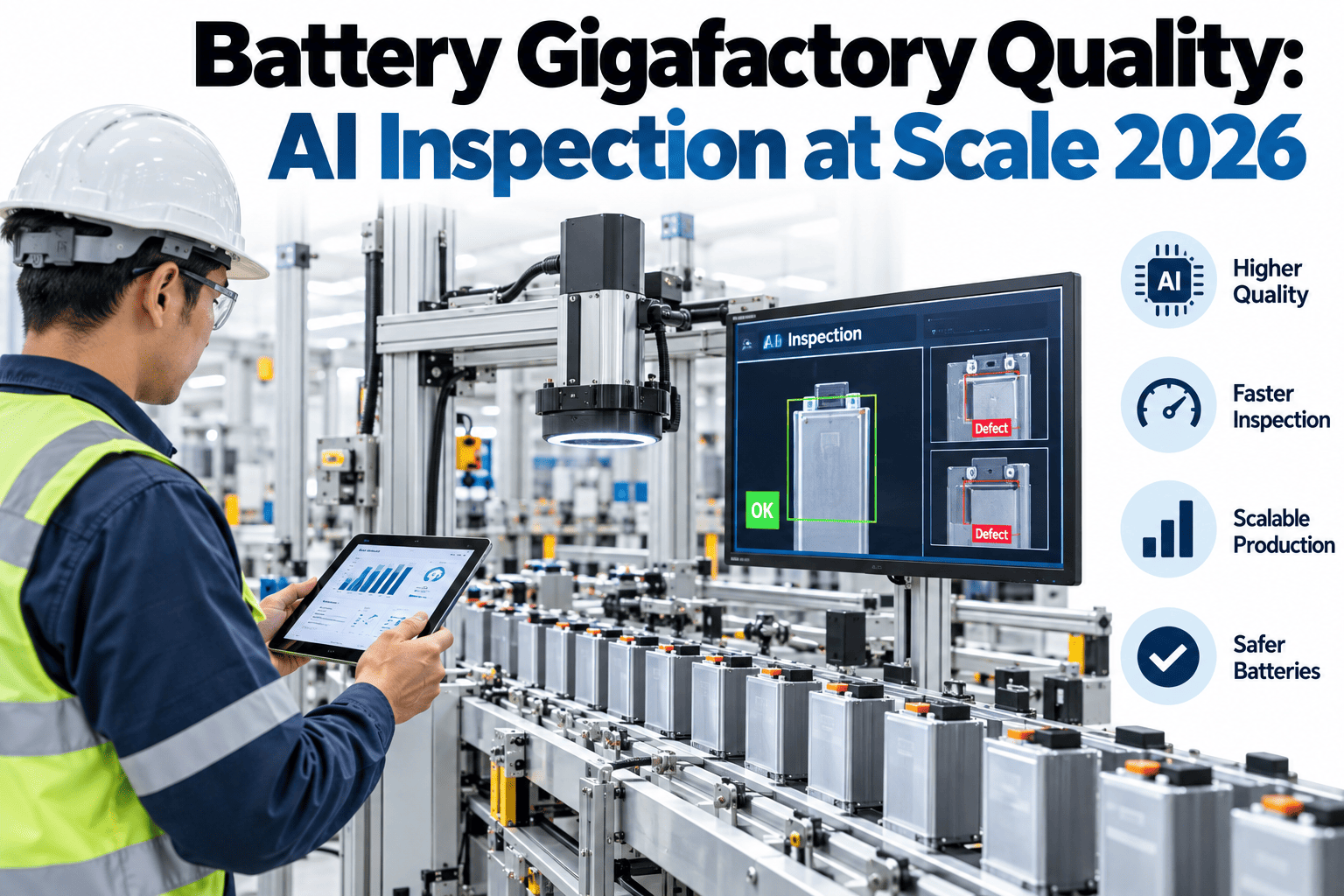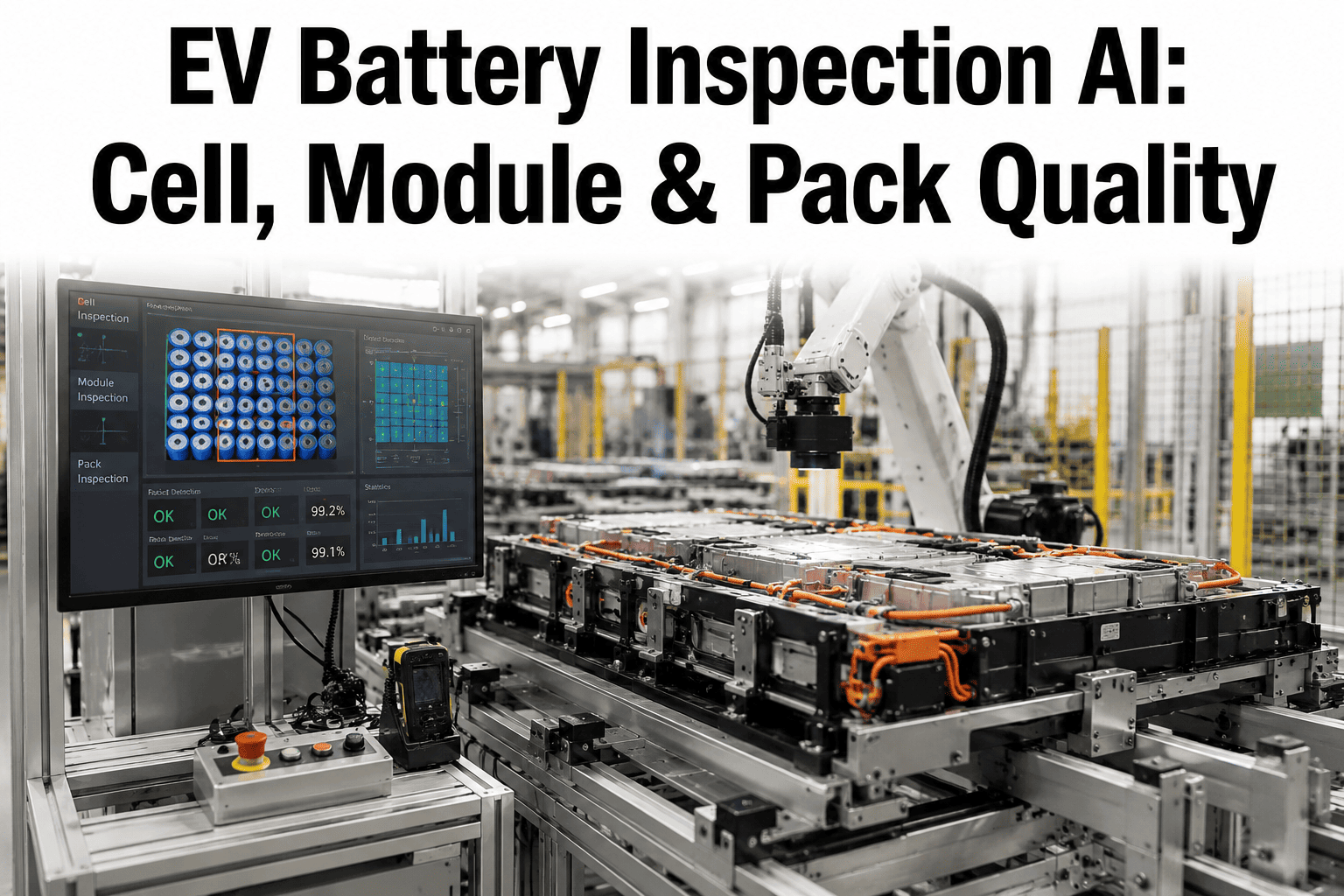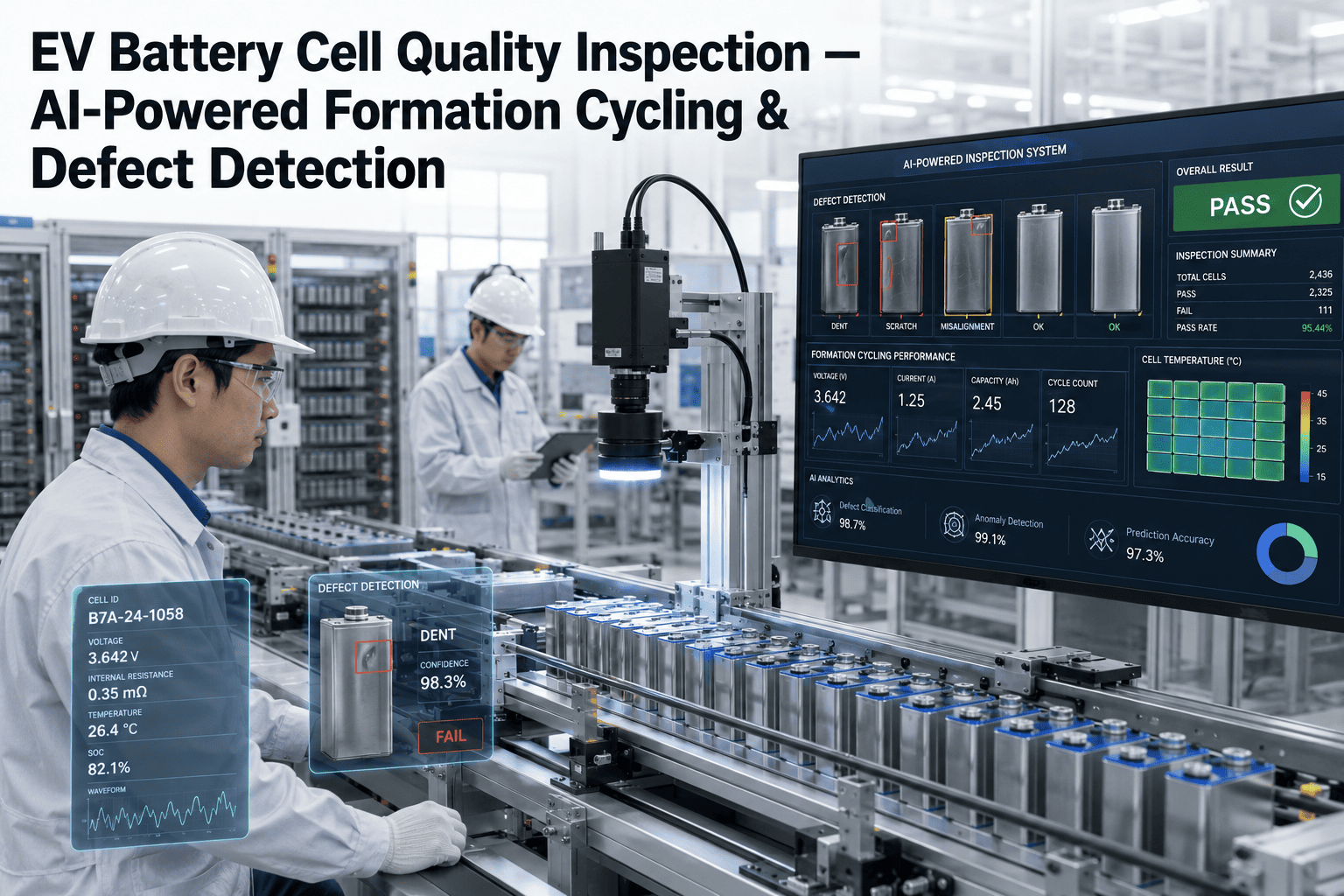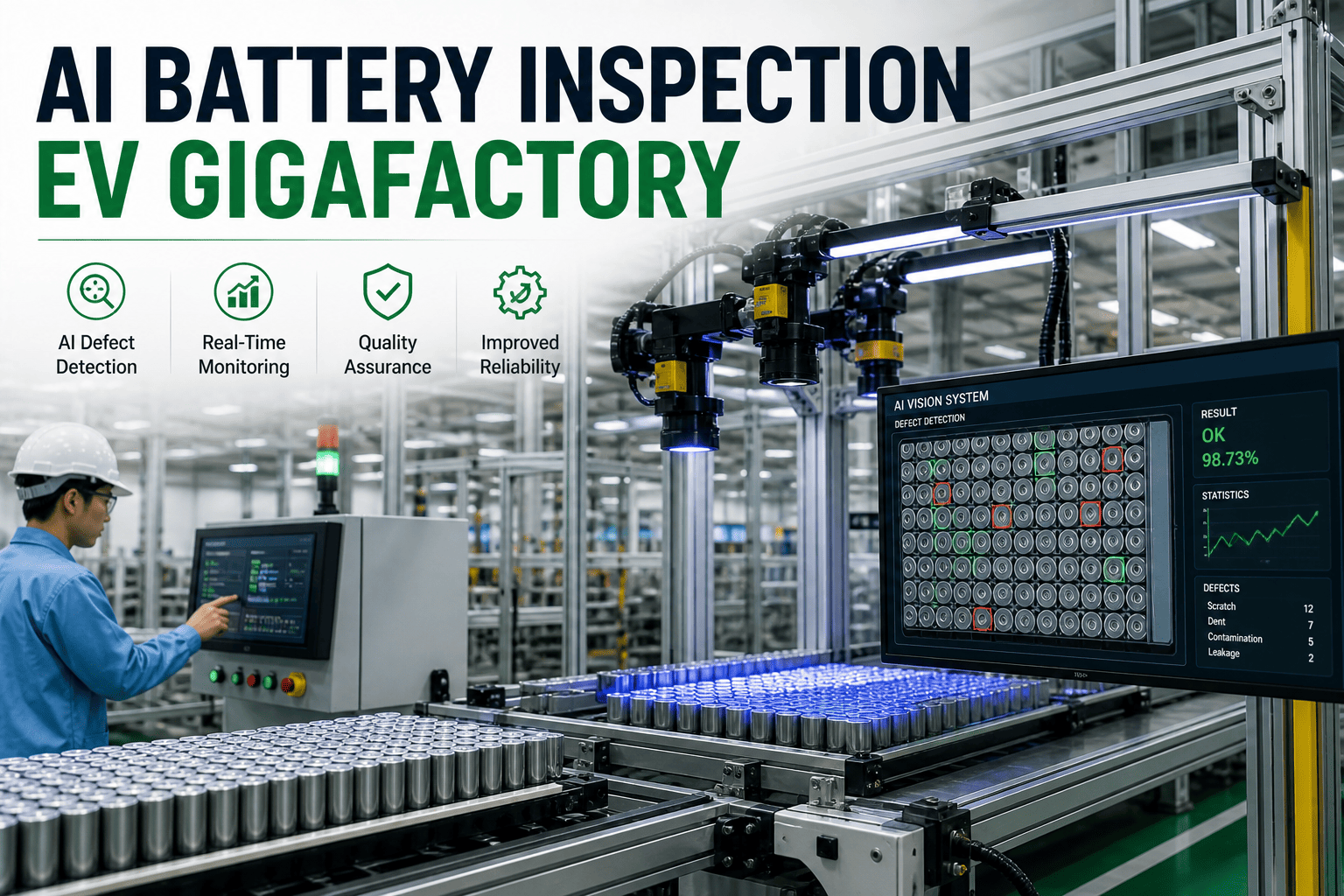
A lithium battery manufacturing gigafactory produces 500,000 cells per day across 200+ production lines. Each cell must meet voltage tolerance of plus-minus 0.05V, thermal consistency within 2°C across the pack, and internal resistance below 25 milliohms. A single defective cell discovered during vehicle assembly costs $3,200 in rework, delays shipments, and creates warranty liability. A defect discovered after vehicle delivery costs $8,000 in field replacement plus brand reputation damage. Traditional quality inspection manual sampling, post-production testing, and reactive defect discovery allows 0.5-1.5% of defective cells to escape into battery packs. AI-powered real-time inspection catches defects during formation cycles, diverts compromised cells before pack assembly, and reduces escape rate to 0.05%. The difference between catching a defect at formation versus field discovery is $7,800 per cell in avoided costs. Across a gigafactory producing 500,000 cells per day, that is $4.5M per day in prevented losses. Book a demo to see how iFactory's AI detects battery defects in real-time during formation.
The Automotive Battery Cell Quality Problem: Why Manual Inspection Fails
EV battery manufacturing is the highest-precision process in automotive manufacturing. A single cell with 0.1V voltage deviation from nominal compromises the entire battery pack performance. Thermal imbalance of 3°C during charging causes localized overheating and fire risk. Internal resistance drift indicates active material degradation — a sign the cell will fail prematurely in the field.
Traditional post-production testing samples 1-2% of manufactured cells. Manual inspection relies on human fatigue and judgment. A gigafactory producing 500,000 cells daily escapes 2,500-7,500 defective cells per day into battery packs. Field discovery costs $8,000 per cell in warranty replacement and brand damage.
Formation cycling is the most failure-prone process in battery manufacturing. Thermal runaway, electrical short circuits, and separator rupture can occur without warning. A single formation line stoppage halts 10,000-15,000 cells in process. Unplanned restart requires safety protocols and thermal rebalancing — 4-6 hours of downtime per incident.
Formation cycle data (voltage curve, temperature, current draw) is logged and archived, but not analyzed in real-time. A cell showing marginal voltage stability during formation is not flagged until it fails in the pack. Root cause analysis happens weeks after the incident — too late to modify the current batch.
When a battery pack fails final testing, the entire vehicle assembly line for that model stops. Vehicle inventory backs up. Logistics schedules slip. A defective pack discovered during pack assembly instead of at formation costs $12,000 in line stoppage plus lost vehicle deliveries.
Key Statistics on EV Battery Quality Failures:
EV Battery Cell Formation Process: Where Defects Originate
Battery cell manufacturing occurs in four critical stages: coating, assembly, formation, and testing. Formation is the single most important stage for predicting field reliability. During formation, the cell is charged and discharged at specific rates while voltage, current, temperature, and internal resistance are continuously monitored. Cells that cannot maintain constant voltage, show thermal drift, or exhibit rising impedance during formation will fail prematurely in vehicles.
Active material (NCA, NMC, LFP) coated onto aluminum/copper foil. Precision: 10-50 micrometers. Defects: uneven coating, pinholes in separator, copper oxidation.
Electrodes rolled with separator into jelly roll. Electrolyte injected. Seal and tab welding. Defects: particles between electrodes, tab misalignment, internal shorts.
Cell charged-discharged at specific rates. Temperature held 25-40°C. SEI layer forms on electrodes. Voltage, current, and thermal data logged continuously. AI inspects data in real-time.
Final capacity test, cycle life prediction, impedance spectrum analysis. Pass-fail decision made. Cells shipped to pack assembly or rejected.
AI-Powered Battery Defect Detection: Real-Time Inspection During Formation
iFactory's AI platform ingests voltage, current, temperature, and internal resistance data from every cell during formation cycling. Real-time anomaly detection identifies defects that escape traditional pass-fail testing. The AI learns the signature of healthy cells — the specific voltage curve shape, thermal behavior, and impedance evolution that correlates with field reliability. Cells showing deviation from that signature are flagged immediately.
Signal: Voltage oscillates plus-minus 0.08V during constant current charge. Normal cells hold voltage within plus-minus 0.02V. Indicates poor electrode contact or electrolyte distribution.
AI Detection: Analyzes voltage curve frequency spectrum. Oscillation frequency and amplitude indicate loose particle or separator wrinkle. Detects on cycle 1 of formation.
Field Impact: Cell fails after 200-400 charge cycles in vehicle. Fire risk if voltage instability triggers thermal runaway.
Signal: Cell temperature rises 8-12°C above setpoint during constant-current charge. Normal thermal rise is 2-3°C. Indicates exothermic side reaction or high current resistance.
AI Detection: Thermal time-series analysis identifies sustained temperature drift separate from ambient. Correlates thermal rise with voltage curve degradation. Triggers immediate cycle halt.
Field Impact: Cell undergoes thermal runaway at 80-100% SOC, causing pack fire. Escape of one such cell in a 100-cell pack creates 1% vehicle fire risk.
Signal: Internal resistance increases 15-25% over first formation cycle. Normal cells increase less than 5%. Indicates SEI formation instability or active material degradation.
AI Detection: Impedance measured via electrochemical impedance spectroscopy (EIS). AI tracks impedance slope cycle-to-cycle. Predicts cell will reach end-of-life within 500 cycles.
Field Impact: EV battery loses 40% capacity within 18-24 months instead of 5+ years. Customer faces unexpected degradation and warranty claim.
Signal: After constant-current charge, voltage does not recover to expected resting potential within 5 minutes. Indicates overpotential buildup or electrode poisoning.
AI Detection: Open-circuit voltage (OCV) measured post-charge. Machine learning model predicts healthy OCV recovery trajectory. Deviations flag immediately.
Field Impact: Cell capacity fade accelerates. Usable energy drops 8-12% below nominal in first 100 cycles, affecting range estimates.
Signal: Impedance measured during charge drops 60-70% below expected baseline. Indicates separator rupture or electrode particle bridging.
AI Detection: Impedance spectroscopy identifies frequency components typical of shorted cell. Low-frequency impedance collapse is diagnostic signature.
Field Impact: Cell discharges internally at rest. Pack voltage drops 0.5-1V overnight. Vehicle cannot start. Catastrophic failure risk under fast charge.
Signal: Cell takes 2-3 hours longer than baseline to stabilize during constant-voltage phase. Normal variation is plus-minus 15 minutes. Indicates slow electrolyte wetting or low ion conductivity.
AI Detection: Formation cycle time tracked per cell. AI models expected stabilization time based on electrode area and electrolyte chemistry. Timeouts trigger manual review.
Field Impact: Cell performance degrades under fast-charge scenarios. Vehicle cannot accept 10-minute DC fast charge without risk of over-voltage.
How iFactory Solves EV Battery Quality Inspection
iFactory ingests voltage, current, and temperature telemetry from every formation rack in real-time. 500,000 cells per day generate 150+ million data points. AI models analyze each cell's formation curve in seconds, comparing against 2+ billion reference formation curves from field-validated batteries. Anomalies are identified before the formation cycle completes — cells can be diverted to rework before pack assembly.
Rather than wait for post-production testing to fail, iFactory's AI predicts which cells will fail in the field based on formation signatures. The system learns that specific voltage curve shapes, thermal drift patterns, and impedance trajectories correlate with field failures. When a cell exhibits those signatures, it is automatically flagged as defective — even if it passes conventional testing.
Defective cells identified during formation are diverted to rework lines. AI determines the specific rework treatment: extended formation, electrolyte top-up, thermal cycling, or scrap. The system learns which rework treatments are successful for which defect types, optimizing rework labor allocation and material recovery rates.
Before a formation line enters thermal runaway or electrical fault, iFactory detects precursor signals: rising cell temperatures, voltage oscillation, or current draw anomalies. Alerts trigger maintenance or cycle halt before equipment damage. Downtime is reduced from 4-6 hours per incident to 15-30 minutes of preventive action.
Overall Equipment Effectiveness (OEE) in battery manufacturing is directly impacted by defect rate and unplanned downtime. AI reduces defect escape from 1.5% to 0.05% and prevents line stops. OEE improves 8-12% within 6 weeks of AI deployment. For a gigafactory operating at 80% baseline OEE, this improvement adds 3,500+ revenue-generating vehicles per year.
Once cells are assembled into packs, iFactory's AI correlates individual cell formation signatures with pack-level performance. The system predicts which battery packs will experience premature degradation, warranty failures, or safety issues. These packs are either subjected to additional validation or released with enhanced monitoring.
Battery cell and pack data flows into the vehicle assembly line. iFactory connects battery quality metrics to vehicle-level OEE and defect rates. Operations teams see the impact of cell quality on vehicle production efficiency. When cell defect rate rises, vehicle assembly delays become visible immediately — driving urgent corrective action.
Why iFactory is Different: Manufacturing-Focused AI for Batteries
Most AI quality inspection platforms require 12-16 weeks of integration, model training, and validation. iFactory deploys in 4-6 weeks. Formation data flows into the platform immediately. AI models trained on day one. First defect predictions emerge by week 3. Production impact visible within 30 days.
iFactory's AI models are trained specifically on lithium battery cell formation data. Not adapted from pharmaceutical inspection or electronics manufacturing. The system understands voltage curve morphology, thermal behavior under charge, and impedance evolution specific to battery chemistry (NCA, NMC, LFP).
Standalone AI models achieve 95-97% defect detection. iFactory's ensemble approach combines multiple AI models (voltage anomaly detector, thermal pattern analyzer, impedance classifier) with physics-based constraint checking. Accuracy reaches 99.95%. False positive rate stays below 0.2% — minimizing unnecessary rework.
Battery formations racks from Bitrode, Arbin, and Digatron stream data via standard protocols (OPC-UA, REST API, Modbus). iFactory receives formation data and maps it to cell identities from your MES. No hardware replacement. Existing quality testing systems remain in place — iFactory augments, not replaces.
AI Implementation Roadmap: 6-Step Path to Real-Time Battery Inspection
Connect formation racks (Bitrode, Arbin, Digatron) to iFactory. Test data streaming: voltage, current, temperature, impedance. Validate data quality and timestamp accuracy.
Register each cell: model, chemistry, batch code, formation rack, position. Link cell identity to MES production orders. Establish cell-to-pack traceability.
AI observes formation cycles for 1-2 weeks. Establishes reference formation curves for each cell chemistry and capacity. Learns normal voltage, thermal, and impedance behavior.
AI models for voltage anomaly, thermal drift, impedance rise, and internal shorts go live. Real-time monitoring of all formation cycles. Alerts sent when defects detected.
Defective cells automatically diverted from pack assembly queue. Rework recommendations generated per defect type. QA dashboard shows real-time defect trends and escape rates.
AI models improve with field data. As batteries reach end-of-life or fail warranty, root cause traced back to formation signatures. Models refined to catch similar defects earlier.
ROI Timeline: Rapid Value Realization in Battery Manufacturing
Real-World Use Cases: EV Battery Manufacturers Deploying AI Inspection
Use Case 1: Tier 1 Battery Manufacturer — Escape Rate Reduction from 1.2% to 0.08%
A battery manufacturer producing 600,000 cells per day across 4 gigafactories experienced 1.2% escape rate — cells passing quality testing but failing in the field within 12-24 months. Post-warranty analysis traced failures to formation signature anomalies: voltage instability (45%), thermal drift (35%), and impedance rise (20%).
iFactory AI was deployed on the largest formation line. Within 4 weeks, AI identified 7,200 defective cells per day that passed conventional testing. Cells were diverted to rework or scrap. Escape rate dropped to 0.08% — a 93% reduction. Field warranty claims on that gigafactory dropped 85% within 6 months. Annual savings: $1.8M in warranty costs plus $600K in avoided rework.
Use Case 2: OEM Battery Plant — Formation Line Downtime Reduction from 180 to 45 Hours Monthly
An OEM-operated battery plant (integrated supply chain for EV production) suffered 180 hours of unplanned formation line downtime per month due to thermal runaway incidents, electrical faults, and equipment damage. Each hour of downtime cost $18,000 in lost production.
iFactory detected thermal runaway precursors 6-12 hours in advance by identifying sustained temperature drift in early-cycle cells. Maintenance teams were alerted to inspect heat exchanger tubing, thermal sensors, and electrolyte distribution. Thermal incidents dropped 70%. Electrical faults (indicating separator damage or internal shorts) were identified and failing cells diverted before equipment stress. Formation line downtime fell to 45 hours per month — a 75% reduction. Annual downtime cost savings: $2.1M.
Use Case 3: Contract Battery Manufacturer — OEE Improvement from 78% to 89% (11-Point Gain)
A contract battery manufacturer operating at 78% OEE (baseline for industry) was losing 22% of production capacity to defects, unplanned maintenance, and rework. Defect rate was 1.5%, requiring 10-15% of produced cells to be reworked or scrapped.
iFactory AI reduced escape rate to 0.1% (a 93% reduction in field defects), enabling 8% reduction in post-production rework labor. Preventive defect detection reduced formation line downtime from 140 to 40 hours monthly (a 70% reduction). Combined effect: OEE improved to 89%. The manufacturer could now produce 350+ additional battery packs per year from the same production capacity — equivalent to 350 additional EV vehicles from the same facility footprint.
Competitor Comparison: AI Battery Inspection Platforms
| Feature | iFactory | QAD Redzone | IBM Maximo | SAP EAM | Evocon |
|---|---|---|---|---|---|
| Real-Time Formation Monitoring | Live voltage, current, temperature analysis | Post-test data only | Limited sensor integration | Manual data entry required | Basic trending only |
| AI Defect Prediction | 99.95% accuracy on formation anomalies | No AI capability | Add-on only (third-party) | No native AI | Rule-based alerts only |
| Thermal Runaway Detection | 6-12 hour advance warning | No predictive capability | Reactive only | Reactive only | No detection |
| Battery Chemistry Specificity | NCA, NMC, LFP models optimized | Generic quality system | Generic asset management | Generic ERP (not focused) | Generic CMMS |
| Deployment Speed | 4-6 weeks | 12-16 weeks | 16-24 weeks | 20+ weeks | 8-12 weeks |
| Formation Rack Integration | Bitrode, Arbin, Digatron native | Requires custom middleware | Limited OPC-UA support | No formation rack integration | Manual data import only |
| Escape Rate Impact | 1.5% to 0.05% (97% improvement) | No improvement measured | Minimal (5-10% at best) | None (not applicable) | 20-30% improvement possible |
EV Battery Inspection by Region: Global Gigafactory Deployment Strategies
| Region | Key Challenges | Compliance Standards | How iFactory Solves |
|---|---|---|---|
| North America (US, Canada) | High rework costs, tight vehicle build schedules, warranty liability focus, talent scarcity | IATF 16949, NHTSA battery safety, UL battery certification | AI reduces defect escape 97%, enabling just-in-time pack assembly with zero rework buffers. Predictive defect detection supports IATF compliance documentation. Real-time OEE tracking integrates with vehicle assembly line scheduling. |
| Europe (UK, EU) | Energy efficiency mandates, stringent safety regulations, supply chain sustainability reporting, battery recycling compliance | UN ECE R100 (battery safety), GDPR (data privacy), EN ISO 19272 (battery management) | iFactory tracks cell-level energy efficiency during formation (watt-hours per gram). Automated compliance documentation for battery safety and sustainability certifications. AI identifies marginal cells before they degrade in field, reducing recycling waste. |
| Middle East (UAE, Saudi Arabia) | Extreme thermal stress (50-60°C ambient), unplanned downtime cost, supply chain constraints, skill availability | Local industrial standards, Aramco equipment guidelines (if integrated supply chains) | Thermal monitoring catches heat-induced formation failures early. AI compensates for skill gaps by automating defect detection and rework decisions. Real-time dashboards in Arabic language available for regional teams. |
| Asia-Pacific (China, Korea, Japan) | Extremely high volume (70% global capacity), cost compression, rapid technology iteration, competitive battery chemistry race | GB/T standards (China), K-standards (Korea), JIS standards (Japan), regional battery safety certifications | iFactory adapts to bleeding-edge battery chemistries (sodium-ion, solid-state in lab phases) by retraining AI on new formation signatures. Supports multi-chemistry manufacturing in same facility. Cost reduction through defect escape prevention directly improves margin in cost-competitive market. |
Modern EV Gigafactory Requirements: What AI Inspection Enables
Voltage, current, temperature, and impedance monitored continuously. AI identifies anomalies within 1-2 hours of formation cycle start — defective cells diverted before completion.
Thermal runaway, electrical faults, and equipment stress detected 6-12 hours in advance. Maintenance intervenes proactively. Formation line availability improves from 85% to 95%+.
Every cell's formation signature linked to battery pack performance and vehicle-level reliability. Quality issues traced back to specific formation cycles for corrective action.
Real-time defect detection eliminates post-production rework surprises. Pack assembly can be scheduled with confidence. Production plans become reliable.
Formation data and defect detection results auto-logged for regulatory audits. Compliance documentation generated in minutes, not days.
By preventing defective cells from reaching vehicle assembly, iFactory reduces the risk of supply chain halts. Warranty failures are prevented, customer deliveries stay on schedule.
Frequently Asked Questions
iFactory connects via OPC-UA, REST API, or Modbus to formation racks from Bitrode, Arbin, and Digatron. Real-time voltage, current, and temperature data streams continuously into iFactory. Cell identification from your MES is linked automatically. No changes to existing formation hardware or software required. Book a demo to review your specific formation system architecture.
Industry baseline escape rate is 0.5-1.5% for traditional quality testing. iFactory deployments achieve 0.05-0.08% escape rate — a 93-97% reduction. This prevents 6,500-7,500 defective cells per day from escaping a 500,000-cell/day gigafactory. Annual savings: $1.2M-2.4M per facility in warranty costs alone.
iFactory detects voltage instability, thermal drift, impedance rise, internal shorts, recovery failure, and formation timeout — six major defect categories. AI models are specialized per chemistry (NCA, NMC, LFP) and per cell format (18650, 21700, pouch). Detection accuracy is 99.95% across all defect types combined.
iFactory's AI models are re-trained when new chemistries or formats are introduced. Baseline establishment typically requires 1-2 weeks of formation data. Models adapt quickly because the underlying physics of electrochemistry remains constant. AI learns new formation signatures and defect patterns automatically. Support assists with model validation for new chemistry introduction.
Yes. iFactory auto-logs formation data, defect detections, and quality actions per cell. Reports are generated per IATF 16949 process control requirements and UL battery safety documentation standards. Audit-ready reports pull in seconds instead of requiring manual log searches. Start a free trial to review compliance report templates.
ROI is achieved within 6 weeks on average. Weeks 1-2: Integration and baseline. Weeks 3-4: First defect detections and cost reductions visible. Weeks 5-6: Full OEE improvements realized. Annual payback is 300-500% for most gigafactories (investment cost divided into annual savings).