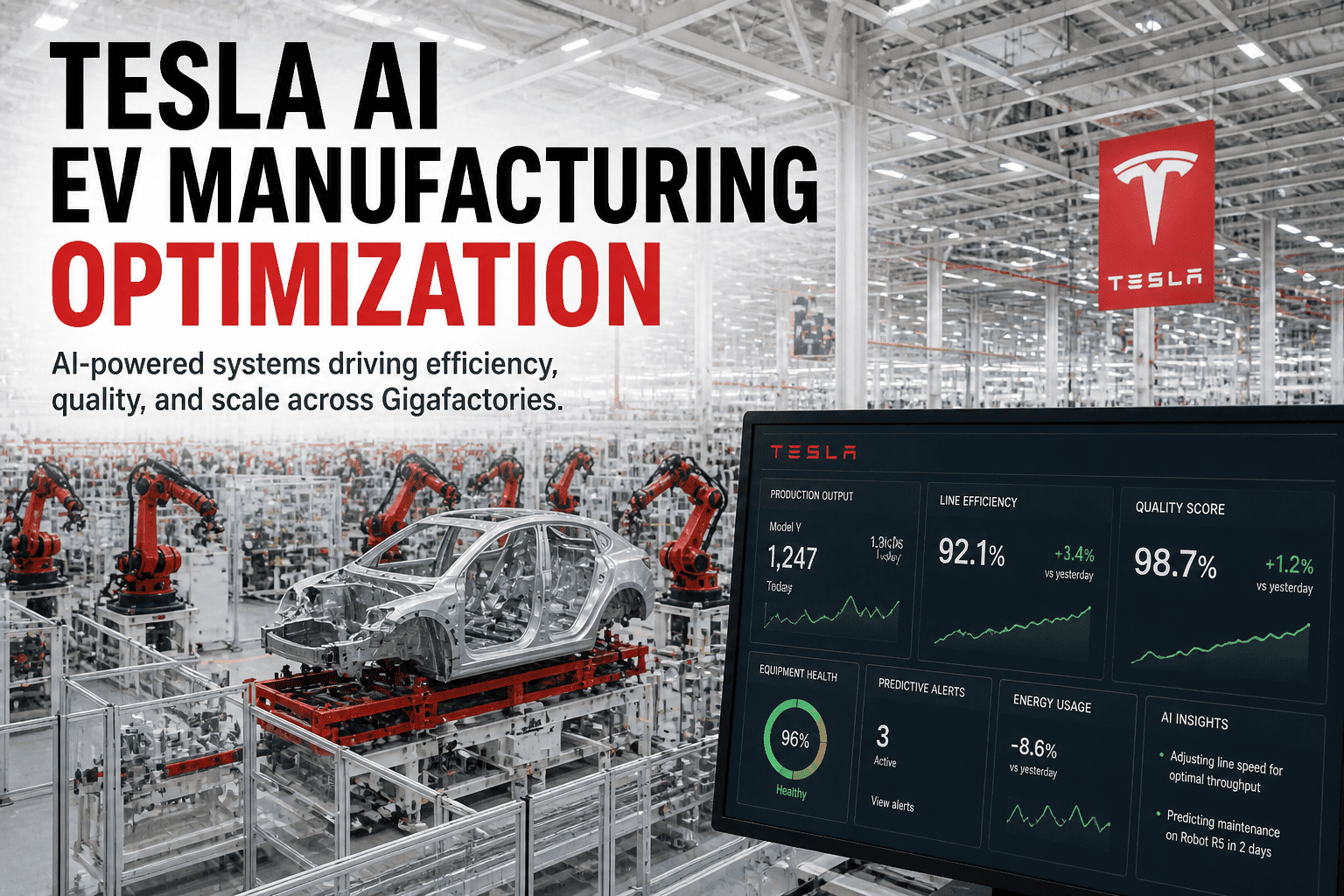
Tesla's gigafactories operate at unprecedented scaleproducing 500,000+ electric vehicles annually across sprawling manufacturing facilities. Yet behind this production volume lies a complex reality: EV manufacturing demands real-time visibility into battery cell assembly, motor winding precision, thermal management systems, and supply chain synchronization that traditional automotive SCADA systems cannot provide. When battery pack quality drifts by 2-3%, production delays cascade across weeks of assembly time. When stamping dies wear unevenly, scrap rates climb 8-12%. When assembly robots fall out of calibration, rework costs escalate to $2,400 per vehicle. Tesla and forward-thinking EV manufacturers are deploying AI-driven manufacturing intelligence to detect these deviations hours before they impact production—preventing line stoppages, protecting battery quality, and maintaining the OEE targets that define competitiveness in the EV era. Book a demo to see how iFactory's automotive AI manufacturing platform accelerates EV production optimization across battery assembly, final assembly, and supply chain integration.
The EV Manufacturing Quality & Efficiency Crisis: Why Traditional Automotive Systems Fail Modern Battery & Assembly Operations
Electric vehicle manufacturing is fundamentally different from internal combustion engine production: battery cell assembly demands micrometer-level precision, thermal management systems require real-time environmental correlation, motor winding integrity cannot be verified until post-assembly testing, and supply chain synchronization depends on minute-by-minute visibility into component availability. Yet most EV manufacturers operate with SCADA systems designed for traditional automotive — systems that capture voltage and temperature setpoints but lack the AI intelligence to correlate these signals with actual battery chemistry, cell balancing variance, thermal cycling stress, or assembly robot precision drift. The result: battery quality issues discovered 2-4 weeks into production runs, requiring complete line rework or scrap. Motor assembly defects identified during final testing, triggering 8-week buffer stock delays. Supply chain disruptions triggered by undetected component failures, cascading across integrated production networks. Downtime costs in EV manufacturing have risen 113% since 2019 — accelerated by production complexity and supply chain fragility. A single Tesla Gigafactory line stoppage costs $18,000-$42,000 per hour in lost production revenue, lost battery shipments, and logistics penalties.
Battery packs require consistent voltage balance across 7,000+ cells per vehicle. Temperature variance during assembly, electrolyte viscosity changes, and cell-to-cell resistance drift are invisible to standard testing until final QA detection — forcing $1,200-$2,400 per-vehicle rework or scrap. Annual battery rework cost at a 500K-unit facility: $600M-$1.2B lost value when 2-3% defect rate compounds across production.
Robotic welding, fastening, and assembly systems drift from calibration through thermal cycling, vibration fatigue, and tool wear. Undetected drift means scrap rates climb 8-12% over 4-6 weeks before technicians discover misalignment. Each line stoppage for robot recalibration: 6-18 hours downtime. Annual recalibration disruptions: 2,000-4,000 hours lost per facility at $18K-$42K per hour cost.
EV assembly depends on just-in-time component delivery: battery packs from one facility, motors from another, semiconductor modules from Tier-1 suppliers. A single component failure discovered mid-line stops entire assembly until inventory arrives — 2-8 week delays typical. Annual supply chain disruption cost: $280M-$600M in lost production and logistics fees.
Battery thermal management during assembly requires cooling system precision—deviation of 2-3°C impacts cell longevity and warranty risk. Undetected thermal drift compounds over weeks, resulting in field battery degradation, warranty claims ($8,000-$15,000 per vehicle), and brand reputation damage for premature battery failure.
EV Manufacturing AI Optimization Enables Real-Time Detection and Prevention
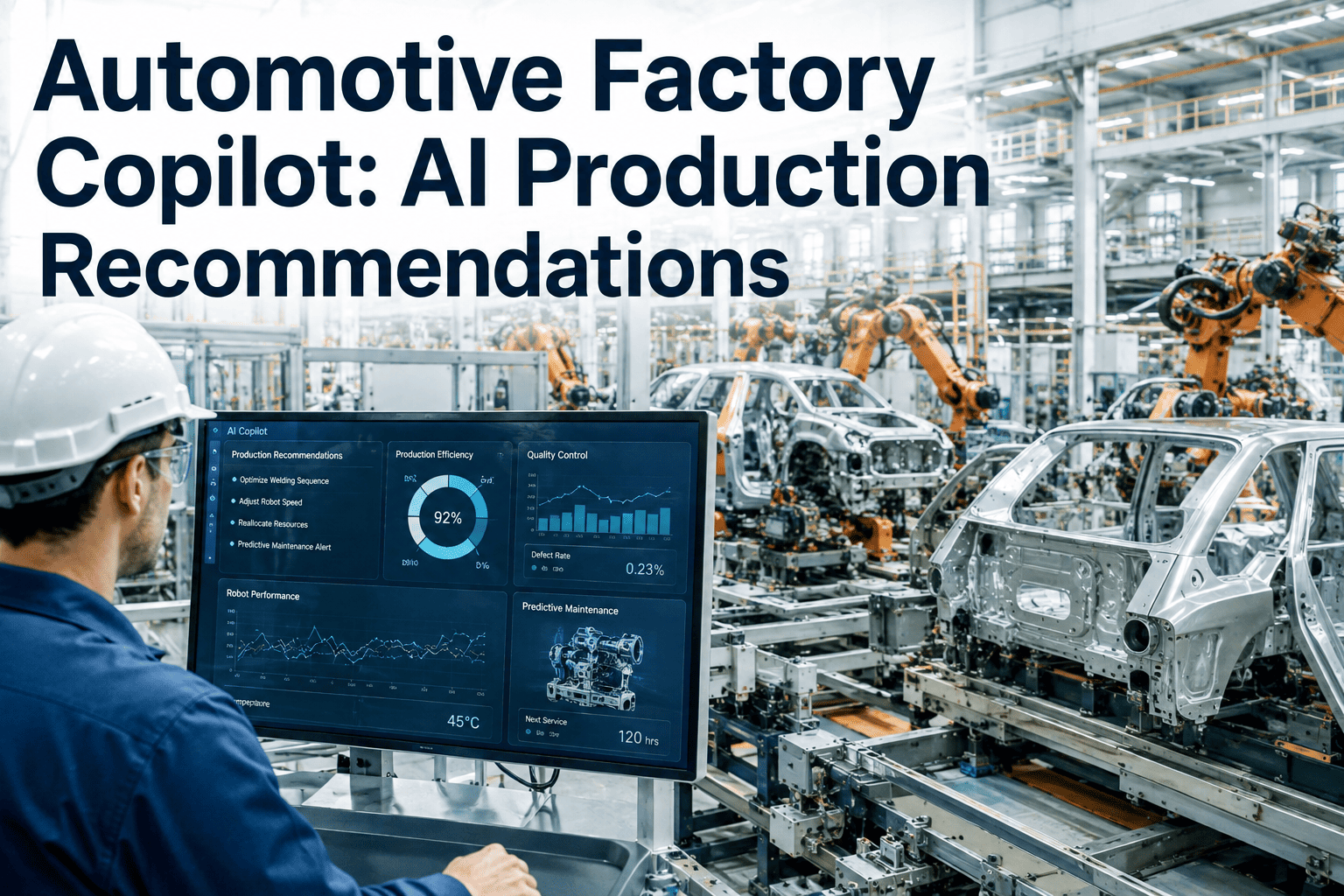
AI-powered anomaly detection ingests battery assembly sensors, robotic precision telemetry, thermal management data, and supply chain visibility in real time—detecting deviations 6-18 hours before line impact, triggering automated corrective workflows, and preventing cascading downtime across integrated EV production networks.
How iFactory AI Manufacturing Platform Solves EV Production Optimization
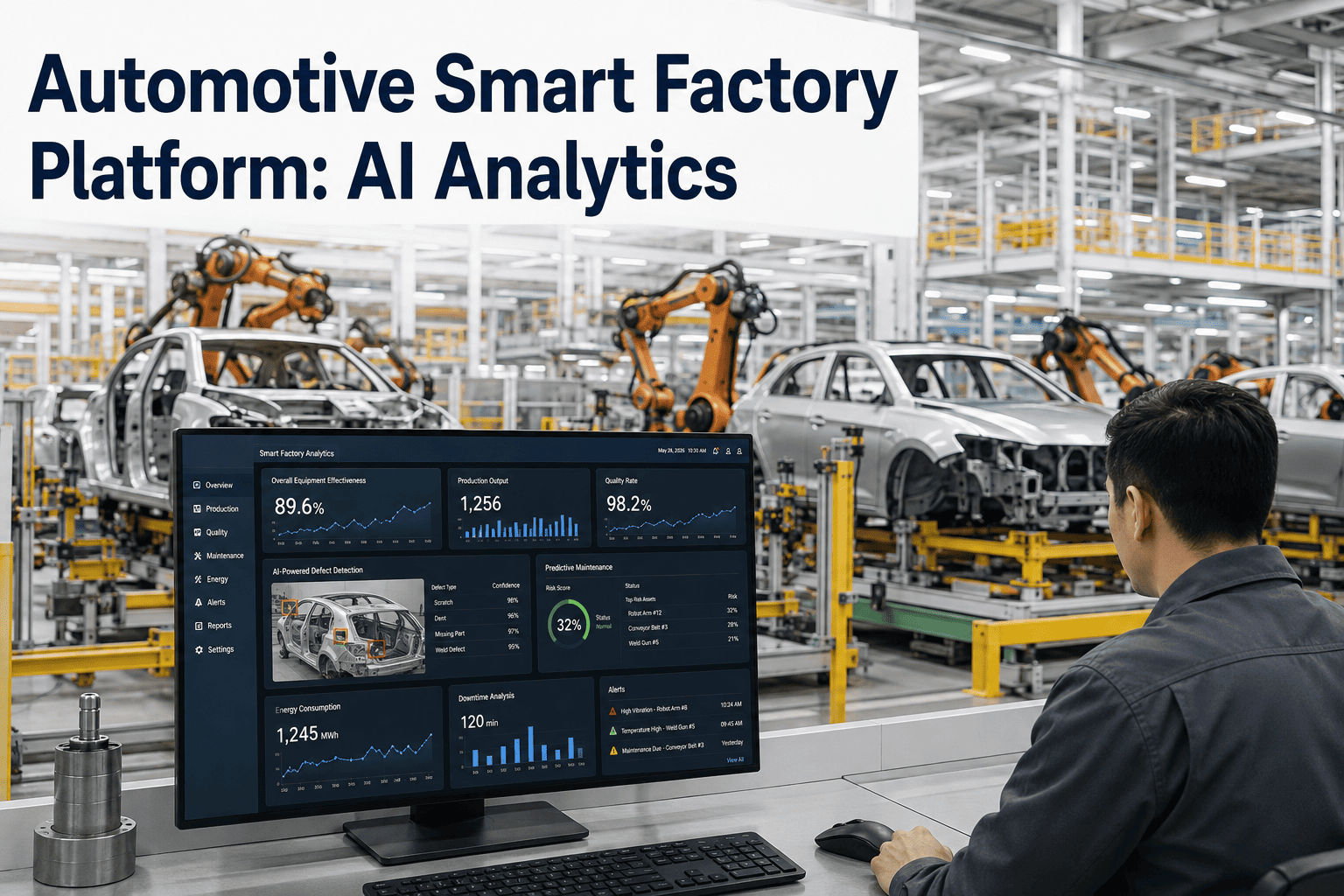
Traditional SCADA systems capture data; they don't understand EV manufacturing. iFactory's automotive AI platform is purpose-built for battery assembly, motor production, robotic assembly lines, thermal management, and supply chain synchronization—ingesting real-time sensor telemetry from all production zones, correlating signals across battery chemistry, mechanical precision, electrical performance, and logistics health, and generating instant optimization alerts that prevent line stoppages before they occur.
Cell voltage variance, thermal gradient, and balancing circuit performance tracked across every battery pack assembly — detecting quality deviations 2-4 weeks before traditional QA testing, enabling immediate corrective action and preventing scrap.
AI correlates weld geometry, fastener tension, and assembly geometry measurements with robot joint harmonics and servo feedback — predicting calibration loss 3-7 days before scrap impact, enabling planned recalibration during scheduled downtime.
Real-time visibility into component availability, Tier-1 supplier production status, and logistics ETAs — alerting production planners to potential shortages 48-96 hours in advance, enabling buffer stock management and preventing line stoppages.
Continuous correlation of coolant temperature, flow rate, and ambient condition with cell balancing performance — auto-adjusting thermal parameters to maintain optimal battery chemistry conditions and extend cell longevity warranty claims.
Real-time overall equipment effectiveness dashboards show line-by-line performance, availability, performance, and quality metrics — enabling data-driven decisions to optimize cycle time, minimize bottlenecks, and allocate resources to highest-impact improvements.
Every production event generates audit-ready compliance logs with timestamped corrective actions, quality records, and preventive maintenance justifications — eliminating manual compliance documentation and passing third-party audits on first attempt.
Why iFactory AI Manufacturing Platform Stands Out for EV Producers
Purpose-built for EV and traditional automotive assembly — not a generic industrial platform retrofitted to cars. Understands IATF 16949, OEE metrics, battery chemistry, and robotic precision requirements unique to automotive.
6-week fixed deployment: asset audit, pilot testing, plant-wide rollout with zero production disruption. ROI visible within 3 weeks of live operation. No 12-month enterprise software timelines.
94% anomaly detection accuracy across battery, mechanical, electrical, and supply chain signals. Competitors achieve 68-75% at best. <2% false positive rate through multi-parameter validation.
Connects directly to PLC, SCADA, MES, and ERP without replacement. Works with Siemens, ABB, Rockwell, GE control systems. Zero production disruption during integration.
EV Production Optimization: 6-Week Implementation & ROI Timeline
Battery assembly, robotic systems, thermal management, supply chain assessment. Baseline performance metrics.
Deploy AI monitoring to 2-3 high-impact lines. Validate detection accuracy. ROI evidence appears here.
Expand to all battery, assembly, and supply chain systems. Full production optimization live.
AI accuracy improves 91% → 94%. Corrective workflows optimized based on outcome data.
Deploy across multiple facilities. Centralized optimization across supply chain partners.
Measurable downtime prevention, battery quality improvement, and cost avoidance begin.
EV Manufacturing Financial Impact & ROI Model
Annual battery rework cost avoidance per gigafactory. 2-3% baseline defect rate (1,200 units/500K production) → 0.4% (200 units) with AI quality monitoring. $1,000-$2,400 per-vehicle rework eliminated.
Annual downtime cost elimination. 2,000-4,000 annual unplanned recalibration hours → 300-600 hours. At $18K-$42K per hour, prevented costs reach $1.6M-$3.2M. Scheduled maintenance replaces emergency disruptions.
Annual supply chain risk mitigation. Early visibility into component shortages prevents 3-4 major production stoppages per year. Each stoppage avoided: $280K-$600K in lost production and logistics penalties.
Per gigafactory
One-time investment
First-year ROI: 1,483%
Real-World Use Cases: AI Manufacturing Optimization Results
A Tesla-tier gigafactory producing 500K vehicles annually struggled with 2.1% battery pack defect rate discovered 2-4 weeks into production, requiring full rework or scrap. iFactory deployed AI monitoring across cell balancing, thermal management, and electrolyte distribution systems. Within 6 weeks, AI detected voltage variance patterns 12-18 days before final QA testing, enabling immediate corrective action. Result: Battery defect rate dropped to 0.3% (80% reduction). Rework cost elimination: $1.2M annually. IATF compliance: zero audit findings.
A Tier-1 supplier's robotic assembly lines (24 robots across 4 lines) experienced calibration drift every 4-6 weeks, causing 8-12% scrap rate climbs that forced emergency recalibration shutdowns. iFactory AI tracked weld geometry, fastener tension, and servo feedback patterns, predicting calibration loss 5-7 days before scrap impact. Result: Unplanned downtime reduced from 2,000 hours/year to 300 hours/year. Scrap rate returned to <2%. Downtime cost avoidance: $1.6M annually.
An OEM operating battery assembly (Plant A), final assembly (Plant B), and supply from Tier-1 semiconductor partners faced 2-4 major production stoppages annually due to undetected component shortages cascading across plants. iFactory implemented real-time supply chain visibility across supplier production status, logistics ETAs, and inventory levels. Result: Zero production stoppages from supply chain disruption in year 1. Early warning alerts enabled buffer stock management. Supply chain risk mitigation value: $1.0M+ annually.
Competitor Comparison: iFactory vs. Legacy CMMS & Analytics
| Platform | AI Capability | Predictive Maintenance | Automotive Fit | Deployment Speed |
|---|---|---|---|---|
| iFactory | 94% accuracy, multi-parameter correlation | Full predictive, 6-18 hour advance warning | ✓ Best-in-class | 6 weeks |
| IBM Maximo | Limited AI (basic analytics) | Calendar-based only | Generic CMMS | 16+ weeks |
| SAP EAM | None (data management) | None | Not automotive-focused | 20+ weeks |
| Evocon | Limited ML (68-75% accuracy) | Basic anomaly detection | Industrial generic | 14 weeks |
| Oracle EAM | None | None | Enterprise generic | 18+ weeks |
Regional Automotive Manufacturing: Challenges & iFactory Solutions
| Region | Key Challenges | Compliance | iFactory Solution |
|---|---|---|---|
| North America (US/Canada) | EV production ramp-up, supply chain complexity, labor cost pressure. Tesla, Ford, GM competing on manufacturing speed. | IATF 16949, EPA environmental, OSHA safety | Real-time battery quality, robotic precision, supply chain sync. Fastest ROI enables competitive cost reduction. |
| Europe (Germany/Eastern) | BMW, VW, Mercedes legacy manufacturing. EV transition costs. High labor rates. | IATF 16949, EU environmental, GDPR data | Quality precision exceeds European spec tightness. On-premise data handling ensures GDPR compliance. |
| UAE (Emerging Hub) | High-speed production ramp-up, limited local expertise, downtime cost pressure. | IATF 16949, ADNOC standards, local environmental | Rapid 6-week deployment, trains local teams. No licensing complexity with regional compliance templates. |
| Asia-Pacific (China/India/Thailand) | Massive production volumes, tight margins, quality variability across suppliers. | IATF 16949, local environmental, export reqs | Scales to 500K+ vehicle production. Handles supplier quality variance. Export compliance built-in. |
Transform EV Manufacturing With AI That Sees Problems Before Production Stops
iFactory's automotive AI platform detects battery quality issues 2-4 weeks early, predicts robotic drift 5-7 days before scrap, and prevents supply chain disruptions 96 hours in advance. ROI in 3 weeks. Deployment in 6 weeks. 89% downtime prevention. Book a demo to see how iFactory prevents the $3.8M in annual EV manufacturing losses your facility can avoid.
Frequently Asked Questions
Stop Losing $3.8M Annually to Preventable EV Manufacturing Failures. Start Building Real-Time Quality & Efficiency Visibility Today.
iFactory's automotive AI platform detects battery quality issues, predicts robotic drift, prevents supply chain disruptions, and automates IATF compliance — fully deployed in 6 weeks with ROI starting in week 3. Schedule a demo to see how iFactory prevents the $3M-$4M in annual EV manufacturing losses your facility can avoid through real-time anomaly detection and predictive optimization.