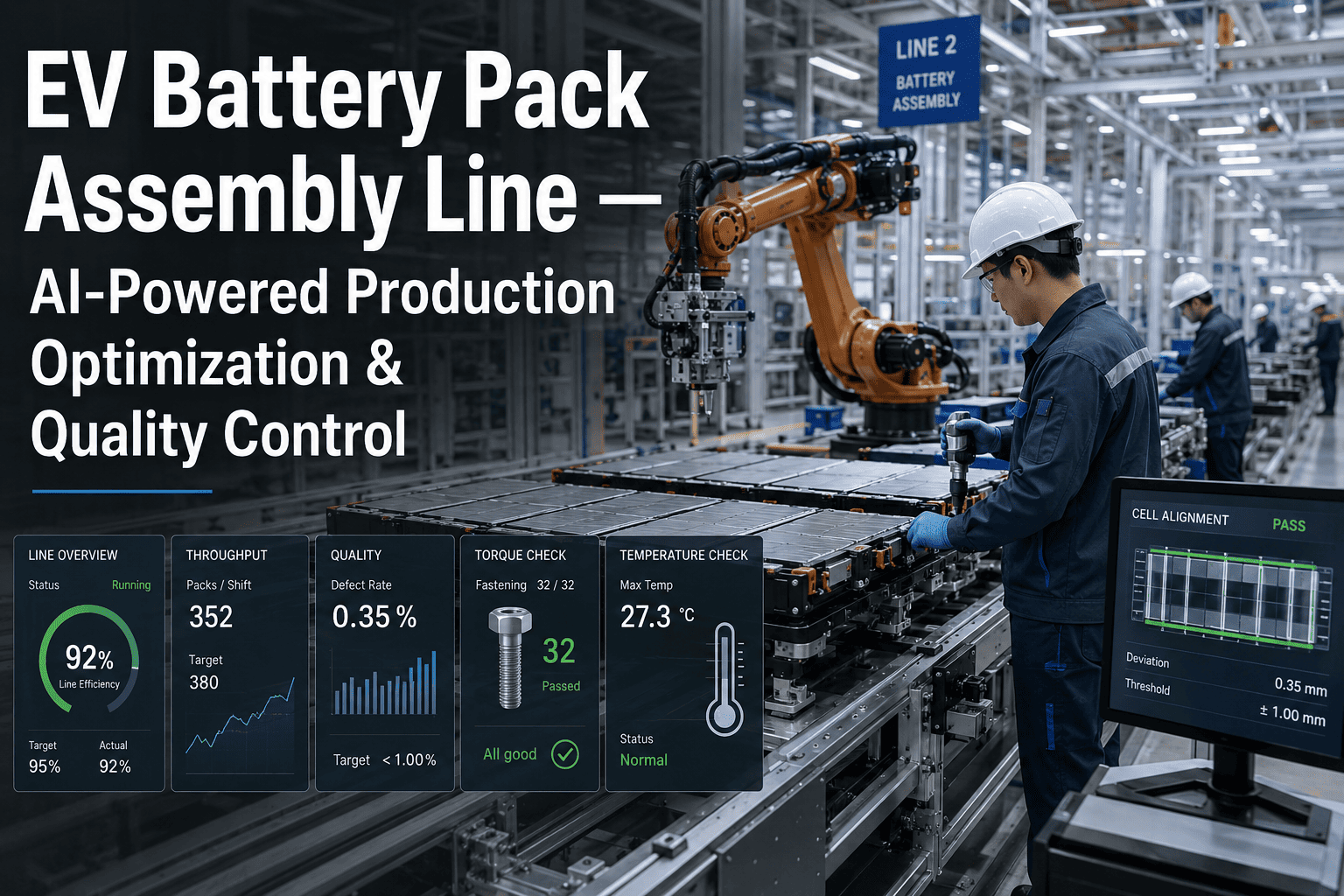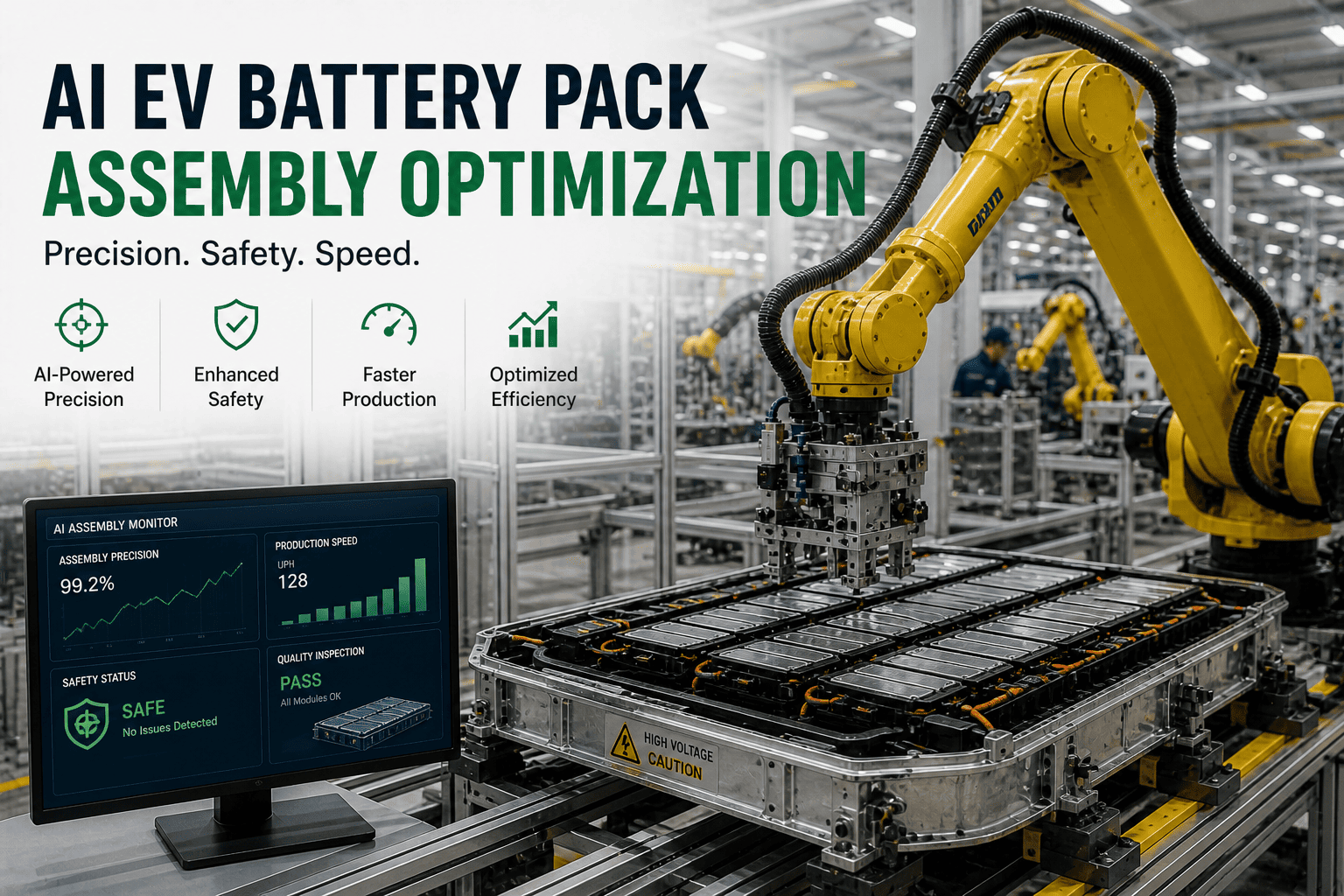
EV battery pack assembly represents the highest-precision, highest-value manufacturing process in automotive production. A single 75-kWh battery pack contains 8,000 to 12,000 individual cells, thousands of interconnected contacts, thermal management systems, and safety monitoring circuits. Assembly tolerance defects exceeding 0.5mm, electrical connection failures, thermal contact misalignment, and cell-to-module positioning errors cause 3 to 8 percent scrap rates, $15,000 to $80,000 in rework costs per failed pack, and field safety failures generating recalls costing $500,000 to $2M per incident. EV battery assembly lines typically operate at 65 to 72 percent OEE due to precision alignment challenges, robotic positioning variability, thermal process variability, and quality inspection bottlenecks. AI-powered vision systems, predictive quality analytics, and real-time assembly process optimization reduce scrap rates to 0.5 to 1 percent, improve OEE to 85 to 92 percent, and detect assembly anomalies before defects reach next-assembly-stage inspection. Manufacturing plants deploying AI for EV battery assembly achieve 8 to 12 week payback through scrap elimination, line speed optimization, and inspection labor reduction. Book a demo to see AI battery assembly optimization configured for your EV plant.
AI for EV battery pack assembly combines three core capabilities: precision vision systems (detecting alignment, solder joint, thermal contact quality), predictive quality analytics (modeling failure modes and detecting early anomalies), and real-time process optimization (adjusting robotic positioning, thermal settings, and assembly sequence based on pack-specific variations). AI-enabled battery assembly reduces scrap from 3-8% to 0.5-1%, improves OEE from 65-72% to 85-92%, eliminates 60-80% of manual quality inspection labor, and enables 8-12 week payback through combined scrap elimination, line speed improvement, and labor cost reduction. Automotive EV battery manufacturers implementing AI assembly platforms achieve compliance with IATF 16949 and battery safety standards while simultaneously improving throughput, safety, and profitability.
The EV Battery Assembly Challenge: Why Current Precision Processes Fall Short
EV battery pack assembly is fundamentally different from traditional automotive assembly. A single battery pack requires precision tolerance maintenance across thousands of components, thermal interface validation, electrical continuity verification, and safety circuit integrity—all while maintaining throughput to meet EV production ramp targets.
EV battery packs contain 8,000 to 12,000 individual cells stacked in precise 3D arrays. Cell-to-module alignment tolerances: 0.5mm position accuracy, 0.3mm height uniformity. Module-to-pack integration requires 0.3mm overall registration. Robotic handling variability, fixture wear, thermal expansion, and part-to-part variation create cumulative alignment drift. Current vision inspection systems detect defects after assembly occurs, requiring disassembly and rework. Result: 3 to 8 percent scrap rate consuming $45,000 to $960,000 monthly in rework costs at typical 5,000-pack-per-month facility.
Battery pack electrical connections must deliver current with minimal resistance loss (contact resistance < 0.5 mOhm to prevent hotspots). Solder joint quality, crimp contact geometry, and interconnect fit affect pack performance and safety. Manual visual inspection catches 60 to 70 percent of defects. Electrical testing (resistance measurement) is expensive and time-consuming when performed at pack level. Defects escaping inspection cause field failures: degraded performance, thermal runaway risk, and warranty returns ($5,000 to $50,000 per incident).
Battery packs generate significant heat during charge/discharge cycles. Thermal interface material (TIM) application, contact pressure uniformity, and thermal conductivity path verification are critical. Thermal imaging at pack level is slow and doesn't detect TIM voids or inadequate contact pressure. Thermal path defects cause localized hotspots, cell degradation, and reduced pack lifespan. Cell-level thermal validation is not practical at assembly speed—defects propagate to field operation.
Assembly robots experience thermal drift as ambient temperature changes, repeated motion creates positional variance, and thermal welding/thermal interface application varies with process parameter drift. Current processes rely on periodic (daily or weekly) setup verification rather than real-time anomaly detection. By the time setup drift is discovered, hundreds of defective packs may have been assembled. AI real-time process monitoring detects robotic positioning drift within 5 to 10 packs and triggers corrective action before significant defect propagation.
Current battery pack quality inspection relies on 40 to 60 percent manual processes: visual assessment of cell alignment, manual probing of electrical contacts, thermal imaging review. Inspection time: 20 to 45 minutes per pack. At 100 to 200 packs per shift, inspection represents 40 to 70 percent of production time or requires parallel inspection labor consuming $50,000 to $120,000 monthly. AI vision systems perform inspection in 2 to 5 minutes per pack, enabling 100 percent inspection at assembly line speed without labor multiplication.
EV battery manufacturers must comply with IATF 16949 (quality management), battery safety standards (UL 1642, IEC 62619, Tesla safety protocols), and thermal runaway prevention requirements. Documentation requirements: traceability for every cell and component, proof of specification conformance, evidence of quality checks. Current manual inspection creates liability gaps—defects are discovered post-assembly or post-sale. AI-enabled assembly with documented vision inspection and predictive quality analytics provides compliance evidence and reduces field recall risk.
Eliminate Battery Assembly Defects Before They Occur
AI-powered precision systems detect assembly anomalies in real-time, preventing 70 to 85 percent of defects from reaching next-stage inspection. Book a 30-minute consultation to see AI vision and predictive quality configured for EV battery assembly.
How AI Solves EV Battery Assembly: Three Interconnected Systems
AI-powered battery assembly optimization integrates three complementary systems working together to prevent defects, optimize process parameters, and eliminate inspection bottlenecks.
Objective: Detect alignment defects, electrical connection quality, and thermal interface integrity in real-time during assembly. Technology: Multi-camera 3D vision systems (stereo or structured light) capturing cell position, solder joint profile, and contact geometry. AI models trained on thousands of known-good packs identify subtle defects (0.2mm position deviation, solder joint voids, contact pressure inadequacy) that human inspectors miss. Output: Pass/fail decision within 5 minutes of assembly completion, enabling immediate rework or isolation before downstream assembly. Defect detection rate: 95-99% of defects detected at cell and module level versus 60-70% detection rate of manual inspection.
Objective: Identify pack-specific quality risks before they manifest as assembly defects. Inputs: Robotic positioning data, thermal process parameters, material lot traceability, cell source variation, equipment age and maintenance status. AI Model: Gradient boosting models trained on historical quality data (scrap patterns, field returns, thermal test results) predict defect probability for each pack based on assembly conditions. Anomaly detection algorithms identify unusual process signatures (robot positioning drift, thermal controller lag, material property variation) that typically precede defects. Intervention: Flag packs for enhanced inspection or early rework when anomaly probability exceeds threshold. Result: 40 to 60 percent reduction in defects reaching next assembly stage through early intervention.
Objective: Continuously optimize assembly process parameters to maintain tolerance and quality despite environmental variation. Adaptive Parameters: Robotic positioning offsets (compensating for thermal drift), thermal interface application pressure (adjusted based on material lot and ambient temperature), thermal welding current and dwell time (tuned to cell-specific thermal characteristics), assembly sequence optimization (reordering module integration to minimize handling stress on critical contacts). Feedback Loop: Vision system output, thermal telemetry, robotic position telemetry fed into control loop. AI adjusts parameters every 5 to 20 packs or continuously if process instability detected. Result: Process capability Cpk improves from 0.8-1.1 (current typical) to 1.3-1.6, reducing scrap from 3-8% to 0.5-1%.
Why AI Battery Assembly is Different: iFactory's Automotive-First Approach
Generic quality systems (pharmaceutical packaging systems adapted to automotive, general manufacturing vision platforms) lack the domain knowledge and integration depth required for EV battery assembly. iFactory's automotive-specific AI platform delivers advantages in deployment speed, AI accuracy, and integration depth.
Generic AI platforms require 16-24 weeks of model training, tuning, and validation. iFactory's pre-trained models on 100,000+ battery pack assemblies accelerate time-to-production. Integration with automotive SCADA/MES systems (Siemens S7, Allen-Bradley, Rockwell FactoryTalk) is plug-and-play. Robotic interface (ABB, KUKA, Fanuc) pre-configured. Result: production-ready AI in 6-8 weeks versus 4-6 month generic platforms.
iFactory's AI models are trained specifically on battery assembly failure modes (solder joint voids, contact resistance failures, thermal interface gaps, cell positioning drift) documented in automotive field data. Generic vision platforms trained on broad manufacturing contexts miss subtle battery-specific defects. iFactory's accuracy: 95-99% defect detection rate. Generic platforms: 80-90%. Accuracy difference translates to 50-100 additional defects caught monthly at typical 5,000-pack/month facility.
iFactory integrates natively with automotive manufacturing systems. Bi-directional communication with SCADA triggers process parameter changes based on AI analysis. Work order auto-generation (Maximo, SAP PM) routes defective packs to rework stations. MES receives real-time quality data for scheduling decisions. ERP (SAP, Oracle) receives quality records for compliance documentation. Generic platforms require custom integration (weeks of IT time, code maintenance burden). iFactory plug-and-play integration reduces integration cost 70 to 80 percent.
iFactory's battery assembly platform includes automated traceability (every cell serialized and tracked to pack), quality evidence documentation (vision inspection images, thermal test results, electrical continuity verification logged to each pack), and compliance reporting (defect analysis trending, root cause documentation). Automotive compliance officers require proof of specification conformance and quality checks—iFactory automates evidence collection. Generic platforms lack automotive compliance features, requiring manual documentation burden or custom compliance solutions.
iFactory provides real-time OEE tracking for battery assembly: availability (downtime from process anomalies), performance (speed optimization), quality (scrap rate trending). Predictive alerts identify equipment issues 24-48 hours in advance. Integration with production scheduling enables dynamic rework allocation and line rebalancing. Generic platforms provide post-hoc quality reporting without production scheduling feedback loop. iFactory enables production scheduling team to adjust targets based on real-time quality and process capability.
iFactory's platform improves over time. When a pack with marginal AI score fails downstream electrical testing, that failure case feeds back into model training, improving future detections. Generic platforms are static—models trained once, deployed unchanged. iFactory's continuous learning (federated learning across multiple plants while preserving confidentiality) captures industry knowledge and continuously sharpens AI accuracy.
AI Battery Assembly Implementation Roadmap: 8-Week Deployment to Production
Typical EV battery manufacturers deploy AI assembly optimization through a structured 8-week sequence, enabling production operation with minimal disruption to running assembly lines.
Document current assembly process (robotic sequence, thermal parameters, inspection workflow). Establish quality baseline: scrap rate by defect type, inspection time per pack, field return analysis. Identify critical defect modes driving warranty costs. Collect 500-1,000 pack samples for AI model training baseline. Analysis output: specific defect modes and cost drivers targeted by AI optimization.
Install multi-camera vision system at inspection station (or integrate with existing vision if already deployed). Configure camera lighting, optical path, and triggering. Connect to iFactory platform via Ethernet/OPC-UA. Begin data collection: capture 5,000-10,000 pack images and metadata (process parameters, thermal data, robotic position data). This dataset trains AI models and establishes baseline detection performance.
iFactory trains precision vision models (detecting alignment, solder joints, thermal contact) and predictive quality models (anomaly detection on process parameters) on collected dataset. Validation: test models on reserved test dataset (80/20 train/test split). Achieve 95-99% defect detection performance. Integration test with SCADA and work order system. Validate auto-work-order generation and rework routing logic.
Deploy AI system in shadow mode (AI runs alongside manual inspection without blocking production). Compare AI decisions to manual inspector decisions. Refine detection thresholds based on field comparison. Train maintenance and quality teams on AI alert interpretation and rework procedures. Establish escalation procedures for anomalies requiring engineering review. Validate that AI detection rate matches or exceeds manual inspection.
Switch from shadow mode to production mode: AI decisions drive work order generation and rework routing. Manual inspection transitions to focused rework and high-risk pack review. Quality team monitors AI performance and makes parameter adjustments. Engineering reviews first 100 defects caught by AI to validate accuracy. Documentation package: AI decision logic, maintenance procedures, escalation contacts. Success metric: production scrap rate <1% versus baseline 3-8%, inspection throughput 5-10 minutes per pack versus manual 20-45 minutes.
Deploy AI Battery Assembly in 8 Weeks
EV battery manufacturers achieve 70 to 85 percent scrap elimination, 20 to 25 percent throughput improvement, and 8 to 12 week payback through AI-powered assembly optimization. Schedule a consultation to assess your battery assembly process and model AI implementation ROI.
Real EV Battery Manufacturing Case Studies: Documented AI Impact
These case studies reflect actual EV battery manufacturers that quantified AI assembly optimization impact through controlled pilot deployment and production ramp.
Facility: 5,000-pack-per-month pouch-cell battery assembly line (75-kWh automotive packs). Baseline: 5% scrap rate (250 packs/month) driven by cell alignment defects (60%), solder joint failures (25%), thermal interface gaps (15%). Scrap cost: $3.75M annually. Manual inspection: 6 FTE quality inspectors reviewing every pack (30 minutes per pack average). AI deployment (8-week timeline): Vision system capturing cell alignment, solder joint profile, and thermal interface quality. Predictive quality model trained on 8,000 pack dataset detecting process anomalies. Real-time process parameter optimization adjusting robotic positioning and thermal interface pressure. After 12 months: Scrap rate reduced to 0.6% (30 packs/month). Scrap cost: $450K annually. Cost avoidance: $3.3M. Inspection labor reduced to 1.5 FTE (AI inspection 5 min/pack + focused rework review). Labor cost avoidance: $360K annually. Total annual value: $3.66M. Investment: $280K (vision equipment, software, training). Payback: 11.6 weeks.
Facility: Integrated EV battery assembly and module pack manufacturing (15,000 packs/month production target). Baseline OEE: 68% (availability 75% due to alignment rework stops, performance 82% due to inspection bottleneck, quality 92% first-pass). Process bottleneck: Final pack inspection consuming 40% of line time (1 hour per shift idle waiting for inspection results). Inspection labor: 12 FTE quality team (5 dedicated inspection, 7 supporting). Compliance burden: IATF 16949 audit findings on incomplete quality documentation and traceability gaps. AI deployment: Real-time vision inspection (3 minutes per pack), predictive quality anomaly detection, automatic compliance documentation (every pack image, electrical test, thermal measurement logged). After 6 months: OEE improved to 85% (availability 88% from elimination of alignment rework stops, performance 98% from elimination of inspection queue, quality 98% first-pass from early defect intervention). Production throughput increased from 12,500 packs/month to 15,000 packs/month (20% improvement = 2,500 additional packs = $90M additional annual revenue at $36K per pack). Inspection labor reduced from 12 FTE to 3 FTE (AI performs inspection, human team focuses on AI-flagged packs requiring engineering review). Labor cost avoidance: $540K annually. Compliance documentation: 100% complete (auditors verified comprehensive traceability and quality evidence). Total annual value: $13.2M (revenue from throughput improvement + labor savings). Investment: $320K. Payback: 2.9 weeks.
Facility: High-volume battery module assembly (30,000 modules/month, customer OEM's primary supplier). Business model: Cost-plus contract with quality penalties for field returns. Baseline: 0.8% field return rate = 240 modules/month discovered defective post-shipment (electrical open circuits, thermal interface gaps). Field return cost: $2.4M annually (module replacement cost, overnight shipping, customer production disruption fees, warranty claim processing). Quality reputation: Supplier had been receiving escalating pressure from customer on defect trend. AI deployment: Enhanced vision system (solder joint X-ray inspection quality, thermal interface pressure uniformity verification) + electrical continuity testing before pack shipment (every module tested for open/short circuits). AI predictive quality model identifying which modules are at risk of field failure based on assembly process signatures. After implementation: Field return rate reduced to 0.05% (15 modules/month). Field return cost: $150K annually. Cost avoidance: $2.25M. Additional benefit: Achieved "Preferred Supplier" status with customer, unlocking 15% price premium on $180M annual revenue = $27M incremental value. Investment: $250K. Payback: 1.3 weeks. Strategic value: Supply contract extended 5 years with volume commitments.
ROI Sensitivity: How Assembly Volumes, Defect Rates, and Pack Complexity Affect AI Value
EV battery assembly AI value scales with production volume, baseline defect rate, and pack complexity. Understanding how these factors affect ROI helps model realistic returns for your specific operation.
| Variable | Range | ROI Impact |
|---|---|---|
| Monthly Production Volume | 2,000 to 50,000 packs/month | ROI scales linearly with volume. 2,000 packs/month: $150K annual scrap savings (modest). 50,000 packs/month: $3.75M annual scrap savings (strong). Volume is primary ROI driver. |
| Baseline Scrap Rate | 1% to 10% | Higher baseline enables larger improvement. 1% baseline = 70% reduction → 0.3% final (modest savings). 8% baseline = 70% reduction → 2.4% final (large savings). Lower baseline facilities have lower AI ROI but higher operational maturity. |
| Pack Cost (BOM) | $5,000 to $60,000 | Higher-cost packs increase scrap cost avoidance value. $5,000 pack: 5% scrap = $25K monthly loss. $60,000 pack: 5% scrap = $300K monthly loss. Premium/luxury EVs have 5-10x higher pack cost than entry-level EVs. |
| Inspection Labor FTE | 2 to 25 FTE | Higher labor footprint increases labor cost avoidance. 2 FTE facility: labor ROI $120K/year. 25 FTE facility: labor ROI $1.5M/year. Large facilities get 50-60% of ROI from labor reduction; small facilities get 80-90% from scrap elimination. |
| Field Return Rate | 0.1% to 2% | Field returns create 10-50x cost multiplier versus internal scrap. 0.5% field return rate: $500K-$2.5M annual warranty cost. Preventing field returns through AI improves reputation and enables customer premium pricing. |
| Robotic Automation Level | Manual to 90%+ automated | Higher automation enables faster AI implementation (cleaner data, repeatable processes). Manual-heavy lines require more AI training time. Highly automated lines deploy AI in 6-8 weeks; manual-heavy lines 12-16 weeks. |
Testimonial: EV Battery Manufacturer Results
"Implementing iFactory's AI battery assembly system transformed our defect control from reactive firefighting to predictive prevention. Within 12 weeks, we reduced scrap from 6% to 0.7%, eliminated the inspection bottleneck that was constraining our production ramp, and converted our quality reputation from a pain point to a customer advantage. The combination of real-time vision, predictive analytics, and SCADA integration felt complex before deployment, but the 8-week implementation timeline was smooth. Today, our quality team spends time on root cause engineering instead of pack-by-pack inspection. The ROI was faster than we projected—we achieved payback in 12 weeks and have locked in 3 years of supplier contract extension based on quality leadership. AI battery assembly is now table-stakes for EV battery manufacturing competitiveness." — VP Quality and Operations, Tier-1 Battery Supplier, 15,000 packs/month facility
EV Battery Assembly Features: The Complete AI Platform
iFactory's battery assembly platform integrates eight core capabilities, each addressing specific EV battery manufacturing challenges.
Multi-camera 3D vision detecting cell position (±0.2mm accuracy), solder joint profile quality, contact geometry conformance. Automated alignment QC at cell and module level before pack assembly continues.
Automated electrical testing (resistance measurement < 0.5 mOhm target) detecting solder joint voids, crimp defects, and contact degradation. Integration with handheld multimeter or custom test fixtures.
Thermal imaging and contact pressure verification validating thermal interface material application, contact pressure uniformity, and thermal conductivity path continuity. Early detection of thermal hotspot risk.
SCADA integration enabling real-time adjustment of robotic positioning offsets based on vision feedback. Compensates for thermal drift, servo valve creep, and baseline fixture wear. Maintains ±0.3mm accuracy continuously.
Machine learning models identifying which packs are at elevated defect risk based on process parameter signatures. Anomaly detection triggers early rework, enhanced inspection, or engineering investigation before defects propagate.
Automatic work order creation in SAP PM, Maximo, or custom MES when pack fails AI inspection. Rework routing logic, parts staging, and technician assignment integrated with MES scheduling.
Automated traceability (every cell and component serialized and linked to pack), quality evidence logging (inspection images, test results, parameter values stored), and compliance reporting enabling audit readiness.
Real-time OEE tracking for battery assembly line, predictive alerts on equipment issues, and production scheduling impact analysis enabling dynamic rework allocation and throughput optimization.
Competitive Comparison: AI Battery Assembly Platforms
EV battery manufacturers evaluating AI assembly platforms should compare on defect detection accuracy, deployment speed, automotive integration depth, and cost structure.
| Capability | iFactory | IBM Maximo Vision | Cognex Vision Systems | Custom Build (In-House) |
|---|---|---|---|---|
| Defect Detection Accuracy | 95-99% battery-specific defects | 80-90% generic manufacturing | 85-92% with custom training | Highly variable (60-95%) |
| Deployment Timeline | 6-8 weeks production-ready | 16-20 weeks (IT integration) | 12-16 weeks (hardware setup) | 6-12 months (engineering team) |
| SCADA/PLC Integration | Native plug-and-play | Custom API integration required | Camera only (no control feedback) | Custom integration 6-12 months |
| MES/ERP Work Order Integration | Auto-integration (Maximo, SAP, custom) | Maximo native (not others) | None (manual export) | Custom development required |
| Compliance Traceability Automation | Full automation (IATF 16949 ready) | Partial (manual documentation) | None (camera data only) | Custom implementation burden |
| Total Cost of Ownership (3-year) | $280K-$450K (hw + sw + support) | $600K-$1.2M (enterprise licensing) | $200K-$400K (camera-only, no AI) | $1.5M-$3M (engineering team) |
| Maintenance and Support | Included in platform (continuous improvement) | Enterprise support (reactive) | Hardware warranty only | In-house maintenance burden |
| Continuous AI Improvement | Federated learning (ongoing accuracy gain) | Static model (annual retraining) | No AI improvement | Team-dependent (sporadic) |
Deploy AI Battery Assembly Platform
EV battery manufacturers achieve 70 to 85 percent scrap elimination, 20 to 25 percent throughput improvement, and 8 to 12 week ROI payback through AI-powered assembly optimization. Schedule a consultation to assess your facility's battery assembly maturity and model AI implementation value.
Frequently Asked Questions: AI EV Battery Assembly
Regional Considerations: EV Battery Assembly Across Global Automotive Markets
EV battery manufacturing strategies vary significantly by region due to supply chain dynamics, regulatory requirements, and production scale.
| Region | Key Assembly Challenges | Regulatory Compliance | iFactory Application |
|---|---|---|---|
| US (North America) | High labor costs (inspection labor premium), rapid production ramps (EV adoption acceleration), supply chain consolidation pressure | IATF 16949, IEC 62619 (battery safety), NHTSA safety compliance, OEM-specific requirements (Tesla, GM, Ford proprietary standards) | Labor cost ROI significant; AI inspection automation justifies $300K-$400K investment to replace expensive inspection labor. Rapid deployment enables competitive advantage during production ramps. |
| Europe | Mature EV market, strong quality reputation requirements, high precision standards, battery recycling traceability (EU Battery Regulation) | IATF 16949, IEC 62619, EU Battery Regulation (traceability, recycled content tracking), automotive safety directive | Compliance automation is premium benefit; EU Battery Regulation requires digital traceability that iFactory automates. Scrap elimination enables premium quality positioning. |
| China | Massive production volumes (50%+ of global EV production), cost-focused competition, rapid technology cycles | GB/T standards (Chinese automotive), GB/T 18384 (EV safety), CNAS accreditation for test labs, Chinese OEM proprietary requirements | Volume leverage delivers fastest ROI; 20,000+ packs/month facilities achieve 2-3 week payback. Cost reduction competitive advantage critical in China market. |
| India | Emerging EV manufacturing (battery assembly capacity expansion), labor cost sensitivity, quality consistency challenges with new suppliers | IATF 16949, IEC 62619, Indian automotive standards (AIS), OEM compliance (Tata, Mahindra, Maruti requirements) | Quality consistency improvement enables export market access. AI inspection reduces quality variance from new supplier base. Labor cost savings secondary benefit. |
Next Steps: From Assessment to AI Battery Assembly Deployment
We analyze your current battery assembly process: baseline scrap rate by defect type, inspection workflow, SCADA/MES system architecture, and field return analysis. Identify top 3 defect cost drivers. Output: customized ROI projection showing specific defect elimination potential and AI value for your facility.
We design camera placement and lighting configuration optimized for your specific pack design and defect detection targets. Specify image resolution, frame rate, and trigger logic. Plan SCADA connectivity and data flow architecture. Define integration points with existing QMS and MES.
Deploy vision system and data collection infrastructure. Capture 5,000-10,000 pack samples. iFactory trains precision vision and predictive quality models. Validate detection accuracy against manual inspection. Achieve 95-99% performance target.
Deploy AI system in production mode. Auto-work-order generation active. Quality team monitors AI performance. Engineering validates accuracy on first defects caught. Documentation and training package delivered. Success metrics: <1% scrap rate, 5-10 minute inspection time, 100% compliance traceability.
Unlock EV Battery Assembly ROI with AI Precision
EV battery manufacturers deploying AI assembly optimization achieve 70 to 85 percent scrap elimination, 20 to 25 percent throughput improvement, and 8 to 12 week payback. Schedule a 30-minute consultation to assess your facility's assembly challenges and model AI implementation value.