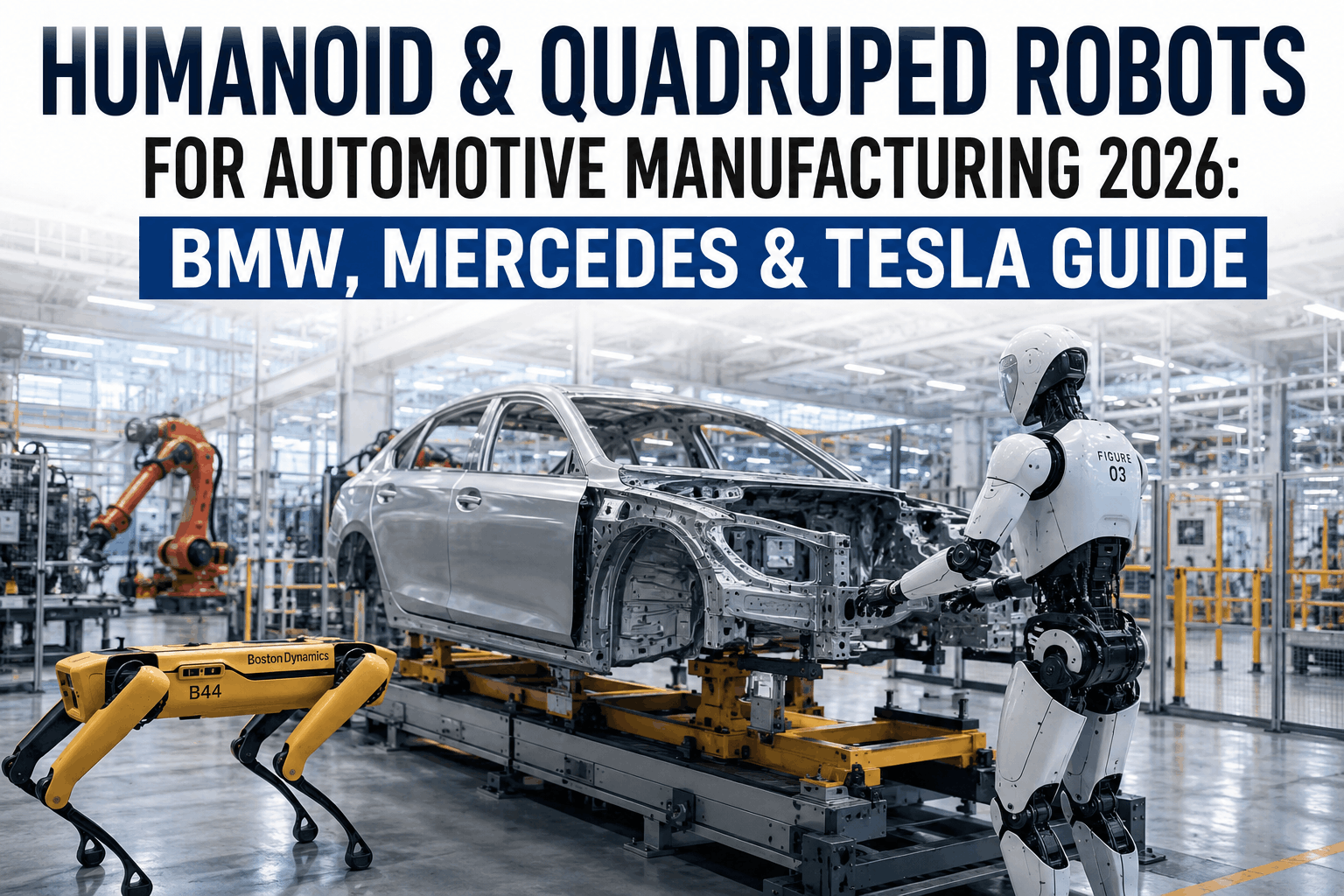
Automotive final assembly has always been the hardest stage to automate. Welding, painting, and stamping yielded to industrial robots decades ago — but trim installation, door fitting, cockpit assembly, and gap-and-flush inspection remained stubbornly human. The tasks are too varied, the tolerances too tight, and the work environments too unstructured for traditional fixed automation. Humanoid robots are changing that. BMW's Figure 02 just completed 1,250 operating hours and 90,000 component movements at Spartanburg. Hexagon's AEON is live at Plant Leipzig. Tesla's Optimus is running on its own production lines. The industrial humanoid era in automotive final assembly has begun — and the manufacturers deploying an orchestration platform to manage these robots alongside their existing MES and quality systems are the ones turning pilot results into production scale. Book a demo to see how iFactory orchestrates humanoid robots in automotive final assembly.
Why Final Assembly Is the Humanoid Robot's Natural Domain
Unlike body shop welding or paint — which traditional fixed automation handles well — final assembly is defined by its variability. Each vehicle variant has different trim pieces, different door seals, different cockpit configurations. Tasks require two-handed coordination, near-human reach envelope, and the ability to navigate between a windshield and a dashboard without a programmed path. These are exactly the capabilities humanoid robots are being designed to deliver.
The Four Final Assembly Tasks Where Humanoids Are Deploying Now
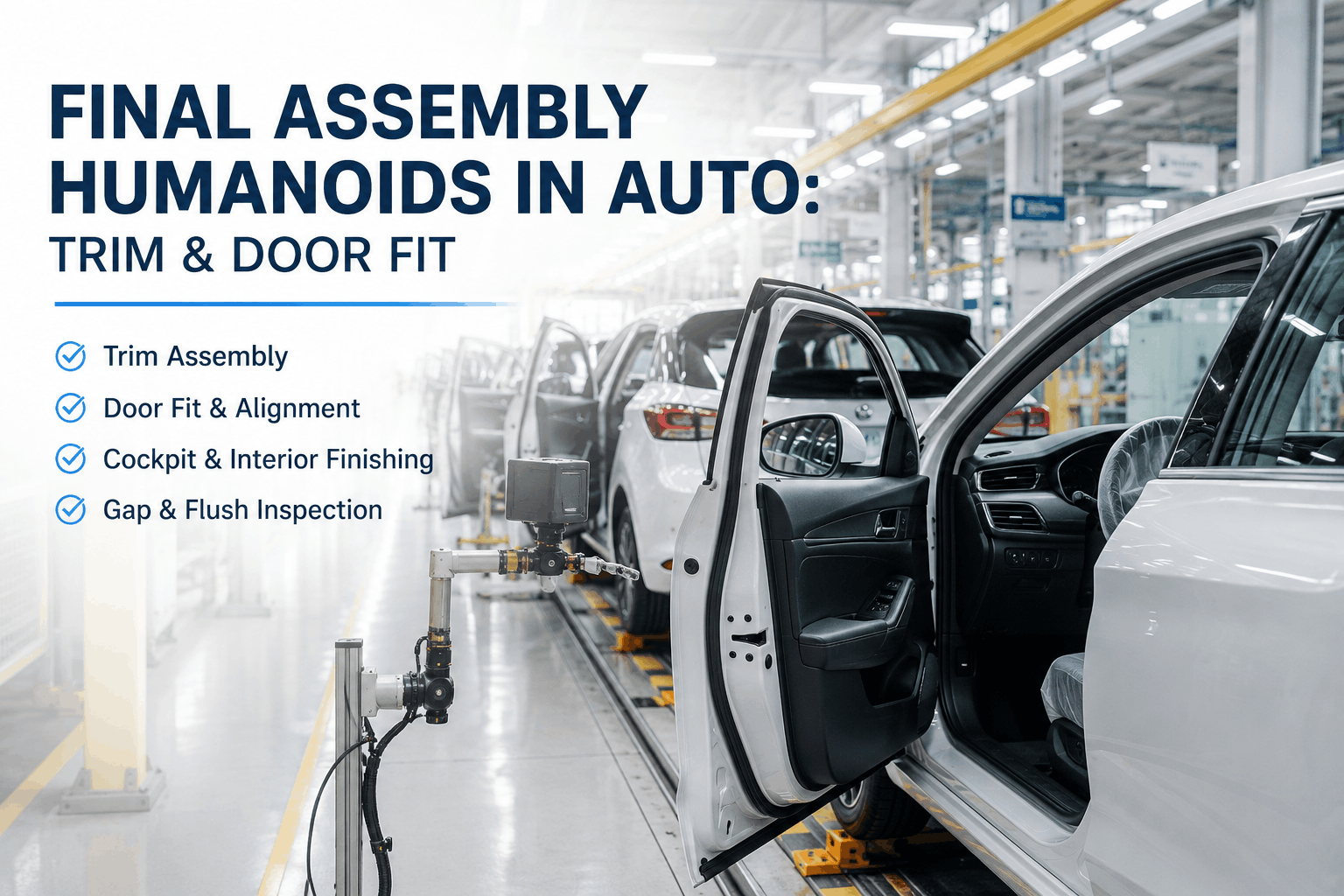
Door fitting requires millimetre-level precision on three axes simultaneously — hinge alignment, striker-latch engagement, and seal compression. It demands two-handed coordination across a 1.4m span with force feedback to detect proper engagement without distorting the door skin. Humanoid robots equipped with force-torque sensors and vision guidance can perform initial hang and adjustment cycles, with human workers performing final acceptance checks.
Interior trim installation — door cards, A-pillar covers, headliners, carpet edges — involves clip engagement sequences that require precise positioning and controlled force application across irregular geometry. Each vehicle variant has different clip patterns, different trim materials, and different sequencing requirements. Humanoid robots navigate the cabin space, apply clips in sequence, and validate engagement through force-feedback confirmation — tasks that have resisted traditional automation because no fixed robot can reach all positions in a vehicle interior.
Cockpit module installation — lowering the instrument panel, connecting the HVAC ducts, securing the steering column surround, and fitting the centre console — is one of the most ergonomically demanding tasks in final assembly. It requires workers to reach deep into the cabin in awkward postures, often with limited sight lines. Humanoid robots with scanning attachments and multi-axis wrists can perform these insertions with controlled force, guided by cavity-detection algorithms that orient the module to the A/B-pillar datum points. BMW's AEON humanoid at Leipzig is specifically targeting high-voltage battery assembly and component manufacturing where precision and ergonomics are both critical.
Gap-and-flush verification — measuring the consistency of panel gaps and surface flushness between body panels, doors, hoods, and trunk lids — is traditionally a manual inspection performed with handheld gauges at the end of the line. It is slow, subjective, and 100% dependent on operator attention. Humanoids equipped with structured-light scanning heads traverse the vehicle exterior in a defined path, capturing full gap-and-flush profiles at every panel junction. AI analysis compares measurements against vehicle-specific tolerances from the MES work order and flags any junction that deviates — before the vehicle leaves the station.
Who Is Deploying — The Market Reality in 2025–2026
The Orchestration Gap: Why Humanoids Need iFactory
Deploying a humanoid robot is the easy part. Integrating it into a live automotive production environment — with MES work orders driving task assignment, quality results flowing to traceability records, predictive maintenance monitoring robot health, and digital twin simulation validating task changes before physical deployment — requires an orchestration platform purpose-built for manufacturing. That is precisely what iFactory delivers. Talk to an iFactory expert about integrating humanoids into your final assembly line.
On-Premise or Cloud: iFactory Deploys Both Ways
FAQ: Humanoid Robots in Automotive Final Assembly
Yes — with important qualification on which tasks. Structured, repeatable tasks in final assembly are deployment-ready today: sheet metal part placement (validated at BMW Spartanburg — 90,000 components, 30,000+ vehicles), gap-and-flush scanning, clip engagement with force feedback, and ergonomically demanding cockpit insertions where the robot follows a defined programme. Fully unstructured assembly — adapting in real time to unexpected part variation or novel fixture positions — remains a medium-term capability horizon. The practical approach is to identify the 5–8 highest-value, highest-repeatability tasks in your final assembly and deploy humanoids there first, expanding scope as confidence builds. Book a demo to identify the highest-value humanoid tasks for your specific line.
iFactory's orchestration platform connects to your MES — SAP Digital Manufacturing, Siemens Opcenter, or custom systems — via standard APIs and OPC-UA. The humanoid receives its task assignment (vehicle variant, task sequence, quality parameters) from the active MES work order before approaching the vehicle. Task completion, quality measurement results, and any exception events are written back to the MES record automatically. Your MES remains the system of record; iFactory provides the AI orchestration layer between MES intent and physical robot execution. Contact support to confirm compatibility with your MES version.
Both deployments deliver identical platform capabilities — MES integration, humanoid orchestration, quality data capture, predictive maintenance, and digital twin simulation. The difference is infrastructure: on-premise means a pre-configured edge server installed in your plant, where production data never leaves your facility and latency to humanoid task commands is under 100ms. Cloud means iFactory manages the infrastructure, enabling rapid onboarding and multi-plant visibility without local server investment. OEMs with data sovereignty or cybersecurity requirements typically choose on-premise; Tier 1 and Tier 2 suppliers and multi-site operators typically prefer cloud.
iFactory's orchestration platform is designed to be robot-agnostic — connecting to humanoid platforms via their native APIs and ROS2 interfaces. Supported or in-development integrations include Figure AI's Figure 02/03, Hexagon AEON, Apptronik Apollo, Agility Robotics Digit, and Boston Dynamics Atlas Electric. The platform's AI scheduling, MES connectivity, and digital twin modules are hardware-independent — allowing OEMs to deploy multiple humanoid vendors on the same line without separate orchestration systems per robot type. Book a demo to discuss your specific robot platform requirements.
Fixed overhead vision systems cover only the surfaces within their field of view — typically the roof, hood, and trunk. They cannot inspect door-to-sill gaps at low height, A-pillar-to-windscreen junctions at awkward angles, or interior trim flush levels inside the cabin door opening. A humanoid equipped with a structured-light scanner head traverses the full exterior and relevant interior junctions — providing 100% coverage at ±0.2mm resolution that fixed systems cannot match. Results are written to the MES vehicle quality record in real time, feeding back into process SPC to identify root causes of gap variation across the production run.
ROI for humanoid deployment in final assembly comes from four sources: labour cost reduction on high-repetition tasks (typically the largest component), quality improvement from 100% gap-and-flush inspection and clip engagement validation vs. sampling, ergonomic injury cost avoidance on high-strain tasks (cockpit insertion, headliner fitting), and flexibility value from variant-adaptive robots that don't need reprogramming for model changes. BMW's Spartanburg results — 10-hour daily shifts, 90,000 components over 10 months — represent the first confirmed production-scale ROI data point. Industry analysts project humanoid robot prices reaching $20,000–$30,000 at scale (Tesla's target), at which point payback periods on high-utilization tasks fall under 18 months.