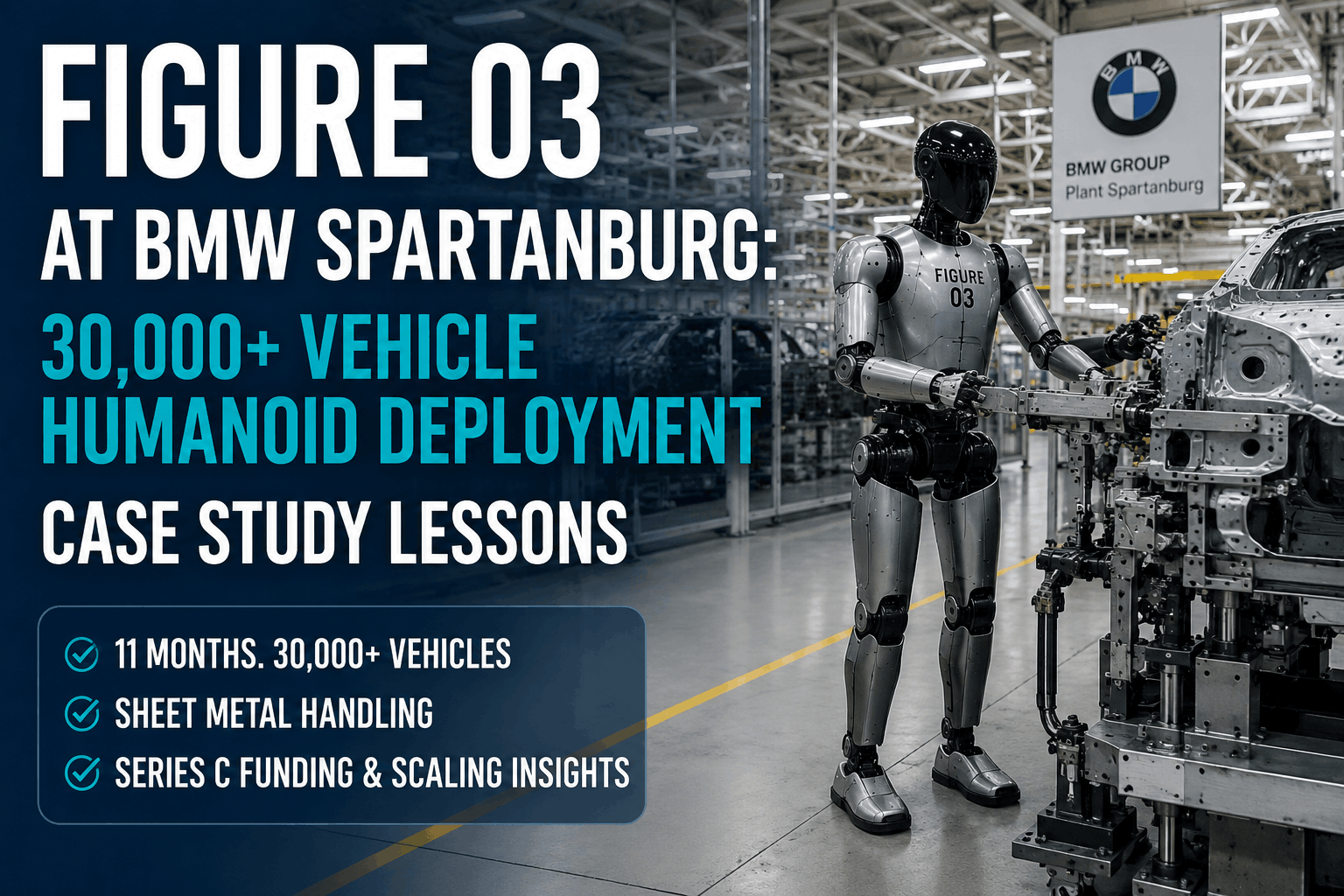
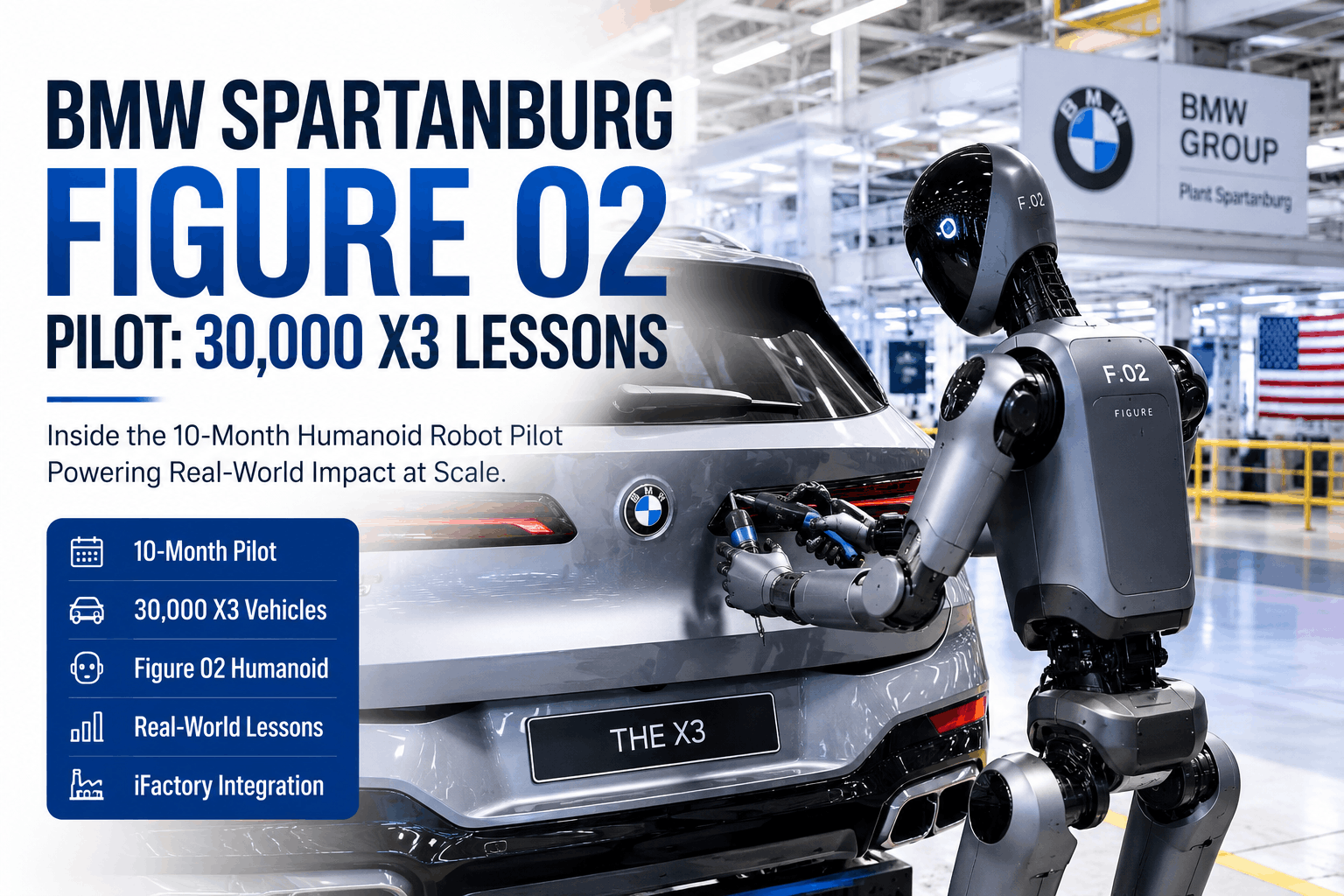
In November 2023, Figure AI signed a commercial agreement with BMW Manufacturing. By October 2024, humanoid robots were handling sheet metal on a live production line at Spartanburg, South Carolina — the plant that builds every BMW X5, X6, X7, XM, Z4, and M8 sold worldwide. Eleven months later, those robots had contributed to the assembly of over 30,000 vehicles. This is the most documented, most scrutinised humanoid robot deployment in manufacturing history — and it contains lessons every automotive manufacturer needs to understand before 2027. Book a demo to see how iFactory connects humanoid robot deployments to production intelligence.
Case Study — BMW Spartanburg
Figure 03 at BMW Spartanburg: Inside the World's Most Documented Humanoid Manufacturing Deployment
11 months · 30,000+ vehicles · Sheet metal body shop · Figure AI Series C · The operational lessons that will define automotive humanoid scaling through 2028.
30,000+
Vehicles assembled with humanoid assistance
11 mo
From contract signing to live production deployment
$2.6B
Figure AI valuation at Series C (2024)
98.7%
Sheet metal task success rate reported
The Context: Why BMW Spartanburg Was the Right Plant for This Experiment
BMW's Spartanburg plant is not a small or peripheral facility. It is BMW's largest manufacturing plant in the world by volume — producing over 400,000 vehicles per year across six models on a single production campus. The decision to deploy humanoid robots here, rather than at a smaller pilot site, was deliberate: if humanoid robotics was going to prove its industrial viability, it needed to do so at scale and in a real high-volume environment.
The specific deployment zone chosen — sheet metal handling in the body shop — was equally strategic. Sheet metal panel loading is one of the most ergonomically demanding tasks in automotive assembly: heavy, repetitive, requires precise positioning, and carries significant injury risk for human workers. It is also highly structured and repeatable — making it suitable for first-generation humanoid robot capability. Contact iFactory to discuss humanoid integration for body shop environments.
Plant
BMW Manufacturing Co., Spartanburg, South Carolina
Annual Volume
400,000+ vehicles/year — BMW's largest plant globally
Models Produced
X5 · X6 · X7 · XM · Z4 · M8
Deployment Zone
Body shop — sheet metal panel handling and loading
Robot Platform
Figure 02 (initial) → Figure 03 (production)
Agreement Signed
November 2023 — commercial deployment agreement
Timeline: From Contract to 30,000 Vehicles in 11 Months
November 2023
Commercial Agreement Signed
BMW Manufacturing and Figure AI announce a commercial agreement to deploy humanoid robots at Spartanburg. The announcement is the first of its kind between a Tier-1 OEM and a humanoid robotics company for live production deployment — not research or pilot lab work.
Q1 2024
Task Training and Safety Commissioning
Figure 02 robots undergo task-specific training for sheet metal panel loading at BMW's body shop workstations. Safety zones are commissioned per ISO/TS 15066 human-robot collaboration standards. MES integration is established to receive work order and vehicle build sequence data.
March 2024
Figure AI Raises $675M Series C at $2.6B Valuation
With the BMW deployment in commissioning, Figure AI closes a $675M Series C round backed by Microsoft, OpenAI, Nvidia, Amazon, Intel Capital, and Jeff Bezos. The funding round — one of the largest in robotics history — validates the BMW deployment as proof of commercial viability. CEO Brett Adcock describes Spartanburg as the company's "production proving ground."
Q2 2024
Live Production Deployment Begins
Figure 02 robots go live on the BMW Spartanburg body shop production line, handling sheet metal panels on an active production schedule. This marks the first time a general-purpose humanoid robot has operated on a live high-volume automotive assembly line — not a demonstration cell, but production-rate operation with real quality and throughput accountability.
Q3 2024
Figure 03 Platform Introduced — Upgraded Deployment
Figure AI releases Figure 03, a significant hardware upgrade over Figure 02: improved hand dexterity (16-DOF vs 12-DOF), 25% greater payload capacity, extended battery runtime, and faster AI inference on-board. BMW begins transitioning the Spartanburg deployment to Figure 03, expanding the number of active units and the scope of tasks performed.
October 2024
30,000 Vehicle Milestone — 11 Months In
BMW and Figure AI announce that humanoid robots have contributed to the assembly of over 30,000 vehicles at Spartanburg — a number that had not been reached by any humanoid robot deployment previously. The milestone validates not just task capability but operational durability: the robots maintained target performance across shift changes, model changeovers, and production ramp events.
What Figure 03 Actually Does at Spartanburg
The task scope at BMW Spartanburg is deliberately narrow — and that narrowness is the lesson. Figure 03 was not deployed as a general-purpose worker expected to perform any task in any zone. It was deployed on a specific, tightly defined, high-repetition task in the body shop: sheet metal panel loading and handling at designated workstations. This scoped approach is what made the deployment successful.
Sheet Metal Panel Loading
Primary task — fully autonomous
Figure 03 picks sheet metal panels from a defined rack position, orients them to the correct angle, and loads them into the body shop fixture. The task is performed at production cadence — one cycle approximately every 60–90 seconds — with a 98.7% reported success rate.
Part Transfer Between Workstations
Secondary task — supervised autonomous
Moving sheet metal sub-assemblies between adjacent workstation positions within a defined travel path. The robot navigates a controlled zone with safety monitoring, transferring parts without human assistance in normal operating conditions.
Visual Quality Check
Supplementary task — AI-assisted
Figure 03's onboard vision system performs visual checks on panels during handling — flagging surface damage, incorrect part variants, or positional errors before they progress to the weld fixture. Quality data feeds back to BMW's quality management system via the MES integration layer.
Fastener Assistance
In development — 2025 roadmap
BMW and Figure AI have publicly identified fastener assistance as the next task expansion — applying torque tools to accessible fastening points in the body shop. This will require the full dexterity capability of Figure 03's 16-DOF hands and is the most complex task in the expansion roadmap.
Multi-Zone Operation
Planned — beyond 2025
Expanding Figure 03 operation from the current body shop zone into adjacent areas — final assembly ergonomic stations and logistics kitting — is identified as a longer-term objective dependent on task training maturity and safety framework expansion.
Figure 02 vs Figure 03: The Hardware Evolution That Enabled Scale
The Figure AI Funding Story: How BMW Validated a $2.6B Valuation
The timing of Figure AI's Series C round is not coincidental. The $675M raise at a $2.6B valuation — one of the largest robotics funding rounds ever — closed in March 2024, exactly as the BMW Spartanburg deployment was transitioning from commissioning to live production. The BMW deployment was the proof of concept that unlocked the capital.
2022
$70M
Seed + Series A — R&D phase
2023
$150M
Series B — BMW agreement signed Nov 2023
Mar 2024
$675M
Series C — BMW live deployment validation · $2.6B valuation · Backed by Microsoft, OpenAI, Nvidia, Amazon
Series C Investors:
Microsoft
OpenAI
Nvidia
Amazon
Intel Capital
Jeff Bezos
BMW iVentures
10 Lessons From BMW Spartanburg Every Automotive Manufacturer Should Know
01
Start With One Scoped Task, Not a Broad Mandate
Figure 03 was deployed on sheet metal loading — not "general assembly help." The task was defined, repeatable, and measurable. Success in a narrow scope builds the data and confidence to expand.
02
Ergonomic-Risk Tasks Are the Right Entry Point
Heavy panel loading is an injury-prone task that is hard to staff. Targeting ergonomic risk creates immediate value on two dimensions: cost reduction and workforce safety — both measurable from day one.
03
MES Integration Is Not Optional
A robot that doesn't know what vehicle is being built, what variant is in the station, or what the production schedule says is operationally blind. BMW's integration of Figure 03 with MES work orders was fundamental to deployment success.
See iFactory's MES integration for humanoid robots.
04
11 Months Is Achievable — With the Right Sequencing
Contract to production in 11 months is fast — but it required parallel workstreams: task training, safety commissioning, MES integration, and operator change management all running simultaneously from week one.
05
98.7% Is Not 100% — Failure Mode Planning Matters
A 1.3% task failure rate at production cadence means a failure approximately once every 77 cycles. BMW's deployment included defined human intervention protocols for these events — the robot stops, flags, and a human recovers the cycle. Planning for failure is as important as optimising for success.
06
Volume Milestones Matter More Than Demo Videos
The 30,000-vehicle milestone is more meaningful than any demonstration video. It proves the system can sustain performance across model changeovers, shift transitions, equipment maintenance cycles, and production ramp events — the unglamorous conditions that reveal true operational maturity.
07
Hardware Iteration Happens During Deployment
BMW transitioned from Figure 02 to Figure 03 mid-deployment. The lesson: automotive manufacturers should build hardware upgrade cycles into their humanoid deployment contracts — not assume the first platform version will be the final one.
08
The BMW Brand Validates the Entire Category
BMW's decision to deploy at Spartanburg — their highest-volume global plant — was a signal to the entire industry. Every other OEM's humanoid programme accelerated after this deployment became public. First-mover advantage in humanoid integration is real.
09
The Data Layer Is the Competitive Moat
Every cycle Figure 03 completes at Spartanburg generates training data that improves the model. BMW's deployment is building Figure AI's automotive dataset — and BMW's own AI platform will accumulate proprietary performance intelligence that competitors cannot replicate without equivalent deployment time.
10
Production Integration Is Where Most Programmes Will Stall
The hardest part of the BMW deployment was not the robot — it was integrating task execution with MES schedules, quality systems, and safety protocols. Manufacturers who invest in this integration layer early will deploy faster and scale further.
iFactory specialises in exactly this layer.
FAQ: Figure 03 at BMW Spartanburg
Apply the BMW Spartanburg Lessons to Your Plant's Humanoid Programme
iFactory provides the production integration layer — MES connectivity, quality data routing, and AI analytics — that made the BMW Spartanburg deployment operationally successful. Whether you are evaluating, piloting, or scaling humanoid robots, the integration architecture is where programmes succeed or stall.
MES Integration
Humanoid Robot Data
Body Shop AI
Quality System Routing
Production Analytics