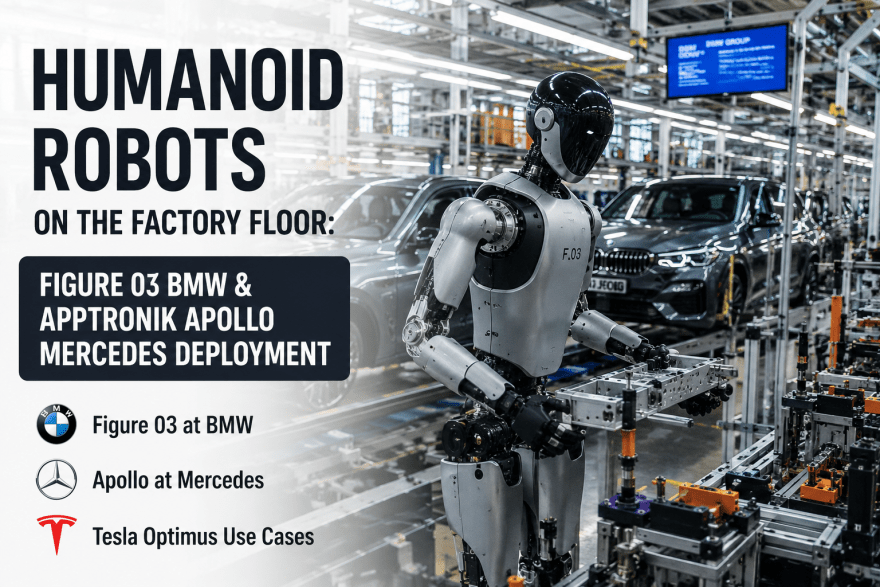
Humanoid robots have moved from research demos to paid production floors in 2026 — and the case studies coming out of BMW Spartanburg, Mercedes-Benz Berlin, and BMW Leipzig now provide the first hard numbers manufacturing leaders can actually plan against. Figure 03 robots are operating at $25 per robot-operating-hour at BMW Spartanburg with 99%+ placement accuracy, Apollo from Apptronik is moving assembly kits across Mercedes-Benz production lines, and Tesla Optimus is being readied for million-unit-scale internal deployment. For U.S. manufacturers, the question has shifted from "will humanoids work?" to "where should I deploy first?" Plants that book a demo with iFactory consistently identify three to five workstations where a humanoid deployment can be ROI-justified in the first 18 months.
Figure 03, Apollo & Optimus on Real Production Lines — What U.S. Manufacturers Need to Know
iFactory integrates humanoid robotics fleets with your MES, work orders, and OEE analytics — turning every humanoid hour into measurable production data.
The State of Humanoid Robots on the Factory Floor in 2026
2026 marks the first year of paid, contracted commercial humanoid robot deployments at scale. The numbers are striking: BMW's Spartanburg pilot saw Figure 02 robots assist in the production of more than 30,000 BMW X3s over a ten-month period, moving 90,000+ parts across 1,250 operational hours with placement accuracy above 99% per shift. Humanoid-specific funding hit $4.3 billion in 2025 — a six-fold increase from 2018. Manufacturing costs dropped 40% between 2023 and 2024, with unit costs projected below $17,000 by 2030. The technology that was a research novelty three years ago is now operating under real-world industrial conditions at three of the world's largest automakers. Manufacturing leaders who book a demo with iFactory get a clear-eyed view of which tasks are humanoid-ready today versus 2027.
Case Study 1: Figure 03 at BMW Spartanburg — The First Commercial Contract
BMW Spartanburg in South Carolina is now home to the first publicly documented, paid commercial-scale deployment of humanoid robots in automotive manufacturing. After a successful ten-month pilot with Figure 02 that produced more than 30,000 X3s, Figure and BMW signed a commercial contract covering an initial fleet of forty Figure 03 units operating across body-shop and assembly-line workstations. Pricing is structured at approximately $25 per robot-operating-hour — economics that finally make humanoid deployment a CFO-defensible line item rather than a research expense. The scope expands across Spartanburg through 2026 and 2027, with separate pilot contracts running at BMW's German plants in Munich, Regensburg, and Leipzig.
Case Study 2: Apptronik Apollo at Mercedes-Benz Berlin & Hungary
Mercedes-Benz is taking a different path. Apollo, the humanoid built by Texas-based Apptronik, is being deployed inside Mercedes' Digital Factory Campus in Berlin-Marienfelde and at the Kecskemét plant in Hungary — focused on intra-logistics rather than direct assembly. Apollo delivers assembly kits, moves totes of kitted parts between workstations, and conducts initial component inspections. The robot is 5'8", 160 lbs, lifts 55 lbs, runs on hot-swappable 4-hour battery packs, and uses a collaborative force-control architecture rated to operate safely alongside human workers. Mercedes-Benz has taken an equity stake in Apptronik, and the program is integrated with MO360 — Mercedes' digital production ecosystem that runs digital twins of every production line in the global network.
Integrate Humanoid Robotics with Your MES, OEE & Maintenance Workflows
iFactory's Robotics AI module connects humanoid fleets with work orders, downtime tracking, and quality data — so every robot-hour is measured against real production KPIs.
Case Study 3: BMW Leipzig AEON Pilot & Tesla Optimus Internal Deployment
BMW's third pilot — separate from the Figure 03 program — uses AEON humanoid robots from Zurich-based Hexagon Robotics at Plant Leipzig. AEON is BMW's first humanoid robot deployment in Europe. Two units target full production by end of 2026, working on high-voltage battery assembly and component manufacturing. AEON uses 22 sensors, self-swapping batteries, and four layers of physical AI including imitation learning — where as few as 20 demonstrations can train autonomous operation. Meanwhile, Tesla is taking the most aggressive vertical path: internal Optimus deployments inside Tesla factories, with a dedicated manufacturing facility at Gigafactory Texas targeting 10 million units annually by 2027, plus a 1-million-unit-per-year Optimus line replacing Model S/X production at Fremont by late 2026.
The Five Tasks Humanoid Robots Are Actually Doing on Factory Floors
Across all current humanoid deployments at BMW, Mercedes-Benz, and Tesla, five task categories account for nearly every production-floor application. These are the workstations where humanoid form factor and dexterity actually beat purpose-built fixed automation — typically because the workspace was designed around human reach envelopes and full facility redesign isn't economical. U.S. manufacturers planning their first deployment should scope to these five categories first. Teams that book a demo with iFactory get a workstation-by-workstation readiness map for their own plant.
Parts Handling & Sub-Assembly Placement
The Figure 03 workhorse task at BMW Spartanburg. Pick parts from kits or bins, orient them correctly, and place them into sub-assemblies at 84-second cycle time targets. Humanoid dexterity wins where parts vary in shape, weight, or orientation — the long tail traditional pick-and-place robots struggle with.
Assembly Kit Delivery & Intra-Logistics
Apollo's primary role at Mercedes-Benz Berlin. Move totes of kitted parts between workstations, deliver components to line-side at the moment of assembly. Replaces tasks currently performed by human operators walking miles per shift through facilities designed for human reach.
Quality Inspection at Receiving & Line-Side
Vision-driven inspection of incoming parts or completed sub-assemblies. Humanoids combine the mobility of a worker with the consistency of machine vision — useful at touchpoints where a stationary inspection cell would interrupt material flow.
Machine Tending & Material Handling
Load and unload CNCs, presses, injection molders, and other production machines where the workspace was designed for human access. Humanoid form factor reaches into the same access points without requiring guarding changes or cell redesigns.
High-Voltage Battery & Component Manufacturing
BMW Leipzig's AEON pilot target. EV battery assembly is physically demanding, often hazardous, and well-suited to humanoid form factor — handling cells and modules at human-scale workstations where the safety case for collaborative humanoids is strong.
Platform Comparison: Figure 03 vs Apollo vs Optimus vs AEON
Four platforms now have live factory-floor deployments. Each is optimized for slightly different operating models — Figure 03 and Optimus prioritize scale economics, Apollo prioritizes commercial integration depth, AEON prioritizes flexibility through its mobile wheelbase. U.S. manufacturers evaluating a first deployment should match platform strengths to their specific workstation profile rather than chasing any single brand.
| Platform | Deployed At | Primary Task Class | Form Factor | Commercial Status |
|---|---|---|---|---|
| Figure 03 | BMW Spartanburg | Assembly, parts handling, inspection | Bipedal humanoid | Paid commercial contract ($25/hr) |
| Apollo | Mercedes-Benz Berlin & Kecskemét | Kit delivery, intra-logistics, QC | 5'8" 160 lb, 55 lb lift | Paid pilot, Mercedes equity stake |
| Optimus Gen 3 | Tesla Fremont (internal) | Material handling, learning workloads | Bipedal humanoid | Internal-only, 3rd-party 2027 target |
| AEON | BMW Leipzig | HV battery, component manufacturing | Mobile wheeled humanoid | Pilot summer 2026, production EOY |
A Practical Deployment Roadmap for U.S. Manufacturers
A credible humanoid deployment program isn't a single robot procurement — it's a sequenced capability build that runs alongside MES, work order, and OEE workflows your plant already operates. The four-quarter framework below mirrors how BMW and Mercedes-Benz approached their own programs and is the structure iFactory recommends to manufacturers starting humanoid evaluation in 2026.
Workstation Readiness Audit
Score every workstation against the five humanoid-ready task categories. Identify three to five candidates with strongest ROI economics and lowest safety-case complexity.
Single-Unit Pilot
Deploy one humanoid unit at the highest-readiness workstation. Use teleoperation-driven imitation learning to build task policies. Measure cycle time, placement accuracy, and safety incidents.
MES & OEE Integration
Connect humanoid runtime data into iFactory's MES, work order, and OEE analytics modules. Every robot-hour gets measured against production KPIs alongside human and fixed-automation operators.
Fleet Expansion
Roll proven workstation policies to additional units across the candidate task set. Establish fleet management, predictive maintenance routines, and shift-handover protocols.
Expert Review: What These Deployments Actually Prove
Cutting through the press cycle, three signals from BMW, Mercedes-Benz, and Apptronik in 2026 carry the most weight for U.S. manufacturers planning their own deployments. They speak to commercial viability, safety case maturity, and the human factor that determines whether any of this scales beyond pilots.
"The successful first deployment of humanoid robots at our BMW Group plant in Spartanburg proves that a humanoid robot can function not only under controlled laboratory conditions but also in an existing automotive manufacturing environment. As humanoid robots take on repetitive, physically demanding or safety-critical tasks, employees are free to focus on what truly defines human work: experience, judgment and creativity in handling complex processes."
Commercial Viability Is Proven
Figure 03's $25/hour pricing at BMW Spartanburg crosses the threshold where humanoid deployment is a finance-defensible operating line, not an R&D experiment. Unit costs are projected below $17,000 by 2030.
Safety Case Is Hardening Fast
Apollo's collaborative force-control architecture and AEON's 22-sensor stack show that humanoid safety design is converging on cobot-style standards — making side-by-side human-robot work viable at production cycle times.
Training Is the Real Bottleneck
Teleoperation-driven imitation learning (Mercedes' MANUS-glove approach, AEON's 20-demo training) is now the dominant policy-acquisition method. Plants with strong data discipline will scale humanoid fleets fastest.
Conclusion: 2026 Is the Decision Year for U.S. Manufacturers
Three years ago, humanoid robots were a research novelty. In 2026, they are running paid commercial contracts on three continents, moving 90,000 parts per pilot, and pricing in at $25 per robot-operating-hour. The platforms are differentiated, the safety cases are converging, and the early adopters at BMW, Mercedes-Benz, and Tesla have built the playbook the next wave of manufacturers will follow. The risk for U.S. manufacturers isn't moving too fast — it's spending 2026 watching, and then trying to catch up in 2028 when the talent pool, system integrators, and training data are already committed to the early movers. Plants that book a demo with iFactory leave with a clear, workstation-level view of which humanoid use cases are real today and which to plan against for 2027.
Humanoid Robots on the Factory Floor: Frequently Asked Questions
What does it actually cost to deploy a humanoid robot in a factory in 2026?
Figure 03's commercial contract at BMW Spartanburg is structured at approximately $25 per robot-operating-hour on a robot-as-a-service basis. Outright industrial-unit pricing for Figure 02 ranged from $30,000 to $150,000 in 2025. Bank of America projects unit costs below $17,000 by 2030 as manufacturing scales up at facilities like Figure's BotQ plant and Tesla's Gigafactory Texas Optimus line.
Which humanoid robot is best suited for U.S. manufacturing today?
Figure 03 has the most validated production-floor deployment (BMW Spartanburg, 30,000+ X3s assisted). Apollo from Apptronik has the deepest integration with manufacturing IT systems via the Mercedes MO360 deployment. AEON from Hexagon offers the most flexibility through its mobile wheelbase. The right choice depends on whether your priority workstation is assembly, intra-logistics, or flexible component work.
What tasks should we deploy humanoid robots on first?
Across BMW, Mercedes-Benz, and Tesla, five categories cover nearly every active deployment: parts handling and sub-assembly placement, assembly kit delivery and intra-logistics, line-side quality inspection, machine tending where workspaces were designed for humans, and high-voltage battery or component manufacturing. Start with whichever category has the strongest ROI and weakest safety-case complexity in your plant.
How long does it take to train a humanoid robot for a new task?
Modern humanoids use teleoperation-driven imitation learning. AEON at BMW Leipzig can train autonomous operation from as few as 20 human demonstrations. Apollo at Mercedes-Benz uses MANUS data gloves to capture precise hand and finger motion data while operators teleoperate the robot through target movements. The bottleneck has shifted from robot capability to the discipline of capturing high-quality demonstration data.
Can humanoid robots integrate with our existing MES, OEE, and CMMS systems?
Yes. iFactory's Robotics AI module connects humanoid runtime data into MES, work order, OEE analytics, and CMMS workflows through standard industrial protocols. Every robot-hour gets measured against the same production KPIs as human and fixed-automation operators — making humanoid ROI directly comparable to other capacity options when planning capital and operating budgets.
Ready to Build Your 2026 Humanoid Robot Deployment Plan?
iFactory's Robotics AI, MES, and OEE Analytics modules turn humanoid pilots into measurable production data — so every robot-hour is accountable to the same KPIs as the rest of your plant.



.png)