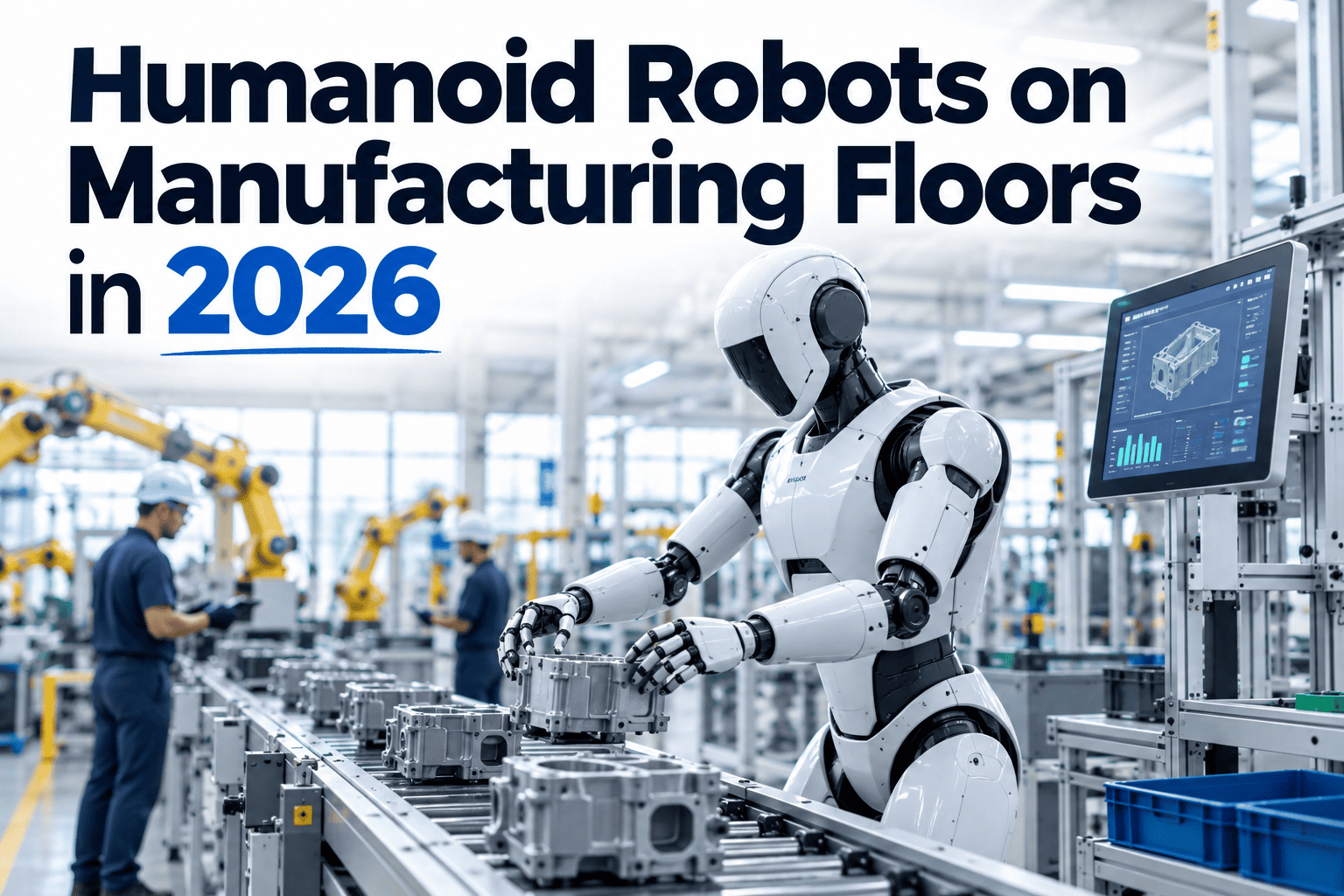
The U.S. manufacturing floor is changing faster than most CFOs can budget for. By mid-2026, more than 1,000 Tesla Optimus units are working inside Gigafactory operations, Figure 03 fleets have entered paid commercial duty at BMW Spartanburg, NEURA Robotics is shipping its Studio F.A. Porsche-designed 4NE1 Gen 3.5 with a published price tag, and Unitree's H2 has cleared U.S. dealer channels for under $41,000. For plant managers, automation engineers, and operations directors evaluating capital expenditure for the next fiscal cycle, the question is no longer whether to consider humanoid robots—it is which vendor offers the best fit for your throughput targets, compliance environment and total cost of ownership. This 2026 manufacturing humanoid vendor comparison breaks down five of the most relevant platforms—Unitree H2, Apptronik Apollo, Figure 03, NEURA 4NE1, and Tesla Optimus Gen 3—across specifications, pricing, deployment readiness, and ROI signals U.S. manufacturing professionals actually need to make a purchase decision.
Manufacturing Humanoid
Vendor Comparison 2026
Side-by-side analysis of Unitree H2, Apollo, Figure 03, NEURA 4NE1, and Tesla Optimus Gen 3—specs, pricing, ROI, and deployment readiness for U.S. manufacturers.
The 2026 Humanoid Robot Market: Where We Are Now
The humanoid robotics segment crossed a threshold in early 2026. Bank of America's 2026 analysis pegs a Western-built humanoid pilot unit at roughly $90,000 to $100,000, while Chinese-manufactured units carry a bill-of-materials closer to $35,000. Goldman Sachs data cited in Deloitte's 2026 Tech Trends report shows manufacturing costs dropped 40% between 2023 and 2024, with unit costs projected to fall below $17,000 by 2030. That cost curve—combined with confirmed pilots at BMW, Mercedes-Benz, GXO, and Jabil—is what's pulling humanoids out of the demo-video phase and into procurement conversations.
Vendor-by-Vendor Breakdown
Below is a detailed profile of each of the five manufacturing humanoid robots U.S. operations teams are most likely to evaluate in 2026. Specifications, pricing, and deployment status reflect verified vendor disclosures and partner deployments through Q2 2026.
Unitree H2
The H2 is a 182 cm, 70 kg full-size humanoid with 31 degrees of freedom and 360 Nm peak joint torque on select joints. Its Commercial variant lists at $40,900 USD through authorized North American dealers, with the EDU research variant at $68,900. Production deliveries to U.S. and Canadian buyers began rolling out from the end of April 2026.
Apptronik Apollo
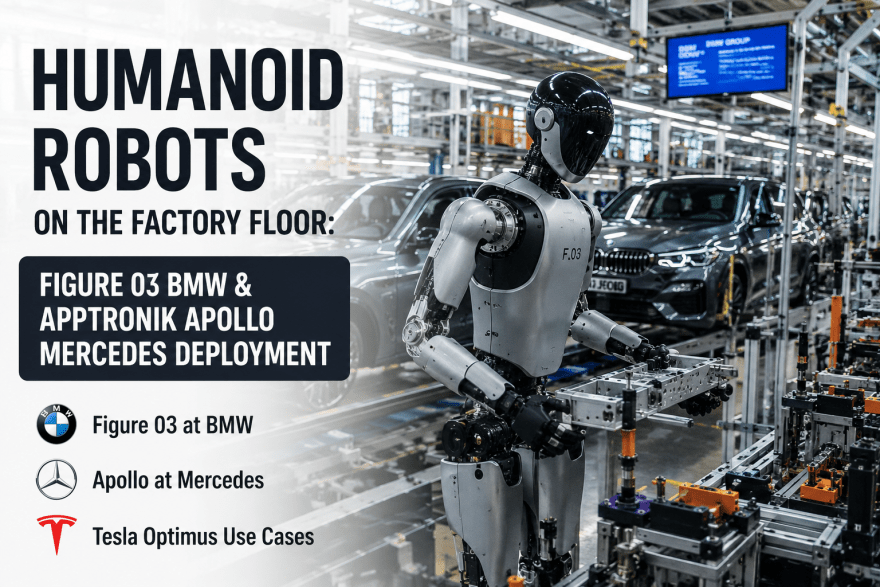
Apollo is a 1.73 m, 72.6 kg general-purpose humanoid engineered specifically for industrial deployment. With 25 kg payload, hot-swappable 4-hour battery packs, and a modular design that supports stationary, wheeled, or fully bipedal configurations, it has commercial pilots running with Mercedes-Benz, GXO Logistics, and Jabil. Apptronik raised $520M in February 2026 at a $5.5B valuation, with Google DeepMind providing the Gemini Robotics foundation model.
Figure 03
Figure confirmed a paid commercial deployment of 40 Figure 03 units at BMW's Spartanburg, SC complex—pricing structured at approximately $25 per robot-operating-hour, covering parts-handling, sub-assembly placement, and quality-inspection. The platform features wireless charging, palm cameras, soft textile covering, 2x camera frame rate over Figure 02, and 3-gram tactile sensitivity. Figure 03 also targets a ~$20,000 long-run consumer price via BotQ vertical manufacturing.
NEURA 4NE1 Gen 3.5
The 4NE1 Gen 3.5—designed in collaboration with Studio F.A. Porsche—lists at €98,000 for individual orders and drops to €60,000 per unit for fleet purchases of 20 or more. It's the sector record for payload at 100 kg, runs 6 to 8 hours on hot-swappable batteries for 24/7 operation, and ships with NVIDIA Thor T5000 onboard compute, AURA AI, 7 cameras for 360° perception, and patented artificial skin for proximity detection. NEURA holds a €1B+ order book and is the first Western humanoid manufacturer offering transparent online pricing.
Tesla Optimus Gen 3
Tesla began mass production of Optimus Gen 3 at Fremont in January 2026, with 1,000+ units already deployed across Tesla manufacturing facilities. The robot stands ~173 cm, weighs ~57 kg, carries 20 kg payload, and runs 10-12 hours on a 2.3 kWh battery. Standout: 22 degrees of freedom per hand (50 actuators across both hands) using biomimetic tendon-driven design. External customer availability is gated to 2026-2027 contingent on internal reliability proof. Production targets 100,000-300,000 units in 2026.
Evaluating which humanoid platform fits your production environment? Book a Demo to see how iFactory AI's MES, Digital Twin, and Robotics AI modules integrate with humanoid fleets from any of these vendors.
Specifications Side-by-Side
The fastest way to short-list candidates is a direct spec sheet. Below is the full comparison across the metrics U.S. manufacturing leaders weigh most heavily—payload, runtime, degrees of freedom, compute platform, and deployment status.
| Specification | Unitree H2 | Apollo | Figure 03 | NEURA 4NE1 | Optimus Gen 3 |
|---|---|---|---|---|---|
| Origin | China | USA | USA | Germany | USA |
| Height | 182 cm | 173 cm | ~168 cm | 180 cm | 173 cm |
| Weight | 70 kg | 72.6 kg | ~70 kg | ~80 kg | 57 kg |
| Payload | 7 kg (21 peak) | 25 kg | ~25 kg | 100 kg | 20 kg |
| DOF | 31 | ~30 | 40+ | 45 | 28 + 50 hand |
| Battery Runtime | ~3 hr | 4 hr (hot-swap) | ~5 hr wireless | 6-8 hr (hot-swap) | 10-12 hr |
| Compute | Integrated | Gemini Robotics | Helix AI | NVIDIA Thor T5000 | Tesla Custom |
| Pricing | $40,900 | Contact sales | $25/hr (BMW) | €60K-€98K | $20K-$30K target |
| Availability | Q2 2026 | Pilots active | Commercial | June 2026 | External 2027 |
Total Cost of Ownership and ROI Signals
List price is rarely the deciding factor in a humanoid robot procurement. Total cost of ownership over a 3- to 5-year window is what drives the ROI model. The components that move the needle are unit price, battery and maintenance cycles, software licensing, integration with your existing MES/ERP/CMMS stack, and—critically—uptime per shift.
Capital Cost
Unitree H2 leads at $40,900. NEURA 4NE1 at €60K (fleet) and Optimus at a $20-30K target offer the strongest scale-down potential. Apollo and Figure 03 sit in the premium tier with custom contracts.
Shift Coverage
NEURA 4NE1 (6-8 hr hot-swap) and Optimus Gen 3 (10-12 hr) cover full shifts. H2 at ~3 hours requires more frequent battery swaps and is better suited to intermittent task loops.
Integration Cost
Robots are only as productive as the production system they plug into. Integration with MES, work order management, and OEE dashboards typically runs 15-30% of CapEx in the first deployment.
Reliability Data
Figure 03 is the only platform with publicly documented production-scale operating hours (BMW Spartanburg, 11-month pilot). Apollo has multiple active pilots. Other platforms remain in early commercial or internal deployment.
Deployment Readiness Matrix
Beyond specs and price, the practical question for plant managers is: can I deploy this robot on my floor in the next 12 months? The matrix below maps each vendor against four readiness dimensions U.S. manufacturers care about—North American supply, paid commercial use, integration maturity, and post-sales support footprint.
How to Choose: A Decision Framework for U.S. Manufacturers
The right humanoid robot for your plant depends on four primary variables. Use this framework to narrow the field before initiating vendor RFPs.
Define the Task Envelope First
Identify whether the target task is high-payload (palletizing, machine loading), high-dexterity (assembly, kitting), or high-mobility (material transport). A 100 kg-payload NEURA 4NE1 is overkill for kitting; a 7 kg-payload Unitree H2 cannot handle a battery tray. Match the robot to the lifting and reach profile of the specific workstation.
Quantify Required Shift Coverage
If your facility runs two or three shifts and you need continuous robot operation, hot-swappable batteries (Apollo, NEURA) or long runtime (Optimus) are non-negotiable. For single-shift, off-peak, or batch operations, the H2's 3-hour cycle is workable.
Audit Your MES and Integration Stack
A humanoid robot is a data source. Without an MES, OEE platform, or CMMS that can ingest task completion, downtime, and exception events, you lose the ROI compounding effect. Plan integration with iFactory AI's Manufacturing Execution System and Robotics AI module in parallel with vendor selection.
Validate Support and Spare-Parts Logistics
A humanoid down for two weeks waiting on a wrist actuator from overseas can erase the productivity gain of an entire fleet. U.S.-built (Apollo, Figure, Optimus) or U.S.-supported (Unitree via authorized dealers, NEURA via enterprise contract) provenance matters operationally.
Expert Review
To pressure-test our vendor analysis, we cross-checked specs and deployment data against multiple independent sources—including Bank of America's 2026 humanoid analysis, Goldman Sachs cost projections via Deloitte's 2026 Tech Trends report, and confirmed deployment data from BMW Group press releases and Apptronik's Series B disclosures.
"The 2026 humanoid market has cleanly split into three camps. Figure 03 and Apollo are leading on real production hours and partnership depth—Figure's BMW contract is the first documented per-hour commercial pricing in the industry. NEURA wins on transparent procurement and the heaviest payload in the field. Optimus is the wild card: if Tesla hits even a fraction of its 100K-300K unit 2026 production target, the cost economics shift permanently. Unitree H2 isn't competing for the same buyer, but at $40,900 it has effectively created a new entry tier for plants that want a humanoid pilot without a six-figure commitment. For most U.S. manufacturers, the right move in 2026 is a single-vendor pilot tied to one workstation, integrated with an MES that tracks task-level OEE—then scale based on data, not vendor pitches."
Need help building the business case for your first humanoid pilot? Book a Demo with iFactory's Robotics AI team for a workstation-level ROI walkthrough.
Conclusion
The 2026 manufacturing humanoid robot market has moved from speculative to operational. Five vendors—Unitree H2, Apptronik Apollo, Figure 03, NEURA 4NE1, and Tesla Optimus Gen 3—now cover the full spectrum from sub-$50K research-grade pilots to full-shift, heavy-payload production fleets. The right choice is not a universal winner; it is a function of your task envelope, shift coverage requirements, integration maturity, and supply-chain risk tolerance.
What separates a humanoid pilot that pays back in 18 months from one that quietly gets mothballed is rarely the robot itself. It is the production system around it—the MES that schedules its tasks, the CMMS that tracks its maintenance, the digital twin that simulates its line, and the analytics platform that proves its ROI to the CFO. iFactory AI provides that production-side infrastructure across MES, Robotics AI, Digital Twin AI, OEE Analytics, and predictive maintenance—giving your humanoid investment the operational backbone it needs to deliver real returns.
Frequently Asked Questions
Build the Production System Around Your Humanoid Fleet
iFactory AI's industrial software stack—MES, Digital Twin, Robotics AI, OEE Analytics, and Predictive Maintenance—is the connective tissue that turns a humanoid robot pilot into a production-grade ROI driver.


.png)